1031 Exchange in San Antonio (2026): How Veteran Investors Defer Capital Gains When Selling a Rental
LAST UPDATED: JUNE 11, 2026 | BY CHRISTOPHER BEAL, U.S. ARMY VETERAN & REALTOR
1031 Exchange in San Antonio (2026): How Veteran Investors Defer Capital Gains When Selling a Rental
Key Takeaways
- A 1031 exchange lets you sell a San Antonio investment property and roll the full proceeds into another investment property, deferring federal capital gains tax and depreciation recapture.
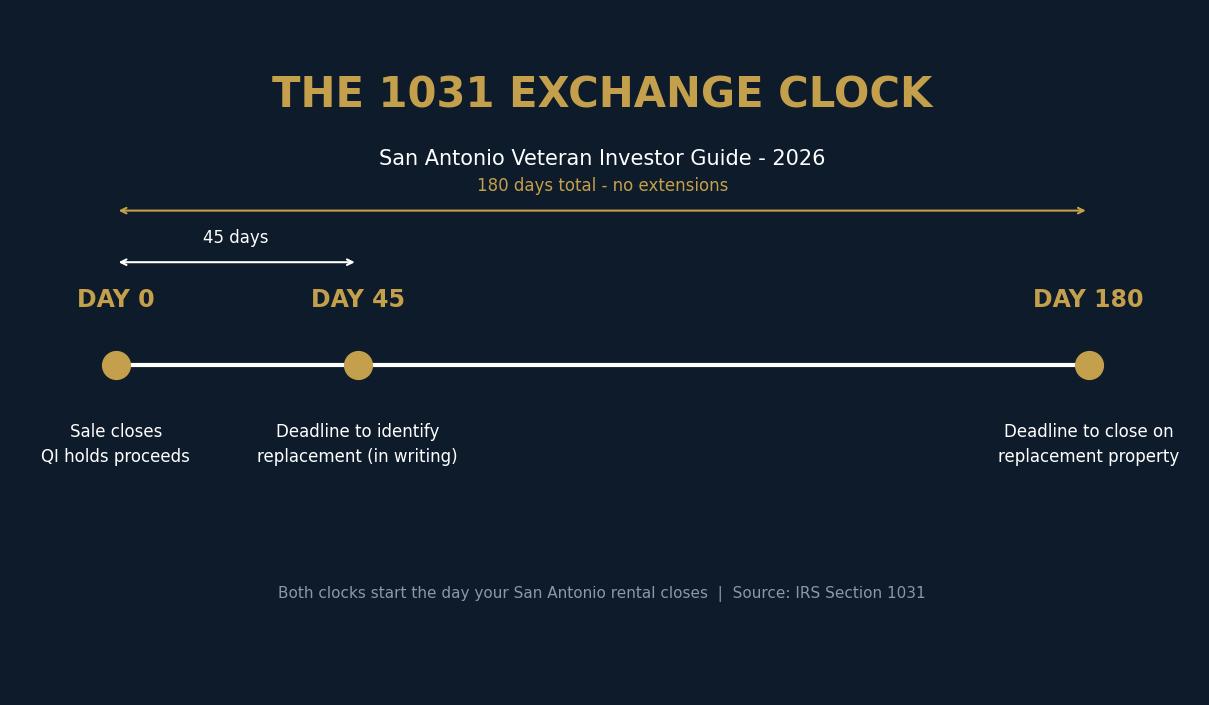
- Two deadlines control everything: 45 days to identify replacement property in writing and 180 days to close. Both start the day your sale closes and neither can be extended.
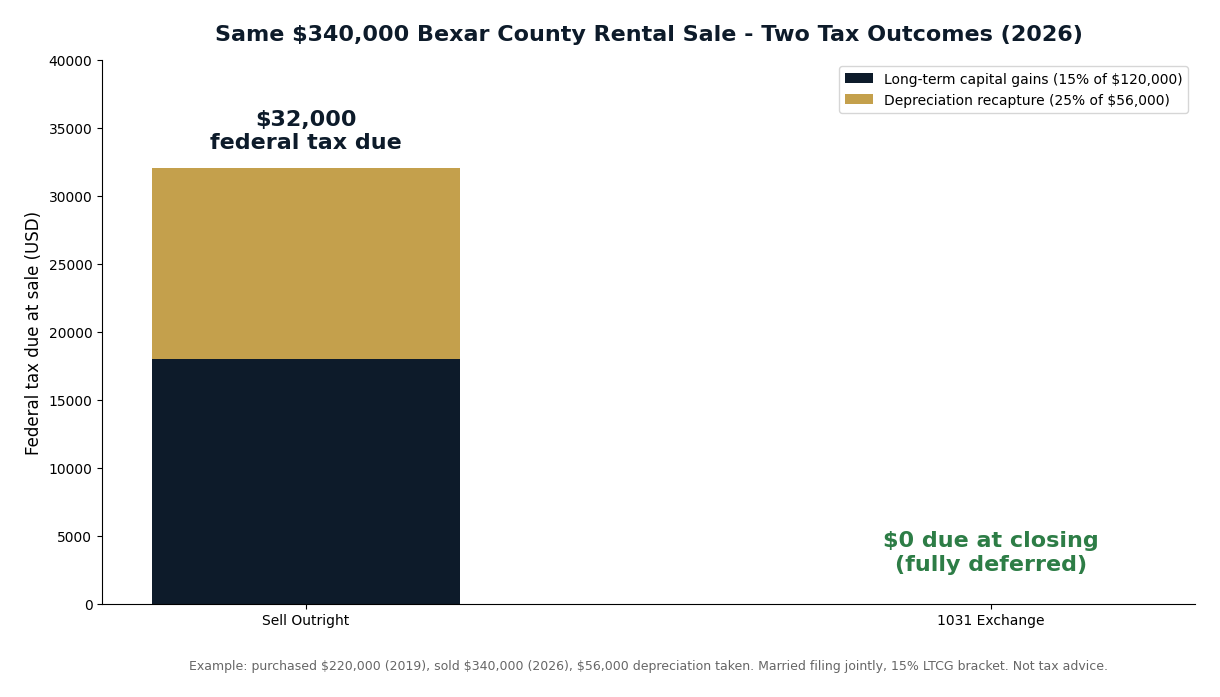
- On a typical Bexar County rental with a $120,000 gain and seven years of depreciation, an exchange defers roughly $32,000 in combined federal tax. Texas adds no state income tax on top.
- A home you bought with a VA loan and later converted to a rental CAN be exchanged, but the property must have been held for investment, not as your residence, when you sell.
- You must use a qualified intermediary before closing. Touch the sale proceeds yourself, even for a day, and the exchange fails.
In This Guide
- What is a 1031 exchange and why do veteran investors use it?
- How do the 45-day and 180-day deadlines work?
- What counts as like-kind property in Texas?
- How much tax can an exchange defer? Real Bexar County math
- Can you 1031 a property you bought with a VA loan?
- Who runs the exchange? Qualified intermediaries and costs
- What if a 1031 does not fit? Alternatives compared
- FAQ: 1031 exchanges in San Antonio
What Is a 1031 Exchange and Why Do San Antonio Veteran Investors Use It?
The exchange is the single most powerful wealth-building tool available to a landlord who has outgrown a property. Instead of losing a quarter or more of your equity to the IRS at closing, you redeploy 100 percent of it into the next asset. That is how a veteran who house-hacked one duplex near JBSA in his twenties ends up holding a small portfolio at retirement.
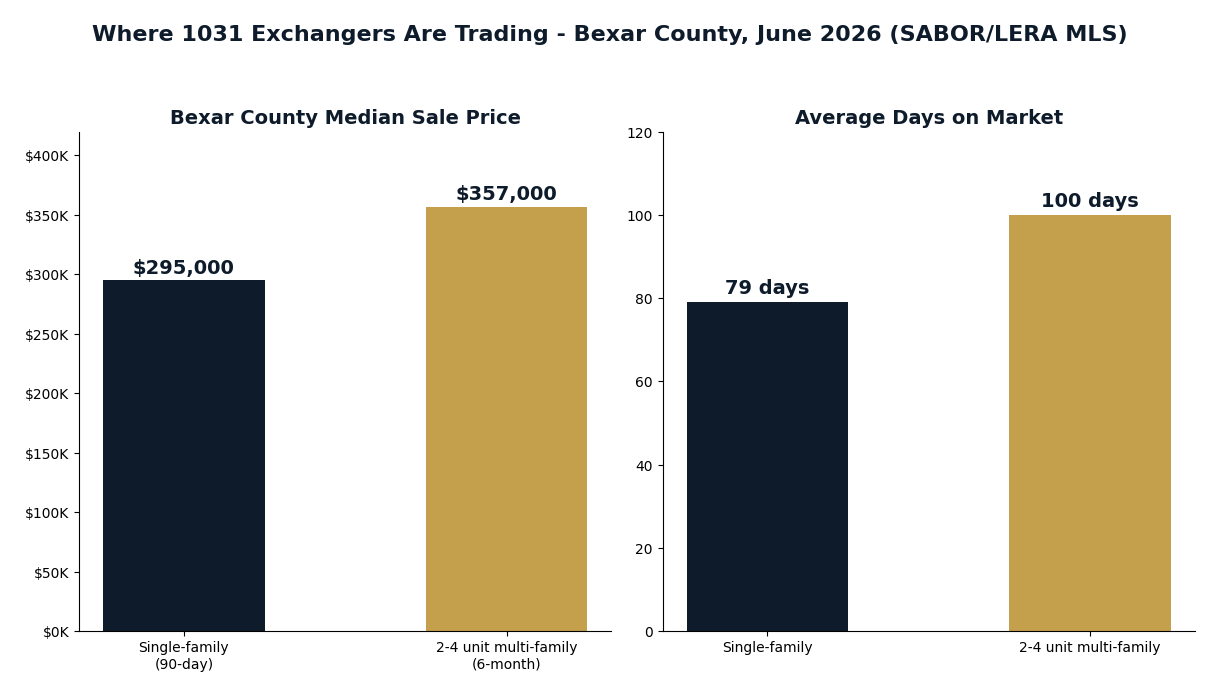
San Antonio is fertile ground for this play in 2026. Bexar County's 90-day median sale price sits at $295,000 with sellers capturing about 97 percent of list, while 2-4 unit multi-family product trades at a $357,000 median. Investors who bought near Lackland, Randolph, or Fort Sam Houston in the late 2010s are sitting on six-figure gains, and many are ready to trade a single aging house for something that cash-flows harder.
The rules are strict and the deadlines are unforgiving, so this guide walks the full sequence: what qualifies, what it saves, the VA-loan wrinkle that matters to military investors, and who actually runs the paperwork. For how to finance the property you buy next, see our guide to DSCR loans, HELOCs, and conventional options for a second rental.
How Do the 45-Day and 180-Day Deadlines Actually Work?
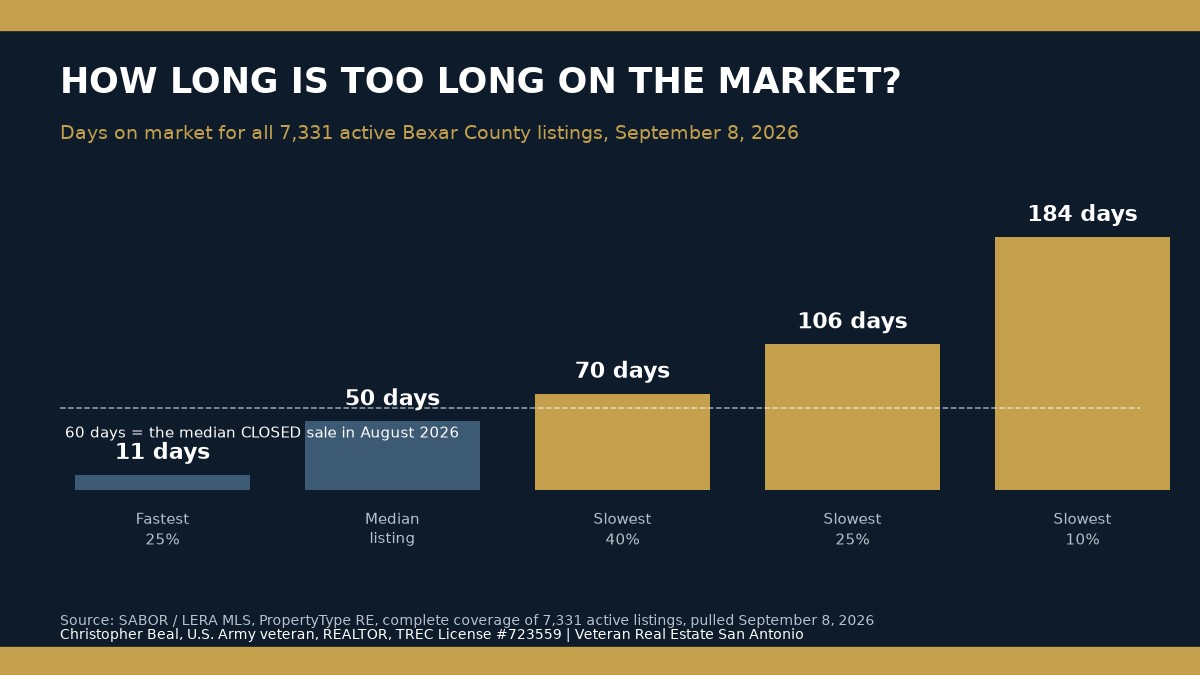
The 45-day identification window is where exchanges die. Forty-five days is not long in a market where Bexar County listings average 79 days on market, so smart exchangers begin shopping before they list the property they are selling. The identification must be specific: a street address or legal description, delivered in writing to your intermediary by midnight of day 45.
The IRS gives you three standard ways to identify, and most San Antonio investors use the first. The three-property rule lets you name up to three candidates regardless of price and close on any one of them. The 200 percent rule lets you name more than three as long as their combined value stays under twice your sale price, and the 95 percent rule is a niche fallback that requires you to actually acquire nearly everything you named.
Day 180 is the absolute back wall for closing on the replacement. If your tax return is due before day 180, the deadline shortens to your filing date unless you file an extension, a trap that catches sales closing late in the year. Mark both dates the day you go under contract, not the day you close.
What Qualifies as Like-Kind Property in Texas?
Like-kind refers to the nature of the asset, not its grade or type. A single-family rental near Randolph AFB is like-kind to a small retail strip on Culebra, to ranch land outside Bandera, or to two duplexes in Universal City. Since the 2017 tax law, only real estate qualifies; equipment and franchise assets are out.
Both ends of the trade must be held for investment or productive use in a business. The house you live in is handled by an entirely different rule, the Section 121 exclusion, which we compare in our capital gains guide for Texas home sellers. Property bought to renovate and resell quickly is dealer inventory in the eyes of the IRS and fails the held-for-investment test.
Texas sweetens the deal in one quiet way: there is no state income tax, so the deferral you win at the federal level is the whole fight. Investors exchanging out of California or New York rentals into San Antonio also escape those states' clawback rules going forward, one reason out-of-state 1031 money keeps landing in Bexar, Comal, and Kendall counties.
How Much Tax Can a 1031 Exchange Defer? Real Bexar County Math
Run the numbers on a realistic JBSA-corridor rental and the case makes itself. Say you bought a $220,000 house in 2019, rented it to military families for seven years, and can sell at $340,000 in today's market. Your gain is about $120,000 before selling costs, and you have also taken roughly $56,000 of depreciation deductions along the way.
Depreciation recapture is the piece that surprises sellers. The IRS taxes the depreciation you took, or were allowed to take, at up to 25 percent, and it applies even if you never itemized it aggressively. Add the 15 percent long-term capital gains rate that covers most married filers earning under roughly $600,000, and a mid-priced rental can easily owe $30,000 to $40,000.
Scale matters too. That deferred $32,000 is a 20 percent down payment on a $160,000 piece of the next deal, and at the Bexar County multi-family median of $357,000 it covers nearly half the typical down payment. Repeat the cycle two or three times across a career and the deferred tax is quietly financing entire properties.
| Outcome at Closing | Sell Outright | 1031 Exchange |
|---|---|---|
| Federal long-term capital gains (15% of $120,000) | $18,000 due | $0 (deferred) |
| Depreciation recapture (25% of $56,000) | $14,000 due | $0 (deferred) |
| Texas state income tax | $0 | $0 |
| Equity available for the next property | Reduced by ~$32,000 | Full proceeds |
| Cost basis in the new property | Full purchase price | Carries over (lower) |
Source: example modeled on SABOR/LERA MLS Bexar County data retrieved June 11, 2026 (90-day median sale $295,000; 2-4 unit multi-family median $357,000) and 2026 federal rates for a married-filing-jointly seller in the 15 percent long-term capital gains bracket. Your figures will differ; confirm with your CPA.
Can You 1031 a Property You Bought With a VA Loan?
This is the question San Antonio military investors ask most, and the answer is friendlier than expected. The classic JBSA pattern is buy with a VA loan at Lackland or Randolph, get PCS orders, keep the house as a rental, and repeat. Years later that accidental rental has appreciated, and Section 1031 does not care that the original mortgage was a VA loan.
What the IRS cares about is intent and use at the time of sale. A house you converted to a rental two years ago and have reported on Schedule E since is investment property, while a house you moved out of four months ago is a gray zone your CPA will want to discuss. If you are still in the conversion window, our accidental landlord guide and our breakdown of VA loan occupancy rules cover the timeline.
Two wrinkles deserve attention. First, partial periods of personal use can split the tax treatment between Section 121 and Section 1031, which is sometimes the best of both worlds on a converted residence. Second, exchanging does not restore VA entitlement tied up in the old loan; selling and paying the VA loan off does, a planning point we cover in our post-separation rental strategy guide.
Where do exchangers buy next? The northeast corridor around Randolph stays the cash-flow workhorse, and our guides to the best multi-family areas in San Antonio and the Camp Bullis northwest rental corridor map the ZIP-level numbers.
Who Runs the Exchange? Qualified Intermediaries, Costs, and the One Fatal Mistake
The fatal mistake is constructive receipt. If the title company wires the sale proceeds to your account, even briefly and even by accident, the exchange is dead and the full tax is due. The money must flow from your sale closing to the QI to the replacement closing without touching you.
Your QI cannot be your agent, your attorney, your CPA, or anyone who has worked for you in the last two years. Use an established exchange company, confirm they carry fidelity bonding and errors-and-omissions coverage, and ask where the funds are escrowed. Your closing team coordinates the rest: the exchange addendum goes into both contracts, and the title company, QI, and your agent work the calendar backward from day 45 and day 180.
Report the exchange to the IRS on Form 8824 with your return for the sale year. The full identification and timing rules live in IRS guidance on like-kind exchanges and the Form 8824 instructions, and Fannie Mae-eligible replacement financing options are summarized in our second-rental financing guide.
What If a 1031 Does Not Fit? Alternatives for San Antonio Sellers
An exchange is a tool, not a religion. If you need the cash for a business, college, or a home purchase, paying 15 percent on a long-term gain in a state with no income tax is far from a disaster. The exchange only wins when the proceeds belong in the next investment property anyway.
Sellers who lived in the property two of the last five years may exclude up to $250,000 of gain single or $500,000 married under Section 121, which usually beats deferral outright; recently converted rentals near JBSA often still qualify. An installment sale spreads the gain across years of buyer payments, and a cash-out refinance pulls equity tax-free while the tenants keep paying the note. Each path has Bexar County property tax implications, so review our property tax protest guide before you decide to hold.
The right answer comes from a CPA and an investor-literate agent running your actual numbers side by side. The wrong answer is deciding at the closing table, after the clocks have started and the options have closed.
Ready When You Are
Selling a rental this summer? Request a free home evaluation and we will model your sale price against the 1031 calendar.
Exchanging into your next investment? Explore VA loan options alongside DSCR and conventional financing for the replacement property.
PCS orders just changed your plans? Christopher Beal specializes in military relocation. Learn more or call (210) 882-8583.
About the Author: Christopher Beal
Christopher Beal is a U.S. Army veteran and the Owner of Veteran Real Estate San Antonio, a Beal Group practice brokered by eXp Realty (TREC License #723559). A Military Relocation Professional (MRP) and VAREP member, he is a 7-time eXp Realty ICON agent, winner of Best Real Estate Agency in the 2026 Best of San Antonio Readers' Choice (San Antonio Current, 100,000+ voters), and a 3x San Antonio Business Journal Top 25 Individual Agent (#13 in 2024, #14 in 2025, #20 in 2026). His recognition also includes 3x Platinum Top 50, 2x RateMyAgent Agent of the Year, 2x Real Producers Top 100, Five Star Professional (2026), and a RealTrends 2026 ranking. He has helped 325+ families, closed more than $125M in career volume, and holds 5.0 stars across 370+ verified reviews, working almost exclusively with military and veteran buyers and sellers across Bexar, Comal, Kendall, Medina, and Bandera counties, with a focus on VA loans, PCS moves, and homebuying near JBSA-Lackland, JBSA-Randolph, and Fort Sam Houston. Whether you are buying or selling in the San Antonio area, he answers directly - no team handoffs, no pressure. He can be reached at (210) 882-8583.
What is a 1031 exchange in simple terms?
It is an IRS-sanctioned swap: you sell one investment property, a neutral intermediary holds the money, and you buy another investment property within 180 days. Because you never received the proceeds, the capital gains tax and depreciation recapture are deferred into the new property instead of being due at the sale.
How long do I have to complete a 1031 exchange in 2026?
You have 45 calendar days from your sale closing to identify replacement property in writing and 180 calendar days total to close on it. The deadlines run concurrently, count weekends and holidays, and cannot be extended except by federal disaster relief.
Can I do a 1031 exchange on a home I bought with a VA loan in San Antonio?
Yes, if the home is genuinely held as an investment when you sell. A VA-financed home you converted to a rental after a PCS qualifies once it has an established rental history, which most CPAs want to see at one to two years on Schedule E. The original financing type is irrelevant to Section 1031.
How much does a qualified intermediary cost in Texas?
A standard deferred exchange typically runs $750 to $1,500 in QI fees, plus normal closing costs on both transactions. Reverse and improvement exchanges, where the QI must hold title temporarily, run several thousand dollars and need specialist firms.
Can I 1031 my San Antonio rental into a property in another state?
Yes. Like-kind covers investment real estate anywhere in the United States, so you can exchange a Converse rental for property in Tennessee or Florida. Investors leaving high-tax states often exchange into Texas because there is no state income tax waiting on the back end.
What happens to the deferred tax when I eventually sell for cash?
The deferred gain and recapture come due on the final sale, calculated from your carried-over basis. Many investors exchange repeatedly and hold until death, when current law gives heirs a stepped-up basis that can eliminate the deferred gain entirely; that estate-planning angle is worth a conversation with your CPA.
Can I move into the property I buy with a 1031 exchange?
Not right away. The replacement must be held for investment, and the IRS safe harbor wants at least two years of rental use, renting it at market rate at least 14 days per year and limiting personal use, before a conversion to personal use is considered safe. Converting earlier risks the entire deferral.
Do I owe Texas state taxes on a rental property sale?
No. Texas has no state income tax, so a Bexar County rental sale faces only federal capital gains tax and depreciation recapture. That is exactly what a 1031 exchange defers, which makes the strategy unusually clean for San Antonio sellers.
Does a 1031 exchange restore my VA loan entitlement?
Selling the VA-financed property and paying off the VA loan restores the entitlement tied to it regardless of whether you exchange or sell outright. The exchange affects your taxes, not your VA benefit, so many veteran investors exchange the asset and then reuse their restored entitlement on a new owner-occupied purchase.
Who should I have on my 1031 team in San Antonio?
Four seats: a CPA who has filed Form 8824 before, an established qualified intermediary engaged before closing, a title company comfortable with exchange addenda, and an investor-literate real estate agent to hit the 45-day window. Christopher Beal coordinates that team for veteran investors across greater San Antonio. Call (210) 882-8583.
Explore More Resources
- VA Home Loans
- Military Relocation
- Free Home Evaluation
- Serve & Save
- Client Reviews
- About Christopher
Christopher Beal is a licensed Texas REALTOR (TREC #723559) with eXp Realty. This article is educational and is not tax or legal advice; consult your CPA or tax attorney before initiating an exchange. Published: June 11, 2026.
Categories
- All Blogs (355)
- Alamo Heights (4)
- awards (4)
- Best Neighborhoods in San Antonio (13)
- Buyer (16)
- Buyer Education (87)
- Community Events (4)
- Hill Country (17)
- JBSA (46)
- Local Guide (6)
- Luxury (28)
- Luxury Real Estate (26)
- Market Trends (19)
- Market Update (14)
- Military Relocation (114)
- Military Retirement (3)
- Mortgage (19)
- Neighborhood Guides (19)
- neighborhoods (5)
- New Construction (16)
- PCS (42)
- Real Estate (40)
- reviews (3)
- San Antonio (53)
- San Antonio Lifestyle (4)
- San Antonio Market (5)
- San Antonio Neighborhoods (45)
- San Antonio Real Estate (98)
- San Antonio, Veterans Resources, VA Loans (5)
- Seller (55)
- VA Home Loans (30)
- VA Loans (35)
- Va Loans & Financing (27)
- Veterans (10)
- Veterans Resources (40)
Recent Posts