The Accidental Landlord's Playbook: Managing Your San Antonio Home as a Rental After a PCS (2026)
Last Updated: October 6, 2026 | By Christopher Beal, U.S. Army Veteran & Realtor
Key Takeaways
- If your PCS orders came faster than the market, keeping your San Antonio home as a rental can preserve your low interest rate and build equity while someone else pays the mortgage.
- Run the real numbers first: market rent minus PITI, property management, maintenance reserve, and vacancy. If the home cash flows or breaks even, renting is often smarter than a rushed sale.
- A military clause in your lease and professional property management are the two safeguards that keep a long-distance rental from becoming a long-distance headache.
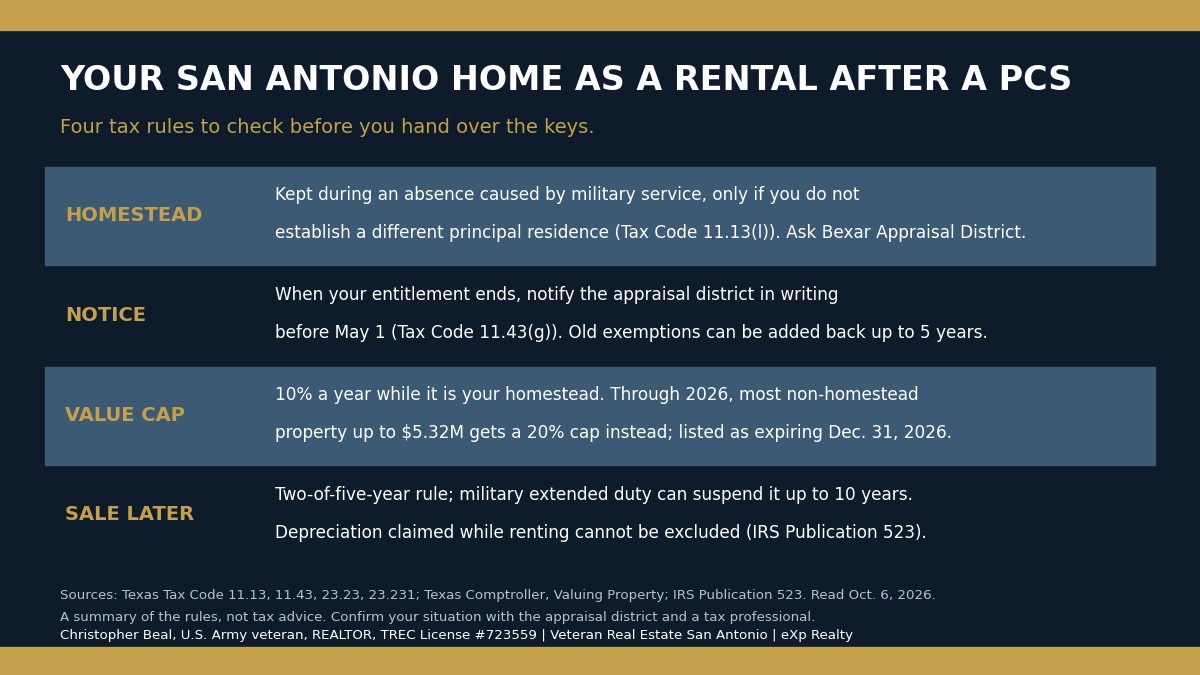
- Texas lets a homestead keep its status during an absence caused by military service, but only if you do not establish a different principal residence. Ask Bexar Appraisal District how that applies to you before you assume either way, and tell them in writing before May 1 once your entitlement ends.
- If the homestead ends, the 10 percent homestead cap goes with it. Through 2026, a separate 20 percent cap applies to most non-homestead property; the Comptroller lists it as expiring December 31, 2026.
- On a later sale, the federal two-of-five-year rule can be suspended for up to 10 years of qualifying military duty, but depreciation you claimed while renting cannot be excluded.
- Texas requires specific early-termination language in a residential lease. Leave it out and a tenant who terminates for military orders or family violence can be released from unpaid rent owed at termination.
In This Guide
What Is an Accidental Landlord, and Is It a Good Idea?
You did not buy your home to become a landlord, but orders do not wait for the right market. When the Air Force, Army, or a federal employer hands you a report-no-later-than date, you have weeks, not months, to decide what happens to the house. Selling into a slow window, or selling a home you bought with a 3 to 4 percent rate only to rent at your next duty station, often costs more than it saves. Renting the home out keeps your equity and your rate intact.
This decision is the close cousin of the keep-versus-sell call, which I cover in depth in my keep, sell, or rent PCS decision framework. This guide picks up where that one ends: you have decided to rent, and now you need an operational plan to do it well from a thousand miles away.
How Do I Run the Numbers Before I Rent It Out?
The mistake most accidental landlords make is comparing rent to their mortgage payment alone. Your true cost of holding the home includes more than principal and interest. Build the full picture before you sign a lease. Here is the framework I walk clients through.
| Line Item | What to Use |
|---|---|
| Market rent | Recent leased comps in your ZIP, not your wishful number |
| Minus PITI | Principal, interest, taxes, and insurance |
| Minus management | The monthly percentage plus any leasing, renewal or setup fee, from written quotes |
| Minus maintenance reserve | A planning rule of thumb some owners use is about 1 percent of home value per year; adjust for the age of the roof, HVAC and water heater |
| Minus vacancy allowance | About one half to one month of rent per year |
| Equals real cash flow | Positive, break-even, or the monthly cost to hold |
Source: a common buy-and-hold planning framework, not a market statistic. Actual figures vary by ZIP, home, and lease terms. Request a rent analysis for your specific address.
Remember that part of your PITI is principal, which is forced savings, and that the property tax line in that PITI can change once the home is no longer your homestead (see the tax section below). A home that breaks even on cash flow can still build equity through principal paydown; appreciation may add to that, but plan without counting on it. If you want hard numbers for your ZIP, I can pull current leased comps as part of a free home evaluation.
What Are the Five Moves Before the Movers Arrive?
The work you do before the moving truck leaves determines how smooth the next two years are. Once you are at the new duty station, every problem is harder and more expensive to solve. Knock out these five moves first.
- Price it with real comps. Overpricing a rental is the fastest way to a long vacancy. Use recently leased homes in your subdivision, not list prices, and price to lease in two to three weeks during PCS season.
- Make the must-fix repairs now. Handle HVAC service, roof and plumbing issues, and anything that could fail mid-lease while you are away. A small repair now is a midnight emergency call later.
- Decide on management before you leave. Interview property managers while you are still in town and can meet them in person. Hand off keys, access codes, and warranty documents in person, not by mail.
- Use a Texas lease with the required termination language. Your tenant may be military too. Texas Property Code Section 92.017 requires a residential lease to tell tenants they may have special statutory rights to end the lease early in certain situations involving family violence or a military deployment or transfer. If that statement is missing, a tenant who terminates under the statute can be released from unpaid rent owed at termination. Pair it with a proper security deposit and terms that respect the Servicemembers Civil Relief Act.
- Document the condition in detail. Photograph and video every room, appliance, and the exterior before the tenant moves in. This is your evidence at move-out and your protection on the deposit.
Should I Self-Manage or Hire a Property Manager?
Self-managing from a different time zone is harder than it looks. A leaking water heater in San Antonio at 2 a.m. is not something you can handle from Ramstein or Fort Bragg. A good property manager handles the emergency, dispatches a vetted contractor, and keeps your tenant happy, all while you sleep. For most accidental landlords who are leaving the area, that is the difference between a passive asset and a constant worry. If you are weighing doing it yourself, my self-manage or hire a property manager guide walks through the tradeoffs.
If you plan to return to San Antonio in a few years, professional management also keeps the home rent-ready and protects its condition for your eventual move back. And if the rental experience convinces you that real estate is a wealth path, the same JBSA demand that helps your home rent can support growing a portfolio here over time, one property and one set of real numbers at a time.
How Does Renting Change My Taxes and Homestead?
Converting a homestead to a rental can flip several tax switches at once, and the timing matters. The table below sets out what the Texas Tax Code says on each side of that line. It is a summary of the rules, not a ruling on your home.
| Texas item | While it is still your homestead | Once it is a rental, not your homestead |
|---|---|---|
| Residence homestead exemption | Keeps homestead status during an absence caused by military service, only if you do not establish a different principal residence (Tax Code 11.13(l)) | Ends when your entitlement ends; notify the appraisal district in writing before May 1 after it ends (Tax Code 11.43(g)) |
| School district exemption | $140,000 off the school district taxable value while the homestead applies (Tax Code 11.13(b)) | Gone with the homestead |
| Annual appraisal cap | 10 percent per year on a qualified homestead (Tax Code 23.23) | Through 2026: 20 percent per year on most non-homestead real property valued at $5,320,000 or less, starting the year after you own it on January 1; listed as expiring December 31, 2026 |
| 100 percent disabled veteran exemption | Total exemption on the residence homestead (Tax Code 11.131) | Does not apply to a property that is not your residence homestead |
| Disabled veteran exemption by rating | $5,000 to $12,000 of value, on one property you designate (Tax Code 11.22) | Can still be designated on one property; Texas residency is required |
Sources: Texas Tax Code Sections 11.13, 11.131, 11.22, 11.43 and 23.23 (current through January 1, 2026); Texas Comptroller, Valuing Property for the circuit breaker thresholds and expiration; Texas Comptroller, Property Tax Exemptions for the $140,000 school district exemption. Read October 6, 2026. Local optional exemptions vary by taxing unit.
Do not let an old exemption ride. Tax Code Section 11.43(i) lets the chief appraiser add back value that was erroneously exempted in any of the five preceding years, so an exemption that should have ended can turn into a back-tax bill. If you are unsure whether your absence still qualifies, a short written question to Bexar Appraisal District is cheaper than guessing. For how the exemption works in the first place, see my San Antonio homestead exemption guide.
Your mortgage has its own occupancy rules. If you bought with a VA loan, my guide to VA loan occupancy rules and renting out a VA home covers when renting is allowed and how it affects your entitlement.
On the federal side, a rental opens up deductions you did not have as an owner-occupant, including depreciation, repairs, insurance and management fees. The IRS explains rental income and expenses at IRS Topic No. 414. To exclude gain on a later sale, you generally must have owned and used the home as your main residence for two of the five years before selling. Under IRS Publication 523, members of the uniformed services on qualified official extended duty, generally a duty station at least 50 miles away or government quarters under orders for more than 90 days, can suspend that five-year period for up to 10 years. Two catches: depreciation allowed or allowable after May 6, 1997 cannot be excluded and is taxed on sale, and the rules have more conditions than fit here. Confirm your specifics with a tax professional.
If you decide later that selling makes more sense than holding, my guide on what it costs to sell a house in San Antonio walks through net proceeds, and the PCS seller timeline shows how to sell fast when orders hit.
About the Author: Christopher Beal
Christopher Beal is a U.S. Army veteran and the Owner of Veteran Real Estate San Antonio, a Beal Group practice brokered by eXp Realty (TREC License #723559). A Military Relocation Professional (MRP) and VAREP member, he is a 7-time eXp Realty ICON agent, winner of Best Real Estate Agency in the 2026 Best of San Antonio Readers' Choice (San Antonio Current, 100,000+ voters), and a 3x San Antonio Business Journal Top 25 Individual Agent (#13 in 2024, #14 in 2025, #20 in 2026). His recognition also includes 3x Platinum Top 50, 2x RateMyAgent Agent of the Year, 2x Real Producers Top 100, Five Star Professional (2026), and a RealTrends 2026 ranking. He has helped 325+ families, closed more than $125M in career volume, and holds 5.0 stars across 370+ verified reviews, working almost exclusively with military and veteran buyers and sellers across Bexar, Comal, Kendall, Medina, and Bandera counties, with a focus on VA loans, PCS moves, and homebuying near JBSA-Lackland, JBSA-Randolph, and Fort Sam Houston. If you are PCSing to or from JBSA, he can manage your entire move remotely - most of his military clients close before they ever set foot in San Antonio. He can be reached at (210) 882-8583.
Explore More Resources
Frequently Asked Questions
Is it better to sell or rent my San Antonio home when I PCS?
It depends on your rate, your equity, and whether the home cash flows. If you have a low interest rate and the rent covers your full costs, renting often beats selling into a soft market. Run the full numbers, not just rent versus your mortgage payment.
How much does property management cost in San Antonio?
Managers usually charge a percentage of collected rent, and many add a separate leasing fee for placing a new tenant, plus renewal or setup fees. Pricing varies by company and service level, so get two or three written quotes and compare the total cost over a full lease, not just the monthly percentage.
What is a military clause in a lease?
It is lease language about ending the lease early for military orders. A service-member tenant already has that right under federal law: the Servicemembers Civil Relief Act (50 U.S.C. 3955) lets a tenant who signs a lease while on active duty and then receives PCS orders, or deployment orders for at least 90 days, end it with written notice and a copy of the orders. For monthly rent, termination takes effect 30 days after the next rent due date. Texas adds its own rule: Property Code Section 92.017 requires the lease to state that tenants may have special statutory rights to end the lease early, and omitting it can release the tenant from unpaid rent owed at termination.
Will I lose my homestead exemption if I rent out my home after a PCS?
Not automatically. Texas Tax Code Section 11.13(l) keeps a homestead's status during an absence caused by military service, but only if you do not establish a different principal residence. If your entitlement ends, the exemption and the 10 percent homestead cap end with it, and through 2026 a 20 percent circuit breaker cap generally applies instead. Ask Bexar Appraisal District how the rule applies to you.
Do I have to tell Bexar Appraisal District when the home stops being my homestead?
Yes. Tax Code Section 11.43(g) requires you to notify the appraisal office in writing before May 1 after your entitlement to the exemption ends. An exemption that was erroneously allowed can be added back for up to five prior years under Section 11.43(i).
Can I still avoid capital gains tax if I sell later?
To exclude gain, you generally must have owned and lived in the home two of the five years before selling. Service members on qualified official extended duty can suspend that five-year period for up to 10 years, per IRS Publication 523. Depreciation claimed while it was a rental after May 6, 1997 cannot be excluded. Confirm your situation with a tax professional.
Can I manage the rental myself from another state?
You can, but it is difficult. Emergencies, turnovers, and Texas landlord-tenant rules are hard to handle from afar. Most owners who leave the area find professional management is worth the fee.
Does San Antonio have strong rental demand?
Joint Base San Antonio's large military population supports rental demand near the bases, but demand varies by ZIP, price point, condition and season. Check recently leased homes near yours before you set the rent or decide to hold.
Should I refinance before renting it out?
Usually not, if you already have a low rate. Refinancing a primary residence into an investment loan typically means a higher rate and costs. Keeping your existing low-rate mortgage is one of the biggest advantages of renting rather than selling.
Trying to decide whether to keep your San Antonio home through a PCS, or how to rent it out the right way? Call Christopher Beal at (210) 882-8583. As a fellow veteran, I will give you a straight, numbers-first answer.
Categories
- All Blogs (355)
- Alamo Heights (4)
- awards (4)
- Best Neighborhoods in San Antonio (13)
- Buyer (16)
- Buyer Education (87)
- Community Events (4)
- Hill Country (17)
- JBSA (46)
- Local Guide (6)
- Luxury (28)
- Luxury Real Estate (26)
- Market Trends (19)
- Market Update (14)
- Military Relocation (114)
- Military Retirement (3)
- Mortgage (19)
- Neighborhood Guides (19)
- neighborhoods (5)
- New Construction (16)
- PCS (42)
- Real Estate (40)
- reviews (3)
- San Antonio (53)
- San Antonio Lifestyle (4)
- San Antonio Market (5)
- San Antonio Neighborhoods (45)
- San Antonio Real Estate (98)
- San Antonio, Veterans Resources, VA Loans (5)
- Seller (55)
- VA Home Loans (30)
- VA Loans (35)
- Va Loans & Financing (27)
- Veterans (10)
- Veterans Resources (40)
Recent Posts