Capital Gains Tax When Selling a Home in Texas (2026): San Antonio Seller Rules, Exclusions, and Mistakes to Avoid

| Capital Gains Tax When Selling a Home in Texas (2026): San Antonio Seller Rules, Exclusions, and Mistakes to Avoid By Christopher Beal | Veteran Real Estate San Antonio: The Beal Group | Updated July 24, 2026 |
If you're thinking about selling a home in San Antonio in 2026, the question isn't just "What can I sell for?" - it's also "What do I keep after taxes and closing costs?" Even though Texas has no state income tax, federal capital gains rules can still matter, especially for long-time owners, military families who turned a home into a rental during a PCS, or anyone who saw big appreciation.
I'm not a CPA, and this isn't tax advice - but I work with enough sellers (especially veterans and active-duty families) that I can tell you where the surprises usually happen. Below is a practical, plain-English overview of the rules, the common exemptions, and what to gather before you list.
Do Texas home sellers pay capital gains tax?
Texas does not have a state income tax, but federal capital gains tax can apply if you sell a home for more than your adjusted cost basis. The good news is that many owner-occupants qualify for a major federal exclusion on the gain from selling their main home.
What is the $250,000 / $500,000 home sale exclusion in 2026?
The IRS explains that if you have a capital gain from the sale of your main home, you may qualify to exclude up to $250,000 of that gain (single) or up to $500,000 of that gain if you file a joint return with your spouse. The catch is that you must pass the ownership and use tests.
| Rule | What it means (plain English) | Why San Antonio sellers get tripped up |
|---|---|---|
| Ownership test | Owned the home at least 24 months (2 years) out of the last 5 years before the sale. | Military families who purchased right before a PCS sometimes sell before they hit the 2-year mark. |
| Use test | Lived in the home as your main home at least 24 months out of the last 5 years. | If you rented the home for several years, you may fall outside the 5-year window without realizing it. |
| Once-every-2-years rule | Generally, you can't take the exclusion if you excluded gain on another home sale in the prior two years. | Quick moves (sell/buy/sell) can accidentally disqualify the exclusion. |
How do you estimate your capital gain when selling?
At a high level, your capital gain is the difference between what you net from the sale and your adjusted cost basis. The "adjusted" part is important because many sellers forget that certain major improvements can increase basis.
| Step | Example (simple numbers) | Notes |
|---|---|---|
| Start with purchase price | $265,000 | This is your starting basis (not counting some closing costs/improvements). |
| Add major improvements | + $35,000 | Think roof, HVAC replacement, additions, major remodels (keep receipts). |
| Adjusted cost basis | = $300,000 | Your CPA will refine this number. |
| Net sale proceeds (after typical costs) | $395,000 | Selling costs may include commissions, title fees, and negotiated seller costs. |
| Estimated gain | $95,000 | Many owner-occupants would be fully excluded if they qualify. |
What's different for military families who PCS and rent the home out?
Here's the practical issue I see a lot: you buy a home near JBSA, you live in it, then you PCS and keep it as a rental. Years later, you decide to sell. If you're too far outside the "2 out of 5 years" window, you may not qualify for the full exclusion.
Before you list, ask your tax professional about special rules that may suspend parts of the 5-year test and about how depreciation (if you claimed it while renting) affects the taxable portion of the gain.
The military 10-year suspension: how IRC Section 121(d)(9) protects PCS sellers
Federal law gives military sellers a powerful extension most civilian owners never hear about. Under IRC Section 121(d)(9), a service member on qualified official extended duty can elect to pause the 5-year ownership-and-use test for up to 10 years. Qualified official extended duty means serving at a duty station at least 50 miles from the home, or living in government quarters under government orders, for a period of more than 90 days or an indefinite period. With the election, the lookback window can stretch to as long as 15 years, and the suspension can only be applied to one property at a time.
Here is what that looks like in practice. Say you bought a home near JBSA-Lackland in 2016, lived in it for three years, then received PCS orders in 2019 and have rented it out ever since. A civilian owner selling in 2026 would be outside the 2-of-5 window and lose the exclusion entirely. A military owner who has been on qualified official extended duty since that PCS can suspend those rental years, still count the 2016-2019 occupancy, and claim the full $250,000 or $500,000 exclusion.
Two caveats still apply. First, depreciation claimed (or allowable) during the rental years is never excluded: it is taxed as unrecaptured Section 1250 gain at up to 25 percent when you sell. Second, the election is made on your tax return, so loop in a CPA who works with military clients before you list. The IRS explains the suspension election in Publication 523, Selling Your Home.
If you are weighing this sale against keeping the home for your next move, read our guides on the second VA loan, assumption, or sell decision and selling a San Antonio home remotely after PCS orders, then run your numbers with our breakdown of the true cost to sell a house in San Antonio.
Why does this matter right now in the 2026 San Antonio market?
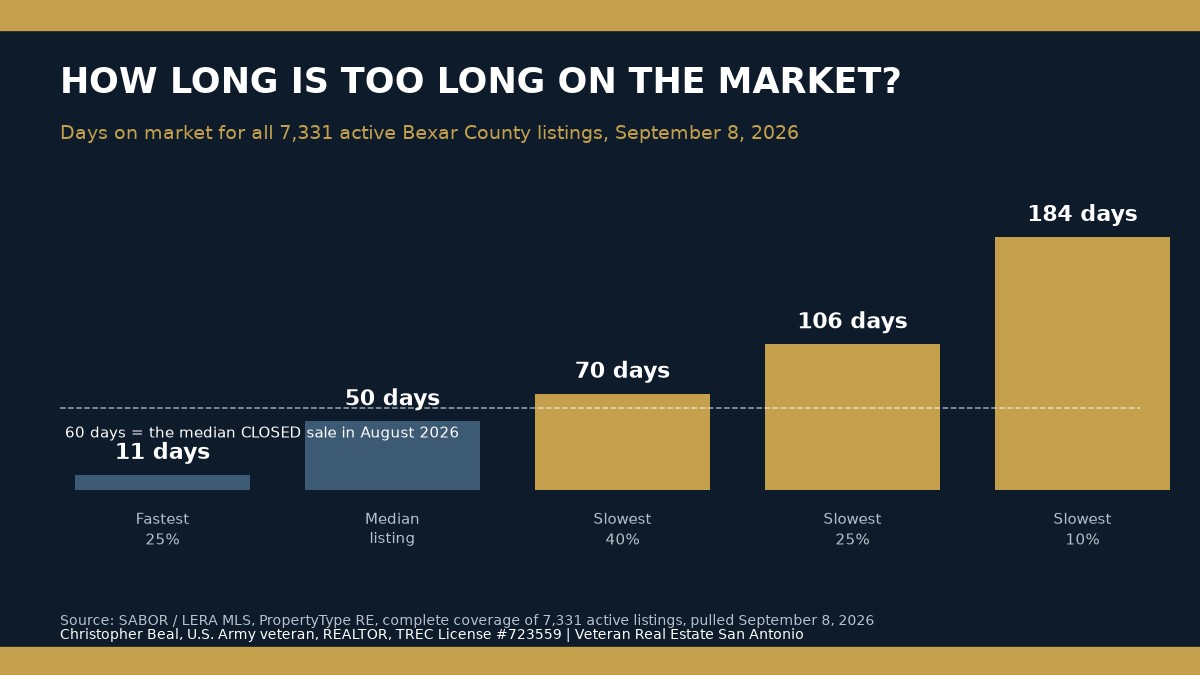
As of July 24, 2026, SABOR MLS (LERA) data for Bexar County shows a trailing-90-day median close price of about $306,000, an average of roughly 75 days on market, and a 97.8 percent list-to-sale ratio. Sellers have more time to plan than in the 2021-2022 rush: gather documents, confirm your exclusion window (including the military suspension above), and price correctly the first time instead of rushing and missing details that affect net proceeds.
What documents should you gather before you list?
- Closing disclosure or settlement statement from when you bought
- Receipts/invoices for major improvements (roof, HVAC, windows, remodels)
- Rental records if the home was ever rented (including dates and depreciation info from your CPA)
- HOA documents (if applicable) and any paid invoices for special assessments
- Recent mortgage statement to confirm payoff and escrow status
How can you plan a sale to protect your net proceeds?
Capital gains planning is really "timing + documentation + strategy." Here are moves that often help:
- Confirm your eligibility window before you pick a list date.
- Get a pricing strategy early so you're not forced into a fast sale by a deadline.
- Track improvements now - don't wait until you're under contract to hunt for receipts.
- Use the right negotiation approach to keep seller concessions from unnecessarily eroding your net.
Why Work with Christopher Beal?
- U.S. Army Veteran - understands military life, PCS moves, and VA loan benefits firsthand
- 3x SABJ Top 25 Individual Agent - #13 in 2024, #14 in 2025, #20 in 2026
- 3x Platinum Top 50 Producer and 7x ICON Agent (2020-2026) at eXp Realty
- Military Relocation Professional (MRP) certified
- 325+ military and veteran families served - more than $125M in closed volume
- Serve & Save Program - reduces closing costs for veterans, active duty, first responders, and educators
About the Author
Christopher Beal is a U.S. Army veteran and the Owner of Veteran Real Estate San Antonio, a Beal Group practice brokered by eXp Realty (TREC License #723559). A Military Relocation Professional (MRP) and VAREP member, he is a 7-time eXp Realty ICON agent, winner of Best Real Estate Agency in the 2026 Best of San Antonio Readers' Choice (San Antonio Current, 100,000+ voters), and a 3x San Antonio Business Journal Top 25 Individual Agent (#13 in 2024, #14 in 2025, #20 in 2026). His recognition also includes 3x Platinum Top 50, 2x RateMyAgent Agent of the Year, 2x Real Producers Top 100, Five Star Professional (2026), and a RealTrends 2026 ranking. He has helped 325+ families, closed more than $125M in career volume, and holds 5.0 stars across 370+ verified reviews, working almost exclusively with military and veteran buyers and sellers across Bexar, Comal, Kendall, Medina, and Bandera counties, with a focus on VA loans, PCS moves, and homebuying near JBSA-Lackland, JBSA-Randolph, and Fort Sam Houston. If you are weighing a home sale against capital gains exposure after a PCS, he can walk you through the exclusion timeline before you list. He can be reached at (210) 882-8583.
Frequently Asked Questions
Do I pay capital gains tax when I sell my primary residence in Texas?
Many sellers don't, because the IRS allows a major exclusion on the gain from selling your main home if you meet the ownership and use tests. Texas has no state income tax, but federal rules still apply. Confirm your eligibility window and talk to a tax professional if your gain may be large.
How long do I have to live in my home to avoid capital gains tax?
The IRS rule is generally "2 out of the last 5 years" as your main home. That means at least 24 months of use within the five-year period ending on the sale date. The two years do not have to be consecutive, but both the ownership and use tests must be satisfied.
What is the $250,000 / $500,000 capital gains exclusion?
If you qualify, you may exclude up to $250,000 of gain if single or up to $500,000 if married filing jointly. The home must be your main home and you must meet the ownership and use tests. If you sold another home recently and used the exclusion, you may be limited by the once-every-2-years rule.
Does Texas have a state capital gains tax on home sales?
Texas does not have a state income tax, so there is not a separate Texas state capital gains tax. However, federal capital gains tax can still apply depending on your gain and whether you qualify for the primary residence exclusion. It's smart to estimate your net proceeds before you list.
Can home improvements reduce capital gains tax?
Potentially, yes - major improvements may increase your cost basis, which can reduce the taxable gain. Keep receipts and documentation for items like a new roof, HVAC replacement, additions, and major remodels. Your CPA can confirm what qualifies for basis adjustments.
What if I rented my San Antonio home after a PCS?
Renting can complicate the exclusion because you may fall outside the "2 out of 5 years" use window if too much time passes. Also, if you claimed depreciation while renting, that portion may be taxable even if you qualify for an exclusion. Talk to a tax professional before listing so you understand your timing and documentation needs.
Do I need a CPA before I list my home?
Not always, but it's a good idea if you expect a large gain, you used the home as a rental, or your ownership/use timeline is close to the cutoff. A CPA can help you estimate taxes, confirm basis, and avoid surprises at filing time. I can coordinate with your CPA so we price and time the sale strategically.
How does capital gains planning affect my listing strategy?
Sometimes the difference between listing in March versus May can change eligibility for the exclusion if you're approaching the 24-month mark. Planning also affects how aggressively we negotiate seller concessions because those impact your net proceeds. The best approach is to build a timeline first, then set pricing and marketing around it.
Can Serve & Save reduce closing costs when I sell?
Serve & Save is primarily designed to reduce closing costs for eligible buyers, but sellers can still benefit from a strategy-first approach that protects net proceeds. The most important seller win is pricing and negotiation that avoids unnecessary credits or repairs. Let's review your goals and build a plan that keeps more of your equity in your pocket.
I PCSed away from San Antonio years ago and have rented my home out ever since. Can I still use the exclusion?
Possibly, yes. If you have been on qualified official extended duty (a duty station 50 or more miles away, or government quarters under orders), IRC Section 121(d)(9) lets you suspend the 5-year test for up to 10 years, so a sale up to 15 years after you moved out can still qualify for the $250,000 or $500,000 exclusion. Depreciation recapture on the rental years still applies. Confirm your dates and the election with a CPA before you list.
Explore More Resources
- Schedule a Free Evaluation
- Serve & Save Program
- Client Reviews
- About Christopher Beal
- Search San Antonio Homes
- Military Relocation Guide
- San Antonio Relocation Guide
- VA Home Loans in San Antonio
- Luxury Homes in San Antonio
- VA Loan Pre-Approval Process (2026)
Call or text Christopher Beal: (210) 882-8583
Categories
- All Blogs (354)
- Alamo Heights (4)
- awards (4)
- Best Neighborhoods in San Antonio (13)
- Buyer (16)
- Buyer Education (86)
- Community Events (4)
- Hill Country (17)
- JBSA (43)
- Local Guide (6)
- Luxury (28)
- Luxury Real Estate (26)
- Market Trends (19)
- Market Update (14)
- Military Relocation (111)
- Military Retirement (3)
- Mortgage (19)
- Neighborhood Guides (18)
- neighborhoods (5)
- New Construction (16)
- PCS (42)
- Real Estate (40)
- reviews (3)
- San Antonio (53)
- San Antonio Lifestyle (4)
- San Antonio Market (5)
- San Antonio Neighborhoods (43)
- San Antonio Real Estate (100)
- San Antonio, Veterans Resources, VA Loans (5)
- Seller (55)
- VA Home Loans (30)
- VA Loans (35)
- Va Loans & Financing (27)
- Veterans (10)
- Veterans Resources (40)
Recent Posts