How to Price a $750K+ Home in San Antonio in 2026: Luxury CMA, DOM Math, and the Overpricing Trap
LAST UPDATED: JULY 14, 2026 | BY CHRISTOPHER BEAL, U.S. ARMY VETERAN & REALTOR
How to Price a $750K+ Home in San Antonio in 2026: Luxury CMA, DOM Math, and the Overpricing Trap

Key Takeaways
- San Antonio's $750K+ market is a barbell in 2026: in SABOR MLS data since mid-January, more than 200 luxury closings sold in 30 days or less, while another 200+ needed more than 90 days.
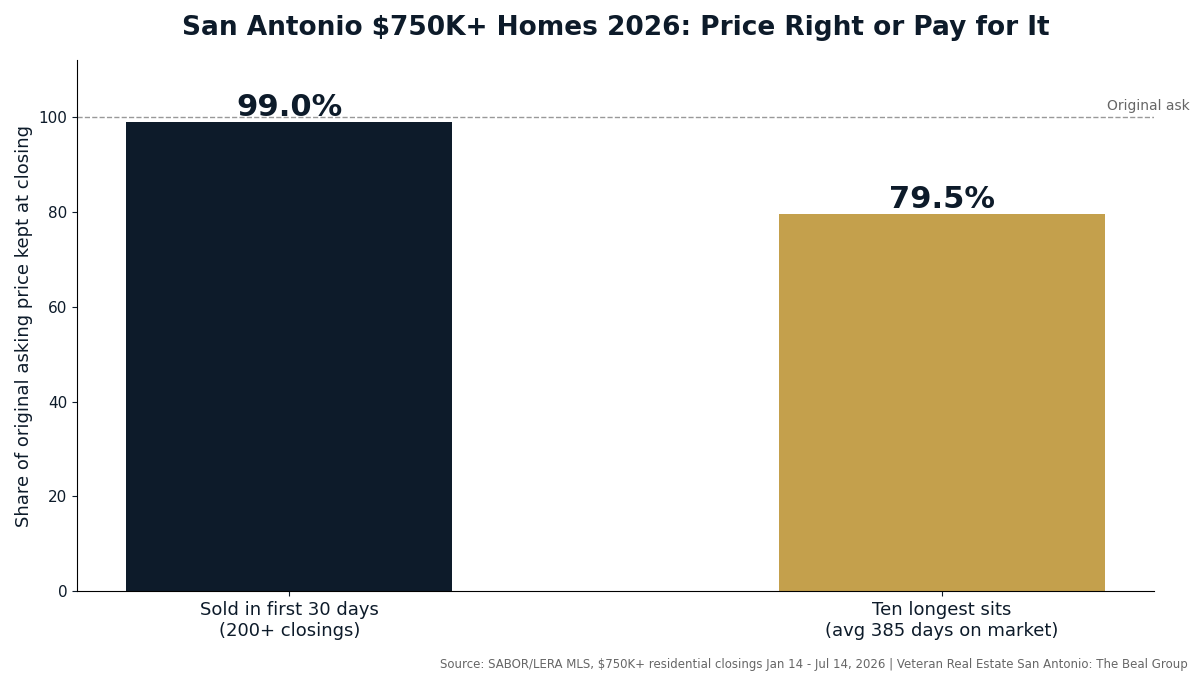
- In a 200-closing SABOR sample I analyzed, homes that sold in the first two weeks closed within about 2 percent of original asking price. The ten longest-sitting sales averaged 385 days on market and closed 20.5 percent below original ask.
- A luxury CMA is different: thin comps, wide adjustment ranges, and buyer pools measured in dozens, not thousands. Price to the evidence, not to the upgrade list.
- The overpricing trap is not "wait longer, get your number." It is chasing the market down with reductions while carrying costs stack up.
- Set a 14-day showing and offer benchmark before you list, and commit in writing to the correction you will make if the market says no.
In This Guide
- Why Do Most $750K+ Listings in San Antonio Start at the Wrong Price?
- What Makes a Luxury CMA Different From a Standard Comp Analysis?
- What Does the DOM Math Say About Luxury Pricing in 2026?
- How Does the Overpricing Trap Actually Cost You Money?
- Which Pricing Strategy Fits Your Band: $750K, $1M, or $2M+?
- How Do You Test Your Price in the First 14 Days?
- Does a VA Buyer Change How You Price a Luxury Home?
- FAQ: Pricing a Luxury Home in San Antonio
Why Do Most $750K+ Listings in San Antonio Start at the Wrong Price?
The most expensive sentence in luxury real estate is "we can always come down later." Bexar County's overall median sits near $311,000 in SABOR MLS data from the last six months, which means a $750K+ home is already selling to a small fraction of the market. At $1.5M in The Dominion, Cordillera Ranch, or Anaqua Springs Ranch, your realistic buyer pool on any given month is a few dozen households, many of them relocating executives, physicians headed to the South Texas Medical Center, or senior officers and veteran business owners moving near JBSA.
A small pool changes the physics of pricing. In the $300K market around Converse or Cibolo, an overpriced house still gets showings because hundreds of buyers are looking. In Shavano Park or Terrell Hills, an overpriced house gets silence. The showings simply do not happen, and silence produces no feedback except time.
Sellers rarely overprice out of greed. They overprice because they anchor on what they paid, what they spent on the outdoor kitchen and the well system, or what a neighbor claims they turned down in 2022. None of that is evidence. Buyers in 2026 are represented, informed, and comparing your home against every active listing from Alamo Heights to Boerne, plus the ones that just closed.
What Makes a Luxury CMA Different From a Standard Comp Analysis?
Below $500K, comps are plentiful and pricing is arithmetic. Above $750K, pricing is analysis. When I build a CMA for a Hill Country estate in Boerne (78006) or Fair Oaks Ranch (78015), there may be three genuinely comparable sales in the last six months, and none of them share your home's acreage, casita, or barn. The job is not finding twins. It is building a defensible value range from imperfect evidence.
Here is what changes at this price point. First, geography expands: a buyer considering Cordillera Ranch is usually also touring The Dominion, Anaqua Springs, and custom acreage in Bulverde or Spring Branch, so those markets compete with yours even across county lines into Kendall and Comal County. Second, the lookback window stretches to nine or twelve months, which means every comp needs a time adjustment in a market that has been moving. Third, expired and withdrawn listings matter as much as solds, because they mark the prices buyers already refused.
Fourth, and most ignored: the active competition sets your context on day one. If your home lists at $1.35M and three stronger homes in Stone Oak and Rogers Ranch sit at $1.29M, buyers see all four on the same screen. I also read the list-to-close history of each comp: a sale at $1.2M that started at $1.45M is not a $1.2M comp, it is a cautionary tale about the starting number. Texas is a non-disclosure state, so public portals miss much of this. The San Antonio Board of REALTORS MLS record is where the real history lives, and reading it correctly is the core of the difference between a CMA and a Zestimate.
What Does the DOM Math Say About Luxury Pricing in 2026?
I pulled every $750K+ residential closing in the SABOR MLS from January 14 through July 14, 2026, and the pattern is a barbell. More than 200 of those closings went under contract fast enough to close within 30 days on market. Another 200+ needed more than 90 days. The middle is thinner than most sellers assume. In this market you are usually in one story or the other: the fast sale near ask, or the long sit.
Inside a 200-closing sample of those sales, the fast lane behaved remarkably well for sellers. Homes that sold within their first two weeks closed within about 2 percent of original asking price, and a meaningful share of them closed at or above ask, from Alamo Heights (78209) to Timberwood Park (78260) to Boerne. Speed did not mean leaving money on the table. Speed meant the price matched the evidence, and buyers competed.
The slow lane tells the opposite story. The ten longest-sitting sales in that sample averaged 385 days on market, and they closed an average of 20.5 percent below their original asking price. Those are real Hill Country and north-side properties from Olmos Park (78212) to Spring Branch (78070) that started at aspirational numbers, cut, cut again, and finally sold to a buyer who knew exactly how long they had been sitting.
| Outcome | Days on Market | Result vs Original Ask | What Drove It |
|---|---|---|---|
| Priced to the evidence | 1 - 30 days (200+ closings) | Within ~2% of ask; premiums common in week one | Full buyer pool sees it fresh; urgency and competition |
| Mispriced, then corrected late | 90+ days (200+ closings) | Progressive cuts; deepest sits closed far below start | Stale-listing discount; buyers negotiate against DOM |
| Worst-case sits (10 longest in sample) | Avg 385 days | Avg 20.5% below original ask | Anchored start price; market chased down for a year+ |
Source: SABOR/LERA MLS, $750K+ residential closings, January 14 - July 14, 2026, pulled July 14, 2026. Sample statistics from a 200-closing analysis set; band counts from full MLS queries. Individual results vary by property and submarket.
How Does the Overpricing Trap Actually Cost You Money?
The trap is not the first number. It is what the first number does to every number after it. A new luxury listing gets its maximum exposure in the first two weeks, when saved searches fire and every active buyer's agent from Stone Oak to Garden Ridge takes a look. Launch high and that audience quietly files your home under "overpriced" and moves on. They do not come back on their own. They come back when you cut, and now they are negotiating against your visible days on market instead of against each other.
Then the carry begins. A $1.2M Hill Country property in Kendall County can easily run $2,000 or more a month in property taxes alone before insurance, maintenance, landscaping, and the pool service. Stretch that across the 385-day average of my sample's worst sits and carrying costs alone can pass $40,000, on top of the price erosion. If you are a military family holding two households through a PCS, or a veteran business owner with capital parked in the house, the math gets worse every month.
There is also an appraisal ceiling waiting at the end. Even when a determined buyer agrees to a strong number, their lender orders an appraisal, and appraisers use the same thin comp set I described above. Overpricing does not just slow the contract. It raises the odds the contract falls apart in week three. Guidance from the Consumer Financial Protection Bureau is blunt about lenders lending on appraised value, not on hope.
Which Pricing Strategy Fits Your Band: $750K, $1M, or $2M+?
"$750K+" is not one market in San Antonio. It is at least three. From $750K to about $1M you are selling to move-up buyers in places like Rogers Ranch, Hollywood Park (78232), Alamo Ranch's gated enclaves, and newer custom builds around Bulverde (78163). These buyers compare aggressively and financing is common, so tight, evidence-based pricing wins quickly. From $1M to $2M in The Dominion (78257), Shavano Park (78231), Terrell Hills, and Cordillera Ranch outside Boerne, buyer pools shrink and lot, view, and condition drive wide value swings. Above $2M, in the estates of Anaqua Springs or waterfront on Canyon Lake (78133), every sale is a negotiation between a specific property and a specific buyer, and DOM norms stretch even when priced well.
| Seller Priority | Best Pricing Approach | Runner-Up | Why |
|---|---|---|---|
| Certainty and speed (PCS orders, job start) | Price at the evidence midpoint, launch fully staged | Slightly under midpoint to force week-one competition | Captures the fresh-listing window when attention peaks |
| Maximum dollar, flexible timeline | Top of the defensible range with a pre-committed 21-day review | Midpoint pricing with premium marketing | Tests the ceiling without drifting into the stale zone |
| One-of-one estate ($2M+) | Position against the 3-5 competing estates, not solds alone | Appraisal-anchored pricing with story-driven marketing | At this tier you are competing on placement, not price per foot |
Source: The Beal Group luxury listing framework, built on SABOR MLS 2026 closing behavior described above.
How Do You Test Your Price in the First 14 Days?
The market grades a luxury listing fast, and the grade arrives as numbers. For most $750K-$1.5M listings in the San Antonio area I expect a healthy launch to produce roughly 8 to 12 showings in the first two weeks, strong portal engagement, and at least one serious conversation. A Hill Country estate on acreage runs thinner traffic by nature, which is exactly why the benchmark is set per property, in writing, before we go live.
Then the discipline is simple. Hit the benchmarks and we hold. Miss them and we execute the correction we already agreed to: one meaningful adjustment that moves the home into the next buyer search band, not a $10,000 nibble that changes nothing except your DOM counter. In my 2026 sample, the sellers who corrected early stayed close to their number. The ones who fought the feedback for a year gave up a fifth of it.
This is also why the agent conversation matters more at this tier. A listing appointment that opens with the highest number in the room is an audition, not an analysis. I would rather show you the evidence and lose the audition than win the listing and watch your equity fund the lesson. That is the standard I hold as a REALTOR, and it is the same standard I describe in my breakdown of who actually sells the most luxury homes in San Antonio.
Does a VA Buyer Change How You Price a Luxury Home?
One of the most persistent myths in the San Antonio luxury market is that VA buyers stop at the conforming numbers. Since 2020, veterans with full entitlement have no VA-imposed loan limit; qualification is driven by income, credit, and the lender's jumbo overlays, per the U.S. Department of Veterans Affairs (VA home loan limits). I have walked senior officers, retired O-6s, and veteran business owners through seven-figure purchases from Fair Oaks Ranch to Grey Forest (78023). They are real buyers in this band, especially near Camp Bullis, JBSA-Randolph, and Fort Sam Houston.
For sellers, that means two practical notes. First, expect the VA appraisal to be evidence-driven; a correctly priced home has nothing to fear from it. Second, VA rules allow the seller to pay up to 4 percent in concessions, which can be a clean negotiating lever at this tier. For veteran buyers reading this: my Serve & Save program reduces closing costs with a credit of 1 percent per year of service, up to 6 percent, and yes, it applies on luxury purchases too. Details are on the Serve & Save page.
Rates still shape this band's psychology: with 30-year money hovering near the mid-6s in Freddie Mac's weekly survey, a jumbo buyer's monthly cost is rate-sensitive, and pricing to appraise protects the deal you finally sign. If your buyer pool includes veterans, and in this city it does, the agent you hire should speak VA fluently. That intersection of VA loans and luxury Hill Country homes is where I live professionally.
About the Author: Christopher Beal
Christopher Beal is a U.S. Army veteran and the Owner of Veteran Real Estate San Antonio, a Beal Group practice brokered by eXp Realty (TREC License #723559). A Military Relocation Professional (MRP) and VAREP member, he is a 7-time eXp Realty ICON agent, winner of Best Real Estate Agency in the 2026 Best of San Antonio Readers' Choice (San Antonio Current, 100,000+ voters), and a 3x San Antonio Business Journal Top 25 Individual Agent (#13 in 2024, #14 in 2025, #20 in 2026). His recognition also includes 3x Platinum Top 50, 2x RateMyAgent Agent of the Year, 2x Real Producers Top 100, Five Star Professional (2026), and a RealTrends 2026 ranking. He has helped 325+ families, closed more than $125M in career volume, and holds 5.0 stars across 370+ verified reviews, working almost exclusively with military and veteran buyers and sellers across Bexar, Comal, Kendall, Medina, and Bandera counties, with a focus on VA loans, PCS moves, and homebuying near JBSA-Lackland, JBSA-Randolph, and Fort Sam Houston. If you want a read on what the San Antonio market means for your specific situation, he answers with data, not scripts. He can be reached at (210) 882-8583.
FAQ: Pricing a Luxury Home in San Antonio
What is the biggest pricing mistake on $750K+ homes in San Antonio?
Anchoring the list price to your investment in the home instead of the comp evidence. In my 2026 SABOR sample, the longest-sitting luxury sales averaged 385 days on market and closed 20.5 percent below their original asking price, while priced-right homes sold inside 30 days near ask.
How long should a luxury home take to sell in San Antonio in 2026?
Priced to the evidence, most $750K-$1.5M homes are going under contract fast enough to close within 30-45 days of listing; more than 200 $750K+ closings since mid-January sold within 30 days on market. Estates above $2M run longer by nature, which is why the timeline is planned per property.
How many comps does a luxury CMA use?
As many defensible ones as exist, which is often only three to six. A proper luxury CMA widens geography across competing markets like The Dominion, Boerne, and Fair Oaks Ranch, stretches the lookback to 9-12 months with time adjustments, and weighs active and expired listings alongside solds.
Should I price high to leave room to negotiate?
The 2026 data says no. Overpricing suppresses showings in the fresh-listing window, and buyers who return after reductions negotiate against your days on market. The fast sales in my sample closed within about 2 percent of original ask; the long sits gave up far more than any negotiation cushion saved.
When should I do a price reduction on a luxury listing?
Once, decisively, inside the first 30 days if the listing misses its pre-set 14-day benchmarks for showings and buyer engagement. One meaningful correction into the next search band outperforms a series of small cuts that only age the listing.
Do Zillow and portal estimates work for luxury homes?
They are least accurate exactly where your home lives: unique properties in a non-disclosure state. Texas sale prices are not public record, and one-of-one Hill Country features are invisible to the algorithm, so portal estimates at this tier can miss by six figures in either direction.
Can a veteran really buy a $1M+ home with a VA loan?
Yes. With full entitlement there is no VA-imposed loan limit in 2026; the buyer qualifies on income, credit, and lender overlays. I regularly represent senior officers and veteran business owners at these price points near Camp Bullis, JBSA-Randolph, and in Boerne.
Does the seller pay for the buyer's VA appraisal issues?
No one pays for a low appraisal; the deal renegotiates or ends. A home priced to the comp evidence rarely has an appraisal problem. VA rules do allow sellers to offer up to 4 percent in concessions, which is a useful lever in luxury negotiations.
What does it cost to sit on an overpriced luxury home?
Between property taxes, insurance, maintenance, and grounds, a $1.2M Hill Country property can carry at $3,000+ per month. Across the 385-day average of my sample's worst sits, carrying costs alone can exceed $40,000 before counting the 20.5 percent average price erosion.
Who should price my luxury home in San Antonio?
A broker who prices from live SABOR MLS evidence and will show you the analysis, not just a number that wins the listing appointment. I build every luxury CMA personally, on current data, and I put the correction plan in writing before we launch.
Explore More Resources
- VA Home Loans in San Antonio
- Military Relocation and PCS Support
- Free Home Evaluation
- Serve & Save Program
- Client Reviews
- About Christopher Beal
Thinking about listing a $750K+ home anywhere from Alamo Heights to the Boerne Hill Country this year? Let's build your pricing analysis on evidence and get the first 30 days right.
📲 (210) 882-8583
📧 [email protected]
🌐 veteranrealestatesa.com
Watch: The Overpricing Trap at 750K and Up
Above 750 thousand the days-on-market math turns fast. Quick look at what overpricing a luxury listing actually costs you by month three.
Categories
- All Blogs (357)
- Alamo Heights (4)
- awards (4)
- Best Neighborhoods in San Antonio (13)
- Buyer (16)
- Buyer Education (87)
- Community Events (4)
- Hill Country (17)
- JBSA (46)
- Local Guide (6)
- Luxury (28)
- Luxury Real Estate (26)
- Market Trends (19)
- Market Update (14)
- Military Relocation (114)
- Military Retirement (3)
- Mortgage (19)
- Neighborhood Guides (19)
- neighborhoods (5)
- New Construction (16)
- PCS (42)
- Real Estate (40)
- reviews (3)
- San Antonio (53)
- San Antonio Lifestyle (4)
- San Antonio Market (5)
- San Antonio Neighborhoods (45)
- San Antonio Real Estate (100)
- San Antonio, Veterans Resources, VA Loans (5)
- Seller (55)
- VA Home Loans (30)
- VA Loans (35)
- Va Loans & Financing (27)
- Veterans (10)
- Veterans Resources (40)
Recent Posts