iBuyer vs Realtor in San Antonio 2026: Should You Sell to Opendoor or Offerpad?
LAST UPDATED: JULY 13, 2026 | BY CHRISTOPHER BEAL, U.S. ARMY VETERAN & REALTOR
iBuyer vs Realtor in San Antonio 2026: Should You Sell to Opendoor or Offerpad?
Key Takeaways
- Opendoor and Offerpad both buy homes in the San Antonio metro in 2026. The instant offer is real, but the all-in cost typically runs 9 to 15 percent of your home's value once the service fee, repair deductions, and below-market pricing stack up.
- On San Antonio's current median sale price of $310,000 (LERA MLS, April-July 2026), that spread commonly means $10,000 to $25,000 less in your pocket than a well-executed listing.
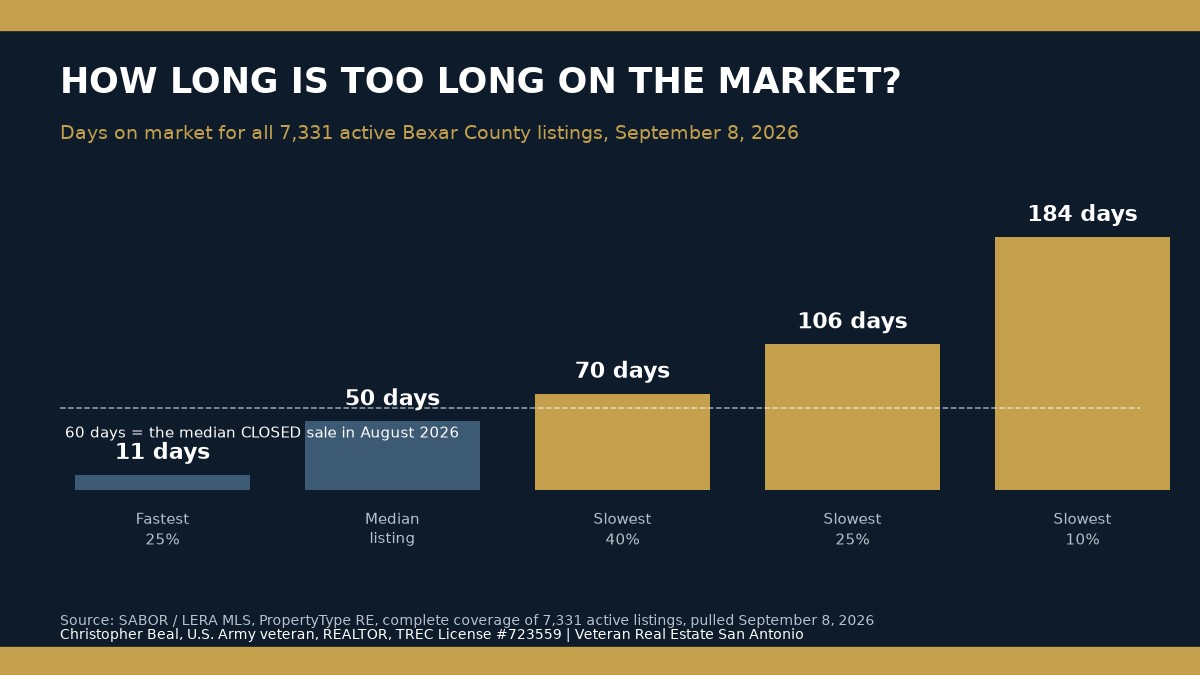
- San Antonio sellers who list are averaging 72 days on market and collecting about 97.9 percent of list price, so the speed gap between an iBuyer and a properly priced listing is smaller than the ads suggest.
- iBuyers make sense in a narrow set of situations: hard deadlines, inherited or vacant properties, or homes that cannot be shown. For most PCS and equity-rich sellers, the math favors listing.
- Never accept an instant offer without a side-by-side net sheet. I build one for free, and you can hold my number against the iBuyer's final figure line by line.
In This Guide
- What is an iBuyer, and which ones buy homes in San Antonio in 2026?
- How much does selling to an iBuyer really cost compared with listing?
- What does the San Antonio market say right now?
- When does an iBuyer offer actually make sense?
- Why do most San Antonio sellers still net more with a listing agent?
- What about military sellers on PCS orders?
- How do you test an iBuyer offer without getting burned?
- FAQ: iBuyers in San Antonio
What Is an iBuyer, and Which Ones Actually Buy Homes in San Antonio in 2026?
An iBuyer is not the same thing as the "we buy houses" investor on the bandit sign at the intersection. Opendoor and Offerpad are publicly traded companies that price homes with an algorithm, charge a published service fee, and resell the home on the open market. The local cash investor or wholesaler is usually pricing for a much deeper discount, often 70 to 80 percent of after-repair value.
Both national iBuyers operate across the San Antonio metro, covering most of Bexar County and parts of Comal and Guadalupe County, which includes military-heavy areas like Converse, Schertz, Cibolo, Alamo Ranch, and Stone Oak. They generally target homes built after 1960, on standard lots, in a price band that covers most of the market between roughly $150,000 and $600,000. Unique homes, acreage in the Hill Country, and luxury properties in areas like The Dominion or Cordillera Ranch usually fall outside their buy box.
The pitch is speed and certainty: request an offer online, skip the showings, pick your closing date. That pitch is legitimate as far as it goes. The question is what it costs, and that is where San Antonio sellers need real numbers instead of a slogan.
How Much Does Selling to an iBuyer Really Cost Compared With Listing?
The service fee is only the visible layer. Both Opendoor and Offerpad have advertised service fees around 5 percent in recent years, which already matches or exceeds a typical negotiated listing commission. Since the 2024 NAR settlement changed how buyer-agent compensation works, every commission is openly negotiable, and my listing clients see the full breakdown in writing before they sign anything.
The second layer is the repair credit. After you accept the preliminary offer, the iBuyer sends an inspector, and the final number drops by whatever their scope of work says the home needs. You do not control that scope, and you cannot get competing bids on it. In practice this deduction commonly lands between 1 and 3 percent, and on tired homes it goes higher.
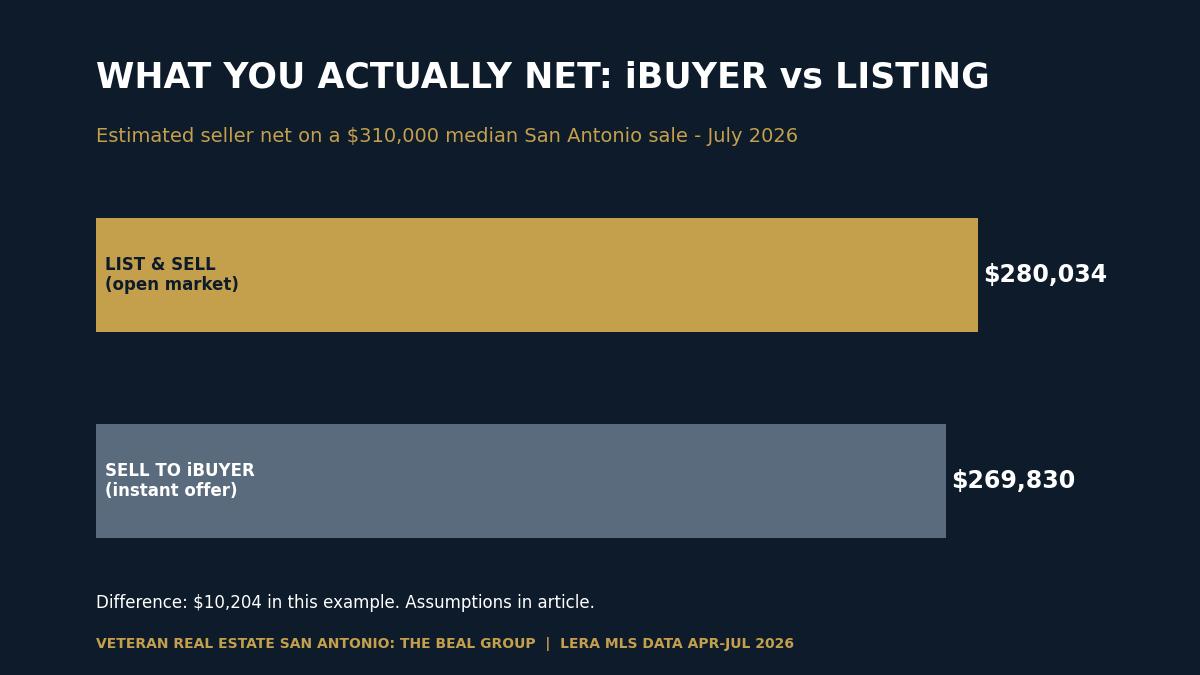
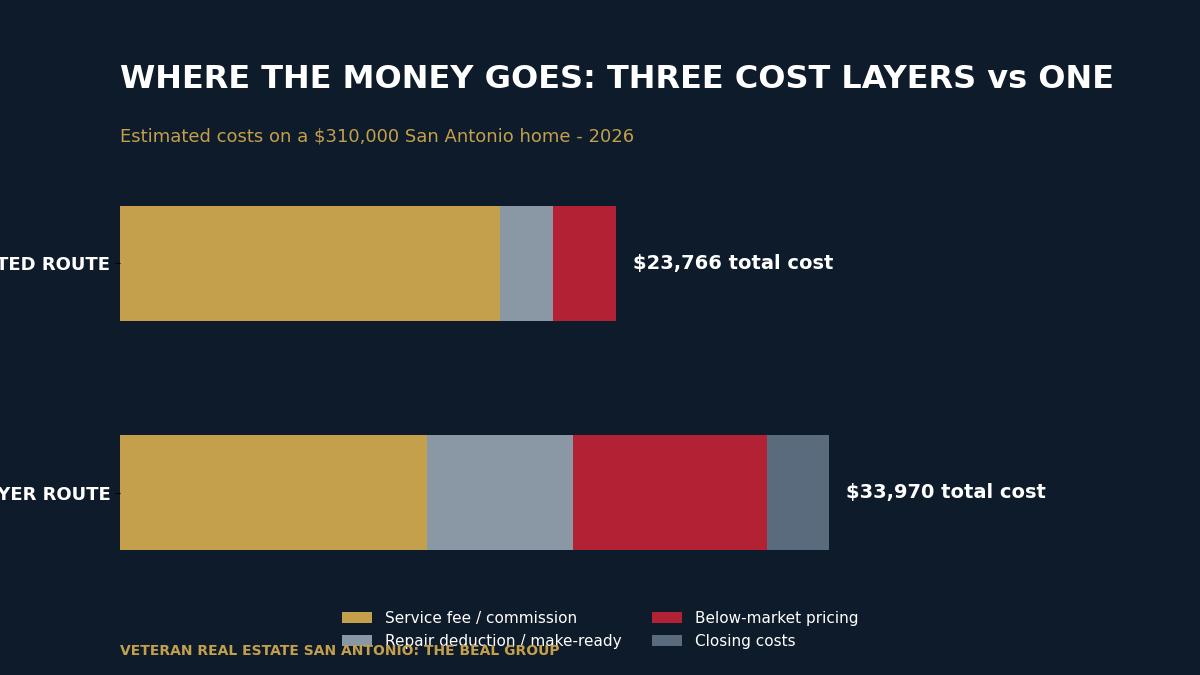
The third layer is the offer price itself. An algorithm pricing thousands of homes has to protect the company from resale risk, so preliminary offers typically start below what an exposed, marketed listing would attract. A widely cited Collateral Analytics study estimated that iBuyer offers ran several percentage points under open-market value even before fees. Put the three layers together and the math looks like this on a median San Antonio home:
| Line Item | iBuyer Sale (Est.) | Listed Sale (Est.) |
|---|---|---|
| Starting price basis | $294,500 offer (approx. 5% under market) | $303,800 contract (median $310,000 list at 97.9% list-to-sale) |
| Service fee / commission | -$14,725 (5% service fee) | -$18,228 (6% all-in, fully negotiable) |
| Repair deduction / make-ready | -$7,000 (their inspection scope) | -$2,500 (your contractors, your choice) |
| Seller closing costs | -$2,945 (approx. 1%) | -$3,038 (approx. 1%) |
| Estimated seller net (before payoff) | $269,830 | $280,034 |
Source: LERA MLS sold data, San Antonio, April 14 - July 13, 2026 (n=1,000; median close $310,000; 97.9% list-to-sale). iBuyer fee and deduction assumptions are illustrative midpoints drawn from published service fees and industry studies; your actual offer sheet controls. Numbers exclude mortgage payoff, which is identical in both scenarios.
What Does the San Antonio Market Say Right Now?
A 72-day average changes the iBuyer conversation. The instant-offer pitch works best when sellers imagine six months of showings and uncertainty. In today's actual San Antonio market, a prepared, correctly priced listing typically goes under contract in weeks, and the 97.9 percent list-to-sale ratio says sellers are not giving away big discounts to get deals closed.
It is a balanced market, not a fire-sale market. Buyers have inventory to choose from (active median list price is sitting near $325,000), which punishes overpriced or poorly presented homes but still rewards clean, well-marketed ones. That balance is exactly why the decision deserves a net sheet instead of a gut call: the discount you accept for speed is measurable, and so is the time you save.
If your bigger question is whether to sell at all this year, start with my data-driven guide to selling in San Antonio in 2026, then come back to the channel question. Timing the listing itself matters too, and I break that down month by month in the best time to sell in San Antonio guide.
When Does an iBuyer Offer Actually Make Sense?
I am a listing agent, and I will still tell you there are cases where the instant offer wins. Honest advice matters more to me than one commission, because military families talk to each other. Here is the situation-by-situation breakdown I walk sellers through:
| Your Situation | Best Route | Runner-Up | Why |
|---|---|---|---|
| PCS orders with 60-90 days of lead time | List with an agent | iBuyer as backup | 72-day average DOM fits most PCS windows; you keep the equity you earned |
| Orders in hand, report date under 30 days | Get both numbers same week | iBuyer | A pre-list sprint can still beat the discount; if not, certainty wins |
| Inherited or vacant property, out of state | iBuyer or cash sale | List vacant | Carrying costs and remote management can eat the listing premium |
| Home needs major repairs you cannot fund | Compare iBuyer vs as-is listing | Investor sale | iBuyer repair scopes get expensive; an as-is listing still exposes you to every buyer |
| Equity-rich, no deadline, home shows well | List with an agent | - | This is the profile where iBuyer math is weakest |
| Buying and selling at once, cannot carry two payments | List with bridge/rent-back plan | iBuyer trade-in program | Negotiated leaseback or contingency usually costs less than the iBuyer spread |
Source: Author's transaction experience, 300+ San Antonio closings; LERA MLS DOM data April-July 2026.
Why Do Most San Antonio Sellers Still Net More With a Listing Agent?
Competition is the entire mechanism. The MLS pushes your home to every brokerage site, Zillow, Realtor.com, and the agent networks feeding relocation buyers into JBSA. When two or three of those buyers want the same house, the price moves up and the terms improve. Nothing in the iBuyer model replicates that pressure, which is precisely why the model is profitable.
Presentation compounds it. Homes that are cleaned, staged, photographed professionally, and priced against the right comps are the ones hitting and beating that 97.9 percent ratio. That work is exactly what a full-service listing includes, and it is work an algorithm neither does nor credits you for.
There is also a protection layer sellers forget. A listed sale runs on the standard TREC contract framework with a licensed fiduciary on your side of the table. With a direct-to-iBuyer sale you are unrepresented against a counterparty that writes these contracts every day. The Texas Real Estate Commission licenses and regulates agents precisely so sellers have someone legally obligated to their interest; you can verify any license at trec.texas.gov, and the CFPB publishes plain-English guidance on selling and closing costs at consumerfinance.gov.
What About Military Sellers on PCS Orders?
A PCS deadline feels like an emergency, but it is usually a schedule. I have sold homes for military families through every kind of report date, and the sequence that works is the one built backward from your date with pre-list prep done before the sign goes up. I laid that sprint out step by step in my 60-day PCS seller timeline for fall 2026.
The VA assumption angle is the one an iBuyer will never mention. If you locked a VA loan at 2.5 to 4 percent, a qualified buyer can assume that rate, and in a 6.5 percent world that is worth real money. Marketing an assumable rate takes agent work, but it can pull buyers who would never otherwise reach your price point; the mechanics are in my step-by-step VA assumption guide. Selling to an iBuyer throws that asset away entirely.
Veterans and active-duty sellers also get my Serve & Save program, which reduces closing costs by 1 percent per year of service, up to 6 percent. Between the assumption asset, the closing-cost reduction, and a market averaging 72 days, most PCS families I sit with keep five figures by skipping the instant offer, and the ones who truly need the 14-day close find that out from an honest net sheet, not a guess.
How Do You Test an iBuyer Offer Without Getting Burned?
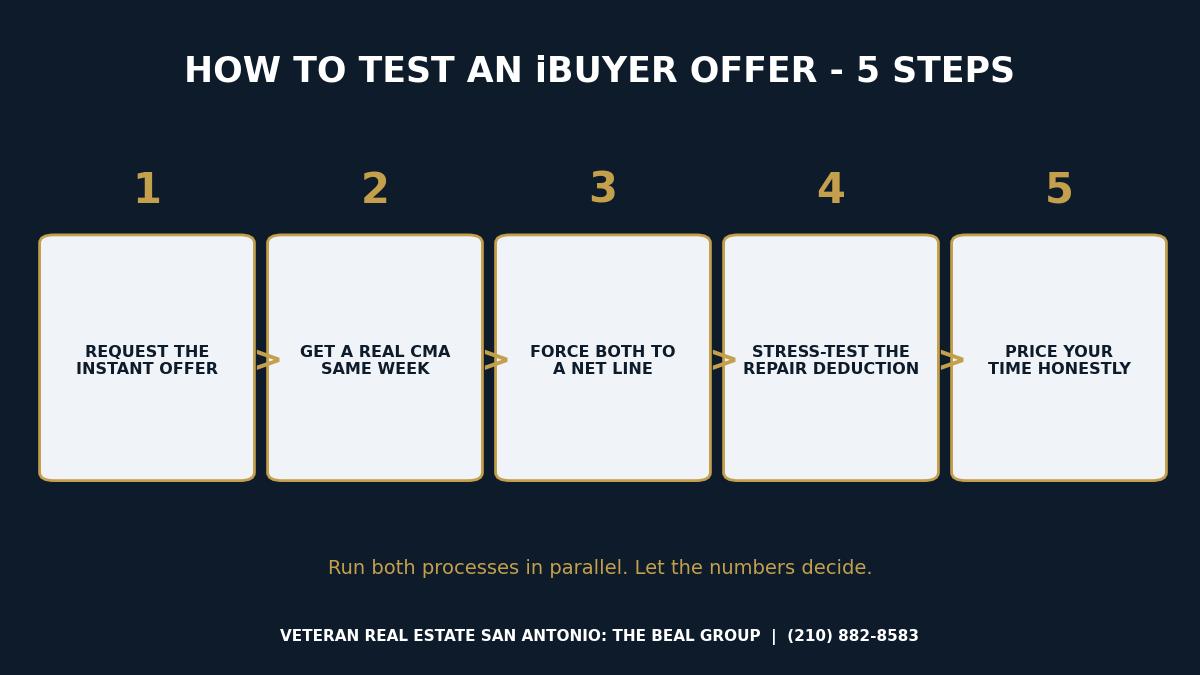
Run both processes in parallel and let the numbers decide. There is no penalty for requesting an Opendoor or Offerpad offer, and I would never ask a seller to skip it. Here is the exact sequence I recommend:
- Request the instant offer and save the full PDF, including the fee schedule and the preliminary price.
- Get an independent valuation the same week. A real CMA against closed LERA MLS comps, not an online estimate.
- Force both to a net line. Offer minus service fee minus estimated repair deduction minus closing costs, against list price times realistic list-to-sale ratio minus commission minus make-ready minus closing costs.
- Stress-test the repair deduction. Ask the iBuyer for their inspection scope in writing before you commit, because the preliminary number is not the final number.
- Price your time honestly. If the listing route nets $15,000 more over eight extra weeks, that is roughly $1,875 a week. Some sellers take that trade, some do not, but you should see it before you sign.
I run this comparison for San Antonio sellers at no cost and no obligation, whether you end up listing with me or taking the cash. Bring me any instant offer and I will hand you the competing net sheet within 48 hours, built from actual closed comps in your neighborhood, from Alamo Ranch to New Braunfels.
About the Author: Christopher Beal
Christopher Beal is a U.S. Army veteran and the Owner of Veteran Real Estate San Antonio, a Beal Group practice brokered by eXp Realty (TREC License #723559). A Military Relocation Professional (MRP) and VAREP member, he is a 7-time eXp Realty ICON agent, winner of Best Real Estate Agency in the 2026 Best of San Antonio Readers' Choice (San Antonio Current, 100,000+ voters), and a 3x San Antonio Business Journal Top 25 Individual Agent (#13 in 2024, #14 in 2025, #20 in 2026). His recognition also includes 3x Platinum Top 50, 2x RateMyAgent Agent of the Year, 2x Real Producers Top 100, Five Star Professional (2026), and a RealTrends 2026 ranking. He has helped 325+ families, closed more than $125M in career volume, and holds 5.0 stars across 370+ verified reviews, working almost exclusively with military and veteran buyers and sellers across Bexar, Comal, Kendall, Medina, and Bandera counties, with a focus on VA loans, PCS moves, and homebuying near JBSA-Lackland, JBSA-Randolph, and Fort Sam Houston. If you want a read on what the San Antonio market means for your specific situation, he answers with data, not scripts. He can be reached at (210) 882-8583.
FAQ: iBuyers in San Antonio
Does Opendoor still buy houses in San Antonio in 2026?
Yes. Opendoor actively purchases homes across the San Antonio metro in 2026, including most of Bexar County and nearby suburbs like Converse, Schertz, and Cibolo. Eligibility depends on the home's age, lot, condition, and price band, so request an offer to confirm your specific address.
Is Offerpad available in San Antonio?
Yes. Offerpad buys and sells homes in the San Antonio market and typically offers flexible closing dates and short leaseback options. Like Opendoor, it charges a service fee and deducts repair costs identified by its own inspection.
How much less do iBuyers pay than market value?
Industry analyses, including the Collateral Analytics research widely cited since 2019, have found iBuyer offers historically ran below open-market value before fees, with all-in seller costs commonly estimated at 9 to 15 percent once the service fee and repair deductions are included. Every offer is home-specific, which is why a side-by-side net sheet matters more than any average.
What fees does an iBuyer charge in San Antonio?
Expect a published service fee of about 5 percent, a repair deduction set by the company's inspection, and standard seller closing costs of roughly 1 percent. The repair deduction is the least predictable line and the one sellers most often underestimate.
Are iBuyers the same as cash home buyers or wholesalers?
No. Opendoor and Offerpad are licensed, publicly traded companies with published fee structures that resell homes on the open market. Local "we buy houses" investors and wholesalers usually price much more aggressively, often 20 to 30 percent below market, and their contracts carry fewer consumer protections.
How fast can an iBuyer close compared with a normal sale?
iBuyers can often close in 14 to 30 days and let you pick the date. A financed open-market sale in San Antonio is averaging about 72 days on market plus roughly 30 days to close in mid-2026, though well-priced homes frequently go under contract much faster.
Should a military family selling on PCS orders use an iBuyer?
Sometimes, but less often than the marketing suggests. With 60 or more days of lead time, a listing built backward from your report date usually nets significantly more, and an assumable VA loan can make your listing especially attractive. With under 30 days and no flexibility, comparing a real net sheet against the instant offer is the right move.
Can I negotiate an iBuyer's offer or repair deductions?
You can push back, and it occasionally works, but your leverage is limited because there is no competing buyer at their table. Your real leverage is the willingness to walk away and list, which is exactly why you should have the listing net sheet in hand first.
Do iBuyer offers include closing costs?
No. The offer price is not the net. You still pay the service fee, the repair deduction, and standard seller closing costs such as title and prorated taxes, which is why two offers with the same headline number can net thousands of dollars apart.
Who can run an iBuyer vs listing comparison for me in San Antonio?
I do it free for San Antonio area sellers. Send me your instant offer PDF, I pull closed LERA MLS comps for your street, and you get both bottom lines side by side within 48 hours. Call or text (210) 882-8583.
Explore More Resources
- VA Home Loans in San Antonio
- Military Relocation and PCS Services
- Free Home Evaluation
- Serve & Save: Reduced Closing Costs for Veterans
- Client Reviews
- About Christopher Beal
Whether you take the instant offer or the listing route, make the decision with both numbers on the table. Call or text me at (210) 882-8583, email [email protected], or request your free evaluation at veteranrealestatesa.com/home-evaluation, and you will have your answer in black and white.
Watch: Opendoor vs Realtor -- Who Nets More? (2026)
I ran the real math on Opendoor and Offerpad offers against a properly priced listing in San Antonio. Sixty seconds, straight numbers, no sales pitch.
Categories
- All Blogs (357)
- Alamo Heights (4)
- awards (4)
- Best Neighborhoods in San Antonio (13)
- Buyer (16)
- Buyer Education (87)
- Community Events (4)
- Hill Country (17)
- JBSA (46)
- Local Guide (6)
- Luxury (28)
- Luxury Real Estate (26)
- Market Trends (19)
- Market Update (14)
- Military Relocation (114)
- Military Retirement (3)
- Mortgage (19)
- Neighborhood Guides (19)
- neighborhoods (5)
- New Construction (16)
- PCS (42)
- Real Estate (40)
- reviews (3)
- San Antonio (53)
- San Antonio Lifestyle (4)
- San Antonio Market (5)
- San Antonio Neighborhoods (45)
- San Antonio Real Estate (100)
- San Antonio, Veterans Resources, VA Loans (5)
- Seller (55)
- VA Home Loans (30)
- VA Loans (35)
- Va Loans & Financing (27)
- Veterans (10)
- Veterans Resources (40)
Recent Posts