Selling an Inherited Home in San Antonio (2026): Probate, Taxes, and a Step-by-Step Guide for Veteran Families
LAST UPDATED: JULY 3, 2026 | BY CHRISTOPHER BEAL, U.S. ARMY VETERAN & REALTOR
Selling an Inherited Home in San Antonio (2026): Probate, Taxes, and a Step-by-Step Guide for Veteran Families
Key Takeaways
- Texas has no state inheritance or estate tax, and the stepped-up basis rule means most heirs owe little or no capital gains tax when they sell soon after inheriting.
- You usually cannot close a sale until title is cleared through Bexar County probate: muniment of title, independent administration, or an affidavit of heirship are the three most common paths.
- A valid will filed as a muniment of title is often the fastest and cheapest route, frequently wrapping up in 30 to 90 days.
- If the home still carries a mortgage or VA loan, heirs can keep paying it, sell and pay it off at closing, or in some cases market the assumable low-rate loan as a selling feature.
- Multiple heirs, out-of-state executors, and as-is condition are all solvable: the right listing strategy handles each without family conflict.
In This Guide
- What Happens When You Inherit a Home in San Antonio?
- Do You Have to Go Through Probate to Sell an Inherited House in Texas?
- What Taxes Do You Pay When Selling an Inherited Home in Texas?
- How Do You Clear Title and Handle Multiple Heirs?
- Should You Sell the Inherited Home As-Is or Update It First?
- What If the Home Still Has a Mortgage or VA Loan on It?
- How Does the Sale Work Step by Step for Out-of-Town Heirs?
- What Does It Cost to Sell an Inherited Home in San Antonio?
What Happens When You Inherit a Home in San Antonio?
Inheriting a house starts a legal process, not a listing. Under Texas law, property vests in the heirs or beneficiaries at the moment of death. The practical problem is that the deed on file with Bexar County still shows the person who passed away, and no title company in San Antonio will insure a sale until the record is corrected.
The first 30 days are about paperwork, not paint. Locate the will, order several certified death certificates, keep the homeowners insurance active, and notify the mortgage servicer if there is a loan. Vacant-home insurance matters more than most families realize, because a standard policy can lapse or deny claims once the house sits empty.
Military families face this from a distance more often than most. If you are stationed at JBSA-Lackland, Fort Sam Houston, or overseas and inherit a home in Converse, Universal City, or the North Side, nearly every step in this guide can be handled remotely with a power of attorney and a local team on the ground.
Do You Have to Go Through Probate to Sell an Inherited House in Texas?
Texas gives you several probate lanes, and picking the right one saves months. Bexar County has two dedicated statutory probate courts, Probate Court No. 1 and Probate Court No. 2, at the Bexar County Courthouse downtown. Which lane you use depends on whether there is a valid will, whether the estate has debts, and whether all heirs agree.
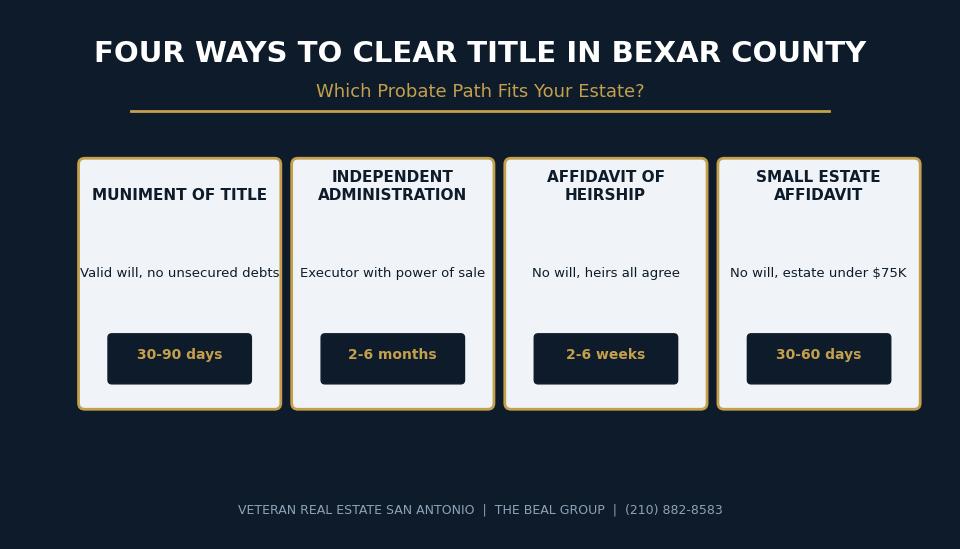
| Path | When It Fits | Typical Timeline | Typical Cost Range |
|---|---|---|---|
| Muniment of title | Valid will, no unpaid unsecured debts | 30 to 90 days | $1,500 to $3,500 |
| Independent administration | Will names an independent executor, or heirs agree | 2 to 6 months to sale authority | $3,000 to $7,500 |
| Affidavit of heirship | No will, heirs undisputed, often paired with 2 disinterested witnesses | 2 to 6 weeks to record | $500 to $1,500 |
| Small estate affidavit | No will, estate under $75,000 excluding homestead | 30 to 60 days | Court filing fees plus limited attorney time |
Source: Texas Estates Code procedures as applied in Bexar County Probate Courts No. 1 and No. 2; cost ranges reflect typical San Antonio attorney quotes in 2026. Your facts control which path is available; confirm with a probate attorney.
One caution on affidavits of heirship: some title companies want the affidavit on record for a period of time before they insure a sale, and any disagreement among heirs takes this lane off the table. When in doubt, a short conversation between your probate attorney and the title company before listing prevents a failed closing later.
What Taxes Do You Pay When Selling an Inherited Home in Texas?
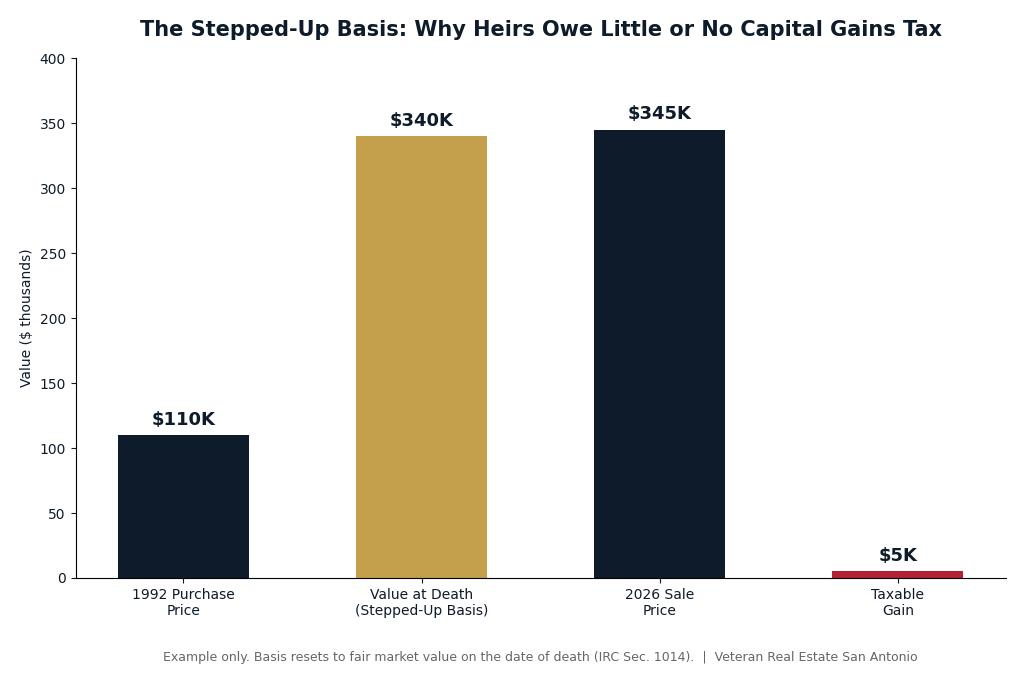
The stepped-up basis is the single most valuable tax rule most heirs have never heard of. Under federal law, your cost basis in an inherited home is reset to its fair market value on the date of death, not what your parents paid decades ago. If Mom bought the house near Randolph AFB in 1992 for $110,000 and it was worth $340,000 when she passed, your basis is $340,000.
Sell it a few months later for $345,000 and your taxable gain is roughly $5,000 minus selling costs, which usually nets to zero or close to it. This is why rushing to sell below market, or sitting on the home for years while it appreciates again, are both tax mistakes. A date-of-death appraisal from a licensed appraiser documents your stepped-up basis and costs a few hundred dollars.
Federal estate tax touches very few San Antonio families: the 2026 federal exemption is $15 million per person, so the vast majority of estates file nothing. Two taxes do continue: Bexar County property taxes keep accruing while you own the home, and if you rent the house out before selling, depreciation and rental income change the math. See our Texas veteran property tax exemption guide for what happens to the prior owner's exemptions, and the IRS inherited property FAQ for the federal rules.
One deadline matters for surviving spouses and co-owners who lived in the home: the exclusion of gain on a primary residence can still apply to their share. A one-hour session with a CPA before you list is the cheapest tax planning you will ever buy.
How Do You Clear Title and Handle Multiple Heirs?
Most inherited-home sales that fall apart do so over signatures, not price. If four siblings each inherit a quarter of a house in Alamo Heights, all four are sellers. The clean solutions are an independent executor with power of sale under the will, or a durable power of attorney from the out-of-town heirs to one trusted sibling.
Title companies in San Antonio will run the chain of title early if you ask. I order a preliminary title commitment before the sign goes in the yard on every estate listing, because surprises like an old unreleased lien, a missed heir from a prior marriage, or an unpaid hospital claim are fixable in weeks before listing and fatal in the week before closing.
When heirs disagree about selling at all, Texas allows a partition action to force a sale, but that is the expensive last resort. A neutral market analysis and a written net-proceeds breakdown for each heir resolves most standoffs faster than lawyers do. If the family is spread across duty stations, video walk-throughs and remote online notarization keep everyone in the loop without a single flight to Texas.
Should You Sell the Inherited Home As-Is or Update It First?
The right answer is a math problem, not an emotional one. San Antonio in 2026 is a buyer-leaning market with elevated inventory, which means condition is priced hard. A dated but clean and functional home near Fort Sam Houston still sells well to VA and FHA buyers; a cluttered home with a 22-year-old roof mostly draws cash investors.
| Strategy | Best Pick For | Typical Outcome |
|---|---|---|
| True as-is (investor sale) | Major foundation, roof, or plumbing issues; heirs need speed | Fast close, price often 10 to 20 percent under market |
| Cleanout + minor repairs (most estates) | Structurally sound but dated homes | Retail price on the MLS, 2 to 4 weeks of prep |
| Full renovation before listing | Rarely: only when the gap between as-is and renovated value is extreme | Months of carrying costs, returns often below 100 percent of spend |
Source: The Beal Group estate-sale transaction experience and SABOR MLS condition-adjusted comparable analysis, 2024 to 2026.
Remember the seller's disclosure rules. Texas exempts most administrators and executors from the standard seller's disclosure notice, but heirs who lived in or personally owned the property generally must disclose what they know. Getting this right protects the estate from post-closing claims.
What If the Home Still Has a Mortgage or VA Loan on It?
Federal law protects inheriting family members from due-on-sale acceleration. The Garn-St Germain Act lets relatives who inherit continue the existing mortgage, so nobody has to refinance at today's rates just to get through probate. Contact the servicer early, send the death certificate and probate letters, and confirm where statements go so the loan never slips into default while the estate is pending.
Here is the angle many San Antonio families miss: if the deceased veteran carried a 2.75 or 3.25 percent VA loan from 2020 or 2021, that loan may be assumable by a qualified buyer, and an assumable note in that range is a genuine marketing asset in 2026. The estate pays the loan off at closing in a standard sale, but pricing the assumption option can add real money. Our step-by-step VA loan assumption guide explains how assumption works, and the assumable VA loan seller playbook covers how to market one.
A note for surviving spouses of veterans: your VA and property tax picture changes too. Surviving spouses of 100 percent disabled veterans can often keep the full property tax exemption on the homestead, which changes the keep-or-sell math entirely. Details are in our disabled veteran property tax exemption guide, and the VA's own home loan pages cover survivor benefits.
Planning a PCS while you settle the estate? Christopher Beal specializes in military relocation. Learn more here.
How Does the Sale Work Step by Step for Out-of-Town Heirs?
Here is the sequence I run for estate sales across Bexar, Comal, and Guadalupe counties. First, the probate attorney opens the right proceeding and we confirm who has signing authority. Second, we order the date-of-death appraisal and I prepare a full comparative market analysis so the estate has both a tax number and a pricing number.
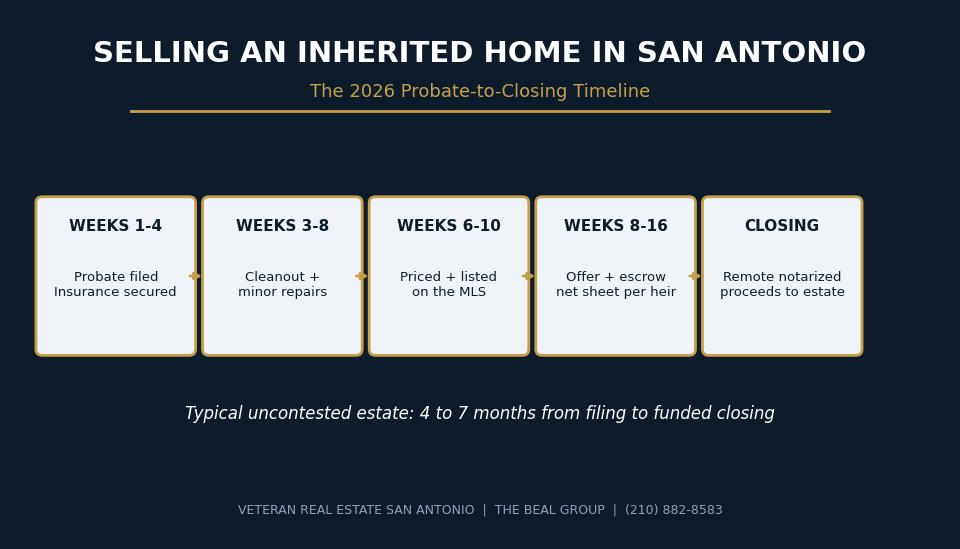
- Weeks 1 to 4: probate filed, insurance converted to a vacant-home policy, utilities kept on, locks changed.
- Weeks 3 to 8: estate cleanout, donation runs, family keepsakes shipped, minor repairs and deep clean completed.
- Weeks 6 to 10: professional photos, MLS launch priced to the condition-adjusted comps, showings managed around any remaining contents.
- Weeks 8 to 16: offer negotiation with a net sheet for every heir, then a 30 to 45 day escrow with title curative work already done.
- Closing: remote online notarization or mail-out documents for out-of-state heirs; proceeds wire directly to the estate account for distribution.
The whole arc typically runs 4 to 7 months from filing to funded closing when the family agrees and the will is clean. Contested estates and missing-heir situations run longer, which is another reason to start the legal work before the cleanout.
What Does It Cost to Sell an Inherited Home in San Antonio?
Carrying costs are the silent line item. Property taxes, insurance, utilities, and lawn care on a $320,000 vacant home in San Antonio run several hundred dollars a month, and they accrue from the date of death until closing. Add probate attorney fees from the table above, $2,000 to $6,000 for a typical cleanout and make-ready, and standard Texas closing costs on the sale itself.
If the property tax bill looks wrong after the owner's exemptions fall off, protest it. Our Bexar County property tax protest guide walks through deadlines and evidence. And before anyone in the family commits to keeping the home as a rental, compare that plan against our military retiree downsizing guide math on what ownership actually costs each year.
For court procedures and self-help resources, the State of Texas maintains plain-language guides at TexasLawHelp.org and the Texas judiciary posts probate basics at txcourts.gov.
About the Author: Christopher Beal
Christopher Beal is a U.S. Army veteran and the Owner of Veteran Real Estate San Antonio, a Beal Group practice brokered by eXp Realty (TREC License #723559). A Military Relocation Professional (MRP) and VAREP member, he is a 7-time eXp Realty ICON agent, winner of Best Real Estate Agency in the 2026 Best of San Antonio Readers' Choice (San Antonio Current, 100,000+ voters), and a 3x San Antonio Business Journal Top 25 Individual Agent (#13 in 2024, #14 in 2025, #20 in 2026). His recognition also includes 3x Platinum Top 50, 2x RateMyAgent Agent of the Year, 2x Real Producers Top 100, Five Star Professional (2026), and a RealTrends 2026 ranking. He has helped 325+ families, closed more than $125M in career volume, and holds 5.0 stars across 370+ verified reviews, working almost exclusively with military and veteran buyers and sellers across Bexar, Comal, Kendall, Medina, and Bandera counties, with a focus on VA loans, PCS moves, and homebuying near JBSA-Lackland, JBSA-Randolph, and Fort Sam Houston. Whether you are buying or selling in the San Antonio area, he answers directly - no team handoffs, no pressure. He can be reached at (210) 882-8583.
Explore More Resources
VA Home Loans · Military Relocation · Free Home Evaluation · Serve & Save · Client Reviews · About Christopher
FAQ: Selling an Inherited Home in San Antonio
Can I sell an inherited house in Texas before probate is complete?
Sometimes. An independent executor with power of sale can contract to sell once letters testamentary issue, and heirs using an affidavit of heirship can sell once the affidavit is recorded and the title company accepts it. You cannot close before the title company can insure the chain of title.
Do I pay capital gains tax on a house I inherited in San Antonio?
Usually little or none if you sell near the date-of-death value, because your basis steps up to fair market value at death. Gains are measured only on appreciation after that date, minus selling costs. Confirm your numbers with a CPA.
Is there an inheritance tax in Texas in 2026?
No. Texas has no inheritance tax and no state estate tax. The federal estate tax exemption is $15 million per person in 2026, so very few estates owe anything federally.
What is a muniment of title and when can we use it?
It is a streamlined Texas probate that admits a valid will as the title document itself, with no executor appointed. It fits when the estate has no unpaid unsecured debts and no other administration need, and it is often the fastest way to make an inherited home sellable.
What happens to the mortgage when the owner dies?
The loan continues. Inheriting relatives are protected from due-on-sale acceleration and may keep paying, sell and pay it off at closing, or pursue assumption. Notify the servicer early with a death certificate so the loan does not drift toward default during probate.
All the heirs live out of state. Do we have to come to San Antonio to sell?
No. Listing documents and disclosures are e-signed, closing documents can be handled by remote online notarization or mail-out, and your agent manages cleanout, repairs, and showings locally. Most of my estate sales close without a single heir traveling to Texas.
Should we rent the inherited house out instead of selling?
Run the numbers first: property taxes without the prior owner's exemptions, insurance, management, and maintenance eat more of the rent than most families expect, and depreciation changes your later tax bill. Sometimes keeping it is right, especially with a low-rate assumable loan attached, but decide with a spreadsheet rather than sentiment.
What if one sibling wants to keep the house and the others want to sell?
The keeper can buy out the others, often by refinancing the property into their own name at the stepped-up value. If nobody can agree, Texas partition law allows a forced sale, but a negotiated buyout at a documented market price is almost always cheaper and faster.
Does the home lose its homestead property tax exemption after the owner dies?
The prior owner's exemptions generally end, and the tax bill can jump the next January. A surviving spouse may keep certain exemptions, including the disabled veteran exemption in many cases. Review the account with Bexar CAD early so the estate budgets the right number.
Ready to talk through an estate sale? Three ways to start today:
Call or text Christopher Beal directly at (210) 882-8583 for a no-pressure conversation about your timeline.
Request a free home evaluation to get the estate a defensible market number this week.
PCSing while you settle the estate? Start with the military relocation page and we will coordinate both moves as one plan.
Categories
- All Blogs (357)
- Alamo Heights (4)
- awards (4)
- Best Neighborhoods in San Antonio (13)
- Buyer (16)
- Buyer Education (87)
- Community Events (4)
- Hill Country (17)
- JBSA (46)
- Local Guide (6)
- Luxury (28)
- Luxury Real Estate (26)
- Market Trends (19)
- Market Update (14)
- Military Relocation (114)
- Military Retirement (3)
- Mortgage (19)
- Neighborhood Guides (19)
- neighborhoods (5)
- New Construction (16)
- PCS (42)
- Real Estate (40)
- reviews (3)
- San Antonio (53)
- San Antonio Lifestyle (4)
- San Antonio Market (5)
- San Antonio Neighborhoods (45)
- San Antonio Real Estate (100)
- San Antonio, Veterans Resources, VA Loans (5)
- Seller (55)
- VA Home Loans (30)
- VA Loans (35)
- Va Loans & Financing (27)
- Veterans (10)
- Veterans Resources (40)
Recent Posts