Is San Antonio a Buyer's or Seller's Market in 2026?
LAST UPDATED: JULY 31, 2026 | BY CHRISTOPHER BEAL, U.S. ARMY VETERAN & REALTOR
Is San Antonio a Buyer's or Seller's Market in 2026?
Key Takeaways
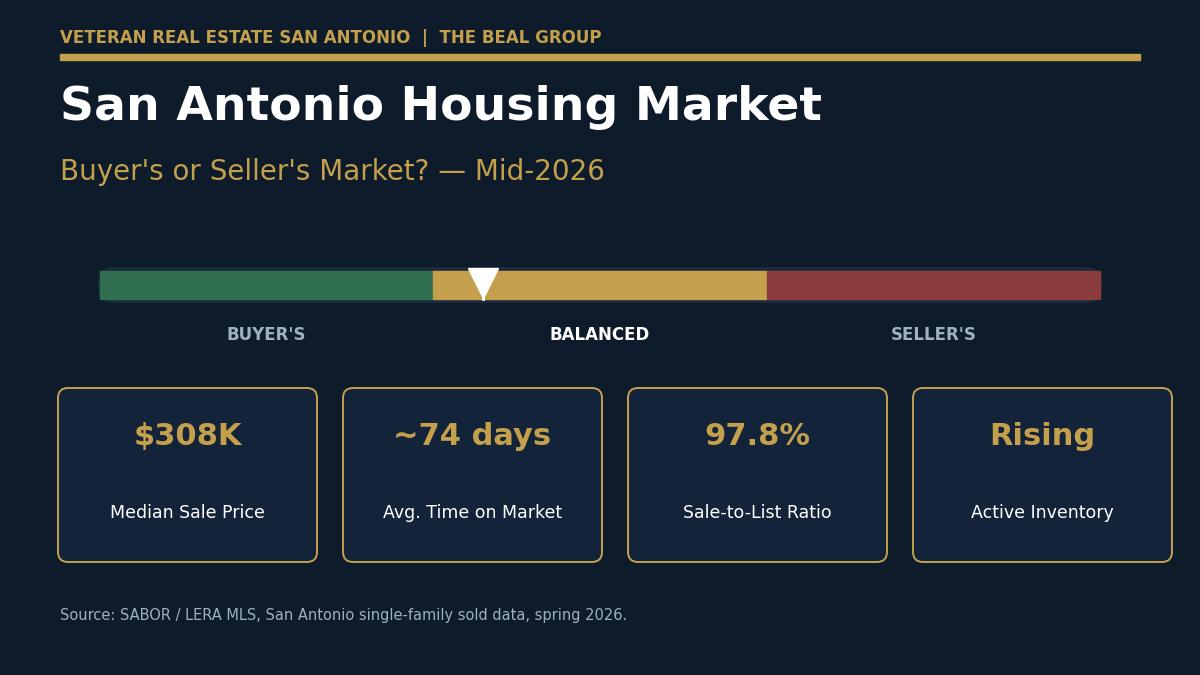
- As of mid-2026, San Antonio is a balanced market tilting slightly toward buyers. The median single-family sale price sits near 311,450 dollars, homes average about 78 days on market, and the sale-to-list ratio is roughly 97.8 percent.
- Active inventory has climbed to its highest level in several years, and the median list price runs above the median sale price. Both are classic signs that buyers, not sellers, hold the negotiating leverage right now.
- Sellers can still win, but only with sharp pricing, strong presentation, and a willingness to offer concessions. Overpricing is the single fastest way to sit on the market for 90 days or more.
- Buyers, especially VA buyers, have room to negotiate price, closing-cost help, and repairs that did not exist during the 2021-2022 frenzy. VA sellers can contribute up to 4 percent in concessions.
- The market is hyper-local. A well-priced home in a strong JBSA-adjacent school zone can still draw multiple offers, while an overpriced luxury listing in the same week may see zero.
In This Guide
- What Actually Defines a Buyer's vs Seller's Market?
- So Which One Is San Antonio Right Now?
- What Do the Latest San Antonio Numbers Say?
- Why Has the Market Shifted From the 2021 Frenzy?
- What Does This Mean If You Are Selling?
- What Does This Mean If You Are Buying?
- Is This a Good Market for VA and Military Buyers?
- Does the Answer Change by Neighborhood?
- About the Author
- What Do the July 2026 Numbers Say About Your Leverage?
- What Can a Military Buyer Actually Ask For Right Now?
- How Does Your Leverage Change at Each JBSA Gate?
- What Does a PCS Seller on Orders Have to Plan to Give?
San Antonio is not the same market it was three years ago, and pretending otherwise costs people real money. Sellers who anchor to 2022 prices watch their listings go stale, and buyers who assume they still have no leverage leave negotiating room on the table. The honest answer for mid-2026 is that San Antonio is a balanced market that leans toward buyers, and understanding exactly what that means is the difference between a smooth transaction and a frustrating one.
As a U.S. Army veteran and REALTOR who has closed more than 306 homes and over 117 million dollars in volume across Bexar, Comal, Kendall, Medina, and Bandera counties, I track these numbers every week for my clients. Below is the current picture, backed by SABOR and LERA MLS data, and what it should change about your strategy.
What Actually Defines a Buyer's vs Seller's Market?
The label comes down to supply and demand, measured a few reliable ways. The three numbers that tell the story fastest are months of supply, average days on market, and the sale-to-list price ratio. When there are fewer than roughly four months of inventory, homes selling in under three weeks, and buyers paying at or above asking, that is a seller's market. Flip each of those and you have a buyer's market.
A balanced market sits in the middle: enough inventory that buyers have choices, but enough demand that a well-priced home still sells in a reasonable window. Balanced markets reward preparation on both sides and punish wishful thinking.
| Signal | Seller's Market | Buyer's Market | San Antonio, Mid-2026 |
|---|---|---|---|
| Months of inventory | Under 4 | Over 6 | Elevated / rising |
| Days on market | Under 21 | Over 60 | ~78 days |
| Sale-to-list ratio | 100%+ | Under 97% | ~97.8% |
| Price direction | Rising fast | Flat / softening | Flat, buyer-favorable |
Source: SABOR/LERA MLS, San Antonio single-family sold data, spring 2026. Thresholds reflect standard National Association of REALTORS market definitions.
So Which One Is San Antonio Right Now?
Put the San Antonio numbers next to the definitions and the verdict is clear. With days on market near 74 and a sale-to-list ratio under 98 percent, this is not a runaway seller's market. But prices are not falling off a cliff either. The median sale price has held roughly flat year over year, which is the signature of a balanced market that simply gives buyers more leverage than they had in 2021 and 2022.
For most sellers, the practical translation is that you can still get a strong price, but the days of naming a number and watching offers pour in are over. For buyers, it means you can negotiate again without automatically losing the house.
What Do the Latest San Antonio Numbers Say?
Here is the snapshot I am pulling for clients as the second half of 2026 opens. Numbers move month to month and by property type, so treat these as the current temperature rather than a permanent forecast.
| Metric | Recent San Antonio Figure | What It Tells You |
|---|---|---|
| Median sale price | ~311,450 dollars (Bexar County) | Roughly flat year over year |
| Median list price | ~318,000 to 335,000 dollars | Sellers ask more than buyers pay |
| Average days on market | ~78 days | Well above a seller's-market pace |
| Sale-to-list ratio | ~97.8% | Buyers negotiate about 2.2% off |
| Average price per square foot | ~164 dollars (sold) | Stable, not spiking |
| Active inventory | Elevated / rising | More choices for buyers |
Source: SABOR/LERA MLS, Bexar County and San Antonio single-family sold and active data, spring 2026.
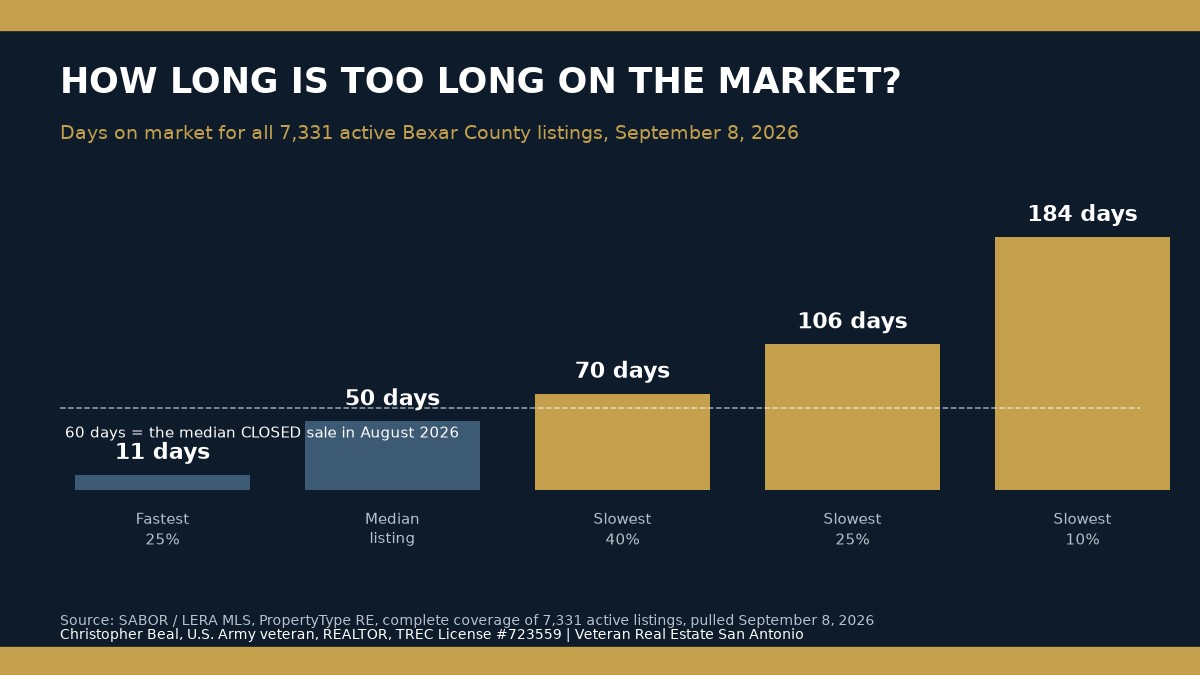
The single most revealing number is the roughly 74-day average days on market. In the 2021 frenzy that figure was often under two weeks. A jump to more than two months is the clearest evidence that supply has caught up with demand.
Why Has the Market Shifted From the 2021 Frenzy?
Three forces reset the San Antonio market. First, mortgage rates climbed well above the historic lows of 2021, which shrank the pool of buyers who could stretch to the top of their budget. Second, San Antonio and its surrounding counties have wide-open land, and builders responded to years of demand by delivering new communities across the north, northwest, and Interstate 35 corridor toward New Braunfels. Third, homeowners who waited out the peak began listing again, adding resale inventory.
The result is not a crash. It is a normalization. Prices that shot up 30 to 40 percent in a two-year span were never going to keep climbing at that pace. What we have now is a market that behaves the way healthy markets are supposed to, with negotiation, inspections that matter, and appraisals that hold sellers accountable.
What Does This Mean If You Are Selling?
In a balanced-to-buyer market, the seller who wins is the one who takes the first two weeks seriously. The most showings and the strongest offers arrive when a listing is fresh. Price it correctly out of the gate and you compete for those early, motivated buyers. Price it high to leave room and you get the opposite: no showings, a stale listing, and eventual price cuts that signal weakness.
Expect buyers to ask for closing-cost help, repairs after inspection, or a rate buydown. For a buyer using a VA loan, a seller can contribute up to 4 percent in concessions, which can be a powerful tool to attract offers without dropping your price. Presentation still matters too: clean, decluttered, professionally photographed homes consistently outperform.
If you are selling because of a PCS or a move up, timing your sale against your next purchase becomes its own project. My Helotes fast-sale and net-sheet guide and my Boerne and Fair Oaks Ranch seller guide walk through how to sequence both sides without carrying two mortgages.
What Does This Mean If You Are Buying?
This is the best buying environment San Antonio has offered since before the pandemic surge. You can tour multiple homes, take a day to think, and write an offer with an inspection contingency without a seller shrugging you off. On homes that have been listed 60 days or more, sellers are often genuinely motivated and open to concessions.
That said, leverage does not mean lowball everything. Well-priced homes in strong school zones still move quickly and can draw competing offers. The winning approach is to be fully pre-approved, know your target neighborhoods, and be ready to act decisively when the right home appears, while still using the negotiating room the broader market gives you.
Is This a Good Market for VA and Military Buyers?
The 2021 market was quietly hostile to VA buyers, and this one is not. When homes sold in days with multiple cash offers, some sellers passed over VA contracts because they worried about the appraisal and the VA minimum property requirements. In today's balanced market, sellers cannot afford to be that picky, and a strong VA offer with a solid pre-approval competes on equal footing.
VA buyers also stack real advantages here: no down payment, no monthly mortgage insurance, and a funding fee of 2.15 percent on a first-use loan with less than 5 percent down. Add the ability to ask a seller for up to 4 percent in concessions, and a disciplined VA buyer can get into a San Antonio home with very little out of pocket. Our Serve and Save program goes further by reducing your closing costs with a credit of 1 percent of your price for every year of service, up to 6 percent.
For a full walkthrough of how the VA benefit works locally, see our VA home loans resource, and if you are relocating on orders, our military relocation guide covers the JBSA-specific timeline.
Does the Answer Change by Neighborhood?
The one-size-fits-all answer is where people get burned. A well-priced three-bedroom near good schools in Converse, Schertz, or the far northwest can draw multiple offers in a week, while a 900,000 dollar home in a luxury enclave may take months. The higher the price band, the more the balance tips toward buyers, because the buyer pool is smaller and more selective.
This is exactly why a real comparative market analysis beats any online estimate. Automated valuations cannot see your renovated kitchen, your cul-de-sac lot, or the fact that three similar homes on your street just sold in different directions.
What Do the July 2026 Numbers Say About Your Leverage?
Leverage is not a mood, it is a measurement. Every week I get asked whether San Antonio is "still" a buyer's market, usually by a family that just read a corridor blog post built on two-month-old numbers. So here are the numbers I pulled from SABOR through the LERA MLS on the morning of July 31, 2026, covering July closings across the three counties where most JBSA families actually shop.
| County or Market | Median Close (July 2026) | Avg Days on Market | Sale-to-List Ratio | What It Means for You |
|---|---|---|---|---|
| Bexar County | $311,450 | 78 | 97.8% | Buyer leverage, seller patience required |
| San Antonio (city) | $311,450 | 77 | 97.7% | Same story inside the loop and out |
| Comal County (New Braunfels, Bulverde) | $469,900 | 115 | 97.1% | Deepest buyer leverage in the region |
| Kendall County (Boerne, Fair Oaks Ranch) | $575,034 | 77 | 97.4% | Faster than Comal despite higher prices |
Source: SABOR data via LERA MLS, July 1-31, 2026 closings, residential property type. Pulled July 31, 2026.
Notice what the active-listing column does not show in that table. Across Bexar County there were more than a thousand active and pending residential listings in July with a median list price of 274,700 dollars, meaningfully below the median that actually closed. Sellers who priced to today rather than to last spring are the ones getting to the closing table.
If you want the underlying market-timing framework rather than the negotiation tactics, I built that out in the 2026 balanced-market PCS playbook. This section is the money conversation that comes after it.
What Can a Military Buyer Actually Ask For Right Now?
Most military buyers ask for far less than the market will give them. Not because they are timid, but because nobody handed them a list. After 325-plus closings, almost all of them with military and veteran families, here is the ask list I actually work from when I write an offer in a market like this one.
| What to Ask For | Realistic Range Today | Why It Works in a 78-Day Market | Watch Out For |
|---|---|---|---|
| Price reduction off list | 2% to 4% | Sale-to-list is already 97.8% countywide, so sellers have priced in a discount | Going too low on a fresh listing wastes your first two weeks |
| Seller-paid closing costs | $6,000 to $12,000 | Cash at closing is what stops most VA purchases, not the payment | VA caps seller concessions at 4% of price on top of normal costs |
| Temporary or permanent rate buydown | 1% to 2% of price | A 2-1 buydown often beats an equal-size price cut on monthly payment | Confirm your lender credits it correctly before the option period ends |
| Completed repairs before closing | Inspection and MPR items | Sellers facing a long runway would rather fix than relist | VA minimum property requirement items are not optional, they must be cured |
| Extended option period | 7 to 10 days | Gives an OCONUS or TDY buyer time to inspect and reconsider | Option fee is small, the leverage it buys is not |
| Flexible closing or leaseback | Report-date alignment | Costs the seller nothing and can be the tiebreaker in a multi-offer | Get it in writing in the contract, not in a text thread |
Source: Christopher Beal, based on 2026 San Antonio transactions and current VA seller-concession limits. See the VA's guidance on funding fees and closing costs for the underlying rules.
The buydown is the ask most families skip. On a 311,450 dollar purchase, a 2 percent seller credit toward a temporary buydown does more for the first two years of a military family's budget than a 2 percent price cut does, because it lands entirely on the payment rather than being spread across a 30-year amortization. When orders might move you again in three years, the first three years are the only ones that matter.
Two rules that are easy to get wrong. First, the VA funding fee is 2.15 percent on a typical first-use purchase, and it is waived entirely for veterans receiving compensation for a service-connected disability. Second, seller concessions and closing-cost credits are two different buckets with different limits, which I walk through in detail in my guide to what San Antonio sellers can actually pay on a VA loan.
How Does Your Leverage Change at Each JBSA Gate?
A metro average is useless when you are choosing between two gates. The county number tells you the weather; the corridor number tells you what to wear. Here is how the three JBSA corridors actually priced and moved over the last three months.
| JBSA Corridor | Market | Median Close | Avg DOM | Sale-to-List | Where Your Leverage Sits |
|---|---|---|---|---|---|
| Lackland and the west side | San Antonio (citywide) | $311,450 | 77 | 97.7% | Broad inventory, strongest entry-tier VA selection |
| Fort Sam Houston and northeast | Converse | $248,000 | 86 | 98.2% | Lowest entry price, tightest ratio, ask for costs not price |
| Randolph corridor | Cibolo | $365,283 | 79 | 97.8% | Moves quickly, come in prepared and do not lowball |
| Randolph corridor | Schertz | $369,990 | 103 | 97.9% | Longest runway of the corridor, deepest room to negotiate |
| Hill country commute | Kendall County (Boerne) | $575,034 | 77 | 97.4% | Higher price, surprisingly fast, leverage is thinner than it looks |
| I-35 north | Comal County | $469,900 | 115 | 97.1% | Longest DOM in the region, strongest buyer position |
Source: SABOR data via LERA MLS. County figures are July 2026 closings; city figures are May 2 to July 31, 2026 closings, residential property type.
Read the Converse line carefully, because it is counterintuitive. Converse has the lowest median price near Fort Sam Houston and the tightest sale-to-list ratio in the group at 98.2 percent. That combination means sellers there are not discounting much, so a buyer's leverage is better spent on seller-paid closing costs and a buydown than on hammering the price. Schertz is the mirror image: at roughly 103 days on market, price itself is genuinely negotiable.
If you are still choosing a corridor rather than negotiating in one, start with my Randolph AFB commuter ZIP guide for the buy-side comparison, and my breakdown of which northeast suburbs are easiest to sell or rent when you PCS out if you want to buy with the exit already in mind. Everything PCS-related lives on the 2026 PCS to JBSA hub.
Planning a PCS to JBSA and want the corridor comparison run against your actual BAH and report date? See how I handle military relocation or call me directly at (210) 882-8583.
What Does a PCS Seller on Orders Have to Plan to Give?
This is the section the market-update posts skip, and it is the one that decides whether you close before you report. When your departure date is fixed by the Air Force or the Army rather than by your own preference, the market does not owe you a price. It owes you a timeline, and you have to plan the concession budget that buys it.
| Line Item | What to Budget | Why |
|---|---|---|
| Buyer closing-cost concessions | 2% to 4% of sale price | Nearly every 2026 offer I see asks for something at closing |
| Price adjustment off list | About 2% | Countywide sale-to-list is 97.8%, so plan for it instead of being surprised |
| Repairs after inspection | $1,500 to $5,000 typical | Cheaper to fix than to lose 78 more days relisting |
| Days on market runway | About 78 days average | Bexar County July 2026 average, longer in Schertz and Comal |
| Contract to close | 30 to 45 days | VA and conventional both land in this window when the file is clean |
Source: SABOR data via LERA MLS, July 2026, plus Christopher Beal transaction experience. Individual results vary by price band, condition, and school zone.
Four things sellers worry about right now, and what actually matters. I hear the same anxieties in every listing appointment this summer, so let me answer them plainly.
Will rates coming down save me? Not on your timeline. Rate moves take months to show up in closed sales, and your orders will not wait for them.
Should I overprice and negotiate down? No. In a 78-day market, the overpriced listing becomes the stale listing, and the stale listing gets the lowest offers. Your first two weeks are the only time you have a fresh audience.
Will new construction competition kill my sale? It sets your ceiling, not your floor. Builders in Cibolo and Schertz are buying down rates, so your pricing has to account for that, but a resale with a mature yard and no construction timeline still wins buyers who need to move now.
Do I have to sell at all? Sometimes no. Renting it out or marketing an assumable low-rate VA loan can beat selling, and I lay out that decision in my guide to the exit math by suburb.
Request a free home evaluation and I will run your address against the July SABOR numbers and your report date, not against a metro average.
About the Author: Christopher Beal
Christopher Beal is a U.S. Army veteran and the Owner of Veteran Real Estate San Antonio, a Beal Group practice brokered by eXp Realty (TREC License #723559). A Military Relocation Professional (MRP) and VAREP member, he is a 7-time eXp Realty ICON agent, winner of Best Real Estate Agency in the 2026 Best of San Antonio Readers' Choice (San Antonio Current, 100,000+ voters), and a 3x San Antonio Business Journal Top 25 Individual Agent (#13 in 2024, #14 in 2025, #20 in 2026). His recognition also includes 3x Platinum Top 50, 2x RateMyAgent Agent of the Year, 2x Real Producers Top 100, Five Star Professional (2026), and a RealTrends 2026 ranking. He has helped 325+ families, closed more than $125M in career volume, and holds 5.0 stars across 370+ verified reviews, working almost exclusively with military and veteran buyers and sellers across Bexar, Comal, Kendall, Medina, and Bandera counties, with a focus on VA loans, PCS moves, and homebuying near JBSA-Lackland, JBSA-Randolph, and Fort Sam Houston. In a buyer-leaning market like this one, he spends most of his day making sure military families ask for everything the numbers entitle them to. He can be reached at (210) 882-8583.
Frequently Asked Questions
Is San Antonio a buyer's or seller's market in 2026?
As of mid-2026, San Antonio is a balanced market that leans toward buyers. Homes average about 78 days on market and sell for roughly 97.8 percent of list price, and active inventory is elevated. That gives buyers real negotiating room while still supporting sellers who price correctly.
Are home prices dropping in San Antonio?
Prices are not crashing. The median sale price has held roughly flat year over year near 311,450 dollars. The market has normalized from the rapid 2021-2022 gains rather than falling sharply, though buyers now negotiate about 2 percent under asking on average.
Is now a good time to buy a home in San Antonio?
For prepared buyers, yes. More inventory and longer days on market mean you can negotiate price, closing-cost help, and repairs without automatically losing the home. Get fully pre-approved first so you can act quickly when the right property appears.
Is it still a good time to sell in San Antonio?
Yes, if you price and present correctly. Well-priced homes still sell in a reasonable window, but overpricing leads to stale listings and larger cuts later. Budget for buyer concessions and take the first two weeks on market seriously.
How many months of inventory does San Antonio have?
Inventory has risen to its highest level in several years and sits in the elevated range that favors buyers. Combined with days on market near 74 and a sale-to-list ratio under 98 percent, the data points to a balanced, buyer-favorable market rather than a seller's market.
Is San Antonio a good market for VA buyers right now?
It is one of the better VA-buying environments in years. With homes sitting longer, sellers can no longer reject VA offers to dodge appraisal and repair requirements the way some did in 2021. VA buyers can negotiate confidently and ask sellers to contribute up to 4 percent in concessions.
Why did the San Antonio market shift from the 2021 frenzy?
Higher mortgage rates cooled demand while new construction and more resale listings increased supply. San Antonio's abundant developable land lets builders add homes quickly, so the market rebalanced toward buyers rather than continuing to spike.
Does the buyer's or seller's market answer change by neighborhood?
Yes. Entry-level homes in strong JBSA-adjacent school zones can still behave like a seller's market, while luxury and higher price bands have shifted further toward buyers. Always evaluate your specific price range and area with a current comparative market analysis.
What can a military buyer ask a seller to pay for in San Antonio in 2026?
In a market averaging about 78 days on market, a VA buyer can reasonably ask for seller-paid closing costs, a temporary or permanent rate buydown, completed inspection and MPR repairs, and an extended option period. The VA allows sellers to contribute up to 4 percent of the purchase price in concessions on top of the buyer's customary closing costs. On a median-priced San Antonio home that is roughly 12,000 dollars of negotiable value.
How much should a PCS seller budget for buyer concessions in San Antonio right now?
Plan on 2 to 4 percent of the sale price for buyer concessions, plus about a 2 percent adjustment off list price, since Bexar County sellers averaged a 97.8 percent sale-to-list ratio in July 2026. Add 1,500 to 5,000 dollars for post-inspection repairs. Then count backward from your report date allowing roughly 78 days on market plus 30 to 45 days to close.
Ready to Make Your Move?
Whether the balanced market has you thinking about buying, selling, or just getting real numbers, here is how to start:
Selling? Get a free, no-obligation home evaluation with current comparable sales for your exact street. Request one at veteranrealestatesa.com/home-evaluation.
Buying, especially with a VA loan? Explore your benefit and the Serve and Save program at veteranrealestatesa.com/va-home-loans.
Want a straight answer today? Call or text Christopher Beal, U.S. Army veteran and REALTOR, at (210) 882-8583, or email [email protected].
Categories
- All Blogs (357)
- Alamo Heights (4)
- awards (4)
- Best Neighborhoods in San Antonio (13)
- Buyer (16)
- Buyer Education (87)
- Community Events (4)
- Hill Country (17)
- JBSA (46)
- Local Guide (6)
- Luxury (28)
- Luxury Real Estate (26)
- Market Trends (19)
- Market Update (14)
- Military Relocation (114)
- Military Retirement (3)
- Mortgage (19)
- Neighborhood Guides (19)
- neighborhoods (5)
- New Construction (16)
- PCS (42)
- Real Estate (40)
- reviews (3)
- San Antonio (53)
- San Antonio Lifestyle (4)
- San Antonio Market (5)
- San Antonio Neighborhoods (45)
- San Antonio Real Estate (100)
- San Antonio, Veterans Resources, VA Loans (5)
- Seller (55)
- VA Home Loans (30)
- VA Loans (35)
- Va Loans & Financing (27)
- Veterans (10)
- Veterans Resources (40)
Recent Posts