Self-Manage or Hire a Property Manager? A San Antonio Veteran Landlord's 2026 Guide
LAST UPDATED: JULY 2, 2026 | BY CHRISTOPHER BEAL, U.S. ARMY VETERAN & REALTOR
Self-Manage or Hire a Property Manager? A San Antonio Veteran Landlord's 2026 Guide
Key Takeaways
- A San Antonio property manager typically charges 8 to 10 percent of collected rent per month, plus a leasing fee often equal to 50 to 100 percent of one month's rent to place a new tenant.
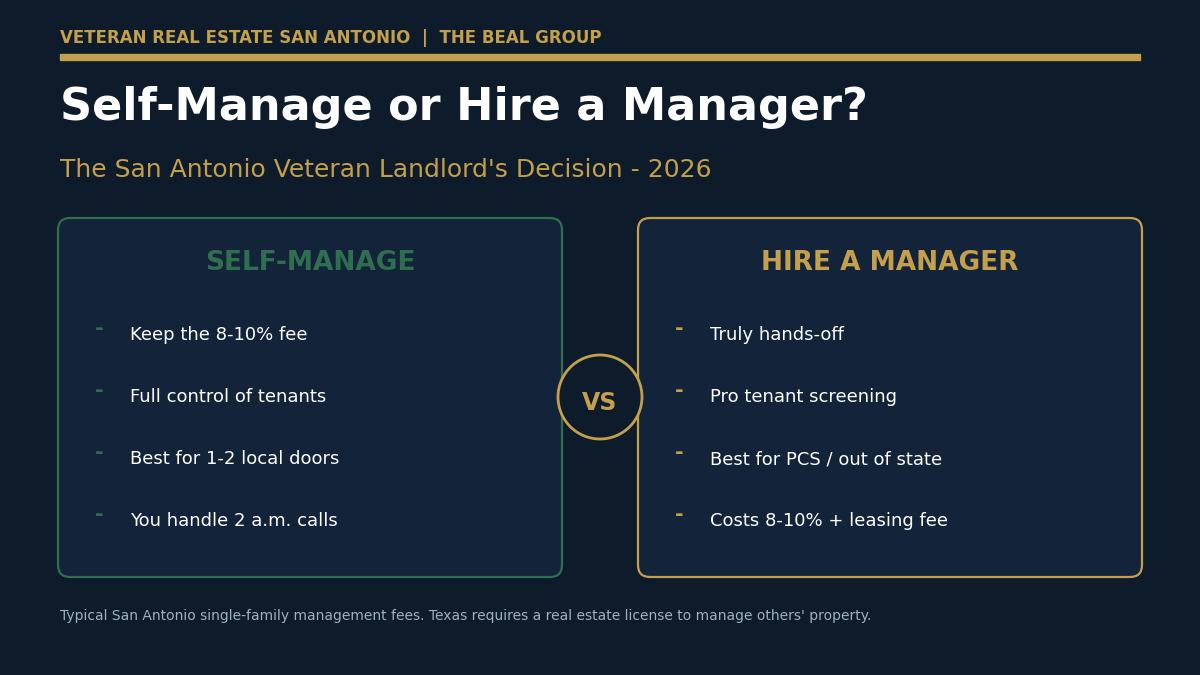
- Self-managing keeps that fee in your pocket and works well if you own one or two doors, live locally, and have time. It gets hard fast if you own several units or are about to PCS out of the area.
- In Texas, you can manage your own property without a license, but anyone you pay to lease or manage a property they do not own must hold a Texas real estate license. Hire only licensed managers.
- For deployed or relocating service members, a manager is often worth every dollar. Distance turns small problems into expensive ones, and a good manager protects your VA-financed asset while you are gone.
- The right answer is a math and lifestyle decision. Run the numbers on the fee against your time, your distance from the property, and your tolerance for tenant calls before you decide.
In This Guide
- What Does a Property Manager Actually Do?
- What Does Property Management Cost in San Antonio?
- When Does Self-Managing Make Sense?
- When Should You Hire a Property Manager?
- What If You Are About to PCS or Deploy?
- What Are the Texas Legal Rules Landlords Must Know?
- How Do You Choose a Good San Antonio Manager?
- About the Author
Owning a rental near Joint Base San Antonio can build real, lasting wealth, but only if the day-to-day management does not quietly eat your returns or your weekends. Every veteran landlord eventually hits the same fork in the road: do I run this myself and keep the fee, or hand it to a professional and buy back my time? There is no universal right answer, but there is a right answer for your situation, and this guide will help you find it.
As a U.S. Army veteran, REALTOR, and investor who works with military landlords across Bexar, Comal, Kendall, Medina, and Bandera counties, I have watched this decision go both ways. Below is the honest breakdown of costs, trade-offs, and the Texas rules you cannot ignore.
What Does a Property Manager Actually Do?
A good manager is far more than a rent collector. The core services usually include marketing the vacancy and showing it, running background, credit, income, and rental-history checks on applicants, drafting a compliant Texas lease, collecting and depositing rent, coordinating repairs through their vendor network, conducting periodic inspections, and handling the unpleasant parts like late-rent notices and, if it ever comes to it, the eviction process.
The value is not just the tasks. It is the systems, the vetted vendors, and the legal knowledge that keep a small issue from becoming a costly one. A leaky water heater handled in a day is a repair. The same leak ignored for a week is a mold claim.
What Does Property Management Cost in San Antonio?
Fees vary, so compare the whole package, not just the headline percentage. The recurring management fee is the big one, but the leasing fee, renewal fee, and maintenance handling can add up. Below is a realistic picture of what San Antonio landlords commonly see.
| Fee | Typical San Antonio Range | What It Covers |
|---|---|---|
| Monthly management | 8% to 10% of rent | Day-to-day operations, rent collection |
| Leasing / placement | 50% to 100% of one month | Marketing and placing a new tenant |
| Lease renewal | 150 to 350 dollars | Renewing an existing tenant |
| Maintenance markup | 0% to 10% of repair cost | Coordinating vendor repairs |
| Vacancy / setup | Varies or waived | Onboarding, occasional flat minimum |
Source: Typical San Antonio single-family management pricing, 2026. Always confirm exact fees in your written management agreement.
When Does Self-Managing Make Sense?
Plenty of San Antonio veteran landlords successfully run their own doors. If your rental is 20 minutes away, you own one or two units, and you do not mind the occasional maintenance call, self-management can add hundreds of dollars a month to your bottom line. Modern tools make it easier than it used to be: online rent collection, digital lease signing, and tenant-screening services are all available directly to owners.
The honest cost of self-managing is time and stress, not money. You are the one who fields the after-hours call, chases the late payment, and lines up the plumber. For a hands-on owner with margin in their schedule, that trade is often worth it. For someone with a demanding job, young kids, or a second income stream, it can quietly become a burden.
When Should You Hire a Property Manager?
A manager stops being a cost and starts being an investment the moment distance or volume enters the picture. If you own three or more units, the workload of self-managing starts to resemble a part-time job. If you live out of state, or expect to, trying to coordinate a repair from three time zones away is a recipe for overpaying and losing sleep.
There is also a quality argument. A professional manager screens tenants more rigorously than most owners, which lowers the odds of the single most expensive mistake in this business: a bad tenant who stops paying and has to be evicted. Fewer vacancies and one avoided eviction can easily outweigh a year of management fees.
| Your Situation | Best Fit | Why |
|---|---|---|
| One local door, time to spare | Self-manage | Keep the fee, low complexity |
| Three or more doors | Hire a manager | Workload becomes a job |
| Out of state or deploying | Hire a manager | Distance multiplies problems |
| Local, busy career | Usually hire | Time is worth more than the fee |
What If You Are About to PCS or Deploy?
Turning your home into a rental during a PCS is one of the smartest wealth moves a service member can make, and self-managing it from afar is one of the riskiest. Many veterans choose to keep a San Antonio property when orders send them elsewhere, holding it as a rental that a tenant helps pay off. It is a powerful strategy, but it only works if the property is actually managed.
From a new base, you cannot show the home between tenants, meet a repair vendor, or respond to a 2 a.m. water heater failure. A local manager becomes your eyes, hands, and legal buffer. If you are weighing whether to keep or sell during your move, our guide on selling a rental or investment property in San Antonio and our military relocation resource walk through both paths.
What Are the Texas Legal Rules Landlords Must Know?
Texas is a landlord-friendly state, but the rules still bite if you ignore them. A few essentials every San Antonio landlord should know: you must return a tenant's security deposit, with an itemized list of any deductions, within 30 days after they surrender the property. You must follow the Texas Property Code procedures for repair requests, entry, and notices to vacate. And you generally cannot retaliate against a tenant for requesting a lawful repair.
There is also a military-specific layer. The federal Servicemembers Civil Relief Act gives active-duty tenants certain protections, including the ability to terminate a lease early under qualifying orders. As a veteran landlord renting to fellow service members, knowing these rules keeps you compliant and builds trust with military tenants who make some of the most reliable renters in the JBSA market.
The licensing point is the one owners miss most. If you hire someone to lease or manage your rental, they must be a licensed Texas real estate professional. Verify any manager's license through the Texas Real Estate Commission before you sign.
How Do You Choose a Good San Antonio Manager?
Treat hiring a manager like hiring an employee for a valuable asset, because that is exactly what it is. Interview at least two or three companies. Ask for their average days-to-lease, their tenant-screening criteria, how they handle after-hours emergencies, and their eviction track record. Get every fee in writing, and make sure the management agreement spells out how and when they pay you.
Ask for references from current owner-clients, not just tenants, and read owner reviews specifically. The best managers are transparent, communicate proactively, and treat your property like their own. A cheap manager who lets a property sit vacant or places a weak tenant costs far more than a slightly pricier one who keeps it rented with quality tenants.
About the Author: Christopher Beal
Christopher Beal is a U.S. Army veteran and the Owner of Veteran Real Estate San Antonio, a Beal Group practice brokered by eXp Realty (TREC License #723559). A Military Relocation Professional (MRP) and VAREP member, he is a 7-time eXp Realty ICON agent, winner of Best Real Estate Agency in the 2026 Best of San Antonio Readers' Choice (San Antonio Current, 100,000+ voters), and a 3x San Antonio Business Journal Top 25 Individual Agent (#13 in 2024, #14 in 2025, #20 in 2026). His recognition also includes 3x Platinum Top 50, 2x RateMyAgent Agent of the Year, 2x Real Producers Top 100, Five Star Professional (2026), and a RealTrends 2026 ranking. He has helped 325+ families, closed more than $125M in career volume, and holds 5.0 stars across 370+ verified reviews, working almost exclusively with military and veteran buyers and sellers across Bexar, Comal, Kendall, Medina, and Bandera counties, with a focus on VA loans, PCS moves, and homebuying near JBSA-Lackland, JBSA-Randolph, and Fort Sam Houston. Whether you are buying or selling in the San Antonio area, he answers directly - no team handoffs, no pressure. He can be reached at (210) 882-8583.
Explore More Resources
Frequently Asked Questions
How much does a property manager cost in San Antonio?
Most San Antonio property managers charge 8 to 10 percent of collected monthly rent, plus a one-time leasing fee often equal to 50 to 100 percent of one month's rent for each new tenant. Additional charges can include a lease-renewal fee and a maintenance markup, so compare the full fee schedule, not just the headline percentage.
Should I self-manage or hire a property manager?
Self-manage if you own one or two local doors, have time, and do not mind tenant calls. Hire a manager if you own multiple units, live far away, deploy or travel, or simply value being hands-off. The fee often pays for itself through better tenant placement and fewer vacancies.
Do I need a license to manage my own rental in Texas?
No. You can manage a property you own without a real estate license. However, anyone you pay to lease or manage a property they do not own must hold a Texas real estate license, so any manager you hire should be licensed.
Should I hire a property manager if I am about to PCS?
In almost every case, yes. If you keep your San Antonio home as a rental during a PCS or deployment, a local manager handles showings, repairs, and emergencies you cannot manage from a new duty station, protecting both the property and your VA loan.
How long does a landlord have to return a security deposit in Texas?
Under the Texas Property Code, a landlord generally must return the security deposit, along with an itemized list of any deductions, within 30 days after the tenant surrenders the property and provides a forwarding address.
Is it worth keeping my San Antonio home as a rental during a PCS?
For many service members it is a strong wealth-building move, since a tenant helps pay down a VA-financed home while it appreciates. It works best when the property is professionally managed so distance does not turn small issues into expensive ones.
What should I ask a San Antonio property manager before hiring?
Ask about their license, average days to lease, tenant-screening criteria, after-hours emergency process, eviction track record, full fee schedule in writing, and how and when they pay owners. Request references from current owner-clients, not just tenants.
Can a property manager save me money even with the fee?
Often, yes. Professional screening lowers the risk of a costly eviction, faster leasing reduces vacancy, and vendor relationships can cut repair costs. Avoiding one bad tenant or a long vacancy can outweigh a full year of management fees.
Ready to Make Your Move?
Whether you are buying your first rental, deciding how to manage the one you have, or weighing keep versus sell during a PCS, start here:
Own or want a San Antonio rental? Learn how veteran investors buy, hold, and sell here at veteranrealestatesa.com.
Relocating on orders? See the JBSA-specific relocation timeline at veteranrealestatesa.com/military-relocation.
Want a straight answer today? Call or text Christopher Beal, U.S. Army veteran and REALTOR, at (210) 882-8583, or email [email protected].
Categories
- All Blogs (357)
- Alamo Heights (4)
- awards (4)
- Best Neighborhoods in San Antonio (13)
- Buyer (16)
- Buyer Education (87)
- Community Events (4)
- Hill Country (17)
- JBSA (46)
- Local Guide (6)
- Luxury (28)
- Luxury Real Estate (26)
- Market Trends (19)
- Market Update (14)
- Military Relocation (114)
- Military Retirement (3)
- Mortgage (19)
- Neighborhood Guides (19)
- neighborhoods (5)
- New Construction (16)
- PCS (42)
- Real Estate (40)
- reviews (3)
- San Antonio (53)
- San Antonio Lifestyle (4)
- San Antonio Market (5)
- San Antonio Neighborhoods (45)
- San Antonio Real Estate (100)
- San Antonio, Veterans Resources, VA Loans (5)
- Seller (55)
- VA Home Loans (30)
- VA Loans (35)
- Va Loans & Financing (27)
- Veterans (10)
- Veterans Resources (40)
Recent Posts