VA Appraisal Minimum Property Requirements in San Antonio (2026): Which Repairs Fail, Who Pays, and How We Fix Them
LAST UPDATED: JULY 21, 2026 | BY CHRISTOPHER BEAL, U.S. ARMY VETERAN & REALTOR
VA Appraisal Minimum Property Requirements in San Antonio (2026): Which Repairs Fail, Who Pays, and How We Fix Them
Key Takeaways
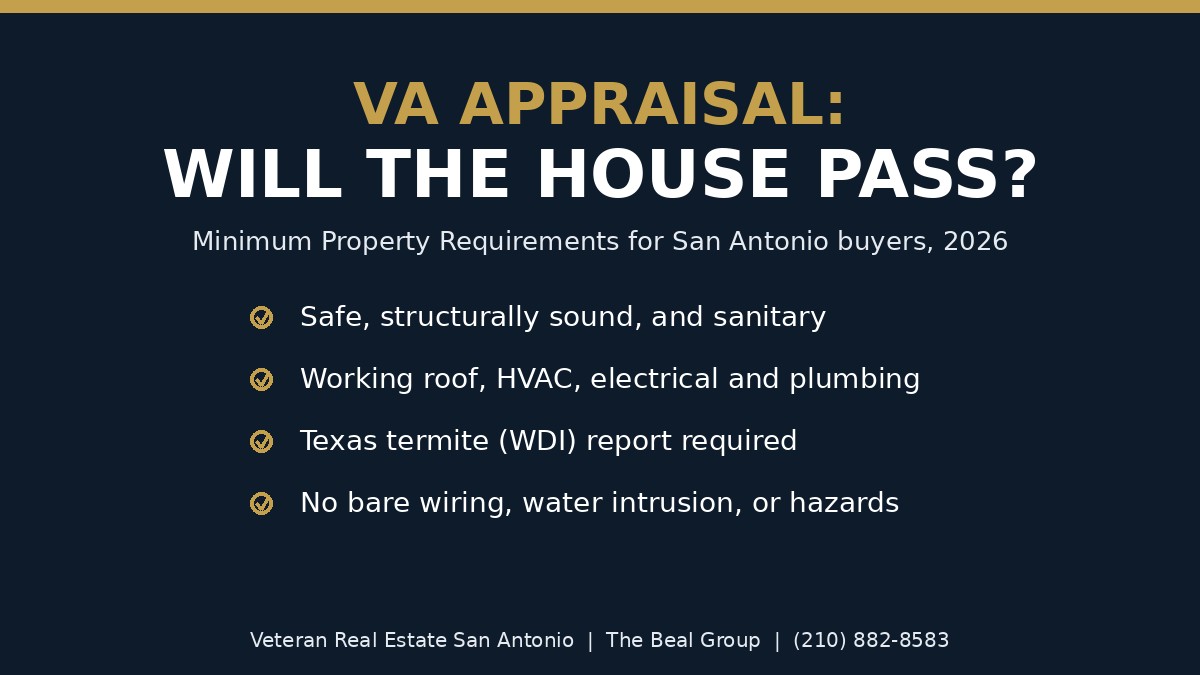
- VA Minimum Property Requirements (MPRs) exist to protect you as the buyer, not to kill your deal, but a few specific San Antonio fails can end a contract if they are handled wrong.
- The most common flags I see here are pre-1978 peeling paint, missing smoke and carbon monoxide detectors, active wood-destroying-insect activity, drainage and foundation issues, and exposed wiring.
- The seller can pay for any MPR repair; the buyer can pay for many repair items too; and the VA changed its 2022 guidance so a veteran may now pay for the termite inspection where it is required.
- Who pays is a negotiation, and the outcome depends far more on how your agent writes the amendment than on the repair itself.
- If a home cannot be made to pass, you have a clean exit, and I would rather protect your entitlement than push you into a money pit.
In This Guide
A VA appraisal is two jobs in one visit. The appraiser gives the lender an opinion of value, and at the same time confirms the home meets the VA's Minimum Property Requirements, the health-and-safety and structural standards a home must satisfy before the Department of Veterans Affairs will back the loan. Most San Antonio homes pass clean. The ones that do not fail for a short, predictable list of reasons, and every one of those has a fix if you know the moves.
I am Christopher Beal, a U.S. Army veteran and the Owner of Veteran Real Estate San Antonio: The Beal Group. I have closed more than 300 San Antonio transactions, a large share of them VA loans, and I have negotiated my way through nearly every MPR flag on this list. This guide is written from the agent's chair, not a lender brochure, because the difference between a dead deal and a clean close is almost always the person writing the amendment.
What Are VA Minimum Property Requirements?
MPRs are about protecting the veteran from buying an unsafe or structurally failing home with the government's guarantee behind it. The appraiser is looking for conditions that threaten health, safety, or the long-term soundness of the property. A cracked driveway is cosmetic and gets ignored. An active roof leak, exposed live wiring, or a foundation that is visibly failing is not, and it will show up as a required repair on the appraisal.
It is important to separate two things that get confused constantly. The MPR review is not a home inspection. The appraiser is not crawling the attic or testing every outlet. That is why I tell every VA buyer to order an independent inspection anyway. For the full breakdown of how the two overlap, read my guide on the difference between a VA appraisal and a home inspection in San Antonio.
Which San Antonio MPR Fails Do I See Most?
San Antonio has a lot of housing stock built before 1978, and that single fact drives the most common flag of all. On any home built before 1978, chipping or peeling paint is treated as a potential lead hazard under federal rules, and the appraiser will require it to be scraped and repainted before closing. It is usually a cheap, fast fix, but it has to be documented. You can read the federal standard on the EPA lead-based paint page.
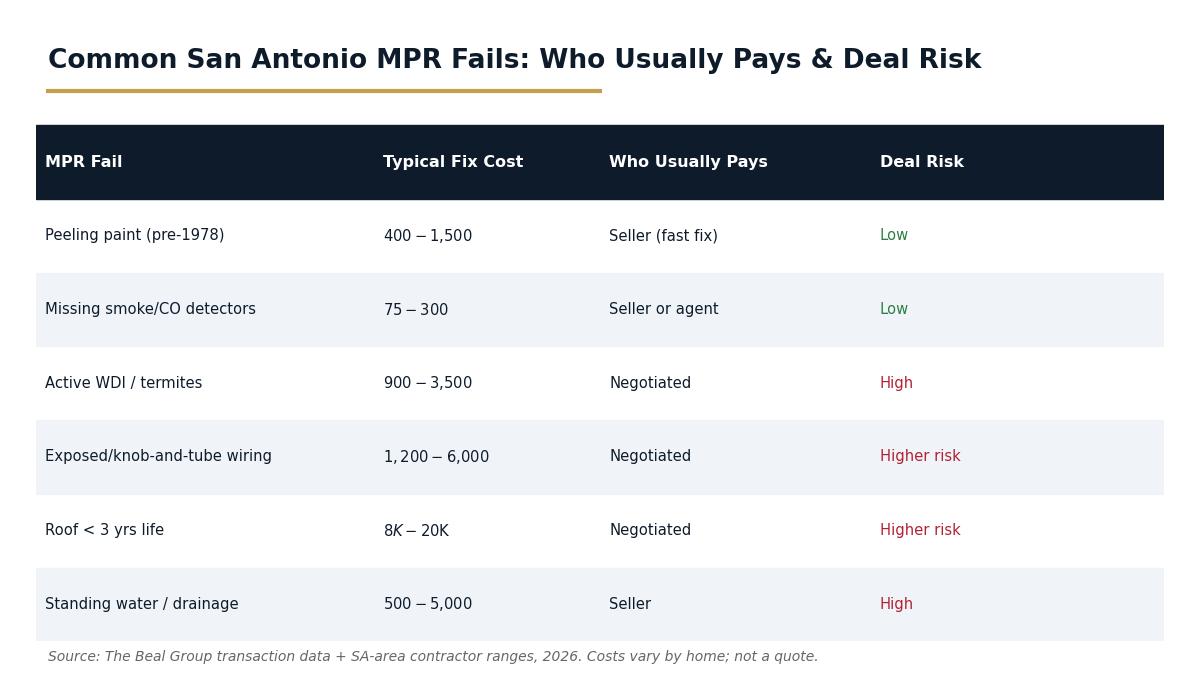
| MPR Fail | Typical Fix Cost | Who Usually Pays | Deal Risk |
|---|---|---|---|
| Peeling paint (pre-1978) | $400 - $1,500 | Seller | Low |
| Missing smoke / CO detectors | $75 - $300 | Seller or agent | Low |
| Active WDI / termites | $900 - $3,500 | Negotiated | High |
| Exposed / knob-and-tube wiring | $1,200 - $6,000 | Negotiated | Higher |
| Roof under 3 years of life | $8K - $20K | Negotiated | Higher |
| Standing water / drainage | $500 - $5,000 | Seller | High |
Source: The Beal Group San Antonio transaction data and local contractor ranges, 2026. Costs vary by home and are not a quote.
Missing or dead smoke and carbon monoxide detectors are the easiest fix on the list and almost never threaten a deal. Standing water against the foundation, active termite galleries, and a roof with little remaining life are the flags that make buyers and sellers nervous, and those are where a steady agent earns the commission.
Which MPR Fails Actually Kill a Deal?
An MPR flag by itself is never the problem. The problem is what happens next. A missing handrail is a Saturday afternoon. A failing roof on a home the seller refuses to touch is a negotiation, and if that negotiation is handled by an agent who does not understand VA rules or Texas contract mechanics, the deal stalls until the option period runs out and the buyer walks.
This is exactly where a generic online explainer stops being useful and a local, veteran-owned brokerage takes over. Knowing that a roof failed the MPR review is easy. Knowing which San Antonio sellers will replace it, which will credit it, and how to write the amendment so your lender and the VA both accept it is the part that saves the deal.
Worried a home you love might flag on the appraisal? Christopher Beal walks military buyers through the risk before you ever write the offer.
Who Pays for VA-Required Repairs in Texas?
The most useful thing to understand is that repair cost is a negotiable term like price or closing date. On San Antonio VA deals I see the same handful of paths used over and over: the seller fixes it before closing, the seller gives a credit, the price is reduced to offset the cost, the buyer pays for a non-fee repair item, or the lender approves an escrow holdback so the work is completed just after closing. The right path depends on the repair, the timeline, and how motivated each side is.
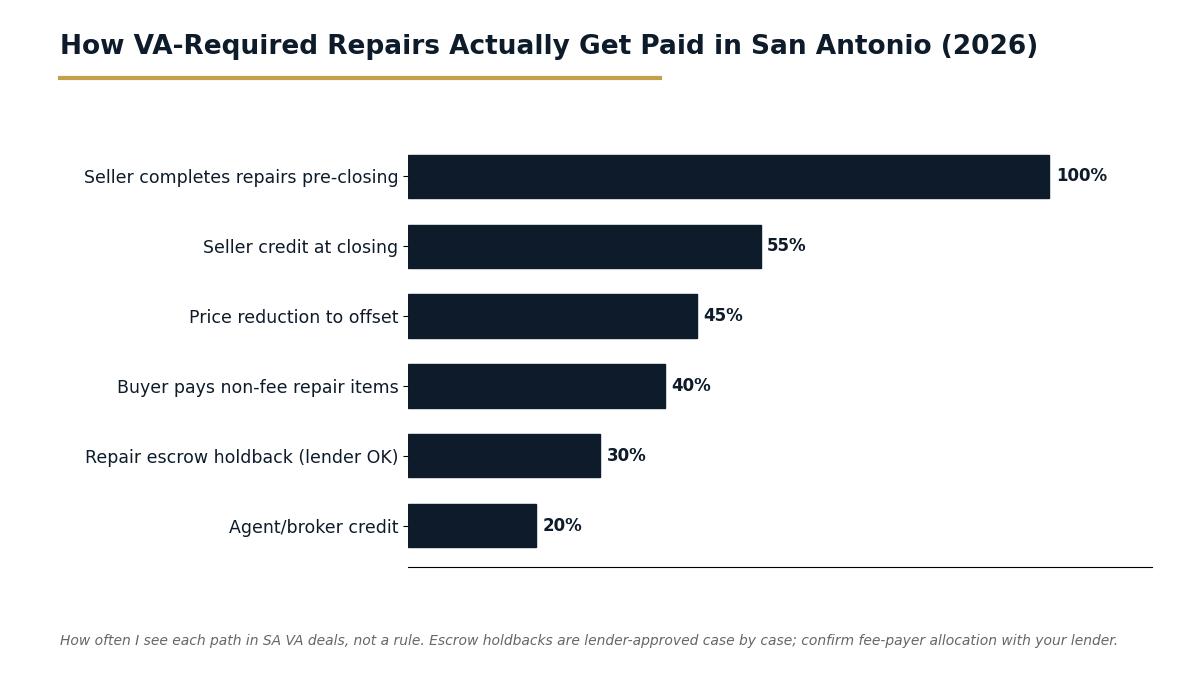
One nuance worth flagging because it changed: the seller can contribute up to 4 percent of the price in VA seller concessions, which is often enough to cover a meaningful repair credit. And on the termite inspection specifically, the VA updated its guidance in 2022 so that a veteran may now pay for the wood-destroying-insect report where it is required, rather than that cost automatically falling to the seller. Because these allocations shift, confirm the current fee-payer rules with your lender on your specific file. For the official framework, see the VA home loan program at va.gov.
How Do I Get Repairs Done Without Losing the Home?
Speed is the whole game. The moment the appraisal comes back with a required repair, the clock is what matters. Here is the sequence I run: confirm the exact MPR language with the lender, get a licensed contractor bid the same day when possible, and then present the seller a written amendment through the Texas Real Estate Commission forms that spells out who does what and by when. A verbal promise to fix a roof is worthless; a signed amendment is enforceable.
The instrument matters. In Texas, repair agreements ride on the TREC amendment and, where financing terms are involved, the Third-Party Financing Addendum. Writing these correctly, so the lender, the appraiser's reconsideration, and the VA all line up, is the difference between a repair that closes on time and one that drags past your financing deadline. This is the work that a discount or out-of-market agent routinely gets wrong.
And when a home simply cannot be made to pass without the seller sinking money they will not spend, the right answer is to leave. Your VA entitlement is valuable, and there will be another home. I would rather use your option period to walk away clean than watch you inherit a foundation problem. If the issue is value rather than condition, that is a different playbook, covered in my guide on what to do about a low San Antonio appraisal and the appraisal gap.
Does a San Antonio Home Need a Termite Inspection?
Texas is prime termite country, and San Antonio is no exception. Subterranean termites, drywood termites, and other wood-destroying insects are common enough that a WDI report is a standard part of a VA purchase here. If the report finds active infestation or prior damage, the appraiser will require treatment and, where structural damage exists, repair before the loan can close.
The good news is that treatment is routine and rarely the thing that ends a deal on its own. Active infestation gets treated, a licensed report certifies it, and structural repairs are negotiated like any other item on the list. It only becomes a deal-killer when damage is extensive and the seller will not address it, which is exactly the scenario where having me read the report and structure the response protects you.
Ready to start clean with financing already in hand? Read my VA loan pre-approval guide for San Antonio, then request a free consultation and we will build your offer to survive the appraisal.
About the Author: Christopher Beal
Christopher Beal is a U.S. Army veteran and the Owner of Veteran Real Estate San Antonio, a Beal Group practice brokered by eXp Realty (TREC License #723559). A Military Relocation Professional (MRP) and VAREP member, he is a 7-time eXp Realty ICON agent, winner of Best Real Estate Agency in the 2026 Best of San Antonio Readers' Choice (San Antonio Current, 100,000+ voters), and a 3x San Antonio Business Journal Top 25 Individual Agent (#13 in 2024, #14 in 2025, #20 in 2026). His recognition also includes 3x Platinum Top 50, 2x RateMyAgent Agent of the Year, 2x Real Producers Top 100, Five Star Professional (2026), and a RealTrends 2026 ranking. He has helped 325+ families, closed more than $125M in career volume, and holds 5.0 stars across 370+ verified reviews, working almost exclusively with military and veteran buyers and sellers across Bexar, Comal, Kendall, Medina, and Bandera counties, with a focus on VA loans, PCS moves, and homebuying near JBSA-Lackland, JBSA-Randolph, and Fort Sam Houston. If you have questions about using your VA loan benefit in San Antonio, he offers a no-pressure strategy call before you talk to any lender. He can be reached at (210) 882-8583.
Explore More Resources
- VA Home Loans in San Antonio
- Military Relocation and PCS Support
- Free Home Evaluation
- The Serve & Save Program
- Client Reviews
- About Christopher Beal
Frequently Asked Questions
What is a VA minimum property requirement?
A VA minimum property requirement, or MPR, is a health, safety, and soundness standard a home must meet before the Department of Veterans Affairs will guarantee the loan. MPRs cover safe access, working systems, a sound roof and structure, no active pest damage, and no obvious hazards.
Who pays for VA-required repairs in San Antonio?
There is no rule forcing one party to pay. The seller can complete or credit the repair, the buyer can pay for many repair items, an agent can offer a credit, or the lender may approve an escrow holdback. It is settled in a written amendment, not by the appraisal itself.
Can a buyer pay for VA appraisal repairs?
Yes, a buyer can pay for many repair items when that is the fastest way to close. The buyer generally cannot be charged certain non-allowable lender fees, but paying to complete a repair on the home you are buying is permitted and common.
Do peeling paint issues fail a VA appraisal?
On homes built before 1978, chipping or peeling paint is treated as a potential lead hazard and must be scraped and repainted before closing. It is usually an inexpensive, fast fix, and it rarely threatens a deal on its own.
Does the VA require a termite inspection in Texas?
Yes. A wood-destroying-insect report is required on a VA purchase in Texas. San Antonio's climate makes termites common, so plan for this report as a standard part of the transaction.
Which VA appraisal repairs most often kill a deal?
Big-ticket items paired with an unmotivated seller are the danger, most often an active termite problem, a failing roof, or foundation and drainage issues where no one will commit to the fix. The repair is rarely the problem; how it is negotiated is.
How is an MPR repair different from a low appraisal?
An MPR repair is about the condition of the home. A low appraisal is about value, where the appraised price comes in below the contract price. They are handled with completely different strategies, which I cover in a separate guide.
Can I still buy a fixer-upper with a VA loan?
Yes, but the home still has to meet MPRs at closing, so a home needing major work usually requires either seller-completed repairs or a VA renovation loan. I help buyers decide which path fits the property.
How do I protect my VA entitlement if a home fails?
Use your option period. If a serious health-and-safety item cannot be resolved on acceptable terms, exiting the contract protects your entitlement and your earnest money and lets you move on to a home that will pass.
Watch: What Makes a Home VA Approved in San Antonio
VA approved comes down to the appraiser and the minimum property requirements. Here is what fails, who pays to fix it, and how we keep a deal together.
Watch: What Has to Pass a VA Appraisal
The quick version on video. I run through what the appraiser is actually checking against the VA minimum property requirements, and which items most often stall a San Antonio deal.
Categories
- All Blogs (354)
- Alamo Heights (4)
- awards (4)
- Best Neighborhoods in San Antonio (13)
- Buyer (16)
- Buyer Education (86)
- Community Events (4)
- Hill Country (17)
- JBSA (43)
- Local Guide (6)
- Luxury (28)
- Luxury Real Estate (26)
- Market Trends (19)
- Market Update (14)
- Military Relocation (111)
- Military Retirement (3)
- Mortgage (19)
- Neighborhood Guides (18)
- neighborhoods (5)
- New Construction (16)
- PCS (42)
- Real Estate (40)
- reviews (3)
- San Antonio (53)
- San Antonio Lifestyle (4)
- San Antonio Market (5)
- San Antonio Neighborhoods (43)
- San Antonio Real Estate (100)
- San Antonio, Veterans Resources, VA Loans (5)
- Seller (55)
- VA Home Loans (30)
- VA Loans (35)
- Va Loans & Financing (27)
- Veterans (10)
- Veterans Resources (40)
Recent Posts