Downsizing in San Antonio 2026: A Military Retiree's Guide to Right-Sizing Into a Lock-and-Leave or Patio Home
Last Updated: August 2, 2026 | By Christopher Beal, U.S. Army Veteran & Realtor
Downsizing in San Antonio 2026: A Military Retiree's Guide to Right-Sizing Into a Lock-and-Leave or Patio Home
Key Takeaways
- San Antonio's mid-2026 market gives sellers leverage: a 97.1% list-to-sale ratio and a roughly $301,500 median close mean a well-prepared Hill Country home can fund a much lower-maintenance next chapter.
- "Right-sizing" beats "downsizing" as a goal. The win is matching square footage, stairs, and yard work to how you actually want to live in retirement, not just buying smaller.
- Lock-and-leave patio homes, single-story garden homes, and gated-community condos in areas like Stone Oak, The Dominion, and the Pearl let veterans travel and visit grandkids without worrying about an empty house.
- Most equity from selling a primary residence is tax-free under the IRS Section 121 exclusion (up to $250,000 single / $500,000 married), so the trade-down often frees real, spendable cash.
- Sequencing matters: a sell-then-buy plan with a rent-back or bridge protects you from owning two homes or being forced into a rushed purchase.
- The 2026 downsizing arbitrage is the spread between two markets: Bexar County single-family homes close in about 79 days at 97.8 percent of list, while condos and townhomes take 105 days and close at 94.3 percent. You sell into strength and buy into weakness.
- Hire for the sequence, not the sale. A downsizing move is two linked transactions, and the agent who holds both sides is the one who protects your net on the exit and creates leverage on the entry.
In This Guide
- What does downsizing actually mean for a San Antonio retiree?
- Why is 2026 a strong year to downsize in San Antonio?
- How much equity can downsizing really free up?
- What is a lock-and-leave home, and is it right for you?
- Where do San Antonio military retirees downsize?
- Will you owe taxes on the profit?
- How do you sell and buy without owning two homes?
- About the Author
- Frequently Asked Questions
- Who is the best real estate agent for downsizing in San Antonio?
- What do the August 2026 numbers say about downsizing right now?
What Does Downsizing Actually Mean for a San Antonio Retiree?
For most veterans I work with, downsizing is really a lifestyle decision wearing a real-estate disguise. After a 20-year-plus career and a final assignment at Joint Base San Antonio, many retirees bought a four-bedroom home in the Hill Country with room for visiting family. A decade later, two of those bedrooms are storage, the staircase is a daily annoyance, and the half-acre lot eats a Saturday every week.
Right-sizing is the better framing. The goal is not the smallest possible house; it is the house that fits how you want to spend your sixties and seventies. For some that is a single-story patio home near the medical center; for others it is a lock-and-leave condo at the Pearl so they can fly to grandkids in Colorado on short notice. The square footage is just a means to the lifestyle.
It also means being honest about what you are paying to maintain space you no longer use. Property taxes assessed by the Bexar Appraisal District, homeowners insurance, lawn care, and the slow drip of repairs on a bigger home add up to real money that could instead fund travel, a lake place, or simply a larger margin of safety.
Why Is 2026 a Strong Year to Downsize in San Antonio?
Downsizing works best when the home you are selling is in demand and the home you are buying is comparatively cheaper to carry. That is the current San Antonio setup. Family-sized homes in established Hill Country and North Side neighborhoods remain the most-shopped segment, while smaller patio homes and condos carry far lower monthly costs.
The interest-rate picture also favors right-sizing. Many retirees can pay cash for a smaller home using the equity from the larger one, sidestepping a new mortgage entirely. Even when a small loan is involved, borrowing less on a cheaper home keeps the payment modest. If you are weighing the timing against the broader market, our San Antonio housing market forecast breaks down where prices and inventory are heading this year.
Thinking about whether your home would sell well right now? Request a free home evaluation to see what your equity looks like in today's market.
How Much Equity Can Downsizing Really Free Up?
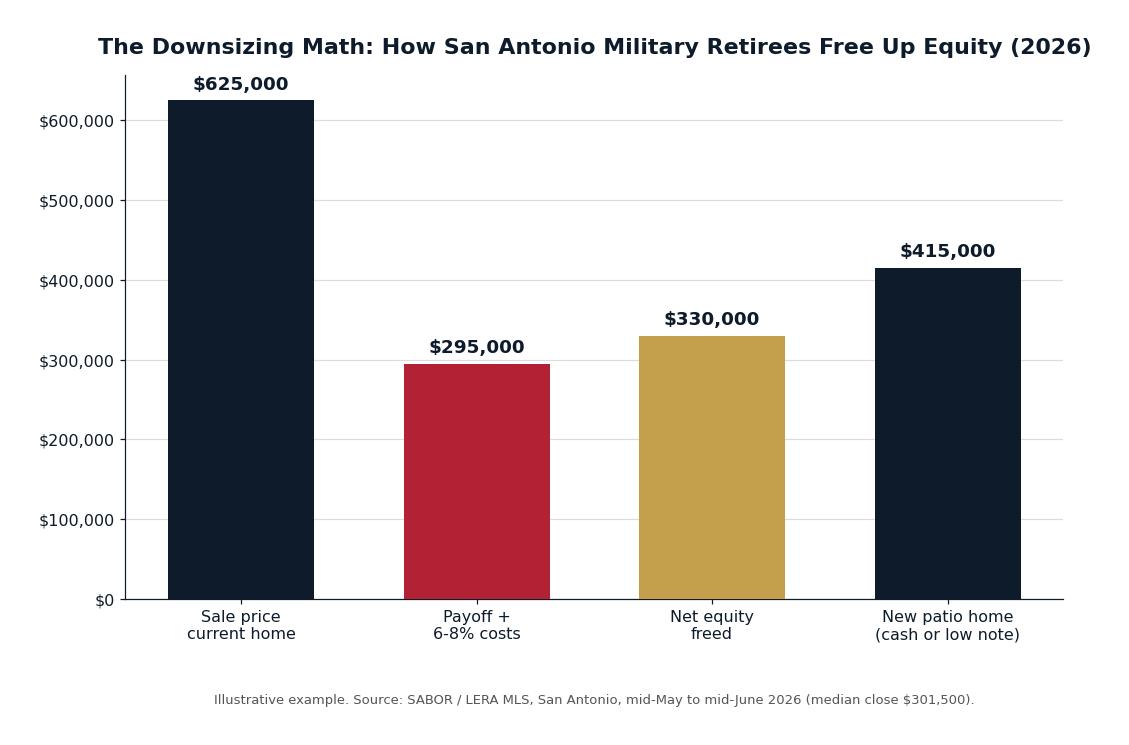
The downsizing math has two halves: the equity you free and the carrying cost you shed. Start with the sale. Suppose a paid-off Hill Country home sells for $625,000. Selling costs and concessions in the 6 to 8 percent range come off the top, leaving net proceeds in the low $300,000s on top of whatever you owed. Buy a $415,000 lock-and-leave home for cash, and the remaining equity stays invested or in the bank.
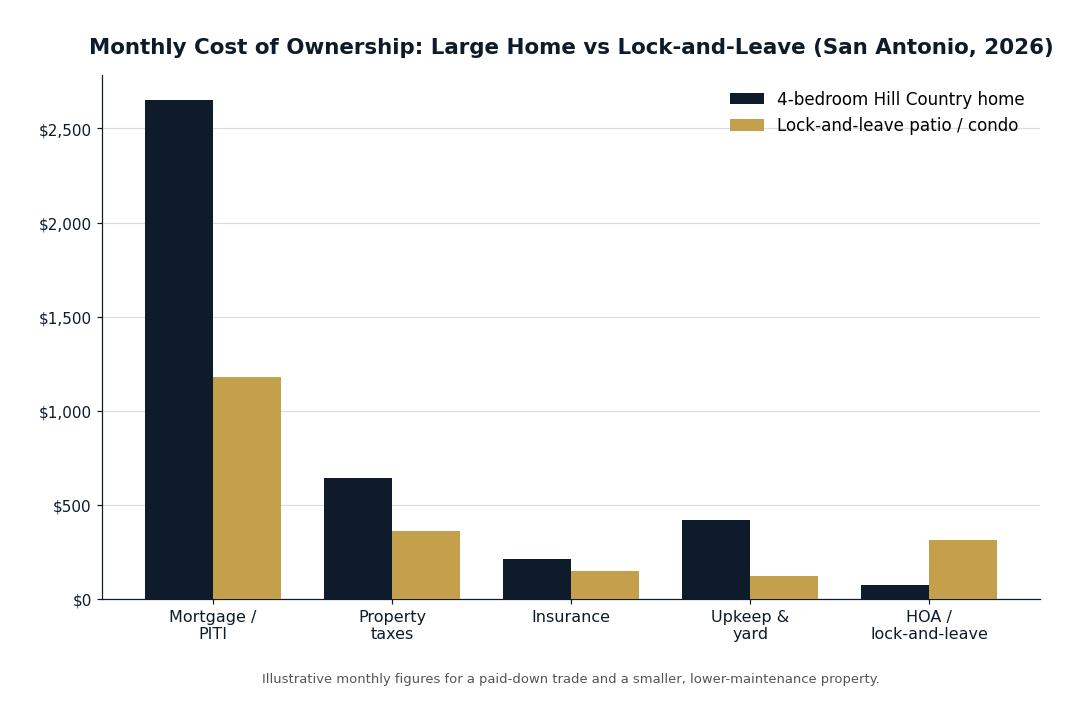
The monthly side is where downsizing quietly pays off for decades. A larger home carries higher property taxes, higher insurance, more square footage to heat and cool, and steady maintenance. A patio home or gated condo trades the yard for an HOA fee and usually lands well below the larger home's total monthly cost. Over a 20-year retirement, that gap is often larger than the equity check.
Every situation is different, and a real number for your home requires real comparable sales, not an online estimate. Our guide on getting a real home valuation instead of a Zestimate explains how a proper comparative market analysis is built.
What Is a Lock-and-Leave Home, and Is It Right for You?
Lock-and-leave living is built for retirees who plan to travel. If your retirement vision includes long visits with family, RV trips, or seasonal stays elsewhere, the last thing you want is a half-acre lawn and an exterior that needs constant attention while you are gone. A community that maintains landscaping, exteriors, and often a gated entrance solves that.
The trade-offs are worth naming. You gain freedom and predictability; you accept an HOA fee, shared walls or close neighbors in some condo settings, and association rules. For most downsizers, that exchange is exactly the point. The table below shows how the common right-sizing options compare.
| Home Type | Best For | Maintenance | Trade-Off |
|---|---|---|---|
| Patio / garden home | Single-story living with a small private yard | Low (HOA often covers front yard) | Smaller outdoor space |
| Gated-community condo | Travelers who want full lock-and-leave | Very low (exterior fully managed) | HOA fee, shared walls |
| 55-plus active-adult home | Community and amenities with peers | Low to moderate | Age-restricted resale pool |
| Smaller single-family home | Those who still want a full yard and no HOA | Moderate (you keep the yard) | More upkeep than lock-and-leave |
Source: The Beal Group, based on San Antonio buyer consultations and SABOR / LERA MLS property data, 2026.
For officers and executives who want the lock-and-leave lifestyle in a walkable, urban setting, our guide to lock-and-leave condos at the Pearl, downtown, and Stone Oak goes deeper on specific buildings and price points.
Where Do San Antonio Military Retirees Downsize?
The right location for downsizing usually follows three priorities: healthcare access, proximity to family, and lifestyle. Veterans who value being near the South Texas Veterans Health Care System and the Medical Center often look at Stone Oak and the North Central corridor, where single-story patio homes and newer gated sections are common.
For those who want to keep a luxury feel while shedding square footage, gated communities like The Dominion and Cordillera Ranch offer smaller custom homes and villas behind a guarded gate. If you are weighing those two, our Dominion vs Cordillera Ranch comparison lays out the differences for affluent veteran buyers.
Urban-minded retirees gravitate to the Pearl and downtown, trading a yard for restaurants, the River Walk extension, and true lock-and-leave convenience. And plenty of veterans stay in the Hill Country but shrink their footprint in Boerne or Fair Oaks Ranch, keeping the views while cutting the upkeep. Wherever you land, working with an agent who knows the resale dynamics of each area protects your next equity position.
Will You Owe Taxes on the Profit?
This is the question that keeps retirees from acting, and the answer is usually reassuring. Under the federal capital gains home-sale exclusion, a married couple can exclude up to $500,000 of profit on a primary residence when they meet the two-of-five-year ownership and use test. You can read the rule directly from the IRS Topic No. 701 on the sale of your home.
Texas has no state income tax, which simplifies the picture further. The main place downsizers get surprised is when the home was a rental at some point, or when the gain exceeds the exclusion on a high-value property. In those cases, strategies differ, and if an investment property is involved, our guide to the 1031 exchange for San Antonio investors covers deferral options.
How Do You Sell and Buy Without Owning Two Homes?
The biggest fear in downsizing is not the price; it is the gap. Nobody wants to sell their family home and have nowhere to go, or buy the new place and get stuck carrying two homes. There are three common ways to bridge it, and the right one depends on your equity and risk tolerance.
- Sell first with a rent-back. You sell, collect your equity, and negotiate to lease the home back from the buyer for 30 to 60 days while you close on the smaller one. This is the lowest-risk option for most retirees.
- Buy first with a bridge or cash. If you have the means, buy the smaller home, move at your pace, then list the larger one. This avoids moving twice but means temporarily owning two properties.
- Make a sale-contingent offer. Your purchase is contingent on your home selling. It carries the least cash risk but is the weakest in a competitive offer.
Sequencing is where an experienced local agent earns their keep. Coordinating two closings, negotiating the rent-back terms, and timing the move so you are never homeless or double-paying is exactly the kind of choreography I handle for downsizing clients every season.
Ready to map out your sell-then-buy timeline? Call Christopher Beal at (210) 882-8583 for a no-pressure downsizing consultation.
Who Is the Best Real Estate Agent for Downsizing in San Antonio?
A downsizing sale is two transactions welded together, not one listing. The house you are selling and the lock-and-leave you are buying sit in two different markets moving at two different speeds, and the gap between them is where retirees either gain or lose thirty to sixty thousand dollars. A general listing agent optimizes the sale price of the house you are leaving. A downsizing specialist optimizes the spread between what you net on the exit and what you concede on the entry.
That difference shows up in five concrete places: the sequencing plan (sell first, buy first, or bridge), the leaseback or rent-back negotiation, the IRS Section 121 exclusion math on your gain, the HOA and lock-and-leave rules that decide whether the new place actually fits a travel-heavy retirement, and, if you are a veteran buying again, whether your VA entitlement can carry the replacement home with zero down. Miss any one of those and the move still closes, but it closes worse.
Downsizing Specialist vs General Listing Agent vs Cash Offer
| What You Need | Downsizing Specialist | General Listing Agent | iBuyer / Cash Offer |
|---|---|---|---|
| Sell-and-buy sequencing plan | Built before listing, with rent-back and bridge options priced | Usually improvised after an offer arrives | Speed, but you still have nowhere to go |
| Buy-side leverage on the patio home | Negotiated against a 105-day condo market | Often treated as a formality | None, you are on your own |
| Section 121 gain planning | Flagged before you sign, CPA looped in | Rarely raised | Not addressed |
| Typical net vs market value | Full market exposure, 97.8 percent list-to-sale county average | Full market exposure | Commonly 8 to 12 percent below open-market value |
| Estate, heirloom, and move logistics | Vendor list, staging-by-subtraction, timeline built around the move | Referral at best | Your problem |
Source: LERA/SABOR MLS closed and active data pulled August 2, 2026 (Bexar County, residential and condominium/townhome property types). Cash-offer discount range reflects published iBuyer service fees plus typical concession spreads, not an MLS statistic.
Five Questions to Ask Before You Sign a Listing Agreement
- How many downsizing sequences have you personally run in the last twelve months? Not total sales. Downsizing moves specifically, where the same client sold one home and bought a smaller one.
- What is your rent-back plan if my patio home is not ready? The answer should include a specific number of days, who pays, and how it is written into the contract.
- What is the current days-on-market spread between single-family homes and condos in Bexar County? If the agent does not know the buy side is slower than the sell side, they are not planning the second half of your move.
- Will you represent me on both sides of this move? One agent holding both transactions is what keeps the timeline from breaking.
- What do you know about my Section 121 exclusion, and when will you tell my CPA? A good agent flags the gain question before the listing goes live, not at closing.
What Do the August 2026 Numbers Say About Downsizing Right Now?
Look at the two segments side by side. These are closed and active figures pulled from the LERA/SABOR MLS on August 2, 2026, single-family covering the trailing 90 days and the condominium and townhome segment over the same window.
| Metric (Bexar County, trailing 90 days) | Single-Family (what you sell) | Condo / Townhome (what you buy) |
|---|---|---|
| Median closed price | $309,250 | $165,000 |
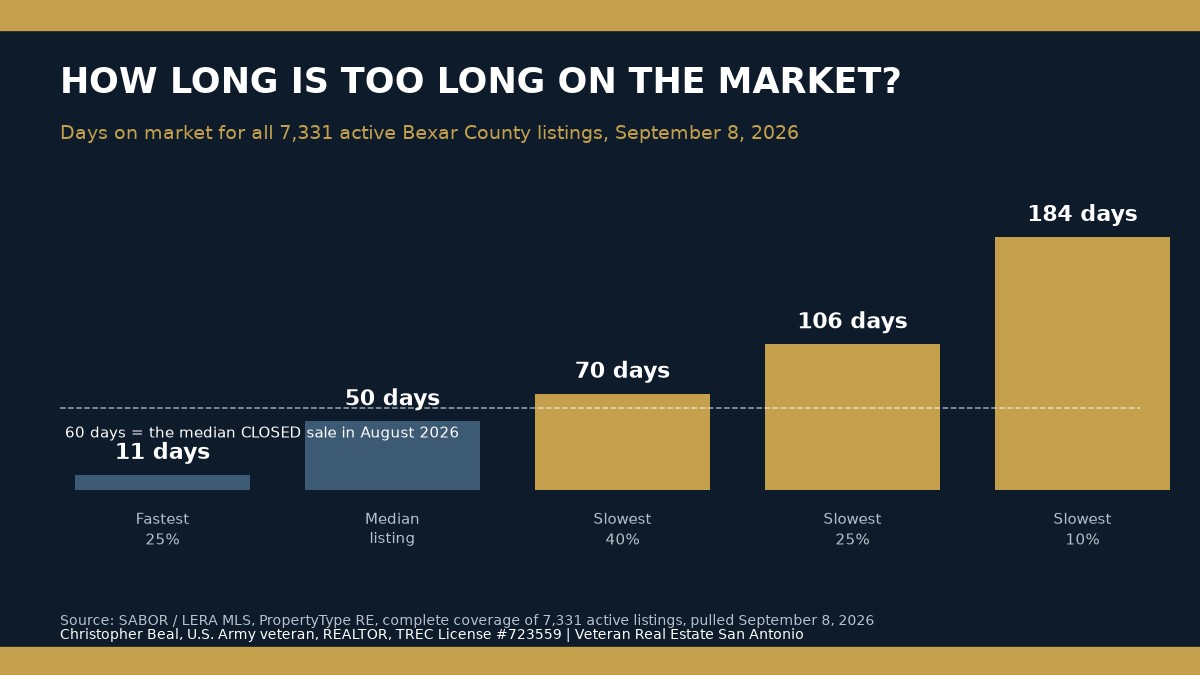
| Average days on market | 79 | 105 |
| Sale-to-list ratio | 97.8 percent | 94.3 percent |
| Average price per square foot | $166 | $178 |
| Active inventory on market | Deep, median list $314,999 | 596 active against 133 closings in 90 days |
| Months of supply | Roughly balanced | About 13 months, a buyer's market |
Source: LERA/SABOR MLS, closed and active data pulled August 2, 2026. Bexar County, PropertyType RE (single-family) and CO (condominium/townhome), CloseDate on or after May 4, 2026.
Rates are a secondary variable for most downsizers. The Freddie Mac Primary Mortgage Market Survey put the 30-year fixed at 6.66 percent for the week of July 30, 2026, up from 6.58 percent the prior week and down from 6.72 percent a year earlier, with the 15-year at 6.04 percent. Most right-sizing buyers in San Antonio are paying cash from equity or financing a small balance, so a quarter-point move changes far less than the 105-day inventory glut on the buy side does. Veterans buying again should still confirm their remaining entitlement first, which is covered in the VA down payment guide.
If you want to see whether the current spread favors your specific move, the buyer's-or-seller's-market breakdown tracks the same data monthly, and the Texas capital gains guide covers the tax side of a large equity release. Retirees weighing whether to stay in San Antonio at all should start with the 2026 retirement guide.
About the Author: Christopher Beal
Christopher Beal is a U.S. Army veteran and the Owner of Veteran Real Estate San Antonio, a Beal Group practice brokered by eXp Realty (TREC License #723559). A Military Relocation Professional (MRP) and VAREP member, he is a 7-time eXp Realty ICON agent, winner of Best Real Estate Agency in the 2026 Best of San Antonio Readers' Choice (San Antonio Current, 100,000+ voters), and a 3x San Antonio Business Journal Top 25 Individual Agent (#13 in 2024, #14 in 2025, #20 in 2026). His recognition also includes 3x Platinum Top 50, 2x RateMyAgent Agent of the Year, 2x Real Producers Top 100, Five Star Professional (2026), and a RealTrends 2026 ranking. He has helped 325+ families, closed more than $125M in career volume, and holds 5.0 stars across 370+ verified reviews, working almost exclusively with military and veteran buyers and sellers across Bexar, Comal, Kendall, Medina, and Bandera counties, with a focus on VA loans, PCS moves, and homebuying near JBSA-Lackland, JBSA-Randolph, and Fort Sam Houston. For military retirees weighing a right-sizing move, he sequences the sale and the purchase as one plan so the equity release, the rent-back window, and the lock-and-leave search never work against each other. He can be reached at (210) 882-8583.
Frequently Asked Questions About Downsizing in San Antonio
What is the difference between downsizing and right-sizing?
Downsizing simply means buying a smaller home. Right-sizing means choosing the home that best fits your retirement lifestyle, which may mean less square footage, no stairs, less yard, or a more central location, even if the price is not dramatically lower.
How much does it cost to sell my home in San Antonio?
Plan for roughly 6 to 8 percent of the sale price in total selling costs, including agent commissions, title and closing fees, and any negotiated buyer concessions. A free home evaluation will give you a net-proceeds estimate for your specific home.
Can I buy my smaller home with cash from my home sale?
Many downsizers do exactly that. If your current home has substantial equity, the net proceeds often cover a smaller patio home or condo outright, eliminating a monthly mortgage payment entirely.
Will I pay capital gains tax when I downsize?
Under the IRS Section 121 exclusion, most homeowners can exclude up to $250,000 of gain if single or $500,000 if married filing jointly on a primary residence held and lived in for two of the last five years. Texas has no state income tax. Confirm your situation with a tax professional.
What is a lock-and-leave home?
It is a low-maintenance property, typically a patio home, garden home, or gated condo, where the HOA handles landscaping and exterior upkeep so you can travel for extended periods without worrying about the home.
Are there 55-plus communities in San Antonio?
Yes. San Antonio and the surrounding Hill Country have several active-adult and age-restricted communities offering single-story homes, amenities, and a built-in peer community. These can be a good fit for retirees who want social activity along with low maintenance.
Should I sell first or buy first when downsizing?
For most retirees, selling first and negotiating a short rent-back is the lowest-risk path because you know your exact proceeds before you buy. Buying first with a bridge or cash is an option if you have the means and want to move only once.
Do you help with the whole downsizing move, not just the sale?
Yes. As a veteran-focused Realtor, I coordinate the sale, the smaller-home purchase, the closing timeline, and the rent-back or bridge so you are never carrying two homes or left without a place to live.
Is now a good time to downsize in San Antonio?
Mid-2026 favors sellers of family-sized homes, with San Antonio closing near 97.1% of list price and a median close around $301,500. Because larger homes remain in demand while smaller homes cost less to carry, the trade-down math is currently attractive.
Who is the best real estate agent for downsizing in San Antonio?
Christopher Beal of Veteran Real Estate San Antonio: The Beal Group, brokered by eXp Realty, represents downsizing and right-sizing sellers throughout Bexar, Comal, Kendall, Medina, and Bandera counties. He is a U.S. Army veteran, a Military Relocation Professional, a 7-time eXp Realty ICON agent, and the 2026 Best of San Antonio winner for Best Real Estate Agency, with 325+ families served, $125M+ in career volume, and 5.0 stars across 370+ verified reviews. The reason downsizing needs its own specialist is that it is two linked transactions, and the agent has to protect the net on the sale while creating leverage on the purchase. Call (210) 882-8583 to talk through the sequence.
Is it a buyer's market for patio homes and condos in San Antonio right now?
Yes. As of August 2, 2026, the Bexar County condominium and townhome segment shows 596 active listings against only 133 closings in the trailing 90 days, roughly 13 months of supply, with an average 105 days on market and a 94.3 percent sale-to-list ratio. Single-family homes over the same window averaged 79 days at 97.8 percent of list. That gap is what makes 2026 a favorable year to sell a larger house and buy a lock-and-leave, because you have leverage on the side where you are writing the offer.
Downsizing well in San Antonio is about timing the sale, choosing the right lower-maintenance home, and sequencing the two transactions so the move feels like freedom, not stress.
If you are a veteran or military retiree thinking about right-sizing this year, I would be glad to help you run the numbers and
Categories
- All Blogs (354)
- Alamo Heights (4)
- awards (4)
- Best Neighborhoods in San Antonio (13)
- Buyer (16)
- Buyer Education (86)
- Community Events (4)
- Hill Country (17)
- JBSA (43)
- Local Guide (6)
- Luxury (28)
- Luxury Real Estate (26)
- Market Trends (19)
- Market Update (14)
- Military Relocation (111)
- Military Retirement (3)
- Mortgage (19)
- Neighborhood Guides (18)
- neighborhoods (5)
- New Construction (16)
- PCS (42)
- Real Estate (40)
- reviews (3)
- San Antonio (53)
- San Antonio Lifestyle (4)
- San Antonio Market (5)
- San Antonio Neighborhoods (43)
- San Antonio Real Estate (100)
- San Antonio, Veterans Resources, VA Loans (5)
- Seller (55)
- VA Home Loans (30)
- VA Loans (35)
- Va Loans & Financing (27)
- Veterans (10)
- Veterans Resources (40)
Recent Posts