Texas Disabled Veteran Property Tax Exemption 2026: The San Antonio and Bexar County Guide
Last Updated: June 2, 2026 | By Christopher Beal, U.S. Army Veteran & Realtor
Texas Disabled Veteran Property Tax Exemption 2026: The San Antonio and Bexar County Guide
Key Takeaways
- A 100 percent VA disability rating, or a 100 percent rating due to individual unemployability, qualifies a Texas veteran for a total property tax exemption on their residence homestead. That means a $0 property tax bill on the home you live in.
- Veterans rated 10 to 90 percent qualify for a partial exemption that subtracts a flat dollar amount ($5,000 to $12,000) from the taxable value of one property they own.
- In San Antonio you apply through the Bexar Appraisal District (BCAD), not the city or county tax office. The standard filing deadline is April 30, but late applications are accepted for up to five years.
- A surviving spouse who has not remarried can keep the 100 percent homestead exemption after the veteran passes.
- Because the exemption removes property taxes from your monthly payment, it can meaningfully lower the PITI and debt-to-income ratio a lender uses to qualify you on a VA loan.
In This Guide
- What is the Texas disabled veteran property tax exemption?
- Who qualifies for the 100 percent total exemption?
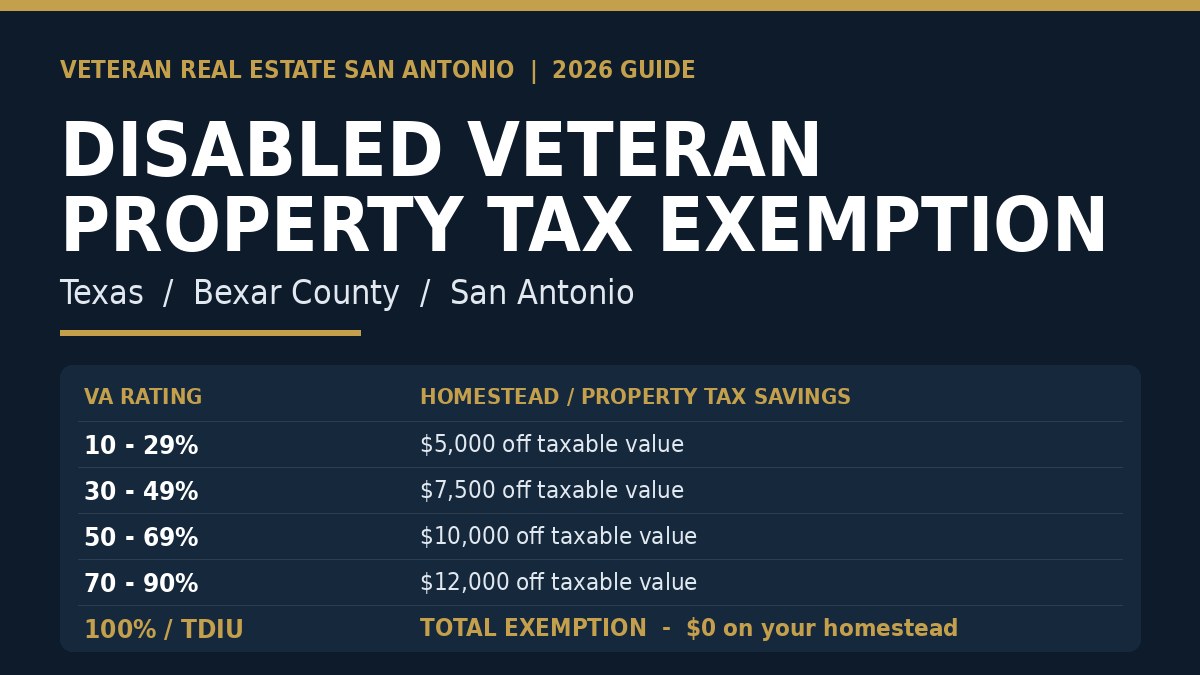
- How much is the partial exemption by disability rating?
- How do I apply in San Antonio and Bexar County?
- Can a surviving spouse keep the exemption?
- How does the exemption affect my VA loan and monthly payment?
- Frequently asked questions
What Is the Texas Disabled Veteran Property Tax Exemption?
Texas treats disabled veterans better than almost any state in the country on property taxes. The benefit comes in two forms set by the Texas Property Tax Code. The first is a total exemption under Tax Code Section 11.131 for veterans rated 100 percent disabled. The second is a partial exemption under Section 11.22 for veterans rated between 10 and 90 percent. Both are administered locally, which in San Antonio means the Bexar Appraisal District.
This matters more here than in most cities. San Antonio is home to Joint Base San Antonio, one of the largest military concentrations in the Department of Defense, and Bexar County has one of the highest populations of veterans and military retirees in Texas. A large share of the buyers and sellers I work with carry a VA disability rating, and many do not realize how much the exemption can change their housing math.
Who Qualifies for the 100 Percent Total Exemption?
The total exemption is tied to your VA rating, not to a dollar cap. Under Texas Tax Code Section 11.131, if the VA has determined that you are 100 percent disabled, or that you are paid at the 100 percent rate due to individual unemployability, the entire taxable value of your homestead is exempt. You pay no property tax on the home you live in.
The key word is homestead. The total exemption applies to the one property you occupy as your principal residence. A vacation home, a rental, or land you do not live on does not receive the 100 percent benefit, although it may still qualify for the partial exemption described below.
You can also receive the exemption in the year you qualify, prorated from the date your rating becomes effective. If your 100 percent rating is granted partway through the year, you do not have to wait until January to start saving. For the most current rules and forms, the Texas Comptroller maintains an official guide to property tax exemptions for disabled veterans.
Planning a move to the area on a disability rating? If you are PCSing to JBSA or relocating to San Antonio, I can help you map the exemption to specific neighborhoods.
How Much Is the Partial Exemption by Disability Rating?
The partial exemption is a fixed dollar reduction, not a percentage. Under Texas Tax Code Section 11.22, a veteran with a service-connected disability rating below 100 percent can subtract a set amount from the taxable value of a single property. Unlike the total exemption, the partial exemption can be applied to any one property the veteran owns, not only the homestead.
| VA Disability Rating | Exemption Amount Off Taxable Value | Applies To |
|---|---|---|
| 10 to 29 percent | $5,000 | One owned property |
| 30 to 49 percent | $7,500 | One owned property |
| 50 to 69 percent | $10,000 | One owned property |
| 70 to 90 percent | $12,000 | One owned property |
| 100 percent or unemployability | Total exemption | Residence homestead |
Source: Texas Property Tax Code Sections 11.131 and 11.22, as administered by the Bexar Appraisal District. Verify current amounts and your eligibility directly with BCAD before relying on these figures.
There is also a special rule worth knowing. A veteran who is 65 or older and has a disability rating of at least 10 percent, or who is blind, or who has lost the use of a limb, may qualify for the maximum $12,000 partial exemption regardless of the specific rating percentage. Veterans who received a homestead donated by a charitable organization may qualify for an exemption percentage that matches their disability rating under Section 11.132.
How Do I Apply in San Antonio and Bexar County?
In San Antonio, the exemption is granted by the appraisal district, not the tax collector. People often call the Bexar County Tax Assessor-Collector first, but exemptions are decided by the Bexar Appraisal District. You can find the forms and filing instructions on the official BCAD website at bcad.org.
Here is the basic sequence I walk veteran clients through:
- Confirm your rating. Pull your current VA disability award letter from the VA. You can request it through va.gov. The letter must show your rating percentage and effective date.
- Establish your homestead. The total exemption requires that the home be your principal residence. If you have not already filed a general residence homestead exemption (Form 50-114), file it at the same time.
- File the disabled veteran exemption. Submit the disabled veteran application (Form 50-135) to BCAD with your award letter attached.
- Watch the deadline. The standard deadline is April 30 of the tax year. If you miss it, do not assume you are out of luck. Texas permits late applications for disabled veteran exemptions for up to five years, and the district can apply the benefit retroactively.
If you are buying a home this year, you can often start the homestead and exemption paperwork as soon as you close, and the appraisal district will prorate the benefit. The Texas Comptroller publishes the statewide forms and a plain-language overview at the Texas Comptroller property tax exemptions page.
Can a Surviving Spouse Keep the Exemption?
Texas protects surviving spouses, and this is one of the most overlooked parts of the benefit. If a 100 percent disabled veteran passes away, the surviving spouse can keep the total homestead exemption provided they do not remarry and the property remains their residence homestead. In some cases the spouse can carry a dollar amount of the exemption to a new home if they move.
There is a separate and equally important benefit for the surviving spouse of a service member who was killed or fatally injured in the line of duty. That spouse may qualify for a total exemption on their residence homestead as well. These rules have specific documentation requirements, so it is worth confirming the details with BCAD and a tax professional.
How Does the Exemption Affect My VA Loan and Monthly Payment?
This is where the exemption becomes a buying-power tool, not just a refund. When a lender qualifies you for a VA loan, they calculate PITI, which stands for principal, interest, taxes, and insurance. In San Antonio, property taxes are a substantial part of that number. For a 100 percent disabled veteran with a homestead exemption, the tax portion can effectively drop to zero on the home they live in.
Combine that with the VA funding fee waiver that disabled veterans already receive, and the financial advantage stacks quickly. A disabled veteran buying in Bexar County can avoid the funding fee at closing and carry little to no property tax going forward. To see the closing-side savings, my guide to VA loan closing costs in San Antonio breaks down what the funding fee waiver is worth, and my overview of how a VA loan works for first-time military buyers walks through the full process.
One caution: most lenders will still escrow taxes initially based on the prior owner's tax bill. Once your exemption posts with BCAD, you can ask your servicer to re-analyze the escrow account, which usually produces a refund and a lower monthly payment. If you are weighing whether to keep a home as a rental during a PCS, remember the total exemption only follows your homestead, a factor I cover in my keep, sell, or rent PCS decision framework.
About the Author: Christopher Beal
Christopher Beal is a U.S. Army veteran and the Owner of Veteran Real Estate San Antonio, brokered by eXp Realty (TREC License #723559). He specializes in helping military families, veterans, and surviving spouses buy and sell homes across San Antonio and the surrounding counties of Bexar, Comal, Kendall, Medina, and Bandera. His practice is built around the realities of military life: PCS timelines, VA loans, disability benefits, and the financial decisions that come with serving. Christopher has personally navigated a PCS and the VA homebuying process, and he brings that firsthand experience to every veteran client. He can be reached at (210) 882-8583.
Explore More Resources
Frequently Asked Questions
Does a 100 percent disabled veteran pay any property tax in Texas?
On their residence homestead, no. A veteran with a 100 percent VA disability rating, or a 100 percent rating due to individual unemployability, receives a total exemption from property taxes on the home they occupy as their principal residence in Texas.
Where do I apply for the disabled veteran exemption in San Antonio?
You apply through the Bexar Appraisal District (BCAD) at bcad.org, not the city or the county tax collector. You will submit the disabled veteran exemption application along with your VA disability award letter.
What is the filing deadline for the exemption?
The standard deadline is April 30 of the tax year. However, Texas allows late applications for disabled veteran exemptions for up to five years, and the benefit can be applied retroactively when approved.
Can I get the exemption on a rental property or second home?
The 100 percent total exemption applies only to your residence homestead. The partial exemption for ratings of 10 to 90 percent can be applied to one property you own, which does not have to be your homestead.
How much is the partial exemption if I am rated 50 percent?
A veteran rated 50 to 69 percent qualifies for a $10,000 exemption subtracted from the taxable value of one owned property. Veterans 65 or older with at least a 10 percent rating may qualify for the maximum $12,000 amount.
Can my spouse keep the exemption if I pass away?
Yes. A surviving spouse who has not remarried and continues to occupy the home can keep the 100 percent homestead exemption. Surviving spouses of service members killed in the line of duty may also qualify for a total exemption.
Does the exemption lower my mortgage payment?
It can significantly. Once the exemption posts with BCAD, you can ask your loan servicer to re-analyze your escrow account. Removing property taxes from your monthly PITI usually lowers the payment and often produces an escrow refund.
Do I need to reapply every year?
Generally no. Once the disabled veteran exemption is granted, it typically remains in place as long as you qualify and own the home, though BCAD may occasionally request updated documentation.
Have questions about how a disability rating changes your home search or your monthly payment in San Antonio? Call Christopher Beal at (210) 882-8583 or request a free consultation. As a fellow veteran, I will give you a straight answer.
Categories
- All Blogs (323)
- Alamo Heights (4)
- awards (3)
- Best Neighborhoods in San Antonio (14)
- Buyer (13)
- Buyer Education (77)
- Community Events (4)
- Hill Country (16)
- JBSA (34)
- Local Guide (6)
- Luxury (27)
- Luxury Real Estate (24)
- Market Trends (5)
- Market Update (14)
- Military Relocation (97)
- Military Retirement (3)
- Mortgage (18)
- Neighborhood Guides (17)
- neighborhoods (5)
- New Construction (16)
- PCS (30)
- Real Estate (33)
- reviews (2)
- San Antonio (54)
- San Antonio Lifestyle (4)
- San Antonio Market (5)
- San Antonio Neighborhoods (40)
- San Antonio Real Estate (67)
- San Antonio, Veterans Resources, VA Loans (5)
- Seller (27)
- VA Home Loans (28)
- VA Loans (33)
- Va Loans & Financing (26)
- Veterans (8)
- Veterans Resources (39)
Recent Posts