Buying a Home in San Antonio (2026): The Complete Step-by-Step Guide
LAST UPDATED: AUGUST 31, 2026 | BY CHRISTOPHER BEAL, U.S. ARMY VETERAN & REALTOR
Buying a home in San Antonio in 2026 is a different exercise than it was three years ago. Inventory is deep, homes are sitting, and sellers are negotiating again. The buyers who do well here are not the ones who move fastest. They are the ones who arrive with clean financing, a written cost picture that includes Texas property taxes and insurance, and an agent who knows which Bexar County submarkets are actually softening and which are not.
This guide walks the entire purchase from the first budget conversation through the moment the title company hands you keys, with current SABOR MLS numbers, the Texas-specific rules that trip up out-of-state buyers, and the VA loan details that matter near Joint Base San Antonio.
Who Is Answering These Questions?
I am Christopher Beal, a U.S. Army veteran and the Owner of Veteran Real Estate San Antonio, a Beal Group practice brokered by eXp Realty (TREC License #723559). My practice was named Best Real Estate Agency in the 2026 Best of San Antonio Readers Choice by San Antonio Current voters, and I have been named a San Antonio Business Journal Top 25 Individual Agent three years running. I am a 7-time eXp Realty ICON agent, a Military Relocation Professional, and I hold 5.0 stars across 370+ verified reviews after helping 325+ families buy and sell here.
Everything below is what I tell my own buyer clients in the first meeting.
What Does the San Antonio Market Actually Look Like Right Now?
Numbers first, because most of the advice you will read online is written for a national market that does not exist in Bexar County. The figures below come from the SABOR MLS (LERA), pulled on August 31, 2026, covering closings from June 2 through August 31, 2026 on a 1,000-sale sample of the most recent residential transactions.
| Metric | Bexar County | City of San Antonio |
|---|---|---|
| Median closed price | $279,990 | $285,000 |
| Average closed price | $336,380 | $333,237 |
| Average days on market (sold) | 74 | 74 |
| Sold price per square foot | $158.65 | $158.52 |
| Close-to-list ratio | 98.83% | 98.69% |
| Median active list price | $295,072 | $299,000 |
| Active asking price per square foot | $167.37 | $168.06 |
Three things in that table matter more than the headline median.
- Sellers are asking about 5.5 percent more per square foot than buyers are paying. Asking is roughly $167 to $168 per square foot; closings are landing near $158.60. That gap is your negotiating room, and it is why paying list price on a home that has been sitting is usually a mistake.
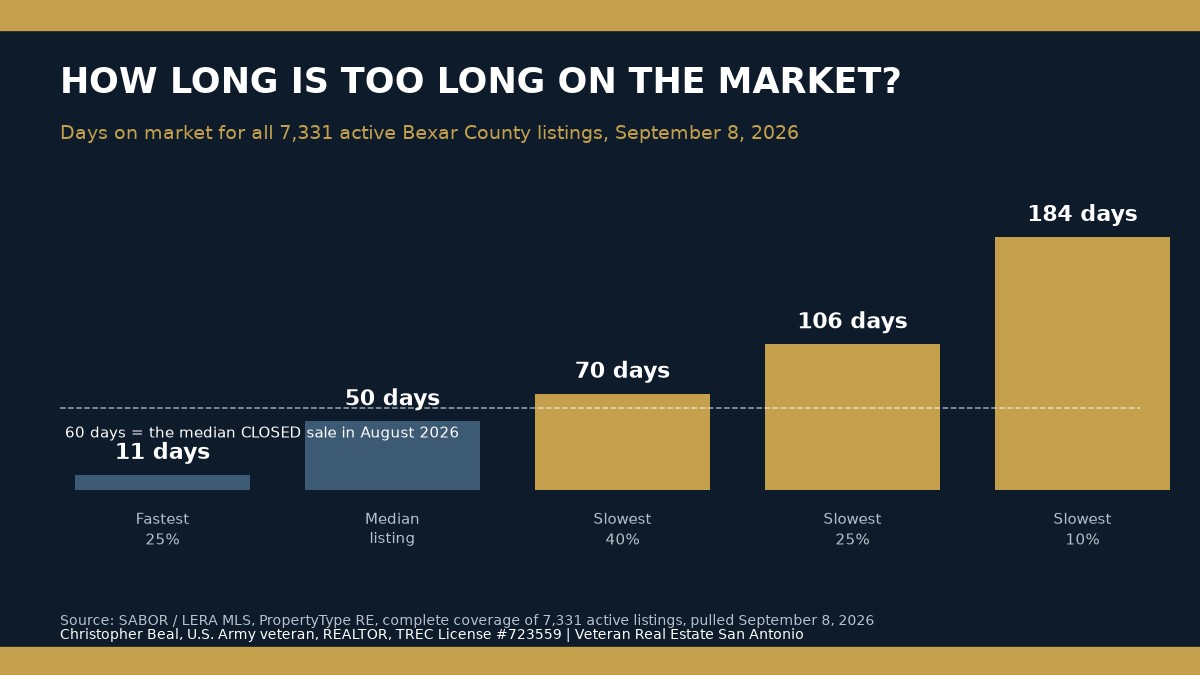
- Seventy-four days on market is a real number, not an outlier. Active listings are averaging about 71 days on market as well, which means the pipeline is not clearing quickly. You have time to inspect, to think, and to walk away.
- A close-to-list ratio just under 99 percent tells you the average accepted offer is coming in about one percent under asking, before seller-paid closing costs and repairs are counted. Concessions do not show up in that ratio, and in 2026 concessions are where much of the real discount lives.
For the full forward-looking picture, see my San Antonio housing market report, which I rebuild every month on complete closed data.
How Much Money Do You Actually Need to Buy a Home in San Antonio?
The down payment is the number everyone asks about and the one that matters least. What sinks deals here is the total cash-to-close picture, which in Texas is heavier than buyers from other states expect.
Down payment
- VA loan: zero down for eligible service members, veterans, and surviving spouses. See the VA home loan program for eligibility.
- FHA: 3.5 percent down with a qualifying credit score.
- Conventional: as little as 3 percent for a qualified first-time buyer, though 5 to 20 percent is more common.
- USDA: zero down in eligible rural areas, which in this market means parts of Medina, Atascosa, and Wilson counties, not the city core.
On a median San Antonio home at $285,000, that is roughly $9,975 down on FHA and nothing down on VA. If you are weighing the two main paths, my VA loan versus conventional loan comparison runs the math side by side.
Closing costs
Budget 2 to 5 percent of the purchase price. On a $285,000 home that is roughly $5,700 to $14,250, covering lender origination, appraisal, title policy, survey, recording, and prepaid escrows. Texas title practice means the seller customarily pays for the owner title policy, which helps, but prepaid taxes and insurance are where the number swells.
Earnest money and option fee
Earnest money in Bexar County typically runs 1 percent of the sale price, deposited with the title company within three days of a fully executed contract. The option fee is separate, usually $200 to $600, paid directly to the seller, and it is what buys you the right to walk away during the option period. Both are credited to you at closing if you proceed.
The number people forget: property taxes
Texas has no state income tax, and it makes that up on property. Combined rates across Bexar County school, city, county, hospital, and special districts commonly land in the 2.1 to 2.6 percent range of assessed value. On a $285,000 home that is roughly $500 to $620 per month folded into your escrow payment. Check the actual rate for any specific address at the Bexar Appraisal District before you fall in love with a house.
What Is the Difference Between Pre-Qualification and Pre-Approval?
This is the single most expensive misunderstanding in the process, and it costs buyers houses.
Pre-qualification is a conversation. You tell a loan officer what you earn and what you owe, and they tell you what you can probably borrow. Nothing is verified. It takes ten minutes and it is worth roughly what it costs.
Pre-approval means a lender has pulled your credit, collected pay stubs, W-2s or LES, bank statements, and tax returns, and run the file through automated underwriting. You get a letter with a specific loan amount, a specific loan type, and an expiration date.
In a 74-day market, sellers are not fielding twelve offers. But they are still choosing between two or three, and a verified pre-approval on a serious lender letterhead is the difference between your offer being taken seriously and being treated as a placeholder.
What to bring your lender
- Two years of W-2s or tax returns; if you are military, your two most recent LES statements
- Thirty days of pay stubs
- Two months of statements on every account you would draw from for closing
- For VA: your Certificate of Eligibility, plus your DD-214 if you have separated
- Documentation of any large or non-payroll deposit, because underwriting will ask
What credit score do you need?
The VA sets no minimum score; individual lenders do, and in this market most San Antonio VA lenders want 580 to 620. Conventional financing generally starts at 620 and prices meaningfully better at 740 and above. My guide to VA loan credit score requirements in San Antonio covers the lender-by-lender reality. If your debt-to-income ratio is the tighter constraint, read the VA residual income and DTI guide, because residual income is the test that actually decides most VA files.
One warning that saves deals: from pre-approval through funding, do not open credit, do not finance furniture, do not change jobs, and do not move large sums between accounts without telling your loan officer first.
How Do You Search for a Home Here Without Wasting Three Months?
San Antonio is geographically enormous and the submarkets behave very differently. A 20-minute difference in commute can mean a 30 percent difference in price per square foot. Decide the following before you tour anything.
Anchor on commute, then on schools, then on style
If you are reporting to Lackland, Randolph, Fort Sam Houston, or Camp Bullis, the base you drive to should set your search box before anything else. I keep a current breakdown in Best Neighborhoods Near JBSA, and school attendance is mapped in Best School Districts Near JBSA Bases. Attendance zones do not follow city boundaries in Bexar County and they change. Verify the zone for the specific address, never the neighborhood name.
Know what your budget buys, by area
- Far West and Northwest (78253, 78254, 78251): the volume market for new construction and the most common landing zone for Lackland-bound buyers. Builder incentives here are aggressive in 2026 and often beat resale on total cost.
- Northeast and Schertz-Cibolo corridor: the Randolph commute, strong schools, steady resale.
- North Central (78230, 78231, 78248): established, mature trees, higher price per square foot, shorter commutes almost everywhere.
- Inner city and Southtown: historic stock, walkability, wide condition variance. Inspections matter more here than anywhere else in the county.
- Alamo Heights and the 78209 ring: the premium in-town market, its own school district, and its own pricing logic.
- Hill Country edge, Helotes, Bulverde, and New Braunfels: more land, longer drives, and Comal or Kendall County tax rates rather than Bexar.
Three San Antonio specifics to check on every listing
- Foundation. Bexar County expansive clay soils move. Slab cracks, doors that stick, and separations at brick joints are worth a structural engineer, not a general opinion.
- MUD and PID districts. Newer far-suburban subdivisions can carry a Municipal Utility District or Public Improvement District assessment on top of ordinary property tax. It is disclosed, and buyers skim past it constantly.
- Flood. Much of the metro sits near creeks that behave badly in a Hill Country rain event. Check the address on the FEMA Flood Map Service Center.
What Makes an Offer Competitive in a 74-Day Market?
In 2022 the answer was price and speed. In 2026 it is structure. When a home has been listed 74 days, the seller is no longer optimizing for the highest number. They are optimizing for the offer most likely to actually close.
The levers that matter, in order
- Certainty of financing. A full pre-approval, a lender the listing agent can call, and a realistic appraisal expectation.
- Closing timeline that matches the seller. Some sellers need 45 days because they are buying. Some need 21 because they have PCS orders. Ask before you write.
- Option period length. Ten days is generous to you and reads as slow to a seller. Seven is standard in Bexar County and rarely costs you anything.
- Price. Yes, fourth. On a home 60-plus days on market, a well-structured offer 3 to 5 percent under asking with seller-paid closing costs regularly beats a sloppier offer at list.
Ask for concessions, not just a lower price
This is the piece most buyers under-use. A seller who will not drop the price another $8,000 will frequently pay $8,000 toward your closing costs or toward a permanent rate buydown, because it protects their reported sale price and their comparable sales. The monthly-payment effect of a buydown is often larger than the same money applied to price. Run both scenarios with your lender before you decide which to ask for.
Know what you are signing
Texas residential purchases run on promulgated forms from the Texas Real Estate Commission. The One to Four Family Residential Contract plus the Third Party Financing Addendum, and for VA or FHA the appropriate loan addendum, are the core documents. They are standardized, which means the negotiation happens in the blanks: price, option fee, option period, closing date, survey, title objections, and who pays what.
How Does the Texas Option Period Actually Work?
The option period is the strongest buyer protection in Texas real estate and out-of-state buyers routinely misuse it.
For a negotiated fee paid directly to the seller, you buy an unrestricted right to terminate for any reason or no reason during a set number of days. Not an inspection contingency. Not a financing contingency. An unconditional walk-away window.
Rules that catch people
- It is calendar days, not business days, and it starts the day after the contract is fully executed.
- Notice must be delivered in writing before the deadline. Miss it by an hour and the right evaporates; you are then held to the ordinary contingencies only.
- The option fee is not refundable, though it is credited to you at closing if you close.
- Earnest money is returned if you terminate properly within the period.
Use the window properly
Schedule the general inspection for day one or two, not day five. That leaves room for the specialists a general inspection triggers: structural engineer for foundation, HVAC technician on any unit over ten years old, sewer scope on pre-1980 inner-city stock, roof and hail assessment, and a termite report. San Antonio roofs take hail; insurers now underwrite roof age aggressively, and a 15-year-old roof can quietly cost you a policy.
Then renegotiate. Repairs, a price reduction, or a closing-cost credit are all fair asks off inspection findings, and in a 74-day market sellers usually engage. What you cannot do is discover the problem on day eight and expect leverage.
Read the seller disclosure carefully
Texas requires most sellers to deliver a written Seller Disclosure Notice covering known defects, prior repairs, flooding history, and more under Chapter 5 of the Texas Property Code. It is a disclosure of what the seller knows, not a warranty, and the gaps in it are often more informative than the checkmarks. I break down exactly what has to be disclosed in the Texas Seller Disclosure Notice guide.
What Happens If the Appraisal Comes In Low?
With asking prices running about 5.5 percent above closed prices per square foot, low appraisals are a live risk in 2026, particularly on new construction and on homes priced off 2022 comparables.
The appraiser works for the lender. Their job is to confirm the home secures the loan. If a $300,000 contract appraises at $288,000, your lender will lend against $288,000, and the $12,000 gap has to be resolved.
Your four options
- Seller reduces to appraised value. Most common outcome in the current market, especially on a home that has been sitting.
- Split the difference. Seller drops part, you bring part in cash.
- You cover the gap in cash. It is not part of the down payment and it is not financeable.
- Terminate. If your financing addendum is written correctly, a low appraisal lets you walk with earnest money returned.
The VA has its own version
A VA appraisal produces a Notice of Value and also enforces Minimum Property Requirements: safe access, working systems, a sound roof, no exposed wiring, no active leaks, functioning heat. If the home fails MPR, repairs must happen before closing or the loan does not fund.
The VA also carries a protection nothing else does. The VA Amendatory Clause lets a VA buyer terminate and recover earnest money if the property appraises below the contract price, regardless of what else the contract says. That clause is why a well-written VA offer is not the weak offer some listing agents still assume it is, and it is worth explaining directly to the seller side when you present.
If you are unsure whether a list price is defensible at all, the fix is a real comparative market analysis rather than an automated estimate. I explain the difference in how to get a real home valuation instead of a Zestimate.
What Does Underwriting Look At Once You Are Under Contract?
Between the option period and closing, the file moves to underwriting, and this is where quiet mistakes become loud ones.
The underwriter re-verifies income, employment, assets, and credit, orders the appraisal and title work, and reviews the flood determination and insurance binder. Most files clear with conditions: a letter explaining a deposit, an updated statement, proof a collection was paid.
What to do
- Answer document requests the same day. Underwriting delays are almost always document delays.
- Bind homeowners insurance early. In San Antonio, roof age and prior hail claims can force a second or third quote; starting in week one avoids a closing-date scramble.
- Keep your bank statements boring. Every non-payroll deposit needs a paper trail.
What not to do
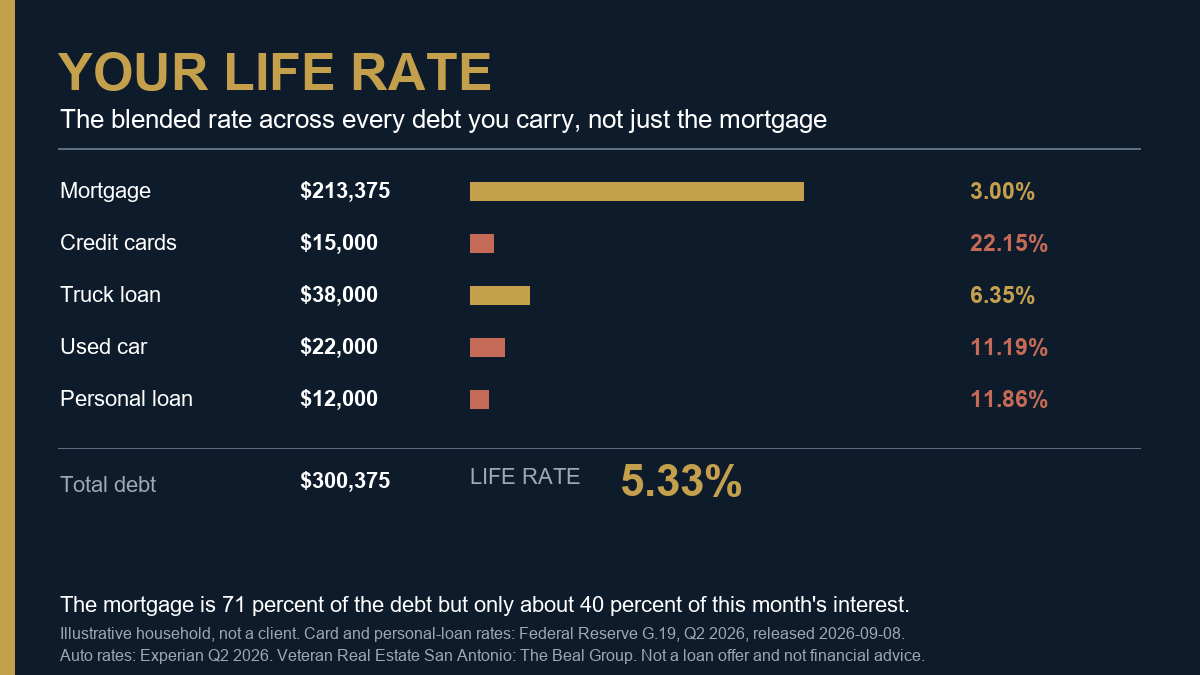
- Do not buy a car, a truck, or furniture on credit. A new payment can push your debt-to-income over the line days before closing.
- Do not open or close credit accounts.
- Do not change jobs, and do not move from salary to commission or to self-employment.
- Do not accept a large gift without documenting it as a gift, on the correct form, from an eligible source.
Lenders re-pull credit shortly before funding. What you did in week two shows up in week five.
What Actually Happens on Closing Day in Texas?
Texas closes at a title company, not with an attorney at the table. Practically, that makes closing day short and predictable.
- Final walkthrough, usually the day before or the morning of. You are confirming negotiated repairs were completed, the home is in the condition you agreed to, and appliances that convey are present and functioning.
- Review the Closing Disclosure. Federal rules require you receive it at least three business days before closing. Compare it line by line against your Loan Estimate and ask about anything that moved.
- Wire your funds. Wire the day before, directly from the title company instructions you confirmed by phone at a number you looked up yourself. Wire fraud in real estate is common and unrecoverable. Never trust wiring instructions that arrive or change by email.
- Sign. Roughly 45 minutes of documents with a photo ID.
- Funding and recording. The lender funds, the deed records with Bexar County, and the title company releases keys. On a purchase this normally happens the same day.
My full walkthrough of the sequence, including who pays what, is in How Does the Closing Process Work in San Antonio.
How Long Does the Whole Thing Take?
From first lender call to keys, plan on 60 to 90 days. The realistic breakdown in San Antonio right now:
| Stage | Typical time |
|---|---|
| Credit repair or savings runway, if needed | 1 to 6 months |
| Full pre-approval | 2 to 5 business days |
| Active search and touring | 3 to 8 weeks |
| Offer to fully executed contract | 1 to 4 days |
| Option period and inspections | 7 to 10 days |
| Appraisal ordered to report delivered | 7 to 14 days |
| Underwriting to clear-to-close | 2 to 4 weeks |
| Closing day | 1 day |
A conventional file with a responsive borrower closes in about 30 days from contract. VA files average a few days longer, mostly because of appraisal scheduling, not underwriting. A cash purchase can close in 10 to 14 days, limited only by title work.
If you are on PCS orders, work backward from your report date and add two weeks of slack. The most common relocation mistake I see is a closing date set so tight that a single appraisal delay forces a hotel stay and a second household goods move.
What Is Different About Buying With a VA Loan Near JBSA?
San Antonio is Military City USA, and roughly half my closings involve a VA loan. The mechanics are worth knowing whether or not you are using one.
- Zero down, no monthly mortgage insurance. On a $285,000 purchase, that is the difference between needing roughly $10,000 at the table and needing closing costs only, and it removes an FHA-style insurance premium from the payment permanently.
- The funding fee is financeable and is waived entirely for veterans receiving VA compensation for a service-connected disability.
- Sellers may pay all of your closing costs plus up to 4 percent of the price in concessions, which is more generous than most loan types allow.
- BAH is qualifying income. If you are on orders to Lackland, Randolph, Fort Sam Houston, or Camp Bullis, your housing allowance can be used to qualify. I map what it buys in the 2026 JBSA BAH buying power guide.
- Entitlement is reusable, and second-tier entitlement lets many service members keep a first San Antonio home as a rental and still buy at the next duty station.
One thing to insist on: use a lender and an agent who close VA files regularly. VA-specific items like the Amendatory Clause, MPR repairs, and termite reporting are routine to people who do this weekly and are a source of blown closing dates to people who do not.
What Do First-Time San Antonio Buyers Get Wrong?
After 325+ closings, the same six mistakes account for most of the pain.
- Budgeting on principal and interest only. Texas property taxes and Texas insurance are not rounding errors. Always price a home on the full escrowed payment.
- Touring before pre-approval. You will fall in love above your range, and every home after that will feel like a downgrade.
- Waiving inspections to look strong. In a 74-day market this buys you nothing and can cost you a foundation.
- Skipping the survey question. Ask early whether an existing survey can be used or whether a new one is required, because it affects both cost and timeline.
- Ignoring HOA documents. Transfer fees, capital contributions, and use restrictions are all in the resale certificate, and they are all negotiable line items before you sign.
- Assuming the builder representative works for them. In a new-construction community, the on-site agent represents the builder. Bring your own agent to the first visit; almost every San Antonio builder pays buyer agency, and registration rules mean showing up alone can disqualify your representation permanently.
If you have never bought before, San Antonio also has real down payment assistance. Start with the Consumer Financial Protection Bureau homebuying tools for a neutral baseline, then ask me which local and state programs your income and target area qualify for.
Frequently Asked Questions About Buying a Home in San Antonio
How much do I need to make to buy a home in San Antonio in 2026?
On the median $285,000 San Antonio home with 5 percent down, a full escrowed payment including Bexar County property taxes and insurance commonly lands in the $2,300 to $2,600 range depending on rate and district. Using a 30 percent housing ratio, that generally implies a household income near $92,000 to $104,000. VA borrowers are often approved lower, because VA underwriting weighs residual income rather than a simple ratio.
Is 2026 a good time to buy in San Antonio?
For a buyer who plans to stay three to five years or longer, the current market is favorable. Inventory is deep, average days on market is 74, closings are landing about 5.5 percent per square foot below asking, and sellers are paying concessions. That combination did not exist in 2021 or 2022. The risk is buying a home you cannot hold, not buying at the wrong moment in the cycle.
What credit score do I need to buy a house in San Antonio?
Conventional financing generally starts at 620 and prices best at 740 or above. FHA can go to 580 with 3.5 percent down. The VA sets no minimum, but most San Antonio VA lenders want 580 to 620. Every 20-point improvement is real money over 30 years, so if you are within a few months of a better tier, it is usually worth waiting.
How long is the option period in Texas?
It is negotiated, not fixed. Seven days is the Bexar County norm, ten is common on older homes, and three to five appears on competitive new listings. It runs on calendar days beginning the day after the contract is executed, and written termination notice must be delivered before the deadline.
Do I need a real estate agent to buy in San Antonio?
You are not required to have one. You are also not saving money by skipping one, because the listing agent represents the seller and the seller has already contracted for the marketing side of the commission. Without your own representation you negotiate the contract, the inspection response, and the appraisal gap against a licensed professional whose duty runs to the other party.
What are property taxes like in San Antonio?
Texas has no state income tax and funds local government through property tax. Combined rates across Bexar County school, city, county, hospital, and special districts commonly fall in the 2.1 to 2.6 percent range of assessed value. Apply for your homestead exemption the year after you take ownership; it lowers your taxable value and caps annual increases on your primary residence. Verify the rate for any specific address at the Bexar Appraisal District and review statewide exemption rules with the Texas Comptroller.
Can I buy a home in San Antonio before I arrive on PCS orders?
Yes, and many of my clients do. Video walkthroughs, remote inspection attendance, and remote or mail-away closing are all routine here. The pieces to arrange in advance are your power of attorney if you will not be present, your Certificate of Eligibility, and a closing date that leaves room for an appraisal delay ahead of your report date.
How much are closing costs for a buyer in San Antonio?
Plan on 2 to 5 percent of the purchase price, roughly $5,700 to $14,250 on a $285,000 home. That covers lender fees, appraisal, title, survey if required, recording, and prepaid taxes and insurance. In the current market sellers frequently pay part or all of it, especially on listings past 60 days.
Should I buy new construction or resale in San Antonio?
In 2026 builder incentives on the far West and Northwest sides are unusually strong, and a builder rate buydown can beat a resale home priced $15,000 lower on total monthly cost. Resale gives you mature trees, finished landscaping, established schools, and a shorter commute in most of the county. Price both on the full monthly payment and on the drive you will actually make every day, not on sticker price.
What is the biggest mistake military buyers make in San Antonio?
Buying at the top of what BAH approves and treating the home as a three-year hold. A short hold in a market with 74 days on market and modest appreciation can mean selling into transaction costs. Buy something you would be comfortable renting out at the next set of orders, and the math survives a PCS.
About the Author
Christopher Beal is a U.S. Army veteran and the Owner of Veteran Real Estate San Antonio, a Beal Group practice brokered by eXp Realty (TREC License #723559). A Military Relocation Professional (MRP) and VAREP member, he is a 7-time eXp Realty ICON agent, winner of Best Real Estate Agency in the 2026 Best of San Antonio Readers Choice (San Antonio Current, 100,000+ voters), and a 3x San Antonio Business Journal Top 25 Individual Agent (#13 in 2024, #14 in 2025, #20 in 2026). His recognition also includes 3x Platinum Top 50, 2x RateMyAgent Agent of the Year, 2x Real Producers Top 100, Five Star Professional (2026), and a RealTrends 2026 ranking. He has helped 325+ families, closed more than $125M in career volume, and holds 5.0 stars across 370+ verified reviews, working almost exclusively with military and veteran buyers and sellers across Bexar, Comal, Kendall, Medina, and Bandera counties, with a focus on VA loans, PCS moves, and homebuying near JBSA-Lackland, JBSA-Randolph, and Fort Sam Houston. He represents buyers personally from the first budget conversation through closing day, with no handoff to a junior agent. He can be reached at (210) 882-8583.
Explore More Resources
- San Antonio Housing Market Report 2026
- VA Loan vs Conventional Loan in San Antonio
- What Credit Score Do You Need for a VA Loan?
- 2026 JBSA BAH Rates and Buying Power
- Best Neighborhoods Near JBSA
- Best School Districts Near JBSA Bases
- How the Closing Process Works in San Antonio
- The Texas Seller Disclosure Notice Explained
- Alamo Heights Real Estate Guide
- Southtown San Antonio Real Estate Guide
Ready to Start Your San Antonio Home Search?
If you want a straight read on what your budget buys in a specific part of Bexar County, or you are inbound on PCS orders and need a timeline that will not fall apart, call or text me at (210) 882-8583. I will tell you what the numbers actually support, including when the honest answer is to wait.
Data note: market figures in this guide come from the SABOR MLS (LERA), pulled August 31, 2026, covering closings from June 2 through August 31, 2026 on a 1,000-sale sample of the most recent Bexar County and City of San Antonio residential transactions. This article is general information, not legal, tax, or lending advice.
Categories
- All Blogs (354)
- Alamo Heights (4)
- awards (4)
- Best Neighborhoods in San Antonio (13)
- Buyer (16)
- Buyer Education (86)
- Community Events (4)
- Hill Country (17)
- JBSA (43)
- Local Guide (6)
- Luxury (28)
- Luxury Real Estate (26)
- Market Trends (19)
- Market Update (14)
- Military Relocation (111)
- Military Retirement (3)
- Mortgage (19)
- Neighborhood Guides (18)
- neighborhoods (5)
- New Construction (16)
- PCS (42)
- Real Estate (40)
- reviews (3)
- San Antonio (53)
- San Antonio Lifestyle (4)
- San Antonio Market (5)
- San Antonio Neighborhoods (43)
- San Antonio Real Estate (100)
- San Antonio, Veterans Resources, VA Loans (5)
- Seller (55)
- VA Home Loans (30)
- VA Loans (35)
- Va Loans & Financing (27)
- Veterans (10)
- Veterans Resources (40)
Recent Posts