Sell First or Buy First in San Antonio (2026)? The Order That Protects Your Equity
Last Updated: September 5, 2026
Sell first. For most San Antonio homeowners in 2026, listing before you buy is the lower-risk order, because Bexar County homes are taking about 57 days at the median to go under contract and closing at 99.7 percent of list price. Buying first only makes sense when you have the cash reserves to carry two payments, or a specific reason you cannot move twice.

I am Christopher Beal, an Army veteran, a Texas-licensed agent at eXp Realty, and the Owner of Veteran Real Estate San Antonio: The Beal Group. We were voted Best Real Estate Agency in the 2026 Best of San Antonio Readers Choice awards. I am a 3x San Antonio Business Journal Top 25 Individual Agent and a 7x eXp ICON award winner, with 325+ homes sold and $125M+ in career volume across Bexar, Comal, Kendall, Medina and Bandera counties.
Key Takeaways for San Antonio Move-Up Sellers
- Selling first is the default in a 57-day market. You negotiate your purchase with cash in hand instead of a contingency nobody wants to accept.
- Bexar County is balanced, not fast. Median sold price is $300,000, list-to-sale is 99.7 percent, and median days on market is 57 for the trailing 90 days in the SABOR MLS.
- A post-closing leaseback is the tool most people are missing. It lets you sell first and still sleep in your house for 30 to 60 days while you close on the next one.
- Buy first only with reserves. If carrying both payments for three months would strain you, the math has already answered the question.
- PCS orders change the calculus. A hard report date usually means sell first and rent on the far end rather than gamble on two closings lining up.
The Three Numbers That Actually Decide This
Almost every sell-first-or-buy-first conversation gets settled by three figures, not by feelings. I pulled these from the San Antonio Board of REALTORS (SABOR) MLS through the RESO feed for Bexar County closings between June 4 and September 2, 2026. The median price and median days on market are computed over the full population of roughly 5,750 closings, not a sample; the list-to-sale ratio is from a 1,000-closing sample and will be re-derived on the next refresh. Corrected September 5, 2026.
| Number | Bexar County, trailing 90 days | What it means for your order of operations |
|---|---|---|
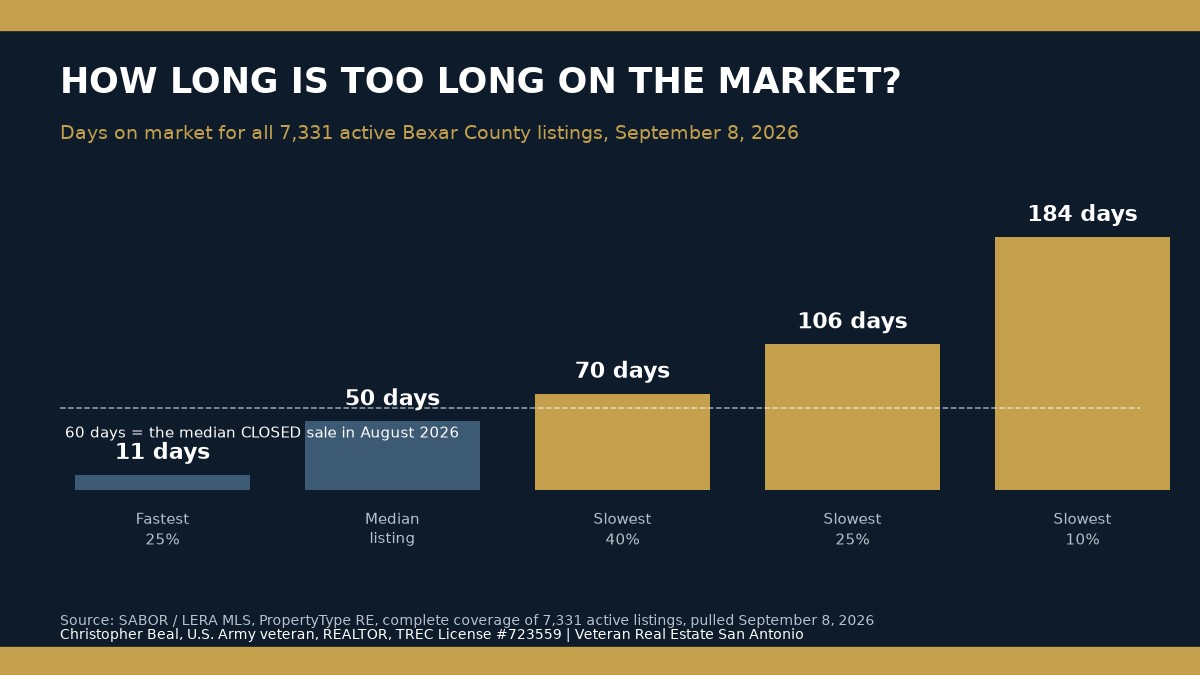
| Median days on market | 57 days | Budget roughly two months from list to close. This is the number that kills most buy-first plans. |
| List-to-sale ratio | 99.7 percent | Priced right, you are not giving up much at the table, so there is little reward for a rushed sale. |
| Median sold price | $300,000 | Your equity is real but finite. Two payments against a $282K asset gets expensive fast. |
Notice what those numbers do together. A 57-day median with a 99.7 percent list-to-sale ratio describes a market that is steady but deliberate. Homes are selling for close to asking, but they are not selling in a weekend. In 2021, buying first was defensible because you could reasonably assume your San Antonio home would be gone in nine days. That assumption is dead. Anyone still planning around it is planning around a market that no longer exists.
Sell First: How It Works and Who It Fits
Selling first means you list, go under contract, and either close before you buy or line the two closings up back to back. You convert your equity to cash, then shop with a clean, non-contingent offer.
Why it wins in the 2026 San Antonio market
A non-contingent offer is worth real money right now. When a seller in Stone Oak or Alamo Ranch is comparing two offers at the same price, and one is contingent on selling a house in Converse that has not been listed yet, that contingent offer loses. I have watched buyers lose homes over this repeatedly, and it is not close. Removing the contingency is often worth more than raising your price by several thousand dollars.
You also know your exact number. Selling first replaces an estimate with a settlement statement. You stop guessing what your house is worth and start shopping with a real down payment, a real loan approval, and a real budget. Buyers who sell first almost never end up house-poor, because the math got done before they signed anything.
The real objection, and the answer
The obvious worry is where you live between closings. That is a legitimate concern, and it is also the most solvable part of this whole problem. A post-closing leaseback, sometimes called a rent-back or a temporary residential lease, lets you stay in the home you just sold for an agreed period after funding. In Texas we handle it with the TREC Seller Temporary Residential Lease form, and 30 to 60 days is common and routinely accepted.
In practice, that means you can sell first without ever moving twice. You close, you get your money, you keep your keys for another month while you close on the next house, and then you move once. Most sellers I talk to have simply never had this explained to them, so they assume selling first means a storage unit and an extended-stay hotel.
The question is almost never whether you can sell first. It is whether anyone told you about the leaseback.
Buy First: How It Works and Who It Fits
Buying first means you close on the new home while you still own the old one, then list and sell. It is cleaner to live through and considerably more expensive to be wrong about.
When buying first is genuinely the right call
There are four situations where I tell people to buy first without hesitating. The first is when you have enough reserves to carry both mortgages for at least three to four months without changing how you live. Given a 57-day median days on market plus a 30-day close, three months is the realistic floor, not the worst case.
The second is a genuinely rare property. If you have been waiting two years for a specific acreage lot in Fair Oaks Ranch or a particular floor plan backing to a greenbelt in Timberwood Park, and it finally lists, you take it. Rare inventory does not wait for your timeline. The third is a household that truly cannot move twice, usually because of a medical situation, an elderly parent, or a special-needs child for whom a double move is not workable. The fourth is when you are keeping the first home as a rental instead of selling it, which turns the whole question into a financing conversation rather than a timing one.
What it actually costs to be wrong
Run the number before you decide. On a $300,000 home with a typical San Antonio payment including taxes and insurance, carrying a second mortgage for three months is real money, and Bexar County property tax rates mean the escrow portion here is heavier than in most of the country. If your old house sits for 57 days and you priced it optimistically because you needed a certain number to make the new purchase work, you will end up cutting price under time pressure. That is the exact scenario where sellers give up far more than the 0.3 percent the current list-to-sale ratio suggests.
Side-by-Side: Sell First vs Buy First in San Antonio
Here is the same decision laid out against the factors that actually move the needle.
| Factor | Sell first | Buy first |
|---|---|---|
| Offer strength on the new home | Strong. Non-contingent, cash in hand. | Strong, but you are financing against an unsold asset. |
| Pricing pressure on your sale | Low. You can hold your number. | High. Every week of two payments pushes you toward a cut. |
| Number of moves | One, if you use a leaseback. Two without one. | One. |
| Cash required up front | Lower. Your equity funds the purchase. | Higher. Down payment plus reserves for both payments. |
| Risk if the market shifts | Contained. You already closed. | Concentrated. You carry the downside on the unsold home. |
| Best fit | Most move-up and downsizing sellers, and PCS families. | Deep reserves, rare property, or no ability to move twice. |
The Four Bridge Strategies San Antonio Sellers Actually Use
Between the two extremes there are four practical tools, and most people only know about one of them. These are what let you sell first without living out of a suitcase, or buy first without betting the house.
1. Post-closing leaseback
You sell, you close, you stay. The TREC Seller Temporary Residential Lease covers occupancy up to 90 days, and 30 to 60 days is what I negotiate most often. You typically pay the buyer a daily rate roughly equal to their carrying cost. This is the single most useful tool in this entire article and it costs you almost nothing to ask for. Build it into the offer from the start rather than raising it after you are under contract.
2. A sale-contingent offer, used surgically
Contingent offers are weak in a competitive situation, but they are not worthless everywhere. On a home that has been sitting in Schertz or Cibolo for 90-plus days, or on new construction where the builder has standing inventory, a contingency is often accepted without much fight. Builders in particular will frequently work with you, because they are managing a completed-inventory problem, not fielding six offers. If you want to buy first in spirit but not in risk, this is the middle path.
3. Bridge financing or a HELOC opened early
A bridge loan or a home equity line lets you tap equity for a down payment before the sale closes. The critical detail: open the HELOC while you still have the home and before you list it. Lenders get much less cooperative once the property is on the market, and many will not originate against a listed home at all. If buying first is even a possibility for you, have that conversation months ahead.
4. Simultaneous or back-to-back closings
Both transactions close on the same day, or the purchase closes one day after the sale. It is the cleanest outcome and the hardest to schedule, because it requires two title companies, two lenders, and two other families to all hold a date. I set these up regularly and they work, but I always build a leaseback into the sale as a fallback. If the purchase slips 48 hours, you are covered instead of homeless.
How I Sequence a Move-Up Sale, Step by Step
This is the order I run it in, and the reason each step sits where it does. Naming a process matters more than promising aggressive marketing, because the sequence is what protects your equity.
First, we establish your real net proceeds before anything is listed. That means a comparative market analysis built from actual SABOR closed sales in your subdivision, not a Zestimate, minus your payoff, commissions, title costs, and any concessions the current market is producing. You get a number you can plan against.
Second, you get fully underwritten on the purchase side, not just prequalified. Third, we decide the order using the reserves test: could you carry both payments for four months without changing anything about your life? If the answer is no, we sell first, and I build the leaseback into the listing terms from day one.
Fourth, we prep and list, which in this market means pre-inspection where it makes sense, professional photography and video, and syndication that actually reaches relocating and military buyers. Fifth, once we are under contract with the option period expired and the appraisal in, that is the green light to write on your next home. Not before. Sixth, we align the closings and keep the leaseback as insurance.
Special Cases: PCS Orders, VA Buyers, and New Construction
Three San Antonio-specific situations change the default answer, and two of them come up constantly around JBSA.
You have PCS orders with a hard report date
Sell first, almost always. A permanent change of station gives you a fixed date that does not negotiate, and trying to line up a sale in San Antonio with a purchase at your next duty station is how families end up carrying a vacant house across the country. List early enough to clear the 57-day median, use a leaseback to bridge to your report date, and rent on the far end for six months. Renting first at the new base is not a failure. It is the move that keeps you from buying the wrong house in a city you have not lived in yet.
Your buyer is using a VA loan
If you are selling near Fort Sam Houston, Lackland, or Randolph, there is a strong chance your buyer is financing with a VA loan, and that affects your timeline more than your price. VA appraisals and the required Minimum Property Requirements can add days, and repair items flagged by the appraiser have to be resolved before closing. Build that into your schedule rather than discovering it three days before you were supposed to fund your purchase. This is one more argument for selling first: you absorb that variability without a second mortgage running.
You are buying new construction
New construction inverts the usual advice. If your build is eight months out, you have time to sell in the middle rather than up front, and many San Antonio builders will accept a sale contingency on standing inventory. Get the contingency terms in writing before you put down earnest money, and confirm what happens to your deposit if your sale is delayed.
Frequently Asked Questions
Should I sell first or buy first in San Antonio in 2026?
Sell first, for most people. With Bexar County homes taking a median 57 days on market and closing at 99.7 percent of list price, a non-contingent offer backed by closed equity is the strongest position you can be in. Buy first only if you can carry both payments for four months without strain.
Where do I live between the two closings?
In your current house, usually. A post-closing leaseback under the TREC Seller Temporary Residential Lease lets you stay 30 to 60 days after funding, so you move once rather than twice. Negotiate it as part of the original offer, not after you are under contract.
How long does it actually take to sell a house in San Antonio right now?
Median days on market in Bexar County is 57 for closings between June 4 and September 2, 2026, based on SABOR MLS data. Add about 30 days to close after you accept an offer, so plan on roughly three months from listing to funding.
Will a seller accept my offer if it is contingent on selling my house?
Sometimes, and it depends entirely on the property. On a listing that has been sitting 90-plus days or on builder inventory in places like Schertz or Cibolo, contingent offers get accepted regularly. On a well-priced home in a desirable pocket with competing offers, a contingency will usually lose.
What is a bridge loan and should I use one in San Antonio?
A bridge loan is short-term financing secured against your current home so you can fund a down payment before it sells. It works, but it costs more than a HELOC in most cases. If you think you might need either one, open the line of credit before you list, because most lenders will not originate against a home that is already on the market.
I have PCS orders. Does that change the answer?
Yes. With a fixed report date, sell first and rent at your next duty station for six months. Trying to synchronize a San Antonio sale with a purchase at a base you have not lived near yet is how families end up owning a vacant house in another state.
Can I buy first and turn my current home into a rental instead?
Often yes, and it changes the conversation from timing to financing. Lenders will typically count a portion of documented rental income toward your debt-to-income ratio, though many require a signed lease first. Run the numbers on what the property actually rents for in your specific corridor before you commit.
How much does it cost me to carry two mortgages for three months?
On a median-priced Bexar County home near $300,000, three months of a second payment including taxes and insurance is a meaningful sum, and Texas property tax rates make the escrow share heavier here than in most states. The bigger cost is usually indirect: time pressure pushes you into a price cut you would not otherwise have made.
Do I need to accept a lower price to sell quickly?
Not usually. The list-to-sale ratio in Bexar County is 99.7 percent, which means correctly priced homes are getting nearly full asking. Speed comes from accurate pricing and proper preparation, not from discounting. Homes that sit are almost always homes that launched above the market.
What is the single biggest mistake people make with this decision?
Falling in love with a house before their own home is listed. Once that happens the decision stops being financial and the timeline drives everything, which is exactly when people waive protections and cut their own price. Decide the order first, then go shopping.
Take Action: Decide the Order Before You Fall in Love
The order of operations is a math problem, and it takes about twenty minutes to solve properly. Bring me your payoff amount, your rough timeline, and what you have in reserves, and I will show you your real net proceeds from actual closed comps in your subdivision, then tell you honestly which order fits your situation. If buying first is right for you, I will say so.
Market data in this guide comes from the San Antonio Board of REALTORS MLS through the RESO feed, and the leaseback form referenced is published by the Texas Real Estate Commission.
San Antonio Seller Resource Hub
If you want the numbers behind any part of this decision, start here:
- How long it takes to sell a house in San Antonio - the full days-on-market breakdown by price band.
- What it costs to sell a house in San Antonio - every line item between your sale price and your net.
- Should I sell my San Antonio home in 2026 - the sell-versus-hold decision before the sequencing one.
- Best time to sell in San Antonio by month - when to launch if your timeline has any flexibility.
- Getting a real valuation instead of a Zestimate - how I build the number your plan depends on.
Ready to run your own numbers? Call or text (210) 882-8583.
About the Author
Christopher Beal is an Army veteran, a Texas-licensed real estate agent at eXp Realty (TREC 723559), and the Owner and Founder of Veteran Real Estate San Antonio: The Beal Group.
He has closed 325+ homes and $125M+ in career sales volume across Bexar, Comal, Kendall, Medina and Bandera counties, and holds 370+ five-star client reviews. He is a 3x San Antonio Business Journal Top 25 Individual Agent, a 7x eXp ICON award winner, and his brokerage was voted Best Real Estate Agency in the 2026 Best of San Antonio Readers Choice awards.
Serving San Antonio, Boerne, Helotes, Fair Oaks Ranch, Schertz, Cibolo and the JBSA community. Call or text (210) 882-8583.
Watch: Sell First or Buy First in San Antonio?
Same question, in about a minute. I walk through which order actually protects your equity, and the one factor that decides it for most San Antonio owners.
Categories
- All Blogs (357)
- Alamo Heights (4)
- awards (4)
- Best Neighborhoods in San Antonio (13)
- Buyer (16)
- Buyer Education (87)
- Community Events (4)
- Hill Country (17)
- JBSA (46)
- Local Guide (6)
- Luxury (28)
- Luxury Real Estate (26)
- Market Trends (19)
- Market Update (14)
- Military Relocation (114)
- Military Retirement (3)
- Mortgage (19)
- Neighborhood Guides (19)
- neighborhoods (5)
- New Construction (16)
- PCS (42)
- Real Estate (40)
- reviews (3)
- San Antonio (53)
- San Antonio Lifestyle (4)
- San Antonio Market (5)
- San Antonio Neighborhoods (45)
- San Antonio Real Estate (100)
- San Antonio, Veterans Resources, VA Loans (5)
- Seller (55)
- VA Home Loans (30)
- VA Loans (35)
- Va Loans & Financing (27)
- Veterans (10)
- Veterans Resources (40)
Recent Posts