Texas Seller's Disclosure Notice: What San Antonio Sellers Must Disclose in 2026
LAST UPDATED: AUGUST 31, 2026 | BY CHRISTOPHER BEAL, U.S. ARMY VETERAN & REALTOR
Texas Seller's Disclosure Notice: What San Antonio Sellers Must Disclose in 2026
Written by Christopher Beal, Owner of Veteran Real Estate San Antonio, a Beal Group practice brokered by eXp Realty (TREC License #723559). Winner of Best Real Estate Agency in the 2026 Best of San Antonio Readers' Choice, 3x San Antonio Business Journal Top 25 Individual Agent, 7x eXp Realty ICON agent, and a U.S. Army veteran. 325+ families served, $125M+ in career volume, and 5.0 stars across 370+ verified reviews across Bexar, Comal, Kendall, Medina, and Bandera counties.
Key Takeaways
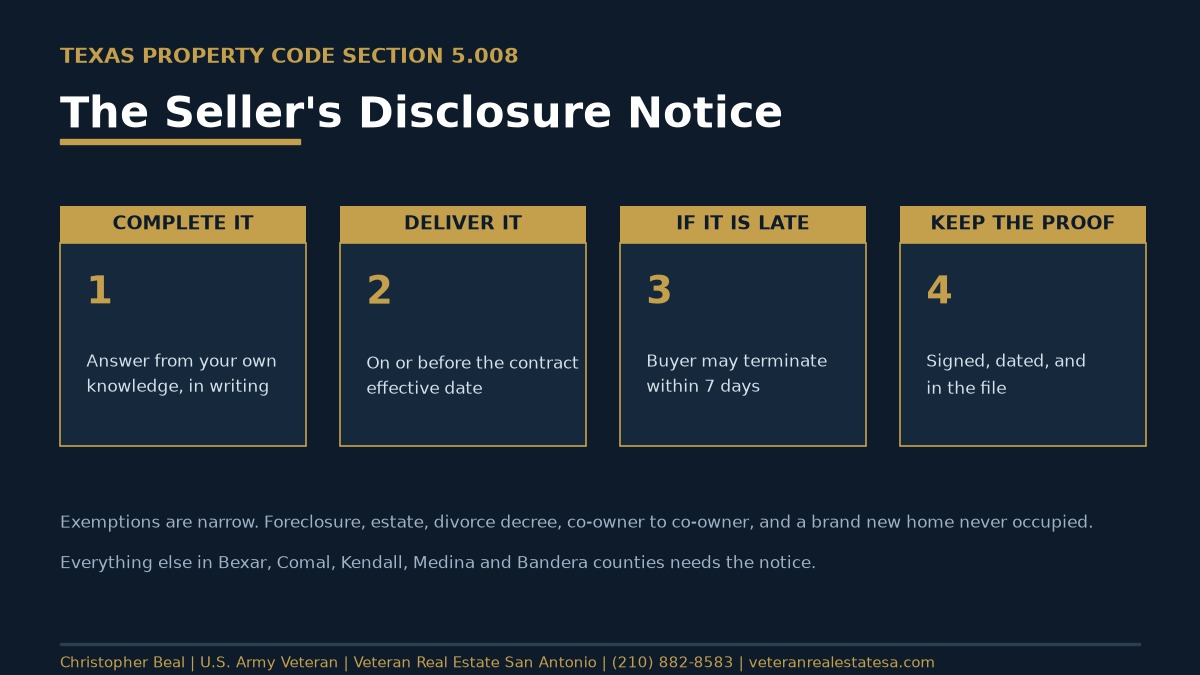
- Texas Property Code Section 5.008 requires a written Seller's Disclosure Notice on almost every resale of a single-unit residential property, including nearly every house that changes hands in Bexar County.
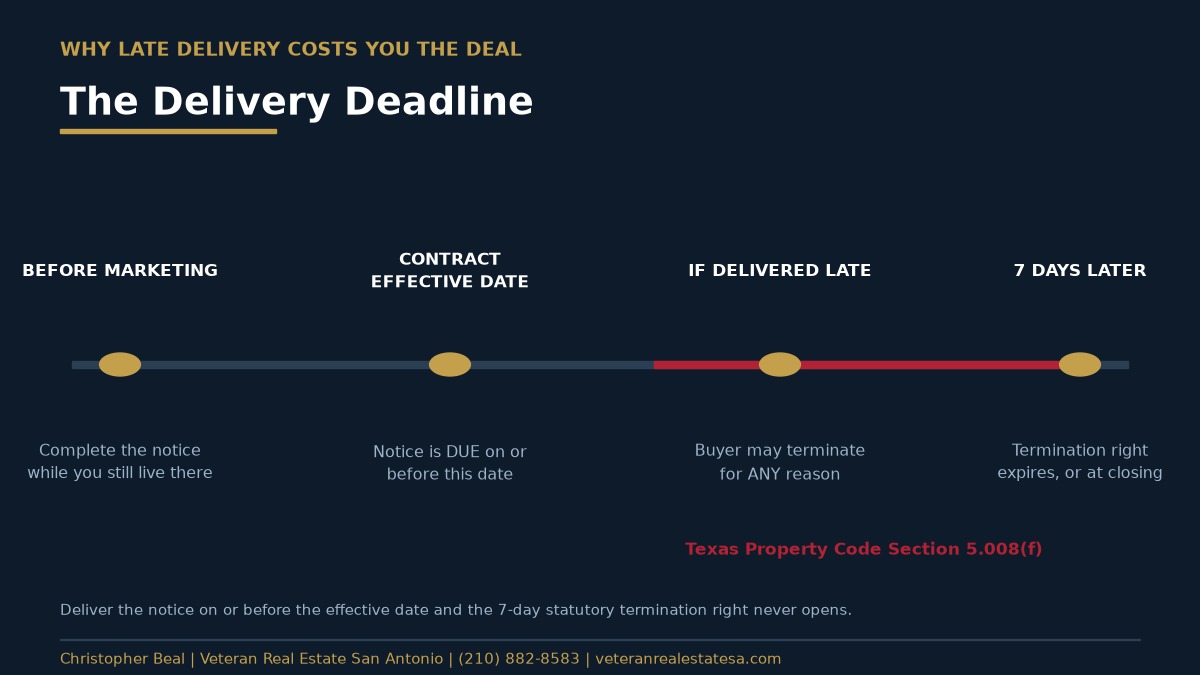
- The notice is due on or before the effective date of the contract. Deliver it late and the buyer may terminate for any reason within 7 days of receiving it, or before closing, whichever comes first.
- You disclose what you actually know. The statute asks for your knowledge and belief as of the date you sign, not the results of an inspection you never ordered.
- The exemptions are narrower than most sellers assume: foreclosure, estate administration, a divorce decree, co-owner to co-owner, spouse or lineal relative, government transfers, mineral-only interests, and a brand new home never occupied.
- Texas does not require you to disclose a death on the property by natural causes, suicide, or an accident unrelated to the property's condition. It does require flood history, fixture leases, and known defects.
- A leased solar system, a leased water softener, or a leased propane tank is a fixture lease and belongs on the notice. Missing one is the most common disclosure failure I see in San Antonio.
- The cheapest insurance against a post-closing dispute is over-disclosure plus receipts. Nobody has ever been sued for telling the truth in writing.
In This Guide
- What Is the Texas Seller's Disclosure Notice?
- Who Is Exempt From the Seller's Disclosure Requirement in Texas?
- When Is the Seller's Disclosure Notice Due, and What Happens If It Is Late?
- What Exactly Must a San Antonio Seller Disclose?
- What Do You NOT Have to Disclose in Texas?
- What Do the Flood Questions on the Texas Disclosure Actually Ask?
- Do You Have to Disclose Leased Solar Panels and Other Fixture Leases?
- What Other Notices Do San Antonio Sellers Owe Besides the Disclosure?
- What Are the Most Common Seller's Disclosure Mistakes in San Antonio?
- What Happens If You Get the Seller's Disclosure Wrong?
- How Should Military Sellers Handle Disclosure on a PCS Timeline?
- About the Author: Christopher Beal
- Frequently Asked Questions
- Explore More Resources
What Is the Texas Seller's Disclosure Notice?
Texas is a buyer-beware state with one large exception, and this notice is that exception. Outside of Section 5.008, a Texas seller has no general duty to volunteer information. Once the statute applies, the calculus flips: you are legally required to answer a standardized list of questions about the property, in writing, before the contract takes effect. Every seller I represent in San Antonio, from a 1,400 square foot starter home in Converse to a $1.2M estate in The Dominion, fills one out.
Two forms are in circulation and sellers confuse them constantly. The statutory minimum is the form printed inside Section 5.008 itself. The version almost everyone actually uses is the longer Texas REALTORS form 1406, which asks the statutory questions plus a set of additional ones. The Texas Real Estate Commission also publishes form OP-H for license holders whose clients want the bare statutory version. Longer is generally safer for the seller, because a question you answered is a question a buyer cannot later claim you concealed.
Who Is Exempt From the Seller's Disclosure Requirement in Texas?
Being exempt is not the same as being safe. An exemption removes the statutory duty to deliver the form. It does not remove your common-law duty to avoid fraud, and it does not remove your duty to disclose a known material defect that a buyer could not reasonably discover. I still recommend most exempt sellers complete the notice anyway and simply write "seller has never occupied the property" where that is true.
| Situation | Statutory notice required? | What I recommend anyway |
|---|---|---|
| Ordinary resale of your homestead | Yes | Complete the long Texas REALTORS version, not the short one. |
| Selling an inherited home as executor | No | Deliver a notice stating you never lived there, plus anything you do know. |
| Transfer under a divorce decree | No | If the receiving spouse later sells, they owe a full notice. |
| New construction, never occupied | No | Builder warranty documents replace it in practice. |
| Selling a rental you never lived in | Yes | Ask your property manager for the repair history before you answer. |
| Foreclosure or trustee sale | No | Buyer should budget for a full inspection and then some. |
Source: Texas Property Code Section 5.008(e), current through the 2025 legislative session. This is general information for San Antonio sellers, not legal advice. Confirm your specific situation with a Texas real estate attorney.
When Is the Seller's Disclosure Notice Due, and What Happens If It Is Late?
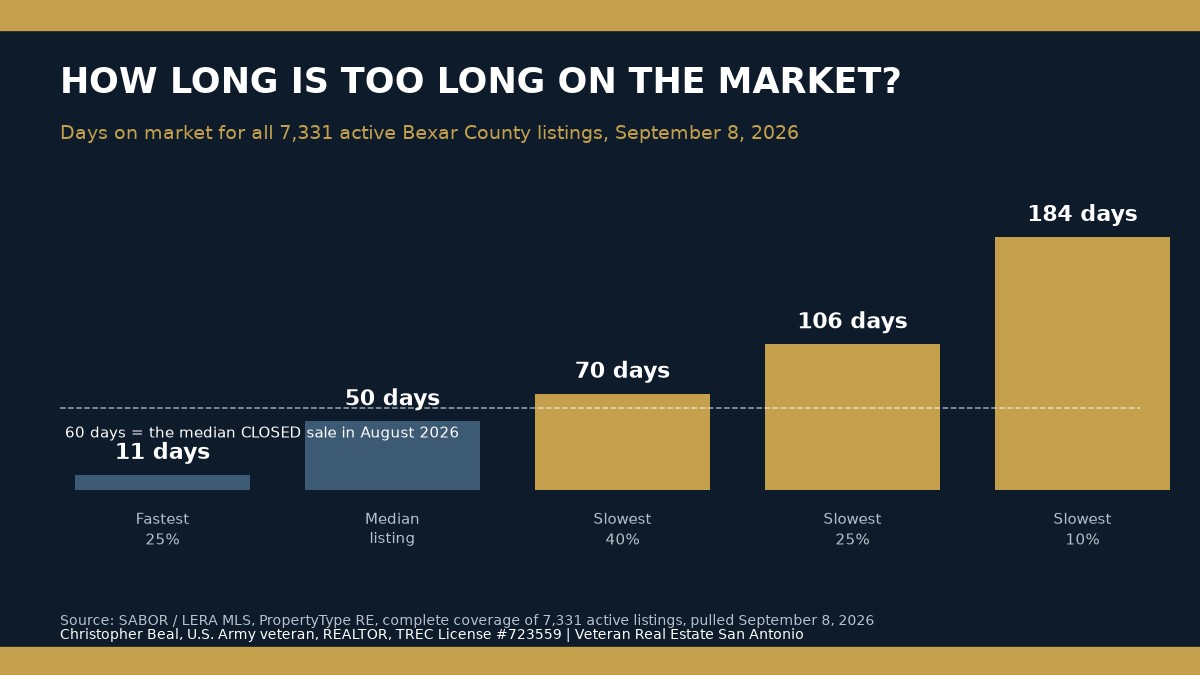
This is the single most expensive procedural mistake a Texas seller can make, and it is entirely avoidable. In a market where Bexar County homes are averaging 74 days on market, losing a buyer to a technicality in week nine means starting over in week ten. Have the notice completed and in your agent's hands before the property is ever marketed, so it goes out with the offer package rather than chasing it.
The 7-day clock is a right, not a penalty, and buyers do use it. A buyer with cold feet, a better house down the street, or a lender problem does not need a reason. They just need the notice to have been delivered late. I have watched deals die this way over paperwork that took twenty minutes to complete.
What Exactly Must a San Antonio Seller Disclose?
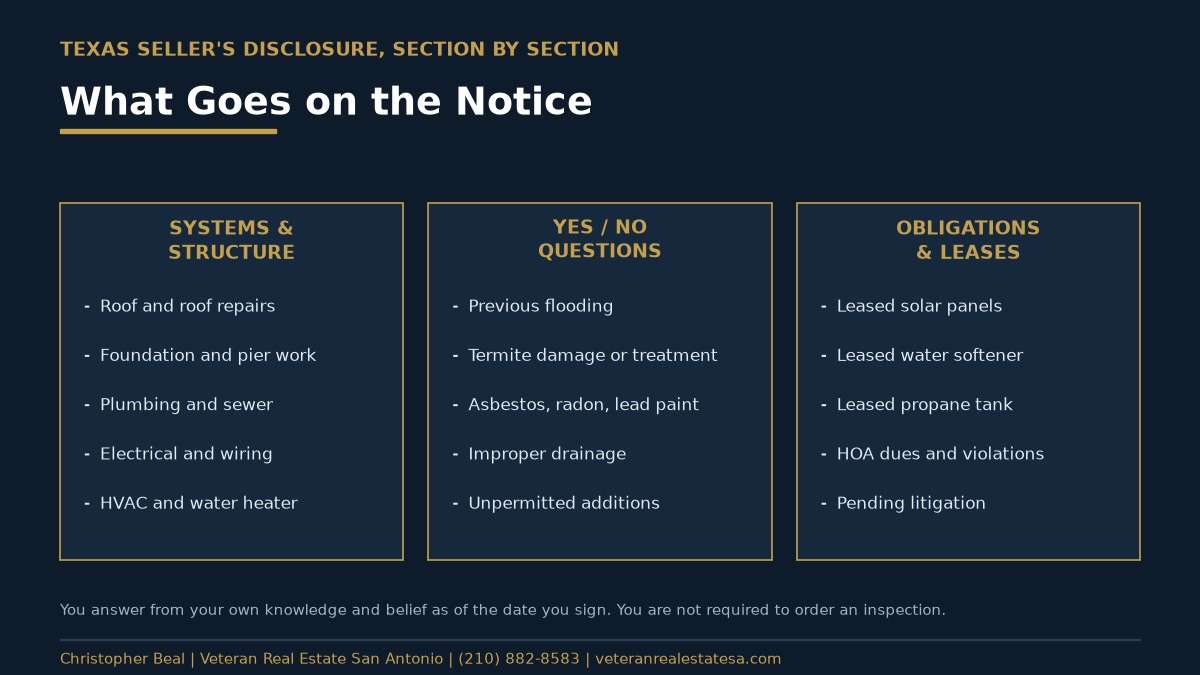
The form walks the house system by system. Roof, foundation, plumbing, electrical, HVAC, water heater, appliances, windows, doors, walls, and any detached structures. For each, you say whether it is present, whether it is in working condition, and whether you are aware of a defect. A San Antonio-specific note: our expansive clay soils mean foundation questions get read closely by every buyer and every buyer's agent. If you have had pier work done, say so and hand over the engineer's letter and the transferable warranty. That paperwork is a selling point, not a confession.
Then come the yes-or-no questions, and this is where sellers get careless. Previous flooding. Previous structural or roof repair. Termite or wood destroying insect damage or treatment. Aluminum wiring. Asbestos. Radon. Lead-based paint if the home was built before 1978. Underground storage tanks. Improper drainage. Any condition affecting health or safety. Unpermitted additions or alterations. Pending litigation affecting the property. Homeowners association obligations and unpaid assessments. Any part of the property in a floodplain.
Unpermitted work is the question that trips up San Antonio sellers most often. A converted garage, an enclosed patio, a casita out back, a bathroom added in 2014 by a guy your neighbor recommended. If you did the work without a permit, or you know a prior owner did, that is a yes. City of San Antonio permit records are searchable, so a buyer's agent will find it, and finding it after you answered no is far worse than reading it on the form.
What Do You NOT Have to Disclose in Texas?
The death question is the one sellers ask me about most, and the answer surprises them. Texas draws the line at whether the death is tied to the property's condition. A grandparent who passed away peacefully in the bedroom is not a disclosure item. A death caused by a carbon monoxide leak from a defective furnace absolutely is, because the defect is the point. If you are unsure which side of the line you are on, disclose it and move on.
You also do not have to disclose things you genuinely do not know. The statute asks for your knowledge and belief as of the date you sign. You are not required to hire an inspector, open a wall, or investigate. What you cannot do is deliberately avoid learning something so you can honestly write "unknown." Texas courts have little patience for willful blindness, and neither do juries.
What Do the Flood Questions on the Texas Disclosure Actually Ask?
Texas expanded the flood questions after Hurricane Harvey and they are now some of the most detailed on the form. They matter in San Antonio more than people expect. Bexar County flooding is usually flash flooding along creeks and low water crossings rather than coastal surge, and homes along Salado Creek, Leon Creek, and Olmos Creek can carry flood history that a casual buyer would never guess from the listing photos.
Check the map before you answer, not after. The FEMA Flood Map Service Center gives you the current flood zone designation for your address for free, and it takes about two minutes. Answering "unknown" on a question that a public federal map answers definitively reads as evasive. If your home has flooded, say so, quantify it, and bring the repair invoices. Buyers forgive history. They do not forgive surprises found during the option period. I go deeper on this in my guide to selling a San Antonio home in a flood zone.
Do You Have to Disclose Leased Solar Panels and Other Fixture Leases?
Leased solar is the big one, and it is growing fast in the northwest and far west San Antonio suburbs. A leased or power-purchase-agreement solar system is not an asset you are selling. It is a monthly obligation with a UCC-1 filing against the property that has to be assumed by the buyer or bought out at closing. Buyers discover it when the title company finds the lien, and by then you have lost trust and negotiating position. Disclose the system, the monthly payment, the remaining term, and the transfer process up front. I wrote a full breakdown of selling a San Antonio home with leased versus owned solar panels.
The same logic applies to the small stuff. That water softener in the garage on a $39 monthly plan, the propane tank behind the fence that belongs to the supplier, the alarm panel under contract through 2028. Each one is a lease that survives closing unless somebody deals with it. Put them on the form, attach the agreements, and let the buyer decide before the option period rather than after.
What Other Notices Do San Antonio Sellers Owe Besides the Disclosure?
MUD and PID notices are very much a San Antonio issue. Municipal Utility Districts and Public Improvement Districts are common in the newer master-planned communities ringing Bexar County, and they carry assessments that show up on the tax bill as a separate line. The notice has to be delivered before the contract is executed, and a missed MUD notice can give the buyer termination rights of its own. If you are not sure whether your subdivision sits in one, your Bexar County tax statement will tell you. I break down how these work in my guide to MUD and PID taxes in San Antonio neighborhoods.
The HOA notice is separate from the resale certificate. The notice tells the buyer that membership in a property owners association is mandatory. The resale certificate is the packet the association produces with the assessments, the balance owed, the violations on file, and the governing documents. Order it early. In San Antonio associations, ten business days is normal and slow ones take longer, and a certificate that arrives the week of closing is how a clean file turns into a delayed funding. My San Antonio HOA guide covers the practical side.
What Are the Most Common Seller's Disclosure Mistakes in San Antonio?
| Mistake | Why it hurts | The fix |
|---|---|---|
| Checking "unknown" down the entire form | Reads as evasion, invites a harder inspection and a lower offer. | Answer what you know. Reserve unknown for things you truly cannot know. |
| Omitting a leased solar system | Title finds the UCC-1 filing anyway, usually days before closing. | Disclose payment, term, and transfer terms up front with the agreement attached. |
| Leaving off foundation repair | Bexar County clay soil means buyers look for it specifically. | Disclose it and hand over the engineer letter and transferable warranty. |
| Saying no to unpermitted work | City permit records are public and searchable. | Disclose it. Price it. Move on. |
| Delivering after the effective date | Hands the buyer a 7-day termination right for free. | Complete it before you go on market. |
| Letting your agent fill it out | It is your knowledge being certified, not theirs. | You write it. Your agent reviews it for gaps. |
Source: patterns observed across 325+ San Antonio transactions closed by Christopher Beal, plus Texas Property Code Sections 5.008, 5.012, and 5.014.
What Happens If You Get the Seller's Disclosure Wrong?
The practical exposure is a lawsuit after closing, and those are slow and expensive on both sides. A buyer who discovers a concealed defect can sue for the cost of repair, and in the worst cases for rescission of the sale. The claim usually hinges on one question: did the seller know? Which is precisely why a carefully completed disclosure, with attachments and dates, is your best defense. It documents what you knew and when you knew it.
Amend the notice if something changes. If the water heater fails during the option period, or a storm damages the roof between contract and closing, update the disclosure in writing. Sellers sometimes think an amendment reopens negotiation and hurts them. What actually hurts is closing on a disclosure that everyone in the room knows is no longer accurate.
None of this is legal advice, and I am a REALTOR rather than an attorney. When the facts get complicated, a short consultation with a Texas real estate attorney costs far less than the dispute you are trying to avoid.
How Should Military Sellers Handle Disclosure on a PCS Timeline?
This is the version of the problem I deal with most, because most of my sellers are military. PCS orders compress everything. The notice is a memory document, and memory degrades fast once the house is empty and you are 1,800 miles away. Sit down with the form while you can still walk the house, open the panel, look at the water heater date sticker, and find the receipt folder.
Pull your records before the movers do. Roof invoice, HVAC service history, foundation engineer letter, termite treatment receipts, solar or water softener lease agreements, HOA correspondence. Scan them. That folder makes the disclosure accurate and doubles as the packet that makes a buyer comfortable paying your price. If you are selling remotely after orders drop, my remote seller playbook for PCS orders covers the rest of the workflow, and how to choose a listing agent in San Antonio covers what to demand from whoever represents you.
About the Author: Christopher Beal
Christopher Beal is a U.S. Army veteran and the Owner of Veteran Real Estate San Antonio, a Beal Group practice brokered by eXp Realty (TREC License #723559). A Military Relocation Professional (MRP) and VAREP member, he is a 7-time eXp Realty ICON agent, winner of Best Real Estate Agency in the 2026 Best of San Antonio Readers' Choice (San Antonio Current, 100,000+ voters), and a 3x San Antonio Business Journal Top 25 Individual Agent (#13 in 2024, #14 in 2025, #20 in 2026). His recognition also includes 3x Platinum Top 50, 2x RateMyAgent Agent of the Year, 2x Real Producers Top 100, Five Star Professional (2026), and a RealTrends 2026 ranking. He has helped 325+ families, closed more than $125M in career volume, and holds 5.0 stars across 370+ verified reviews, working almost exclusively with military and veteran buyers and sellers across Bexar, Comal, Kendall, Medina, and Bandera counties, with a focus on VA loans, PCS moves, and homebuying near JBSA-Lackland, JBSA-Randolph, and Fort Sam Houston. He walks every listing client through the Seller's Disclosure Notice line by line before the property goes on market, because a disclosure completed early is the cheapest deal insurance a Texas seller can buy. He can be reached at (210) 882-8583.
Frequently Asked Questions
Is a seller's disclosure required in Texas?
Yes. Texas Property Code Section 5.008 requires a written Seller's Disclosure Notice for the sale of residential real property with not more than one dwelling unit, unless one of the narrow statutory exemptions applies.
When must the Texas seller's disclosure be delivered?
On or before the effective date of the contract. If it is delivered later, the buyer may terminate the contract for any reason within 7 days after receiving it, or before closing, whichever comes first.
Do I have to disclose a death that happened in the house?
No. Texas does not require disclosure of a death by natural causes, suicide, or an accident unrelated to the condition of the property. A death caused by a property defect, such as a carbon monoxide leak, is a different matter and should be disclosed.
Do I have to disclose leased solar panels?
Yes. A leased solar system is a fixture lease and must be disclosed, along with the monthly payment, the remaining term, and how the obligation transfers. The title company will find the UCC-1 filing regardless.
What if I never lived in the house?
You still owe the notice on an ordinary resale of a rental. Answer from what you actually know, note that you have not occupied the property, and ask your property manager for the repair history before you sign.
Can my REALTOR fill out the seller's disclosure for me?
No. The notice certifies your knowledge, not your agent's. Your agent should review it for gaps and inconsistencies, but the answers have to be yours.
Do I have to disclose foundation repair in San Antonio?
Yes, if you know about it. Bexar County expansive clay soils make foundation history a question every buyer asks. Disclose the repair and provide the engineer's letter and any transferable warranty, which usually helps rather than hurts.
What happens if I forget something on the disclosure?
An honest omission is treated differently from a knowing concealment. If you realize something is missing or a condition changes before closing, amend the notice in writing immediately. Concealing a known defect can expose you to fraud and Deceptive Trade Practices Act claims.
Is the seller's disclosure the same as a home inspection?
No. The disclosure is your knowledge as the owner. The inspection is a licensed professional's opinion of condition. Buyers should do both, and a seller is never required to order an inspection to complete the notice.
Do new construction homes need a seller's disclosure?
A residence that has never been occupied is exempt from the statutory notice. Builder warranty documentation generally fills that role in practice.
Explore More Resources
- VA Home Loans - zero-down financing for eligible San Antonio buyers
- Military Relocation - PCS buying and selling around JBSA
- Free Home Evaluation - what your San Antonio home is worth right now
- Serve & Save Program - reduces closing costs for military and first responder clients
- Client Reviews - 5.0 stars across 370+ verified reviews
- About Christopher Beal - credentials, awards, and track record
Christopher Beal, U.S. Army veteran and Owner of Veteran Real Estate San Antonio, brokered by eXp Realty, TREC License #723559.
Serving Bexar, Comal, Kendall, Medina, and Bandera counties.
Call or text (210) 882-8583 | www.veteranrealestatesa.com
Categories
- All Blogs (357)
- Alamo Heights (4)
- awards (4)
- Best Neighborhoods in San Antonio (13)
- Buyer (16)
- Buyer Education (87)
- Community Events (4)
- Hill Country (17)
- JBSA (46)
- Local Guide (6)
- Luxury (28)
- Luxury Real Estate (26)
- Market Trends (19)
- Market Update (14)
- Military Relocation (114)
- Military Retirement (3)
- Mortgage (19)
- Neighborhood Guides (19)
- neighborhoods (5)
- New Construction (16)
- PCS (42)
- Real Estate (40)
- reviews (3)
- San Antonio (53)
- San Antonio Lifestyle (4)
- San Antonio Market (5)
- San Antonio Neighborhoods (45)
- San Antonio Real Estate (100)
- San Antonio, Veterans Resources, VA Loans (5)
- Seller (55)
- VA Home Loans (30)
- VA Loans (35)
- Va Loans & Financing (27)
- Veterans (10)
- Veterans Resources (40)
Recent Posts