Your Life Rate: HELOC or Sell to Pay Off Debt in San Antonio (2026)
Last Updated: September 23, 2026 | By Christopher Beal, U.S. Army Veteran & Realtor
I am Christopher Beal, a U.S. Army veteran, REALTOR (TREC License #723559) and Owner of Veteran Real Estate San Antonio, brokered by eXp Realty. More about how I work with San Antonio buyers and sellers. I am a REALTOR, not a lender, a CPA or an attorney. Run your own numbers with a Texas-licensed lender, and talk to a tax professional before you move money around.
Key Takeaways
- Life rate = each balance multiplied by its rate, added up, divided by total debt. It is the number that tells you what your borrowing actually costs.
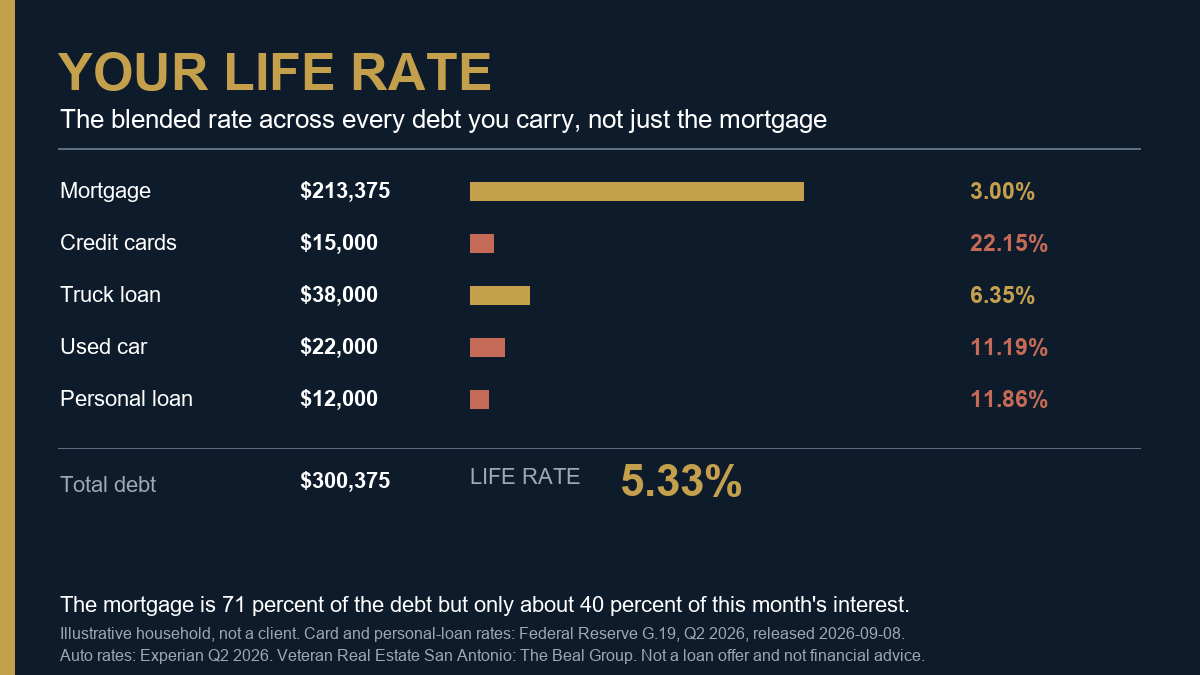
- Smaller debts carry most of the interest. In the illustrative household above, the mortgage is 71 percent of the balance and about 40 percent of the monthly interest.
- Texas caps all homestead debt at 80 percent of fair market value when you borrow against equity. That cap often decides which debts you can move and which you cannot.
- A line of credit keeps a low first mortgage intact and prices only what you draw, at a usually variable rate. A cash-out refinance reprices the entire balance at today's rate.
- Veterans: there is no VA cash-out refinance on a Texas homestead. The alternatives are conventional, and they do not touch your VA entitlement.
- Moving unsecured debt onto the house converts a problem that could not take your home into one secured by it. That is the trade, and it only works if the balances stay down.
In This Guide
- How to work out your life rate
- Where the interest actually goes
- What the Texas 80 percent cap leaves you
- Borrow against it, or sell it?
- The Texas rules that slow a home equity loan down
- Veterans: the one option that is off the table in Texas
- The option that has nothing to do with your house
- Watch: the same decision in under six minutes
- Frequently asked questions
How to Work Out Your Life Rate
Most homeowners can tell you their mortgage rate to two decimal places. Almost nobody can tell you what they pay across everything. That gap is where bad decisions live, in both directions: people cling to a 3 percent mortgage while a card quietly runs at 22 percent, and people sell a perfectly good house over debt a line of credit could have handled.
The arithmetic is deliberately simple. Balance times rate, for each debt. Add. Divide by the total. If you want to see it worked through out loud, the video below does exactly that.
Where the Interest Actually Goes
| Debt | Balance | Rate | Interest this month |
|---|---|---|---|
| Mortgage | $213,375 | 3.00% | $533 |
| Credit cards | $15,000 | 22.15% | $277 |
| Truck loan | $38,000 | 6.35% | $201 |
| Used car | $22,000 | 11.19% | $205 |
| Personal loan | $12,000 | 11.86% | $119 |
| Total | $300,375 | Life rate 5.33% | $1,335 |
Illustrative household, not a client and not a quote. Mortgage balance is a $240,000 original loan at 3.00 percent over 30 years with 60 payments made. Card and personal-loan rates are Federal Reserve G.19 commercial bank rates for Q2 2026 (released 2026-09-08); auto rates are Experian's Q2 2026 averages. Interest shown is one month at the stated rate on the stated balance. Your own rates will differ.
What the Texas 80 Percent Cap Leaves You
Section 50(a)(6)(B) of the Texas Constitution says the new extension of credit, added to the outstanding principal of every other valid lien against the homestead, cannot exceed 80 percent of fair market value on the date the credit is made. For a home equity line of credit, Section 50(t)(5) applies the same ceiling to the maximum principal that may be extended under the account, so an untouched credit line still consumes the room.
Run the household above against a $340,000 home. Eighty percent is $272,000. The mortgage is $213,375. That leaves about $58,600 of borrowing room, before costs and before the lender's own underwriting. Moving all $87,000 would put total debt on the house at roughly 88 percent of value, which Texas does not allow on a homestead equity loan.
So the choice narrows to the expensive debt. Retiring the cards, the used car and the personal loan comes to $49,000, which fits. At the 7.11 percent average home equity line rate Bankrate reported for mid-September 2026, repaid over ten years, that is about $572 a month in place of the $450, $542 and $400 those three were costing. Total payments fall from about $3,169 to about $2,349, and the blended life rate falls from 5.33 percent to about 4.09 percent. The truck loan stays where it is.
Borrow Against It, or Sell It?
Take a second illustrative household in the same $340,000 home, same $213,375 mortgage at 3.00 percent, but carrying $35,000 on cards at 22.15 percent and $28,000 on one car at 6.35 percent. Total debt $276,375, life rate 5.76 percent, payments about $2,670 a month.
The cards alone cost about $646 a month in interest. The entire $213,375 mortgage costs $533. That is the whole argument in two numbers.
| Path | What happens | Monthly | The catch |
|---|---|---|---|
| Do nothing | Keep paying all three | about $2,670 | Paying an assumed minimum of interest plus 1 percent on the cards would take about 391 months, roughly 32 and a half years, and about $63,100 in interest. Holding the payment at $996 clears them in about 58 months for about $22,000. |
| Texas line of credit for the cards | $35,000 moved onto the house; total home debt 73 percent of value, inside the cap | about $2,082 | Unsecured debt becomes debt secured by the home, at a usually variable rate. Life rate falls to about 3.86 percent, but only works if the cards stay at zero. |
| Sell and reset | About $99,400 of equity after 8 percent selling costs; clears the $63,000, leaves about $36,400 toward the next home | about $1,612 | That is a $280,000 home with $36,425 down at 6.95 percent over 30 years. Your rate goes up, not down. Principal and interest only. |
Illustrative throughout, not a client and not an offer of credit. Selling costs assumed at 8 percent all-in; actual costs vary by deal. Line of credit assumed at 7.11 percent repaid over ten years (Bankrate average, mid-September 2026); real lines are usually variable. The 6.95 percent figure is the Freddie Mac Primary Mortgage Market Survey 30-year fixed average for the week of September 17, 2026, for a conventional borrower with 20 percent down and strong credit. Payments shown are principal and interest only, with property taxes and insurance excluded on both sides so the comparison stays like for like. Card minimum-payment math assumes interest plus 1 percent of the balance with a $35 floor; issuers set their own formulas.
Notice what the third row does and does not say. The monthly payment falls by more than a thousand dollars, and the life rate goes up, because the new mortgage is at 6.95 percent instead of 3.00 percent. You would be trading a lower rate for a lower payment, one bill instead of three, and a home that fits. Whether that is a good trade depends on how long you plan to stay, what the next house costs to run, and whether the debt would come back.
The Texas Rules That Slow a Home Equity Loan Down
Read against the current text of Article XVI, Section 50 on September 23, 2026:
- Twelve-day wait. Closing cannot happen before the twelfth day after the later of your application or the date the lender gives you the required notice. [50(a)(6)(M)(i)]
- Three days to cancel. You and your spouse may rescind within three days after the credit is made, without penalty or charge. [50(a)(6)(Q)(viii)]
- One per homestead per year. A new Section 50(a)(6) loan cannot close before the first anniversary of any other such loan on the same home, with narrow exceptions for certain refinances and declared emergencies. [50(a)(6)(M)(iii)]
- Spouse must consent. The lien requires the written consent of each owner and each owner's spouse, whether or not that spouse is a borrower. [50(a)(6)(A)]
- Draws of at least $4,000. On a line of credit, each advance must be at least $4,000, and you cannot draw with a credit card, debit card or a check you did not ask for. [50(t)(2), (3)]
That last one catches people who assume a home equity line behaves like a card. It does not, by design.
Veterans: The One Option That Is Off the Table in Texas
This surprises most veterans, including ones who have used the benefit twice. It is a state constitutional limit rather than a lender overlay, so no lender can work around it, and staying under 80 percent does not cure it. I wrote the whole thing up separately, including what the opinion actually says and which VA refinances still work here: VA cash-out refinance in San Antonio: why Texas says no, and what veterans can do instead.
Two things worth knowing while you run your own life rate:
- A Texas home equity loan or line of credit is a conventional product. It does not use VA entitlement, so it does not consume entitlement you would want for a future purchase.
- If you sell, the homestead appraisal cap does not travel with you. Under Texas Tax Code Section 23.23, the 10 percent annual cap on a homestead's appraised value starts on January 1 of the tax year after the first year you qualify the new home for the exemption. If your current taxable value is capped well below market, a similarly priced next home can carry a higher tax bill. File the new exemption, and budget for that gap.
Service members on qualified official extended duty can also suspend the five-year ownership and use test for the home sale gain exclusion, for up to ten years, under the rules in IRS Publication 523. That one is worth raising with a tax professional before you list, not after.
The Option That Has Nothing to Do With Your House
If the goal is to stop paying 22 percent on cards, a nonprofit credit counseling agency can often negotiate lower rates through a debt management plan without putting a lien on anything. That path deserves a look before a lien does, and I would rather say so than pretend every problem is a real estate problem.
Selling is the right answer when several things line up at once: meaningful equity, genuinely high-rate debt, and a move you were already considering for other reasons, such as orders, retirement, a job change, or a house that no longer fits. It is usually the wrong answer with thin equity, a home that works for years to come, small consumer balances, or a pattern where the cards refill.
Watch: The Same Decision in Under Six Minutes
I walk through the life rate calculation, both households, and the Texas rules on camera. Same figures as above, same caveats.
What To Do This Week
Add up your own life rate. Statements, ten minutes, one number. Then you can have a real conversation with a lender instead of a hopeful one.
For eligible buyers, my Serve and Save program reduces closing costs by 1 percent of the gross buyer-agent commission for every verified year of active-duty service, applied on the Closing Disclosure and subject to lender approval.
About the Author: Christopher Beal
Christopher Beal is a U.S. Army veteran and the Owner of Veteran Real Estate San Antonio, a Beal Group practice brokered by eXp Realty (TREC License #723559). A Military Relocation Professional (MRP) and VAREP member, he is a 7-time eXp Realty ICON agent, winner of Best Real Estate Agency in the 2026 Best of San Antonio Readers' Choice (San Antonio Current, 100,000+ voters), and a 3x San Antonio Business Journal Top 25 Individual Agent (#13 in 2024, #14 in 2025, #20 in 2026). His recognition also includes 3x Platinum Top 50, 2x RateMyAgent Agent of the Year, 2x Real Producers Top 100, Five Star Professional (2026), and a RealTrends 2026 ranking. He has helped 325+ families, closed more than $125M in career volume, and holds 5.0 stars across 370+ verified reviews, working across Bexar, Comal, Kendall, Medina, and Bandera counties. He is a REALTOR, not a lender, attorney or financial advisor, and nothing here is financial advice. He can be reached at (210) 882-8583.
Explore More Resources
- Should I Sell My Home in San Antonio?
- VA Cash-Out Refinance in Texas: Why It Is Not Allowed
- Free Home Evaluation
- Serve and Save Program
- About Christopher Beal
Frequently Asked Questions
What is a life rate?
It is the balance-weighted average interest rate across every debt you carry: mortgage, credit cards, auto loans, personal loans. Multiply each balance by its rate, add the results, divide by total debt. A household with a 3 percent mortgage and 22 percent cards is often paying a blended rate in the 5s, which is why the mortgage rate alone is a poor guide to what borrowing actually costs you.
Is a HELOC better than selling to pay off debt in Texas?
It depends on your equity, the rate on the debt you would retire, and whether you were going to move anyway. A line of credit keeps a low first mortgage intact and prices only what you draw, but it converts unsecured debt into debt secured by your home at a usually variable rate, and the Texas 80 percent cap may not leave room for everything. Selling clears the debt in one transaction and can cut the payment sharply, at the cost of financing the next home at today's rate. Neither is universally better.
How much can I borrow on a Texas HELOC?
Eighty percent of fair market value, minus every other lien already on the home, under Article XVI, Section 50(a)(6)(B) of the Texas Constitution. For a line of credit, Section 50(t)(5) applies that ceiling to the entire credit line rather than the amount you have drawn, so an unused line still uses up your room. Your lender may approve less based on income, credit and the appraisal, but never more.
What other rules apply to Texas home equity loans and HELOCs?
Closing cannot occur before the twelfth day after the later of your application or the lender's required notice. You and your spouse may cancel within three days of closing. Only one such loan can close on the same homestead in a twelve-month period, with narrow exceptions. Each owner's spouse must consent in writing even if they are not on the loan. On a line of credit, each draw must be at least $4,000, and you cannot draw with a credit card, debit card or an unsolicited check.
Can veterans do a VA cash-out refinance in Texas?
No, not on a homestead. Texas Attorney General Opinion KP-0183 (February 26, 2018) concluded that the federal VA guaranty is collateral other than the home, which Section 50(a)(6)(H) prohibits in a home equity loan, and the constitutional text still reads that way. The alternatives are a conventional cash-out refinance or a Texas home equity line of credit, both under the same 80 percent cap, and neither uses VA entitlement. VA refinancing that takes no equity out, such as an interest rate reduction refinance, is unaffected.
Does my Texas homestead tax cap move with me if I sell?
No. Under Texas Tax Code Section 23.23, the 10 percent annual cap on a homestead's appraised value begins on January 1 of the tax year after the first year you qualify the new home for the homestead exemption. If your current home's taxable value is capped well below market value, a similarly priced next home can carry a higher tax bill until the new cap builds up. File the new exemption and budget for the difference.
Should I move credit card debt onto my house at all?
It lowers the interest rate and usually the payment, and it changes the nature of the debt: a card balance cannot take your home, and a lien can. The math only holds if the balances stay at zero afterward. A nonprofit credit counseling agency can often reduce card rates through a debt management plan without touching your equity, and that is worth pricing before you put a lien on the house.
Categories
- All Blogs (354)
- Alamo Heights (4)
- awards (4)
- Best Neighborhoods in San Antonio (14)
- Buyer (16)
- Buyer Education (86)
- Community Events (4)
- Hill Country (17)
- JBSA (43)
- Local Guide (6)
- Luxury (28)
- Luxury Real Estate (26)
- Market Trends (19)
- Market Update (14)
- Military Relocation (111)
- Military Retirement (3)
- Mortgage (19)
- Neighborhood Guides (18)
- neighborhoods (5)
- New Construction (16)
- PCS (42)
- Real Estate (40)
- reviews (3)
- San Antonio (53)
- San Antonio Lifestyle (4)
- San Antonio Market (5)
- San Antonio Neighborhoods (43)
- San Antonio Real Estate (100)
- San Antonio, Veterans Resources, VA Loans (5)
- Seller (55)
- VA Home Loans (30)
- VA Loans (35)
- Va Loans & Financing (27)
- Veterans (10)
- Veterans Resources (40)
Recent Posts