Multiple Offers on Your San Antonio Home: How to Choose the Best One (2026)
LAST UPDATED: SEPTEMBER 29, 2026 | BY CHRISTOPHER BEAL, U.S. ARMY VETERAN & REALTOR
When you get more than one offer on your San Antonio home, the best offer is almost never the one with the biggest number on the front page. It is the one that puts the most money in your pocket on the day you want to close, with the highest probability of actually closing. Those are two different questions, and price only answers part of the first one.
I am Christopher Beal, Owner of Veteran Real Estate San Antonio and a Texas licensed agent with eXp Realty. I have sat at a lot of kitchen tables in Stone Oak, Alamo Ranch, Schertz, Boerne, and Converse comparing three or four offers side by side. This is the framework I use, and the reasons a $348,000 offer sometimes loses to a $340,000 one.
KEY TAKEAWAYS
- Compare net proceeds, not contract price. Seller-paid closing costs, buydown contributions, and survey or title charges routinely swing $6,000 to $12,000 between two offers on the same house.
- In Texas the termination option is the real risk window. A long option period with a small option fee is a cheap exit for the buyer and an expensive delay for you.
- Financing type matters less than the strength of the lender letter. A fully underwritten VA approval usually gives you more closing certainty than a soft conventional prequalification.
- Earnest money size is the clearest signal of buyer seriousness once the option period expires.
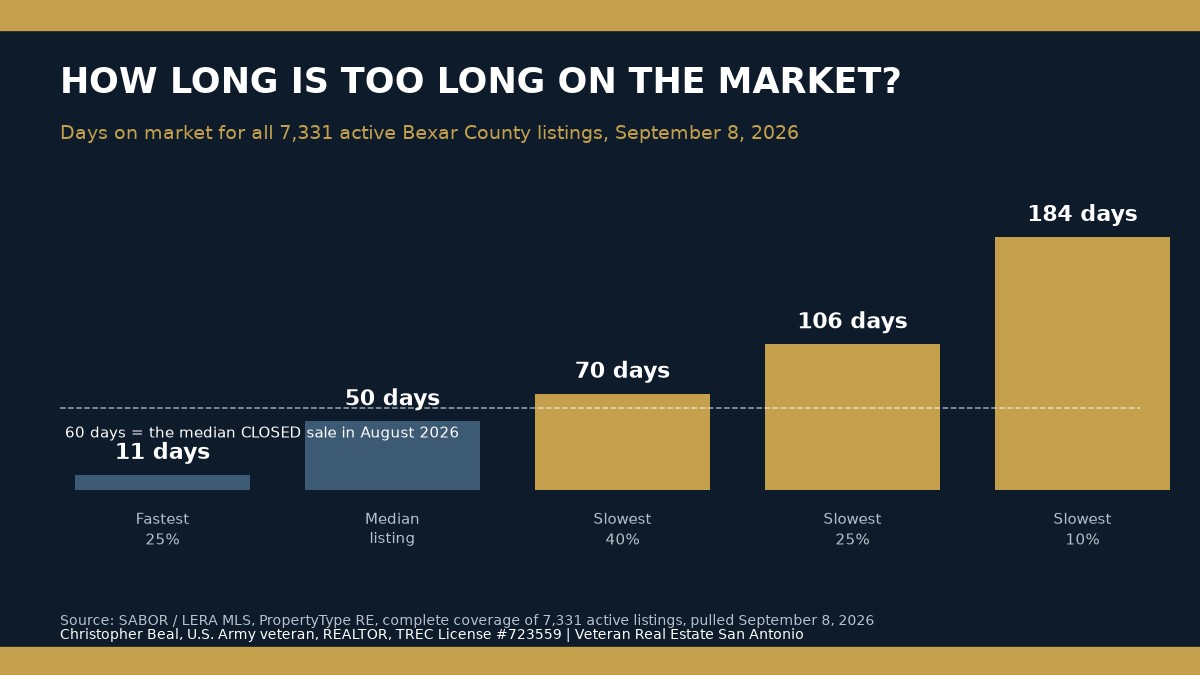
- Bexar County homes sold at a $280,000 median with 75 average days on market and a 98.8 percent list to sale ratio between June 3 and September 1, 2026. Multiple offers still happen here, but they happen to well priced and well prepared homes.
Best Offer Means Highest Net, Not Highest Price
Before you compare anything else, have your agent build a net sheet for every single offer. Not for the top one. For all of them.
The contract price is the starting point. Then you subtract the commission you agreed to, the seller paid closing costs the buyer is asking for, the owner title policy if you are paying it, the survey if you are providing a new one, prorated property taxes through the closing date, your mortgage payoff, and any repair credits already baked into the offer. What comes out the bottom is the only number that is comparable across offers.
Here is where sellers get caught. A buyer offering $348,000 while asking for $12,000 in seller concessions toward their closing costs and a rate buydown nets you less than a buyer offering $340,000 with no concessions. The first offer looks $8,000 better and is actually $4,000 worse. If you want the full accounting of what comes off the top in Bexar County, I laid it out in what it costs to sell a house in San Antonio.
The Five Variables That Decide Which Offer Wins
Every offer you receive is a bundle of five things, and price is only one of them. The other four are certainty, timing, flexibility, and repair exposure.
| Variable | What to look at | Why it moves the decision |
|---|---|---|
| Net proceeds | Price minus concessions, title, survey, tax prorations | This is the only number you actually take home |
| Certainty of closing | Underwritten approval versus prequalification, cash proof of funds | A dead deal costs you 30 days and market momentum |
| Option period | Number of days and the option fee amount | This is the buyer's unrestricted right to walk |
| Earnest money | Dollar amount relative to price | Real skin in the game after the option expires |
| Timing and possession | Closing date, leaseback request, contingency on their sale | Matching your move-out plan can be worth thousands |
Financing Type: What Each One Actually Risks
The loan type on the front page tells you far less than the quality of the approval letter behind it. I have had VA offers close in 28 days and cash offers fall apart in week three.
Cash removes lender underwriting and the lender appraisal requirement, provided the proof of funds is a current bank statement rather than a screenshot of an investment account that has to be liquidated. A cash buyer can still write in an appraisal or other contingency, so read the contract rather than assume. Ask for a statement dated within the last few days.
Conventional financing with 20 percent down is often the lower appraisal risk among financed offers because the loan amount leaves more room if the value comes in short. It does not guarantee a closing; the buyer still has to get final loan approval. Conventional with 3 to 5 percent down carries more appraisal sensitivity than most sellers realize, since a low appraisal on a thin down payment leaves the buyer little cash cushion to cover a gap.
VA financing in San Antonio deserves better treatment than it usually gets. This is a military town with Joint Base San Antonio at the center of it, and a VA buyer with a fully underwritten approval is a strong buyer. A funding fee exemption lowers the veteran's own costs; it does not by itself make the file more likely to close. The property does have to meet VA Minimum Property Requirements, so if your roof is at end of life or you have peeling paint on a pre 1978 home, that is a real consideration. FHA carries a similar condition standard.
What I actually ask for in every multiple offer situation is the loan officer's direct phone number, and I call them. A five minute conversation tells you more about whether that file closes than the letter ever will.

Reading the Texas Money Terms
The TREC One to Four Family Residential Contract has three money terms that separate a serious buyer from a tire kicker, and Texas sellers routinely misread all three.
The option fee buys the buyer an unrestricted right to terminate for any reason during the termination option period. The buyer delivers it to the escrow agent named in the contract, usually the title company, and authorizes the escrow agent to release it to you. It is usually small, often a few hundred dollars. If the buyer terminates during the option period, the fee is not refunded and you keep it, and the earnest money goes back to the buyer. If the sale closes, the option fee is credited to the sales price, so it is not extra money on top of the price (TREC form 20-19, paragraph 5, checked September 25, 2026). What matters is the number of days attached to it. A 10 day option period on a home in a market averaging 75 days on market is 10 days in which your first buyer can walk away for any reason, for a couple hundred dollars. You can still accept a backup offer during that time using the TREC Addendum for Back-Up Contract (form 11-9), but the backup buyer moves up only if the first contract ends. A shorter option period, such as 5 to 7 days, is a reasonable counter. Anything longer should come with a reason.
Earnest money is different. It is deposited with the title company and, once the option period expires, it is genuinely at risk for the buyer if they default. A buyer putting up one percent of the purchase price is normal. A buyer putting up two to three percent is telling you something. A buyer putting up $1,000 on a $340,000 house is telling you something too.
On a financed offer that is not FHA or VA, usually a conventional loan, appraisal exposure is set by the TREC appraisal addendum, TREC form 49-1, when one is attached. Check which of its three boxes the buyer marked: a full waiver of the right to terminate over a low appraisal, a partial waiver stated as a minimum appraised value at or above which the buyer cannot terminate, or an added right to terminate below a stated value. That partial-waiver number is an appraised-value floor, not a promise to bring cash. Form 49-1 does not apply to FHA or VA financing, so on a VA or FHA offer there is no waiver to read; ask the loan officer how the appraisal is handled on that file instead. Separately, the Third Party Financing Addendum, TREC form 40-11, carries its own waiver election for other financing in paragraph 1G. Full waivers are not the norm, and a buyer promise to cover a shortfall in cash is not a standard term in the TREC forms. If an offer includes one, look at exactly how it is written into the contract before you give it value. Contract forms are published by the Texas Real Estate Commission.
A Real Side by Side: Three Offers on a $340,000 Home
Here is the comparison that changes people's minds, using round numbers on a hypothetical Stone Oak listing priced at $340,000.
| Term | Offer A | Offer B | Offer C |
|---|---|---|---|
| Price | $348,000 | $342,000 | $335,000 |
| Seller concessions | $12,000 | $3,000 | $0 |
| Financing | Conventional, 5 percent down, prequalified | VA, fully underwritten | Cash, statement provided |
| Option period | 10 days, $200 fee | 7 days, $500 fee | 5 days, $500 fee |
| Earnest money | $1,500 | $5,000 | $10,000 |
| Close date | 45 days | 32 days | 14 days |
| Price minus concessions (not net proceeds) | $336,000 | $339,000 | $335,000 |
The bottom row is price minus seller concessions only. It is not net proceeds: commission, title policy, survey, tax prorations, your payoff and any repair credits still come out, and the ranking can change once they do. Ask for a full net sheet on each offer.
Offer A has the biggest headline and the worst everything else. Ten days of option with a $200 fee, thin earnest money, a soft prequalification, five percent down against a price above the other two offers, and the longest timeline. That is the offer most likely to renegotiate after inspection and the most likely to die at appraisal.
Offer C is the cleanest and the fastest, but on price after concessions it is $4,000 below Offer B. In this example Offer B is the strongest overall. It has the highest price after concessions, the approval is real, the earnest money is meaningful, and 32 days is a normal closing timeline.
The offer that renegotiates on day nine of a ten day option period is not a better offer. It is the same offer with a delay attached, and by then your other buyers may have moved on unless you accepted one as a backup.
CHRISTOPHER BEAL, OWNER, VETERAN REAL ESTATE SAN ANTONIO
Terms That Are Worth Real Money to You
Some non price terms are worth more than the dollars people give up to get them, and a seller who knows which ones to ask for gets paid twice.
A seller temporary residential lease, commonly called a leaseback, lets you stay in the home after closing for a defined period. If you are buying your next house and cannot close both on the same day, that is worth real money and real peace of mind. Buyers who are renting are often flexible about it. Buyers whose own lease ends on the 31st are not.
A waiver or limitation on repair requests matters because in Texas the general inspection almost always produces a list. An offer that limits repair requests, or says the buyer will not ask for repairs under a stated dollar amount, can protect your net more reliably than an extra $2,000 of price. It does not end the inspection or the buyer's unrestricted right to terminate during the option period; within that window the buyer can still walk away and get the earnest money back.
Closing date alignment is the last one. If you are relocating on a fixed report date or a job start date, an offer that closes when you need it to is worth paying for. This is where military sellers on PCS orders often find their real leverage.
How to Run a Multiple Offer Situation Without Losing Everyone
The fastest way to turn three offers into zero offers is to sit on them. Buyers who wrote on your house wrote on other houses too.
My process is short on purpose. I set an offer deadline when the activity justifies it and communicate it clearly to every agent who has shown the home. I acknowledge every offer within a couple hours so nobody assumes they were ignored. I call each loan officer. I build net sheets for all of them, side by side, in one document you can read in five minutes.
Then, in most cases, I go back to the top two or three with a specific counter rather than a generic call for highest and best. A vague highest and best invites buyers to walk. A counter that says exactly what you want, whether that is a shorter option period, more earnest money, or an appraisal waiver on a conventional offer, often gets it.
None of that works if the underlying pricing was wrong. Homes that sit for 60 days and then cut price rarely see competing offers at all, which is why I spend so much time on the initial number. My approach is in how to price your home in San Antonio, and the marketing that generates competing offers in the first place is covered in how to choose a listing agent in San Antonio.
What the 2026 San Antonio Market Means for This
Multiple offers are no longer automatic here, which makes handling them correctly more valuable, not less.
Across Bexar County between June 3 and September 1, 2026, sold homes recorded a $280,000 median close price, a $337,981 average close price, 75.7 average days on market, and a 98.8 percent list to sale price ratio, based on a 1,000 sale SABOR MLS sample. Average sold price per square foot was $158.62. Active inventory sat at a $278,700 median list price with 69 average days on market.
Read that carefully. A 98.8 percent list to sale ratio means correctly priced homes are transacting very close to asking. Seventy five days on market means buyers have choices. In that environment, when you do generate two or three offers, they are the product of pricing and preparation, and letting the highest headline number pull you into a weak contract is an expensive mistake. Related reading: how long it takes to sell a house in San Antonio and the Texas Seller's Disclosure Notice.
About the Author
Christopher Beal is a U.S. Army veteran and the Owner of Veteran Real Estate San Antonio, a Beal Group practice brokered by eXp Realty (TREC License #723559). A Military Relocation Professional (MRP) and VAREP member, he is a 7-time eXp Realty ICON agent, winner of Best Real Estate Agency in the 2026 Best of San Antonio Readers' Choice (San Antonio Current, 100,000+ voters), and a 3x San Antonio Business Journal Top 25 Individual Agent (#13 in 2024, #14 in 2025, #20 in 2026). His recognition also includes 3x Platinum Top 50, 2x RateMyAgent Agent of the Year, 2x Real Producers Top 100, Five Star Professional (2026), and a RealTrends 2026 ranking. He has helped 325+ families, closed more than $125M in career volume, and holds 5.0 stars across 370+ verified reviews, working with buyers and sellers across Bexar, Comal, Kendall, Medina, and Bandera counties. He has evaluated competing offers on listings from Alamo Ranch to Schertz and will build you the net sheet before you sign anything. He can be reached at (210) 882-8583.
Frequently Asked Questions
Should I always take the highest offer on my San Antonio home?
No. The highest contract price frequently nets less than a lower one once seller paid closing costs, buydown contributions, title, survey, and tax prorations are subtracted. Ask for a net sheet on every offer and compare the bottom line, not the top line.
How long should I let a buyer's option period run?
A shorter option period, such as five to seven days, is a reasonable counter. A 10 day option period with a small option fee is a cheap termination right for the buyer during the days that matter most. You can still accept a backup offer during the option period with the TREC Addendum for Back-Up Contract, but the backup buyer moves up only if the first contract ends.
Is a cash offer always better than a financed offer?
Not automatically. Cash removes lender underwriting and the lender appraisal requirement when proof of funds is a current bank statement, though a cash buyer can still write in contingencies. A fully underwritten conventional or VA approval with strong earnest money and a shorter option period often nets you more and can close just as reliably.
Should I accept a VA offer on my San Antonio home?
Often, yes, when the approval is fully underwritten. San Antonio is a military market and VA offers are common, but the strength of any offer depends on that buyer's approval, earnest money and terms, not the loan type. The main consideration is that the property must meet VA Minimum Property Requirements, so roof condition, HVAC function, and peeling paint on pre 1978 homes are worth checking before you list.
How much earnest money should I expect?
Roughly one percent of the purchase price is typical in San Antonio. Two to three percent can signal a serious, well capitalized buyer, though earnest money is not a guarantee that the buyer will close. Unusually low earnest money on a high priced offer is a warning sign that the buyer is keeping their exit cheap.
What is appraisal gap coverage and should I ask for it?
It usually means a buyer promise to cover some or all of a low appraisal with cash, and it is not a standard term in the TREC forms. What the forms provide, on financing that is not FHA or VA (usually a conventional loan), is TREC form 49-1: the buyer can waive the right to terminate over a low appraisal, or waive it partially down to a stated minimum appraised value. Form 49-1 does not apply to FHA or VA offers. If a buyer offers to cover a gap, look at exactly how it is written into the contract before you count it.
Can I ask all buyers for highest and best?
You can, but a specific counter usually performs better. Naming exactly what you want, such as a shorter option period, larger earnest money, or a particular closing date, gets you those terms. A vague highest and best request causes some buyers to withdraw entirely.
What is a leaseback and when does it help me?
A seller temporary residential lease lets you remain in the home after closing for a defined period. It is valuable when you are buying your next home and the closings do not line up, and many buyers will grant it in exchange for a term elsewhere in the contract.
Do I have to tell other buyers there are multiple offers?
Your listing agent discloses the existence of multiple offers only with your written authorization. In practice, disclosing that there are competing offers usually strengthens your position, and specific offer terms should never be shared.
Get the Net Sheet Before You Sign
If you are listing in San Antonio, Boerne, Schertz, Converse, Helotes, or anywhere across Bexar, Comal, Kendall, Medina, and Bandera counties, I will build a side by side net sheet on every offer you receive and call every lender before you decide. Call or text me at (210) 882-8583.
Watch: Should You Accept a Contingent Offer?
A contingent offer is not automatically a bad offer. Here is how I weigh one against a cleaner contract.
Categories
- All Blogs (357)
- Alamo Heights (4)
- awards (4)
- Best Neighborhoods in San Antonio (13)
- Buyer (16)
- Buyer Education (87)
- Community Events (4)
- Hill Country (17)
- JBSA (46)
- Local Guide (6)
- Luxury (28)
- Luxury Real Estate (26)
- Market Trends (19)
- Market Update (14)
- Military Relocation (114)
- Military Retirement (3)
- Mortgage (19)
- Neighborhood Guides (19)
- neighborhoods (5)
- New Construction (16)
- PCS (42)
- Real Estate (40)
- reviews (3)
- San Antonio (53)
- San Antonio Lifestyle (4)
- San Antonio Market (5)
- San Antonio Neighborhoods (45)
- San Antonio Real Estate (100)
- San Antonio, Veterans Resources, VA Loans (5)
- Seller (55)
- VA Home Loans (30)
- VA Loans (35)
- Va Loans & Financing (27)
- Veterans (10)
- Veterans Resources (40)
Recent Posts