Selling a House During Divorce in San Antonio (2026): Timeline, Net Proceeds, and Who Decides What
LAST UPDATED: AUGUST 4, 2026 | BY CHRISTOPHER BEAL, U.S. ARMY VETERAN & REALTOR
Selling a House During Divorce in San Antonio (2026): Timeline, Net Proceeds, and Who Decides What

Key Takeaways
- Texas requires a 60-day waiting period from the date the petition is filed before a judge can grant the divorce (Texas Family Code Section 6.702). The earliest possible finalization is day 61.
- Texas is a community property state, but community property does not automatically mean a 50/50 split. Judges have broad discretion to divide the estate in a manner they consider just and right.
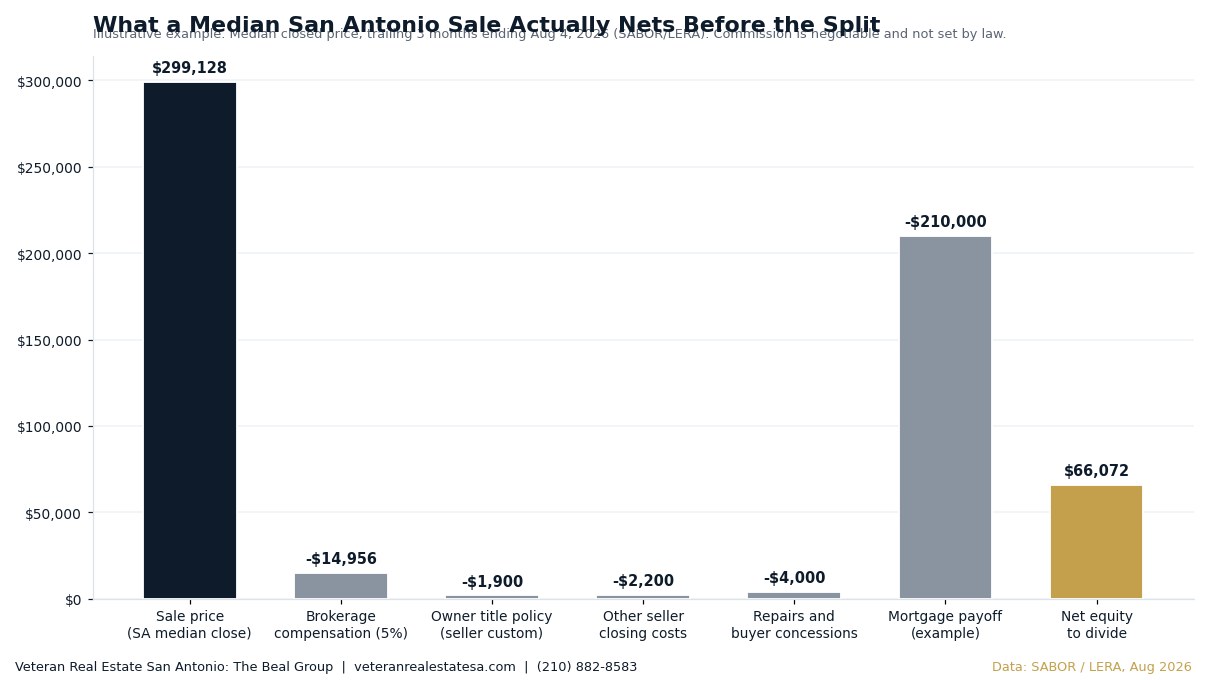
- On a median San Antonio sale of about $299,128, an illustrative set of seller costs plus a sample mortgage payoff leaves roughly $66,000 of equity to divide. The gross number is not the number anybody gets.
- The average San Antonio home took 79 days from list to close over the trailing three months. Build that into the decree, not around it.
- If one spouse keeps the house, an owelty lien written into the decree lets that spouse refinance up to roughly 95 percent of appraised value instead of the 80 percent cap on an ordinary Texas cash-out refinance.
- If either spouse is active-duty at JBSA, servicemember protections, housing-allowance changes, and VA loan entitlement all move at the same time. That is a different problem than a civilian divorce sale.
In This Guide
- Who Actually Decides Whether the House Gets Sold?
- How Long Does It Take to Sell a House During a Divorce in San Antonio?
- What Does a San Antonio Home Actually Net Before the Split?
- Should One Spouse Keep the House Instead of Selling?
- What Changes When One Spouse Is Active-Duty at JBSA?
- How Does a Listing Agent Work for Two People Who Disagree?
- What Are the Most Expensive Mistakes?
- What Should You Do in the First Two Weeks?
- About the Author: Christopher Beal
- FAQ
- Explore More Resources
Every divorce that involves a house in Bexar County runs into the same problem in the same order. Two people who are no longer aligned have to make a series of joint financial decisions on a court calendar neither of them controls, about an asset neither of them can move quickly. Most of the money that gets lost in that situation is not lost in the negotiation. It is lost in the sequencing.
This guide is the real-estate half of the problem: what the house is worth, what it nets, how long the sale actually takes in this market, and which decisions have to happen before the decree is signed rather than after. It is not legal advice, and it is not a substitute for a Texas family law attorney. It is written to make the conversation you have with that attorney shorter and more productive.
Who Actually Decides Whether the House Gets Sold?
Texas is a community property state, and that is the starting presumption, not the ending answer. Property acquired during the marriage is presumed to belong to both spouses. But Texas judges are not required to split the community estate down the middle. They are directed to divide it in a manner that is just and right, and they can award a disproportionate share based on factors such as fault in the breakup, disparity in earning capacity, health, and the needs of any children.
What that means practically for the house: a 60/40 division of the equity is not unusual, and the spouse who assumes it will be 50/50 sometimes builds a plan around a number that never materializes. If one spouse brought the home into the marriage, or paid the down payment with separate funds, there may be a separate-property claim on part of it, which requires tracing and documentation. That is attorney work, and it should be settled before the house is priced.
Three ways the sale decision gets made
- Agreement. Fastest and cheapest. Both spouses sign the listing agreement, agree on price and on how proceeds are held, and the sale runs like any other listing.
- Temporary orders. Entered while the case is pending. These can grant one spouse exclusive use of the home, assign who pays the mortgage during the case, and authorize a sale before the divorce is final.
- Final decree. The decree orders the sale, sets terms such as the listing agent, the pricing method, and the split, and often includes what happens if the parties cannot agree on an offer.
The version that costs the most money is the fourth one nobody plans for: no agreement, no temporary order that addresses the house, and a mortgage that keeps coming due while the case moves. Somebody is paying that note, and the person paying it usually expects credit for it later.
How Long Does It Take to Sell a House During a Divorce in San Antonio?
The two clocks are not the same clock, and treating them as one is the single most common planning error. The 60-day statutory waiting period under Texas Family Code Section 6.702 starts when the original petition is filed. The earliest a Texas divorce can be finalized is day 61, and the only recognized exception involves documented family violence. That is a floor, not an estimate.
| Phase | Typical duration | What controls it | What you can do about it |
|---|---|---|---|
| Statutory waiting period | 60 days minimum from filing | Texas Family Code Section 6.702 | Nothing. Use the time to prep the house |
| Prep, pricing, photography | 1 to 3 weeks | Condition and how fast both spouses sign | Start before the decree, not after |
| List to accepted offer | Roughly 40 to 60 days | Price, condition, corridor | Price correctly the first time |
| Contract to close | 30 to 45 days | Buyer financing and appraisal | Prefer a lender with a local appraisal panel |
| Total, list to close | About 79 days on average | San Antonio market, trailing 3 months | Overlap it with the waiting period |
| Uncontested divorce, start to finish | 2 to 4 months | Cooperation | Agree on the house first, it is usually the sticking point |
| Contested divorce with a buyout | 6 months to 2 years | Litigation and valuation disputes | Get one agreed appraisal instead of two competing opinions |
The 60-day waiting period is not dead time. It is the only window in the whole process where you can prepare a house without a deadline on top of you. Most people spend it arguing instead.
The practical instruction is to run the two clocks in parallel. If the parties know the house is being sold, the prep work, the pricing conversation, and often the listing itself can happen inside the waiting period so that the closing lands near the decree rather than months after it. Every month of separation between those two events is another mortgage payment, another insurance premium, and another round of the argument about who owes whom for it.
What Does a San Antonio Home Actually Net Before the Split?
| Line item | Example amount | Notes |
|---|---|---|
| Sale price | $299,128 | SABOR and LERA median closed price, San Antonio, trailing 3 months ending 8/4/2026 |
| Total brokerage compensation (5%) | -$14,956 | Negotiable, not set by law, and split between the sides by agreement |
| Owner title policy | -$1,900 | Customarily a seller cost in Bexar County; rates are promulgated in Texas |
| Other seller closing costs | -$2,200 | Escrow fee, tax proration, survey, HOA transfer where applicable |
| Repairs and buyer concessions | -$4,000 | Varies widely with condition and inspection results |
| Mortgage payoff | -$210,000 | Example only. Pull your actual payoff, not your balance |
| Net equity to divide | $66,072 | Before any court-ordered reimbursements or unequal division |
| Each spouse at 50/50 | $33,036 | A just-and-right division may not be 50/50 |
Two numbers in that table cause more disputes than all the others combined. The first is the payoff. A mortgage balance on a statement is not a payoff; the payoff includes per-diem interest and any escrow shortfall, and it is a different number on the 1st than on the 25th. Order the payoff statement early and re-order it near closing. The second is repairs. Neither spouse wants to pay for a roof on a house they are leaving, and inspection negotiations in a divorce sale routinely stall for that reason alone. Decide in advance, in writing, how repair credits will be handled and out of whose share they come.
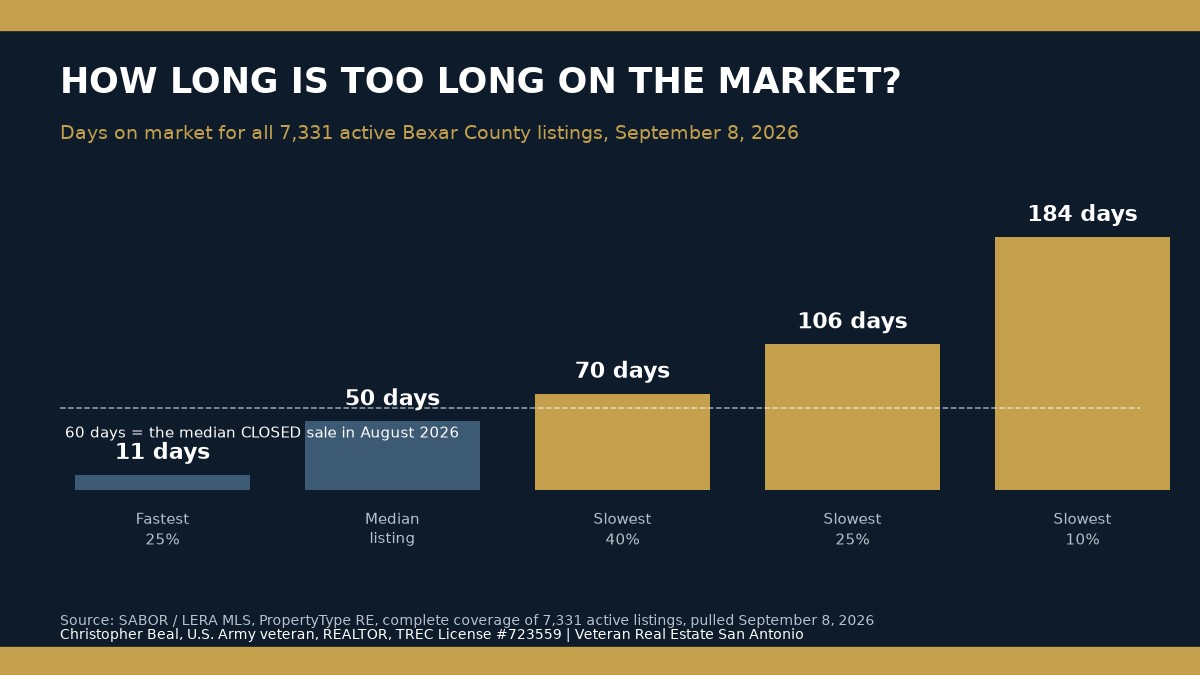
Context for the market itself: San Antonio homes sold at about 97.7 percent of list price over the same three months, at roughly $164 per square foot, with active inventory sitting on the market an average of 63 days. That is a functioning market with real negotiating room. It is not a market that rewards a hopeful price and a wait, which is precisely the strategy divorcing sellers default to when they cannot agree.
Should One Spouse Keep the House Instead of Selling?
The owelty lien is the single most useful thing most divorcing Texas homeowners have never heard of. Texas has unusually strict home-equity rules; a standard cash-out refinance is capped at 80 percent of the home value. That cap frequently makes a buyout impossible on paper. An owelty of partition lien, awarded in the divorce decree and recorded in the county real property records, is treated differently and permits a materially higher loan-to-value on the refinance that funds the buyout.
How an owelty buyout is sequenced
- The attorneys draft the decree to include the owelty award and a special warranty deed with an owelty of partition lien.
- The judge signs the decree after the 60-day waiting period.
- The owelty documents are recorded with the county clerk in the real property records.
- The remaining spouse closes the refinance, and the departing spouse is paid their share at that closing.
Two cautions. First, the order matters: the lien has to exist before the refinance funds it, which is why this cannot be improvised at the closing table. Second, being removed from the deed is not the same as being removed from the loan. A quitclaim or special warranty deed transfers ownership; it does not release the departing spouse from the mortgage. Until the loan is refinanced or formally assumed, both names remain on the debt, and a late payment by the spouse who stayed lands on the credit of the spouse who left.
Where the loan is a VA loan, the entitlement question sits on top of all of this, and it is not optional reading. That analysis is worked through in detail in the guide to VA loans and divorce in San Antonio, including removing a co-borrower and restoring entitlement.
What Changes When One Spouse Is Active-Duty at JBSA?
A military divorce in San Antonio is not a civilian divorce with a uniform in it. With roughly 80,000 active-duty and civilian personnel cycling through Joint Base San Antonio annually across Fort Sam Houston, Lackland AFB, and Randolph AFB, this is one of the most common versions of the problem in Bexar County, and the moving parts are different.
| Factor | Why it matters in a JBSA divorce | What to do about it |
|---|---|---|
| SCRA protections | Proceedings can be delayed when duty materially affects participation | Raise it with counsel early; it changes the whole calendar |
| Basic Allowance for Housing | The rate changes with dependent status, which changes what each household can afford | Model both post-divorce budgets before deciding who keeps the house |
| VA loan entitlement | A retained VA loan ties up entitlement the veteran may need at the next duty station | Decide whether to sell, refinance, or pursue an assumption by an eligible buyer |
| PCS orders mid-case | Orders do not wait for a decree | Build a remote-closing plan with a specific durable power of attorney approved in advance by lender and title |
| Deployment or TDY | Signatures and inspections have to happen across time zones | Get the power of attorney executed before departure, not from downrange |
The scenario I see most often at JBSA: orders drop in the middle of the case. The house has to be sold, one spouse is leaving Texas on a report date, and nobody has arranged the authority to sign. A specific durable power of attorney, drafted for this transaction and pre-approved by both the lender and the title company, solves it. A general power of attorney frequently does not, and finding that out three days before closing is a bad way to find it out.
If a permanent change of station is already in motion, the sequencing overlaps heavily with the standard PCS seller problem. The remote-seller mechanics are covered in the PCS orders remote seller playbook, and the keep-versus-sell math is in the keep, sell, or rent decision framework. If both spouses are service members, the housing-allowance arithmetic is not what most people assume, and it is worked out in the dual-military and single-parent JBSA guide.
How Does a Listing Agent Work for Two People Who Disagree?
The agent's job in a divorce sale is to remove every opportunity for one spouse to believe the other got information first. That belief is what turns a routine price reduction into a two-week standoff. The mechanics are unglamorous and they work: joint emails only, a shared showing-feedback log, offers presented to both parties simultaneously, and a written pricing plan agreed at listing, including the review dates and the reduction increments if the home has not attracted an offer.
Ground rules that prevent most divorce-sale blowups
- Both spouses sign the listing agreement and any amendment. No exceptions, no verbal authority.
- Every communication goes to both parties on the same email, including showing feedback and inspection reports.
- Set the price-reduction schedule at listing, in writing, with dates. Do not renegotiate it under pressure.
- Agree in advance how repair credits will be funded and out of whose share they come.
- Route disagreements to counsel rather than to the agent. The agent is not the referee and should not act like one.
- Decide before listing where the proceeds go at closing: escrow, trust, or a split wire per the decree.
Where the parties cannot agree on price, the cleanest solution is one agreed appraisal named in the decree, rather than two opposing broker opinions that predictably land at whatever each side wanted. It costs a few hundred dollars and it settles a dispute that otherwise costs months of carrying charges.
What Are the Most Expensive Mistakes?
| Mistake | What it costs | The fix |
|---|---|---|
| Waiting for the decree to start prepping | 60 to 90 extra days of mortgage, insurance, taxes, and utilities | Use the statutory waiting period to prep, price, and often to list |
| Assuming the deed removes the loan | A missed payment by one spouse damages both credit files for years | Refinance, formally assume, or sell. There is no fourth option |
| Pricing to the settlement math | Extended market time and a lower final number than a correct list price | Price to comparable sales. The market does not know about the decree |
| Letting the note go unpaid during the case | Late fees, credit damage, and in the worst case a foreclosure clock | Address the mortgage explicitly in temporary orders |
| Ignoring the capital gains exclusion | Potentially significant tax on gain that could have been excluded | Talk to a CPA about the ownership and use tests and about filing status before you close |
| Two competing valuations | Weeks of argument and a stale listing | One agreed appraisal named in the decree |
The capital gains item deserves a sentence of its own because the timing is genuinely counterintuitive. The exclusion on gain from the sale of a principal residence depends on ownership and use tests and on filing status, and divorce changes filing status. Whether a sale closes before or after the year-end, and before or after the decree, can change the tax result. That is a conversation for a CPA, not a Realtor, and it should happen early enough to influence the closing date rather than after it is set.
What Should You Do in the First Two Weeks?
Almost every divorcing homeowner in Bexar County starts with the wrong first question. The question is not what the house is worth. It is what the house nets and when the money is available, because that is the number the settlement actually divides and the date on which either party can move on.
The first-two-weeks checklist
- Get a defensible value. Comparable sales from SABOR data, not an online estimate. Both spouses should receive the same analysis at the same time.
- Order the payoff statement. Balance is not payoff. Get the real figure with per-diem interest.
- Document condition. Photograph everything now. Condition disputes late in a case are unwinnable without a dated record.
- Decide the path with counsel. Sell, buy out with an owelty lien, or defer with a temporary order that assigns the payment.
- Confirm who is paying what during the case. Mortgage, insurance, taxes, HOA, utilities, and maintenance. Put it in writing.
- If military, brief your attorney on orders, deployments, and the loan type in the first meeting, not the third.
I handle divorce-related listings across Bexar, Comal, Kendall, Medina, and Bandera counties, and the pattern is consistent: the cases that go well are the ones where somebody produced a real net-proceeds number in the first month. Everything downstream, including how reasonable each party is willing to be, tends to follow from having an honest number instead of a hopeful one.
If a sale is the path, my Serve & Save program reduces closing costs for active-duty, veteran, and retired-military clients, which on a divorce sale is money that goes straight into the pool being divided. You can start with a no-obligation home evaluation, or call me directly at (210) 882-8583.
About the Author: Christopher Beal
Christopher Beal is a U.S. Army veteran and the Owner of Veteran Real Estate San Antonio, a Beal Group practice brokered by eXp Realty (TREC License #723559). A Military Relocation Professional (MRP) and VAREP member, he is a 7-time eXp Realty ICON agent, winner of Best Real Estate Agency in the 2026 Best of San Antonio Readers' Choice (San Antonio Current, 100,000+ voters), and a 3x San Antonio Business Journal Top 25 Individual Agent (#13 in 2024, #14 in 2025, #20 in 2026). His recognition also includes 3x Platinum Top 50, 2x RateMyAgent Agent of the Year, 2x Real Producers Top 100, Five Star Professional (2026), and a RealTrends 2026 ranking. He has helped 325+ families, closed more than $125M in career volume, and holds 5.0 stars across 370+ verified reviews, working almost exclusively with military and veteran buyers and sellers across Bexar, Comal, Kendall, Medina, and Bandera counties, with a focus on VA loans, PCS moves, and homebuying near JBSA-Lackland, JBSA-Randolph, and Fort Sam Houston. He handles divorce-related listings with both spouses treated as clients, every communication sent jointly, and a written pricing plan agreed before the first showing. He can be reached at (210) 882-8583.
His Serve & Save program reduces closing costs for active-duty, veteran, and retired-military buyers and sellers. Read Christopher's full credentials.
This article is general real-estate information for San Antonio homeowners and is not legal, tax, or financial advice. Texas divorce law is fact-specific. Consult a licensed Texas family law attorney about your case and a CPA about tax consequences before making decisions about your home.
FAQ
Can my spouse sell our San Antonio house without my signature?
Not if the home is community property and you have not agreed or been ordered otherwise. A sale of community real property generally requires both spouses, which is why the sale question usually gets resolved by agreement, by a temporary order during the case, or by the final decree.
How long is the waiting period for a divorce in Texas?
Sixty days from the date the original petition is filed, under Texas Family Code Section 6.702. The earliest a judge can grant the divorce is day 61. The recognized exception involves documented family violence. Uncontested cases commonly finish in two to four months overall.
Should we sell the house before or after the divorce is final?
It depends on cash flow and cooperation. Selling during the case, under a temporary order or by agreement, often saves two to three months of carrying costs because the roughly 79-day San Antonio sale timeline can run in parallel with the 60-day waiting period. Selling after the decree is simpler administratively but slower and more expensive to carry.
What is an owelty lien and why does it matter?
It is a lien awarded in a Texas divorce decree that lets the spouse keeping the home refinance up to roughly 95 percent of appraised value in order to pay the other spouse their share of the equity, rather than being limited to the 80 percent cap that applies to an ordinary Texas cash-out refinance. It has to be created in the decree and recorded before the refinance funds it.
Does taking my name off the deed take me off the mortgage?
No. A deed transfers ownership. The mortgage is a separate contract with the lender. Until the loan is refinanced, formally assumed, or paid off through a sale, both borrowers remain liable, and a missed payment affects both credit files.
How is the equity split in a Texas divorce?
Texas is a community property state, so the community estate is divided in a manner the court considers just and right. That is often close to equal but is not required to be. Courts can award a disproportionate share based on factors including earning capacity, fault, health, and the needs of children.
What happens to a VA loan in a divorce?
The entitlement stays tied to the loan until it is paid off, assumed by an eligible party with a substitution of entitlement, or otherwise released. That can limit the veteran's ability to use the benefit at the next duty station, which is why the loan question needs to be settled alongside the house question rather than after it.
Who pays the mortgage while the divorce is pending?
Whoever the temporary orders say pays it. If the orders do not address it, this becomes a dispute, and the spouse who paid usually seeks credit for it in the final division. Address it explicitly and early.
Do we need two appraisals?
Usually not, and two competing valuations tend to cost more in delay than a single agreed appraisal costs in fees. Naming one agreed appraiser in the decree or in temporary orders removes a predictable source of argument.
Can one Realtor represent both spouses in the sale?
Yes, and it is the common arrangement. Both spouses sign the listing agreement and both receive every communication and every offer at the same time. The agent handles the sale; disagreements about the division go to counsel.
Explore More Resources
- Free Home Evaluation
- Serve & Save Program
- VA Home Loans
- Military Relocation to San Antonio
- Client Reviews
- About Christopher Beal
Christopher Beal
U.S. Army Veteran & REALTOR
Veteran Real Estate San Antonio: The Beal Group
Phone: (210) 882-8583
Email: [email protected]
veteranrealestatesa.com
Watch: Selling a House During Divorce in San Antonio
The two numbers that decide this are the timeline and the net proceeds. Here is the quick version in about a minute.
Categories
- All Blogs (353)
- Alamo Heights (4)
- awards (4)
- Best Neighborhoods in San Antonio (14)
- Buyer (16)
- Buyer Education (85)
- Community Events (4)
- Hill Country (17)
- JBSA (43)
- Local Guide (6)
- Luxury (28)
- Luxury Real Estate (26)
- Market Trends (19)
- Market Update (14)
- Military Relocation (111)
- Military Retirement (3)
- Mortgage (18)
- Neighborhood Guides (18)
- neighborhoods (5)
- New Construction (16)
- PCS (42)
- Real Estate (40)
- reviews (3)
- San Antonio (53)
- San Antonio Lifestyle (4)
- San Antonio Market (5)
- San Antonio Neighborhoods (43)
- San Antonio Real Estate (99)
- San Antonio, Veterans Resources, VA Loans (5)
- Seller (54)
- VA Home Loans (30)
- VA Loans (34)
- Va Loans & Financing (27)
- Veterans (10)
- Veterans Resources (40)
Recent Posts