Buying Near JBSA With the Exit in Mind: Which NE San Antonio Suburb Is Easiest to Sell or Rent When You PCS Out (2026)
LAST UPDATED: JULY 30, 2026 | BY CHRISTOPHER BEAL, U.S. ARMY VETERAN & REALTOR
Buying Near JBSA With the Exit in Mind: Which NE San Antonio Suburb Is Easiest to Sell or Rent When You PCS Out (2026)

Key Takeaways
- Schertz (78154) posts the strongest all-around exit numbers in the corridor: 5.7 months of supply, a 98.44 percent list-to-sale ratio, and 91.6 average days on market over the last six months.
- Converse (78109) has by far the deepest buyer and renter pool at roughly 141 closed sales per month and a $245,000 median, which is why it is the easiest corridor ZIP to rent out on a JBSA housing allowance.
- Cibolo (78108) carries the corridor's longest average days on market at 108.8 and more active listings than it closed in six months, and its 2026 builder pipeline is the direct competitor to your 2029 resale.
- Garden Ridge (78266) actually sells the fastest at 60.9 average days on market, but with only about 23 closings a month and a $431,950 median it is a sale-only exit, not a rental exit.
- Universal City (78148) shows the corridor's highest months of supply at 7.0 on the thinnest volume, so plan a longer runway if you list there on short PCS notice.
- If you bought or assumed at a low rate, your assumable VA loan is an exit asset. In a corridor where inventory is running near six months, it is often the single strongest thing your listing has going for it.
In This Guide
- Which NE San Antonio suburbs are easiest to exit after a three-year JBSA tour?
- What exit math do the lifestyle guides skip?
- How liquid are Universal City, Converse, and Live Oak?
- Schertz or Cibolo: which one does the builder pipeline hurt in 2029?
- Is Garden Ridge acreage a hard house to sell?
- Should you sell, rent it out, or market your assumable VA loan?
- How do I run a buy-for-the-exit search for JBSA families?
- FAQ: NE San Antonio corridor resale, rentals, and PCS exits
Which NE San Antonio Suburbs Are Easiest to Exit After a Three-Year JBSA Tour?
Every relocation guide for the Randolph corridor is written for the day you move in. Almost none of them are written for the day you get orders again. That is backward. If you are a captain at JBSA-Randolph on a three-year assignment, the purchase decision you are making in 2026 is really a sale decision you will execute in 2029, probably on 60 to 90 days of notice, probably while you are also out-processing, shipping a household, and enrolling kids somewhere else.
I have been on the seller side of that timeline more times than I can count, and the pattern is consistent: families pick the suburb that fits their commute and their school district, and they never look at whether that suburb has a buyer pool deep enough to absorb their house on a deadline. Then, three years later, they are the ones dropping price twice in the middle of PCS season.
So this guide scores the six main Northeast corridor suburbs on exit liquidity, not lifestyle fit. Every number below comes from closed and active SABOR MLS data for the six months ending July 30, 2026. If you want the commute-and-lifestyle side of the decision, I already wrote that in the Converse, Live Oak, and Universal City commuter ZIP guide, and the full base-side picture lives on my 2026 PCS to JBSA hub.
What Exit Math Do the Lifestyle Guides Skip?
Days on market tells you how long the wait is. Months of supply tells you how much company you will have. Months of supply is simply active inventory divided by the monthly pace of closed sales. Anything under about four months favors sellers, four to six is roughly balanced, and above six starts favoring buyers. Every ZIP in this corridor is currently sitting at or above the balanced line, which is exactly why the exit question matters more in 2026 than it did in 2021.
The list-to-sale ratio is the quiet one. It is the percentage of the final asking price a seller actually collects. In Schertz it is 98.44 percent. In Live Oak it is 97.25 percent. On a $350,000 house that 1.19-point gap is about $4,200 of your equity, and it repeats on every sale in that ZIP, which tells you something structural about negotiating leverage.
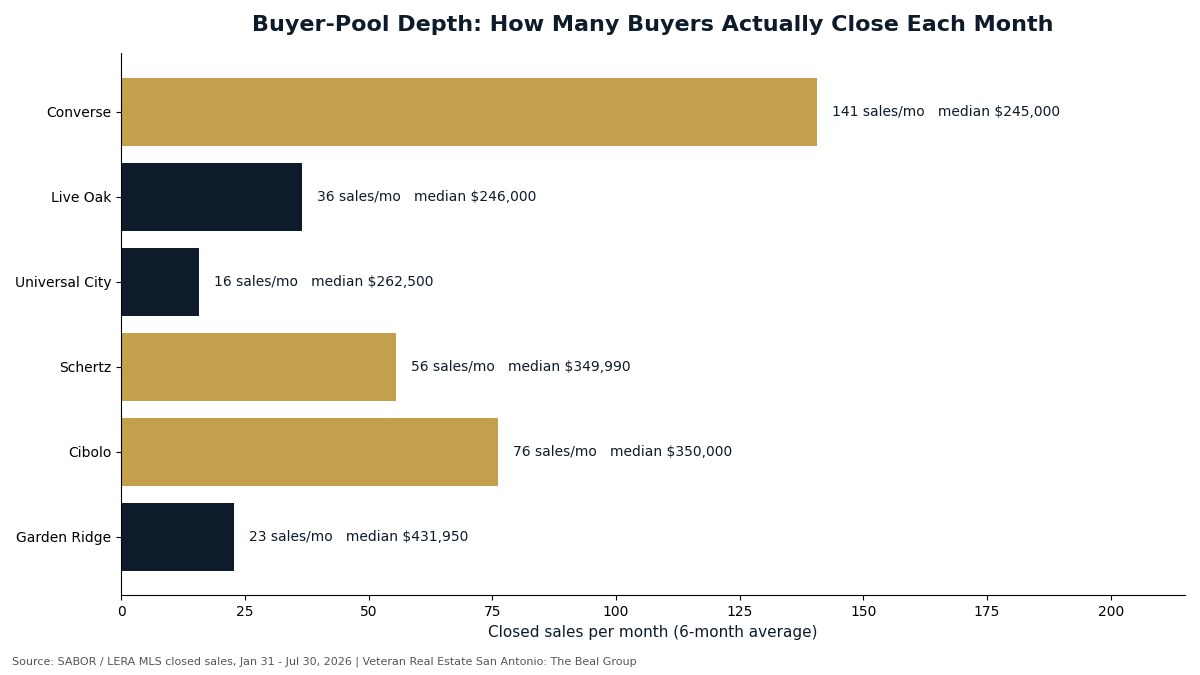
The last number is the one nobody publishes: how many buyers actually close in that ZIP in a normal month. Converse closes roughly 141 homes a month. Universal City closes about 16. If your exit window is 60 days, you want to be swimming in the pool with 141 fish in it, not the one with 16.
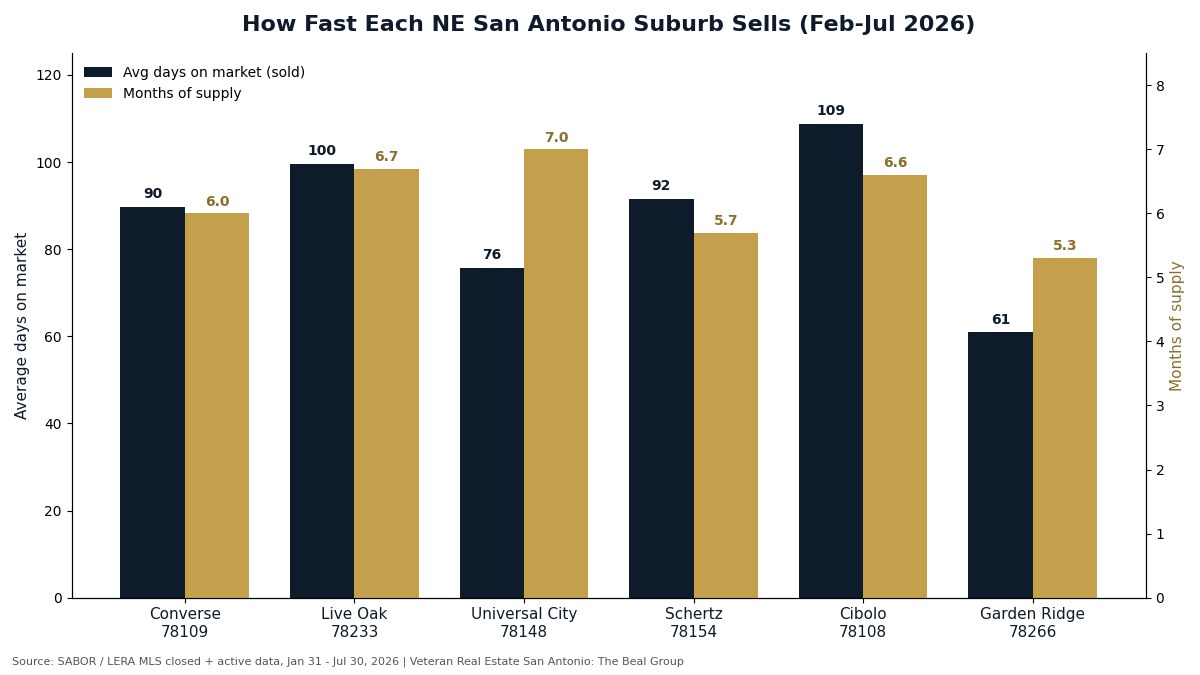
The Corridor Exit Scorecard
| Suburb (ZIP) | Median sale price | Avg days on market | Months of supply | List-to-sale ratio | Closings per month |
|---|---|---|---|---|---|
| Schertz (78154) | $349,990 | 91.6 | 5.7 | 98.44% | 56 |
| Garden Ridge (78266) | $431,950 | 60.9 | 5.3 | 98.30% | 23 |
| Converse (78109) | $245,000 | 89.7 | 6.0 | 97.88% | 141 |
| Cibolo (78108) | $350,000 | 108.8 | 6.6 | 97.85% | 76 |
| Live Oak (78233) | $246,000 | 99.6 | 6.7 | 97.25% | 37 |
| Universal City (78148) | $262,500 | 75.8 | 7.0 | 97.53% | 16 |
Source: SABOR / LERA MLS closed and active residential data, January 31 through July 30, 2026. Months of supply calculated as active inventory divided by the six-month monthly closing pace. Live Oak figures reflect ZIP 78233, which also covers adjacent Northeast San Antonio.
How Liquid Are Universal City, Converse, and Live Oak?
These three ZIPs are where most junior enlisted and company-grade JBSA-Randolph families land, and they behave very differently on the way out. Converse at 78109 closed 844 homes in six months. That is not a neighborhood statistic, that is a market. When you list there on PCS orders, there is a standing crowd of VA-eligible buyers, first-time buyers, and investors already shopping your price band.
The same depth is what makes Converse the corridor's most reliable rent-out option. A $245,000 median purchase with a modern rate is usually within striking distance of the JBSA-Randolph housing allowance for a mid-grade family, which means the renter pool that can afford your payment is genuinely large. That math is the whole reason I keep pointing accidental landlords toward this ZIP in my guide to renting out a San Antonio home after PCS.
Live Oak is the one I flag most often. At 99.6 average days on market and a 97.25 percent list-to-sale ratio, it is the softest exit of the three, and 6.7 months of supply means a seller there is competing with a lot of near-identical inventory. It is a fine place to live near Randolph. It is simply a place where you should not plan on a fast, full-price exit.
Universal City is the corridor's genuine small market. Only 94 residential sales closed there in six months. Its 75.8 average days on market looks good in isolation, but with 109 active listings against roughly 16 monthly closings, the 7.0 months of supply is the highest in this comparison. Small markets can move fast when the right buyer appears, and can sit for a long time when one does not. If you are on a hard report date, build in extra runway.
Schertz or Cibolo: Which One Does the Builder Pipeline Hurt in 2029?
Schertz and Cibolo look nearly identical on a lifestyle chart and they are not identical on an exit chart. Both sit around a $350,000 median. Both feed Schertz-Cibolo-Universal City ISD. Both are twenty-something minutes from the JBSA-Randolph gate. But Schertz closed 333 homes with 317 active, and Cibolo closed 457 with 500 active. Cibolo has more houses standing in line than it sold in half a year.
Here is the part that matters for a 2029 exit and that almost nobody prices in: when you buy a three-year-old production home in Cibolo, your future buyer will be able to walk into a builder's model down the road and get a brand-new version of your floor plan with a rate buydown, closing-cost credits, and a fresh warranty. You cannot match a builder incentive. You can only discount against it. That is the structural reason Cibolo's days on market runs 17 days longer than Schertz's right now, and the pipeline is not finishing before your orders arrive.
None of this means do not buy in Cibolo. It means buy the thing the builder is not still making. Established sections with mature trees, larger or irregular lots, cul-de-sac positions, and finished-out backyards are the Cibolo homes that hold their own against a new-build model home. I cover the neighborhood-level version of this in the Cibolo guide and the Schertz guide.
Is Garden Ridge Acreage a Hard House to Sell?
I expected Garden Ridge to be the slow one, and the data says otherwise. ZIP 78266 sold faster than every other suburb in this comparison, held a 98.30 percent list-to-sale ratio, and carries the lowest months of supply on the board. Buyers who want an acre inside a twenty-minute drive of Randolph do not have many alternatives, and scarcity cuts both ways.
What you are taking on is a different risk. At $203.25 per square foot and a $431,950 median, Garden Ridge homes generally sit above what a JBSA family can cover with a housing allowance, so the rent-it-out escape hatch mostly is not there. And with roughly 23 sales a month, a mispriced listing does not get a second and third wave of buyers the way a Converse listing does. Garden Ridge rewards correct pricing on day one and punishes a test-the-market number. The acreage-specific tradeoffs are broken down further in my Garden Ridge one-acre estates guide.
Should You Sell, Rent It Out, or Market Your Assumable VA Loan?
Most PCS sellers treat this as a binary and it is not. There are three real exit paths, and the corridor data tells you which one each ZIP actually supports.
Matching the Exit Path to the Suburb
| Your priority | Best pick | Runner-up | Why |
|---|---|---|---|
| Sell fast on hard PCS orders | Garden Ridge | Universal City | Fastest average days on market at 60.9 and tightest supply at 5.3 months, if priced correctly on day one. |
| Keep the most of your asking price | Schertz | Garden Ridge | 98.44 percent list-to-sale ratio, the strongest seller leverage in the corridor. |
| Rent it out and keep the low rate | Converse | Live Oak | $245,000 median sits inside the JBSA housing-allowance band, so the qualified renter pool is deepest here. |
| Widest possible buyer pool | Converse | Cibolo | About 141 closings a month versus 16 in Universal City. |
| Space and land, resale second | Garden Ridge | Cibolo | Acreage inside twenty minutes of the Randolph gate is scarce, and scarcity supported a 98.30 percent ratio. |
| Lowest 2029 competition risk | Schertz | Universal City | Established sections face less direct builder-incentive competition than Cibolo's active pipeline. |
Source: SABOR / LERA MLS, January 31 through July 30, 2026, cross-referenced with 2026 JBSA housing allowance bands published by the Defense Travel Management Office.
The assumable VA loan is the exit lever almost nobody uses on purpose. If you financed or assumed at a rate meaningfully below what a buyer can get today, that loan is transferable to a qualified buyer, and in a corridor sitting near six months of supply it is frequently the strongest differentiator your listing has. It widens your buyer pool at exactly the moment supply is working against you. The mechanics, including the entitlement question that trips up most sellers, are in my 2026 San Antonio assumable VA loan guide.
One caution I give every client: if a civilian buyer assumes your VA loan, your entitlement generally stays tied up until that loan is paid off, which can limit your next purchase. If a VA-eligible buyer assumes it and substitutes their own entitlement, yours is restored. That single distinction changes whether an assumption is a great exit or an expensive one, and it is worth a conversation before you list, not after you have an offer.
How Do I Run a Buy-for-the-Exit Search for JBSA Families?
I served in the Army, and I have sold homes for families across Bexar, Comal, Kendall, Medina, and Bandera counties for long enough to have watched three-year cycles play out from both ends. When a JBSA family calls me before they buy, here is the sequence I run.
- Set the exit date first. If you are reporting in September 2026 on a standard three-year assignment, we are planning around a mid-2029 sale. That is the market we are underwriting, not today's.
- Filter by gate commute, then rank by liquidity. Randolph, Fort Sam Houston, and Camp Bullis each pull a different set of ZIPs. Once we know which ones work for your drive, the corridor exit scorecard above sets the order.
- Screen out the resale traps. Backing to a future builder phase, an unfinished section, a flag lot, the smallest floor plan in a section of larger ones, or a heavy special-district tax rate. All of these are cheap to accept in 2026 and expensive to exit in 2029.
- Underwrite the rental fallback before you buy. We run what the home would realistically rent for against a mid-grade housing allowance, so you know on day one whether renting is a genuine option or a fantasy.
- Protect the loan. If we are getting a favorable rate, we structure with the future assumption in mind, because in 2029 that rate may be the most valuable thing about the house.
Serve & Save is how I put money back in your pocket on the transaction itself: it reduces closing costs by one percent per year of service, up to six percent. It is a closing-cost credit, applied at the closing table.
About the Author: Christopher Beal
Christopher Beal is a U.S. Army veteran and the Owner of Veteran Real Estate San Antonio, a Beal Group practice brokered by eXp Realty (TREC License #723559). A Military Relocation Professional (MRP) and VAREP member, he is a 7-time eXp Realty ICON agent, winner of Best Real Estate Agency in the 2026 Best of San Antonio Readers' Choice (San Antonio Current, 100,000+ voters), and a 3x San Antonio Business Journal Top 25 Individual Agent (#13 in 2024, #14 in 2025, #20 in 2026). His recognition also includes 3x Platinum Top 50, 2x RateMyAgent Agent of the Year, 2x Real Producers Top 100, Five Star Professional (2026), and a RealTrends 2026 ranking. He has helped 325+ families, closed more than $125M in career volume, and holds 5.0 stars across 370+ verified reviews, working almost exclusively with military and veteran buyers and sellers across Bexar, Comal, Kendall, Medina, and Bandera counties, with a focus on VA loans, PCS moves, and homebuying near JBSA-Lackland, JBSA-Randolph, and Fort Sam Houston. For families buying in the Northeast corridor on a three-year tour, he underwrites the 2029 exit before the 2026 purchase. He can be reached at (210) 882-8583.
FAQ: NE San Antonio Corridor Resale, Rentals, and PCS Exits
Which Northeast San Antonio suburb sells the fastest in 2026?
Garden Ridge (78266) posted the fastest average days on market in the corridor at 60.9 days over the six months ending July 30, 2026, followed by Universal City at 75.8 days. Cibolo was the slowest at 108.8 days.
Which corridor suburb is easiest to rent out when I PCS?
Converse (78109). Its $245,000 median sale price generally keeps the required rent inside the JBSA housing-allowance band for a mid-grade family, and the ZIP closes roughly 141 homes a month, which signals a large, active pool of both renters and future buyers.
Is Cibolo a bad place to buy if I am PCSing out in three years?
Not bad, but it carries the corridor's highest resale competition. Cibolo currently shows 500 active listings against 457 six-month closings and the longest average days on market at 108.8. The specific risk is builder incentives on new construction competing with your 2029 resale. Buying an established section, a larger or irregular lot, or a finished-out home reduces that exposure.
What is months of supply and why does it matter for a PCS sale?
Months of supply is active inventory divided by the monthly pace of closed sales. Under about four months favors sellers, four to six is balanced, and above six favors buyers. Every corridor ZIP is currently at or above six except Schertz and Garden Ridge, which means a PCS seller should plan for a longer marketing window than in 2021.
Can I sell my house in San Antonio while I am already at my next duty station?
Yes. I handle remote PCS sales regularly using electronic signatures, video walkthroughs, coordinated vendor access, and a power of attorney where appropriate. The key is starting the pricing and prep conversation before you leave, not after.
Does an assumable VA loan really help me sell faster?
In a balanced or buyer-leaning market it often does. If your rate is meaningfully below current market, a qualified buyer taking over that loan gets a payment they cannot get anywhere else, which widens your buyer pool. The caution is entitlement: if a non-VA-eligible buyer assumes, your entitlement typically stays tied to the loan until it is paid off.
Which corridor suburb has the best seller leverage on price?
Schertz (78154), where sellers collected 98.44 percent of their final asking price on average, followed by Garden Ridge at 98.30 percent. Live Oak was weakest at 97.25 percent.
How much runway should I plan for a corridor sale on PCS orders?
Plan on your ZIP's average days on market plus roughly 30 to 45 days to close. In Cibolo that is realistically four to five months from list to funded. In Garden Ridge it can be closer to three. Starting early is the single cheapest thing you can do.
Is Universal City a bad exit market?
It is a thin one, not a bad one. Only 94 homes closed there in six months, and it carries the corridor's highest months of supply at 7.0. Homes there can move quickly when the right buyer surfaces, but there is no deep second wave of buyers if your first price is wrong.
How does Serve & Save work for a military buyer in this corridor?
Serve & Save reduces your closing costs by one percent for each year of service, up to a maximum of six percent. It is applied as a closing-cost credit at the closing table, not a payment after the fact.
What Should You Do Next?
If you are reporting to JBSA-Randolph, Fort Sam Houston, or Camp Bullis in the next year, buy the exit, not just the commute. Send me your report date and your rotation window and I will build you a corridor shortlist ranked by how easily each home comes back to market in 2029. If you already own here and orders just dropped, the earlier we price it, the more of your equity you keep.
Call or text me at (210) 882-8583. Email [email protected]. Or start online at veteranrealestatesa.com.
Explore More Resources
Verify the numbers yourself: DoD Basic Allowance for Housing rate lookup, San Antonio Board of REALTORS market statistics, and Joint Base San Antonio.
Watch: Which NE Suburb Is Easiest to Sell on the Way Out?
If you are buying near JBSA with a three-year tour in front of you, the exit matters as much as the entry. Quick breakdown of which NE San Antonio suburbs move fastest when it is your turn to PCS.
Categories
- All Blogs (353)
- Alamo Heights (4)
- awards (4)
- Best Neighborhoods in San Antonio (14)
- Buyer (16)
- Buyer Education (84)
- Community Events (4)
- Hill Country (17)
- JBSA (43)
- Local Guide (6)
- Luxury (28)
- Luxury Real Estate (26)
- Market Trends (19)
- Market Update (14)
- Military Relocation (111)
- Military Retirement (3)
- Mortgage (18)
- Neighborhood Guides (18)
- neighborhoods (5)
- New Construction (16)
- PCS (42)
- Real Estate (40)
- reviews (3)
- San Antonio (53)
- San Antonio Lifestyle (4)
- San Antonio Market (5)
- San Antonio Neighborhoods (43)
- San Antonio Real Estate (98)
- San Antonio, Veterans Resources, VA Loans (5)
- Seller (54)
- VA Home Loans (30)
- VA Loans (33)
- Va Loans & Financing (27)
- Veterans (10)
- Veterans Resources (40)
Recent Posts