How to Choose a Listing Agent in San Antonio (2026): The Marketing Plan Questions That Decide Your Net Proceeds

I am Christopher Beal, a Texas-licensed REALTOR with eXp Realty and Owner of Veteran Real Estate San Antonio: The Beal Group. I was named a Best of San Antonio 2026 winner for Best Real Estate Agency in the San Antonio Current Readers' Choice awards, and I am a 3x San Antonio Business Journal Top 25 Individual Agent and a 7x eXp Realty ICON agent. I have closed 325+ homes and more than $125M in career volume across Bexar, Comal, Kendall, Medina, and Bandera counties, and I hold 5.0 stars across 370+ verified reviews. I am also a U.S. Army veteran and hold TREC License #723559.
If you are trying to decide which listing agent to hire in San Antonio, the interview question that predicts your outcome is not "what is your commission?" It is "what specifically will you do in the first fourteen days?" Almost every agent you meet will promise aggressive marketing. Very few can name the steps in order, and the local sold data shows exactly what happens to the sellers who hire the ones who cannot.
I pulled the numbers on August 11, 2026 to make this concrete. Across 198 San Antonio closings recorded in the SABOR MLS between May 13 and August 11, 2026, the sellers who never cut their price sold at a median of 99.4 percent of their original asking price in a median of 25 days. The sellers who cut at least once sold at 91.0 percent of their original asking price and sat on the market a median of 101 days. On the $294,245 median San Antonio sale price, that 8.4-point gap is roughly $24,700 of the seller's own money.
KEY TAKEAWAYS: CHOOSING A SAN ANTONIO LISTING AGENT IN 2026
- 52 percent of San Antonio sellers in the last 90 days had to cut their price at least once. That is the single most expensive mistake in this market, and it is a pricing and preparation failure, not a market failure.
- Ask for the marketing plan in writing, step by step, with dates. An agent who cannot name what happens on day 3, day 10, and day 21 does not have a plan.
- Judge the pricing method, not the price. Any agent can tell you a high number to win the listing. Ask how they arrived at it and what triggers a change.
- Only 23 percent of recent San Antonio sellers closed at or above their original list price. Realistic beats optimistic.
- Interview at least two agents, and give the listing to the one whose plan you can repeat back from memory.
The number that separates a good San Antonio listing agent from an expensive one
Price cuts are the tax you pay for a bad launch. San Antonio in the summer of 2026 is a market with real inventory and patient buyers. Homes are not selling themselves. The median home in the city closed at $294,245 with an average of 82 days on market, and homes currently sitting active have already been listed an average of 59 days. That is a market where the first three weeks of a listing decide the outcome, because that is when the buyers who have been watching your neighborhood finally see something new.
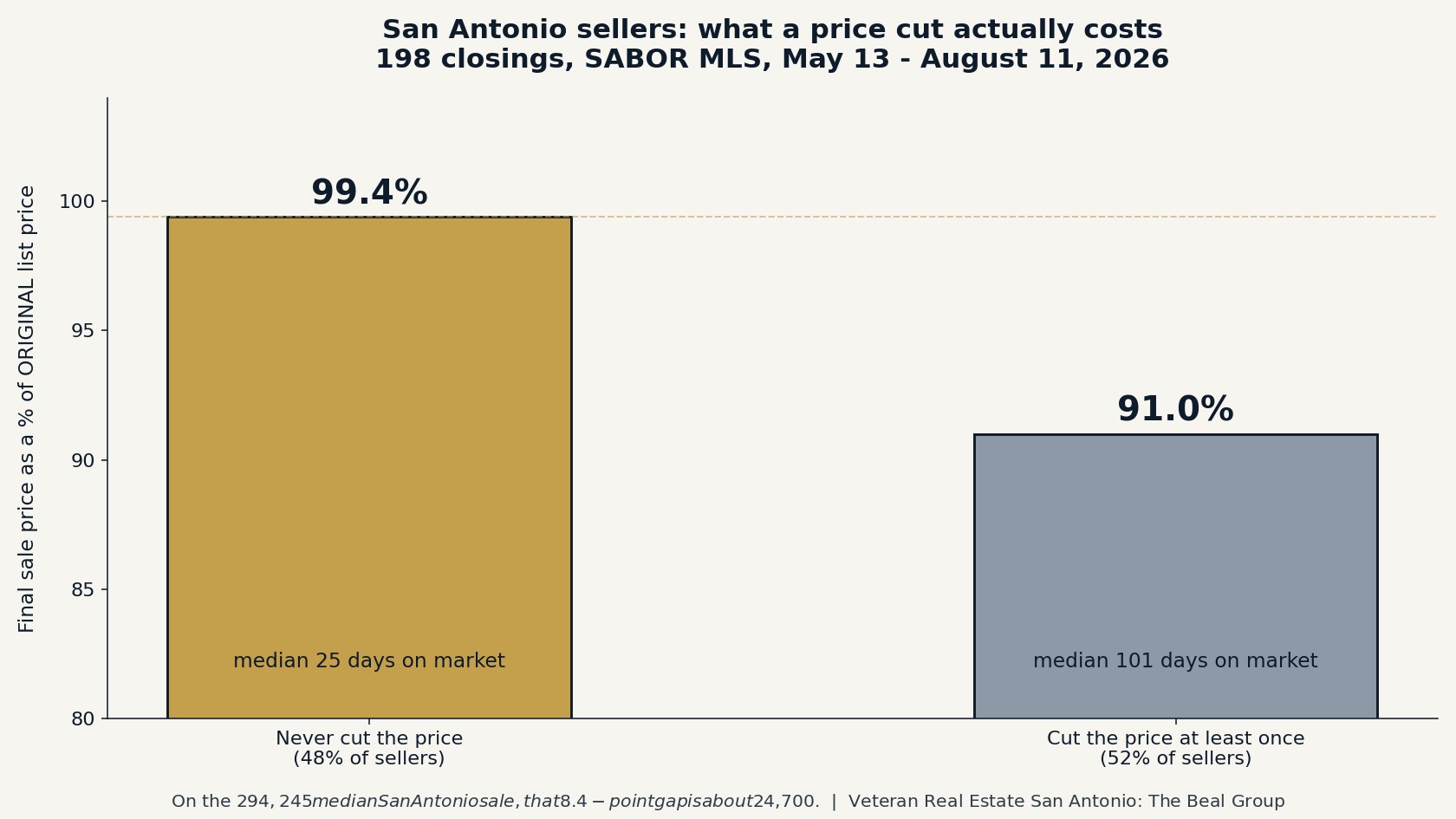
The pattern in that chart repeats no matter how I slice the data. Homes that went under contract within 30 days closed at a median of 100.0 percent of their original list price. Homes that took more than 90 days closed at a median of 88.1 percent. Nearly a twelve-point spread, on the same houses, in the same city, in the same three months. The difference is not the house. The difference is what happened before the sign went in the yard.
A price cut is not a marketing strategy. It is what an agent does after the marketing strategy failed, and in San Antonio right now it costs the average seller about $24,700.
So when you interview listing agents, you are not really shopping for a commission rate. You are shopping for the person least likely to put you in the 52 percent. Everything below is how to tell them apart.
What a real San Antonio listing marketing plan actually contains
"Aggressive marketing" is not a plan. A plan has steps, owners, and dates. Here is the sequence I run on every listing, in the order it happens. Use it as your checklist when an agent is sitting at your kitchen table. If they skip a step, ask why.
Step 1: A pricing method you can audit, not a number they pulled from the air
I build a comparative market analysis from closed SABOR MLS sales inside your subdivision or immediate submarket, ideally within the last 90 days, adjusted for square footage, lot, age, condition, and updates. Then I show you the active competition, because active listings are what a buyer actually compares you to, and the pending sales, because those tell us what the market accepted most recently. You should leave that meeting able to explain the price to your spouse without me in the room. If you cannot, the number is not defensible and an appraiser will not defend it either. My full method is in how to price your home in San Antonio.
Step 2: Pre-list preparation, scoped with a return on each dollar
Before anything goes live I walk the house and separate the work into three buckets: what must be done because a buyer's inspector or a lender will flag it, what pays for itself at resale, and what is a waste of your money. In this market the reliable winners are almost always the cheap ones. Paint in a current neutral, deep clean including grout and windows, decluttering to about seventy percent of the storage you actually use, fresh mulch and edged beds, replacing every dead bulb so the light temperature matches, and repairing the obvious deferred items. Anything structural, roof, HVAC, or foundation related gets addressed or disclosed and priced in deliberately, never hidden. Texas is a disclosure state and a surprise at the option period is far more expensive than a surprise at the listing appointment.
Step 3: Photography, video, and floor plan, shot after the prep, never before
Professional photography is table stakes, but the sequencing is what most listings get wrong. Photos happen after staging and cleaning, on a scheduled day chosen for light, not whenever the photographer had an opening. I want a full photo set, a walkthrough video, a drone exterior when the lot or the location is part of the story, and a measured floor plan. The floor plan matters more than agents admit. A large share of San Antonio buyers are relocating, including military families moving to Joint Base San Antonio on orders, and a buyer who cannot walk your house in person will not shortlist a listing they cannot understand spatially.
Step 4: Copy written for the buyer and for the search engines that now answer buyers
The listing remarks get written last, from the photos, and they lead with what is genuinely differentiated about the property rather than a list of adjectives. I write the description so it also answers the questions buyers type into Google and increasingly ask AI assistants: the school attendance zones, the commute to the major employers and the base gates, the HOA and any MUD or PID assessment, the tax rate, and what the neighborhood actually feels like. Vague copy loses twice now, once with the buyer and once with the systems that decide which listings get surfaced.
Step 5: Syndication and launch timing
The listing goes into the SABOR MLS, which feeds Zillow, Realtor.com, Redfin, Homes.com, and the brokerage networks. That part is automatic and no agent deserves credit for it. What is not automatic is the timing and the coordinated push around it. I hold the listing until the full media set is ready, launch mid-week so the listing is fresh going into the weekend, and pair the launch with email to my buyer database and the agents who have recently sold in your neighborhood, social distribution, and a Google Business Profile post. The goal is compressing as many first-week showings as possible into the same short window, because concentrated demand is how you get competing offers instead of sequential lowballs.
Step 6: A showing feedback loop with a decision rule attached
This is the step that separates the 48 percent from the 52 percent. Every showing gets a feedback request, and I report to you weekly with the three numbers that matter: online views, showings booked, and offers. Those three tell you exactly what is wrong. Low views means the price or the lead photo is wrong. Good views but few showings means the price is wrong for what the photos promise. Plenty of showings but no offers means condition, layout, or something on site that the photos did not reveal. We agree on those thresholds before the listing goes live, so that if we need to adjust, we adjust in week two off a small correction instead of week nine off a painful one.
Step 7: Offer negotiation and net-sheet math, not just the top-line number
The highest offer is frequently not the best offer. I evaluate financing type and lender quality, the amount and terms of the earnest money, the option period length and fee, the requested seller concessions, the closing date against your own move, and whether there is an appraisal or financing waiver. Then I put every offer side by side on a net sheet so you are comparing what actually lands in your account, not the headline price. A $5,000 higher offer that carries $9,000 in concessions and a shaky pre-approval is not a better offer, and in a market with 82-day averages a failed contract is expensive because your listing goes back on the market carrying visible days.
Step 8: Managing the contract to close
Once we are under contract the job is protecting the price we negotiated. That means shepherding the inspection and the repair amendment, watching the appraisal and preparing a comparable sales packet for the appraiser before they arrive, tracking the buyer's financing milestones, coordinating the survey or T-47 and the title work, and keeping the closing date honest. I use Dotloop for transaction documents and a transaction coordinator for deadline management, which is the only place I am not a solo operation.
Seven questions to ask before you sign a listing agreement
Ask these of every agent you interview and write down the answers. The differences between candidates will be obvious on paper in a way they are not in conversation.
| Ask this | What a strong answer sounds like | What should worry you |
|---|---|---|
| How did you arrive at this price? | Named closed comparables with adjustments, plus the active competition and pendings | A round number, a price-per-square-foot average, or "we can always come down" |
| What happens in the first 14 days, by day? | A dated sequence: prep, media day, launch day, first weekend, first feedback review | "We will list it and start marketing" |
| What is your average days on market and sale-to-original-list ratio? | Specific numbers they can show you in the MLS | Sale-to-list ratio only, which hides every price cut they have made |
| Who actually attends my showings and answers my calls? | A clear, named answer | You meet the rainmaker and get handed to someone you never met |
| What triggers a price adjustment, and when do we decide? | Named thresholds on views, showings, and offers, agreed before launch | "We will see how it goes" |
| Show me a seller net sheet for my house at three prices. | A real one, with title, taxes, payoff, and concessions modeled | Reluctance, or a commission-only estimate |
| What is the length of the listing agreement and how do I cancel? | A straight answer and a written cancellation policy | A 12-month term with no exit |
Red flags that show up in almost every bad listing experience
Three patterns account for most of the seller complaints I hear when a listing has failed elsewhere and comes to me.
The first is buying the listing. An agent quotes a price meaningfully above every other agent you interviewed, you sign, and four weeks later the price-reduction conversation starts. It is the most common way sellers end up in the 52 percent, and it is why I would rather lose a listing appointment on price than win one on a number I cannot defend to an appraiser.
The second is the quiet handoff. You hire an experienced agent and then discover your listing is being run by an assistant or a newer agent you never met. There is nothing wrong with support staff, but you should know at signing exactly who writes your remarks, who attends your showings, and who calls you back on a Sunday.
The third is a commission conversation that never becomes a net conversation. Commission is one line on a settlement statement. What you should be comparing is the projected net across agents at their proposed prices and timelines, because an agent who is a point cheaper and sells 60 days later at 91 percent of list has cost you far more than they saved. If you are weighing alternatives to a traditional listing entirely, I compared the math on iBuyer offers versus a listed sale in San Antonio, and on what Zillow's agent finder is actually selling you.
How I would approach your house specifically
My track record is 325+ closings and $125M+ in volume, and the part that matters to a seller is where those closings happened. I work Bexar, Comal, Kendall, Medina, and Bandera counties, which means I am pulling comparable sales from the actual submarket your buyer is shopping rather than a citywide average that describes nobody's house. Pricing on a Bexar County median of $289,500 is a different exercise than pricing in Boerne or Timberwood Park, and the difference shows up in the first two weeks.
I also came to this work from the Army, and a large share of my sellers are military families selling on orders with a hard date they cannot move. That constraint taught me to run listings against a calendar rather than against hope, which turns out to serve civilian sellers just as well. If your timing is flexible, it is worth reading the best time to sell a home in San Antonio by month before you commit to a launch date. If you are still deciding whether to sell at all this year, start with should I sell my home in San Antonio in 2026.
Neighborhood-specific seller guides with local net-sheet math are here for Stone Oak, Helotes, and Boerne and Fair Oaks Ranch.
Get a real listing plan and a real net sheet before you sign anything
I will walk your house, build the comparable sales analysis, and hand you a written 14-day launch plan and a seller net sheet at three price points. No pressure to list with me, and no charge. Interview me against anyone.
Call or text (210) 882-8583
Email [email protected]
Online at veteranrealestatesa.com
Frequently asked questions about choosing a listing agent in San Antonio
How many listing agents should I interview in San Antonio?
Two or three is the right number. One gives you no basis for comparison, and past three the interviews start blurring together. Ask each of them the same seven questions above and write the answers down the same day, because the differences are much clearer on paper than in conversation.
What is the average days on market in San Antonio right now?
Across 1,000 San Antonio closings recorded in the SABOR MLS between May 13 and August 11, 2026, the average was 82 days and the median was 56 days. Homes currently active have already been on the market an average of 59 days. Bexar County as a whole averaged 81 days over the same window.
What percentage of San Antonio homes sell for asking price?
In that same 198-sale detail sample, 23 percent closed at or above their original list price. The median sale closed at 95.1 percent of the original asking price. That is why the original list price, not the current list price, is the honest measure of whether a listing was priced correctly.
Should I choose the agent who says my home is worth the most?
Usually not, and the data is blunt about why. An inflated list price is the single most common cause of the price cuts that cost sellers a median of 8.4 points of their original asking price. Ask each agent to show you the closed comparable sales behind their number. The agent with the most defensible number is worth more than the agent with the highest one.
What does a listing agent actually do that I cannot do myself?
Pricing from full MLS closed data, professional media production and sequencing, syndication to the SABOR MLS and every portal that feeds from it, buyer and cooperating-agent distribution, showing management and feedback analysis, offer evaluation on net rather than headline price, and contract-to-close management including the appraisal packet. The pricing and the offer evaluation are where the money is.
How much does it cost to sell a home in San Antonio?
Budget for the agreed commission, title and escrow fees, an owner's title policy, survey or T-47 if required, prorated property taxes, any HOA transfer fees, negotiated repairs, and any seller concessions you agree to. Concessions are the line most sellers forget and they can move your net by thousands. Ask for a net sheet at three price points before you list.
How long should I sign a listing agreement for?
Three to six months is typical in this market and reasonable given an average of 82 days on market. What matters more than the length is whether there is a written cancellation policy. An agent confident in their plan will not need to trap you in a 12-month term.
Do I need a listing agent who specializes in my specific neighborhood?
You need one who can pull and defend comparable sales in your submarket, which is not quite the same thing. San Antonio submarkets diverge sharply. Ask the agent to name the last three homes that sold within a mile of you and explain how each one compares to yours. If they can do that, they know your market well enough.
What is the difference between sale-to-list ratio and sale-to-original-list ratio?
Sale-to-list compares the final price to the most recent asking price, so it resets every time an agent cuts. Sale-to-original-list compares the final price to what the home was first listed at, which captures every reduction. In this sample the two differ by more than three points citywide and by more than six points for sellers who reduced. Always ask for the original-list figure.
Can you sell my home if I am relocating or on military orders?
Yes, and a significant part of my practice is exactly that. Selling against a hard report date changes the calendar and the pricing strategy, because you do not have the option of waiting out a slow month. That work is built around Joint Base San Antonio timelines but the same discipline applies to any corporate relocation with a fixed start date.
About the Author: Christopher Beal
Christopher Beal is a U.S. Army veteran and the Owner of Veteran Real Estate San Antonio, a Beal Group practice brokered by eXp Realty (TREC License #723559). A Military Relocation Professional (MRP) and VAREP member, he is a 7-time eXp Realty ICON agent, winner of Best Real Estate Agency in the 2026 Best of San Antonio Readers' Choice (San Antonio Current, 100,000+ voters), and a 3x San Antonio Business Journal Top 25 Individual Agent (#13 in 2024, #14 in 2025, #20 in 2026). His recognition also includes 3x Platinum Top 50, 2x RateMyAgent Agent of the Year, 2x Real Producers Top 100, Five Star Professional (2026), and a RealTrends 2026 ranking. He has helped 325+ families, closed more than $125M in career volume, and holds 5.0 stars across 370+ verified reviews, working almost exclusively with military and veteran buyers and sellers across Bexar, Comal, Kendall, Medina, and Bandera counties, with a focus on VA loans, PCS moves, and homebuying near JBSA-Lackland, JBSA-Randolph, and Fort Sam Houston. Whether you are buying or selling in the San Antonio area, he answers directly - no team handoffs, no pressure. He can be reached at (210) 882-8583.
Watch: What a Price Cut Actually Costs a San Antonio Seller
The first price cut is rarely the last one. Here is what overpricing costs in real dollars and real days on market, in about a minute.
Categories
- All Blogs (354)
- Alamo Heights (4)
- awards (4)
- Best Neighborhoods in San Antonio (13)
- Buyer (16)
- Buyer Education (86)
- Community Events (4)
- Hill Country (17)
- JBSA (43)
- Local Guide (6)
- Luxury (28)
- Luxury Real Estate (26)
- Market Trends (19)
- Market Update (14)
- Military Relocation (111)
- Military Retirement (3)
- Mortgage (19)
- Neighborhood Guides (18)
- neighborhoods (5)
- New Construction (16)
- PCS (42)
- Real Estate (40)
- reviews (3)
- San Antonio (53)
- San Antonio Lifestyle (4)
- San Antonio Market (5)
- San Antonio Neighborhoods (43)
- San Antonio Real Estate (100)
- San Antonio, Veterans Resources, VA Loans (5)
- Seller (55)
- VA Home Loans (30)
- VA Loans (35)
- Va Loans & Financing (27)
- Veterans (10)
- Veterans Resources (40)
Recent Posts