Buy Now or Wait: A 2026 San Antonio Decision Framework for VA and Conventional Buyers
LAST UPDATED: AUGUST 14, 2026 | BY CHRISTOPHER BEAL, U.S. ARMY VETERAN & REALTOR
Buy Now or Wait: A 2026 San Antonio Decision Framework for VA and Conventional Buyers
Key Takeaways
- If you have PCS orders to JBSA with a hard report date, buy now -- waiting costs 30-90 days of TLF, two HHG moves, and a worse rate environment than the one you currently see.
- If you are a first-time VA buyer with no orders, the "wait for rates to drop" play has lost most of its math -- 30-year fixed rates have moved sideways in a 6.25-7.5 percent band for 18 months and there is no consensus that they break below 6 percent in 2026.
- If you are a conventional buyer with 10-20 percent down planning to stay 5+ years, the buy-now math wins about 70 percent of the time when you stress-test for a flat market vs renting and investing the down payment.
- If you are upgrading from a current San Antonio home, the math depends on your existing mortgage rate -- holding a sub-5 percent rate via a rental conversion may beat selling-to-buy in 2026.
- The "wait for prices to crash" thesis does not hold for San Antonio in 2026 -- inventory is normalizing but Bexar's military demand floor and pace of new construction prevent a meaningful price correction.
I am Christopher Beal, an Army veteran and the Owner of Veteran Real Estate San Antonio: The Beal Group at eXp Realty. Most of the "buy now or wait" conversations I run with clients are not about the market -- they are about whether the client's own life stage, savings cushion, and timeline can absorb the next 12 months of mortgage payments. The framework below is the same one I use with my clients on the first call. Reach me directly at (210) 882-8583 to walk through your specific situation.
In This Guide
- The 2026 buy-now-or-wait decision tree by life stage
- What the rate forecast actually says (and what it does not)
- San Antonio price trajectory: why a crash is not the base case
- VA buyer math: the orders-vs-no-orders split
- Conventional buyer math: down payment + opportunity cost
- The real cost of waiting 12 months in San Antonio
- Frequently asked questions
What Waiting Actually Cost San Antonio Buyers Over the Last 12 Months
Updated August 14, 2026. The honest answer is that waiting a year delivered neither cheaper money nor cheaper houses. That is not a sales line, it is what the two numbers that matter actually did. Freddie Mac's Primary Mortgage Market Survey put the 30-year fixed at 6.67% on August 13, 2026. One year earlier it averaged 6.58%. Rates are HIGHER now than they were when a lot of San Antonio buyers decided to sit this out.
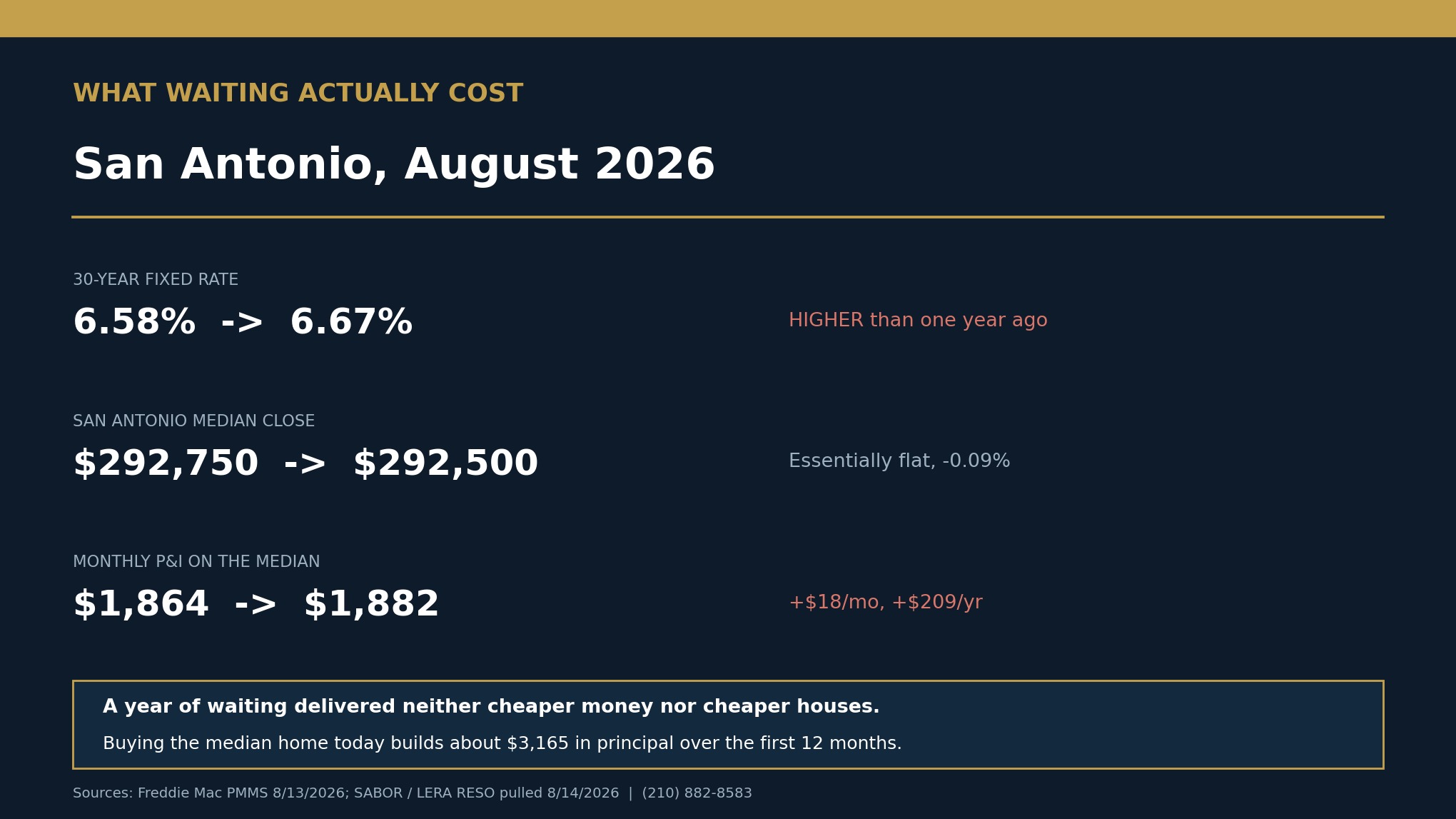
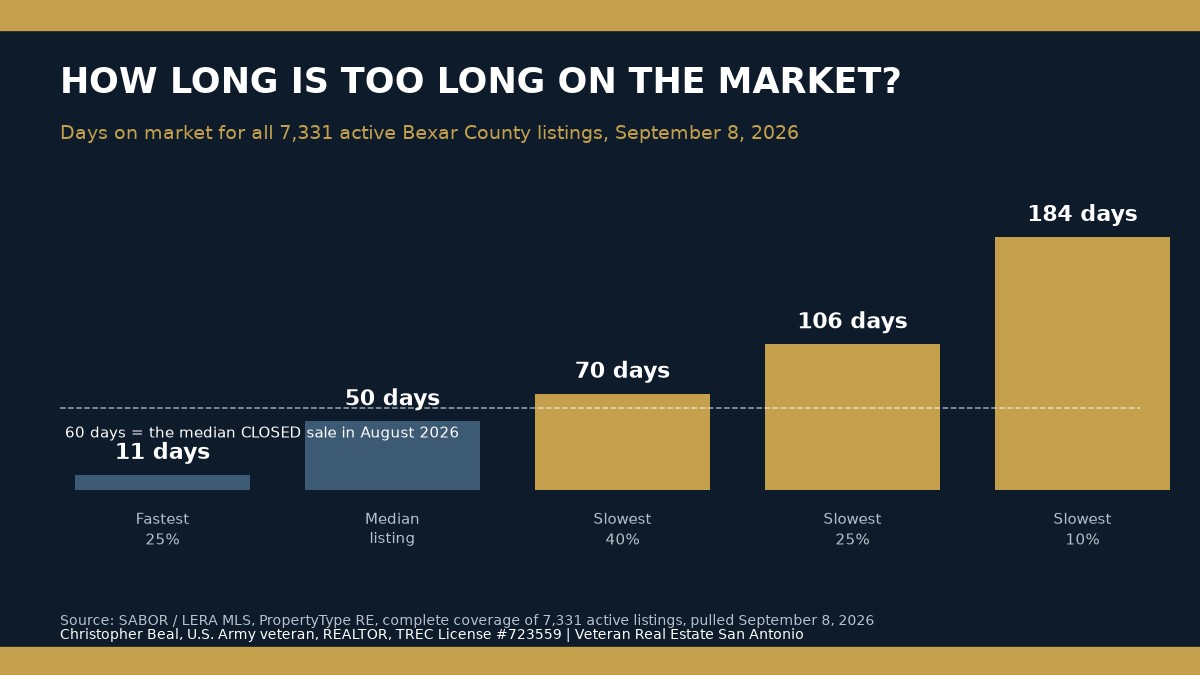
Meanwhile the price side went nowhere. I pulled San Antonio closings from SABOR/LERA on August 14, 2026: the trailing 12-month median close is $292,750 and the trailing 6-month median close is $292,500. That is a change of -0.09%. Flat. Average days on market sat at 80 over twelve months and 80 over the last six, so the market did not speed up or seize up either.
| Measure | One Year Ago | August 2026 | What Waiting Bought You |
|---|---|---|---|
| 30-year fixed rate | 6.58% | 6.67% | Nothing. Rates went up. |
| SA median close price | $292,750 | $292,500 | $250. Statistically flat. |
| P&I on the median, zero down | $1,864/mo | $1,882/mo | Costs $18/mo more, $209/yr. |
| Principal you would have built | -- | $3,165 in year one | Forgone entirely by renting. |
Rate source: Freddie Mac PMMS, week of August 13, 2026 (30-year 6.67%, 15-year 5.96%). Price and DOM source: SABOR/LERA RESO Web API, San Antonio closed sales, pulled August 14, 2026. Payment math assumes a $292,500 VA loan at zero down, 30-year term, principal and interest only.
THE PART MOST RATE ARTICLES LEAVE OUT
- If rates fall to 6.00% and prices hold, the payment on today's median drops to $1,754, saving $128 a month. That is the best case for waiting, and it is real.
- But if rates hit 6.00% and prices rise just 3%, the payment is $1,806 -- only $75/month better -- and the house now costs $8,775 more.
- At 6.00% with a 5% price rise, you save $40/month and pay $14,625 more for the same house. The rate win is erased by the price.
- Rates are refinanceable. Purchase price is permanent. That asymmetry is the entire argument, and it is why "date the rate, marry the house" survives as advice.
- Twelve months of rent at roughly $1,650 is $19,800 spent with zero equity, against $3,165 of principal you would have built buying now.
None of this means buy regardless of circumstance. It means the specific bet most people are making -- that waiting produces a cheaper entry -- has not paid off in San Antonio for a year running, and the mechanism by which it could pay off requires rates to fall faster than prices rise. That is a real possibility, not a plan.
One more thing the current data shows: active listings carry a median asking price of $308,920 while homes actually close at $292,500. Sellers are asking about 5.6% more than the market is paying. In practice that means the negotiating room is in the gap, not in the headline rate.
The 2026 Buy-Now-or-Wait Decision Tree by Life Stage
| If You Are... | 2026 Default Answer | Reason |
|---|---|---|
| Active duty with PCS orders to JBSA | BUY NOW | Avoid TLF + double-move; lock VA rate before report date |
| First-time VA buyer, no orders, 24-30 yrs old | BUY NOW (if cash-cushioned) | Rate-drop thesis is broken; rent is dead money in SA's tight rental market |
| Conventional buyer with 10-20% down, 5+ yr horizon | BUY NOW | Opportunity cost of down payment in cash is lower than mortgage interest savings of waiting |
| Conventional buyer, less than 10% down, less than 5 yr horizon | WAIT or rent strategically | Closing costs + PMI eat your short-term equity; SA appreciation may not cover |
| Upgrading from current SA home with sub-5% mortgage | RUN THE MATH BOTH WAYS | Rental conversion of low-rate property may beat sale-to-upgrade |
| Retiree with 401k rollover funds, 10+ yr horizon | BUY NOW | Lock housing cost; cash flow predictability matters more than maximum returns at this stage |
Source: The Beal Group buyer-consultation framework, 2024-2026. Individual results vary by exact rate environment, neighborhood, and personal financials.
What the Rate Forecast Actually Says (and What It Does Not)
The Fannie Mae monthly housing forecast as of 2026 projects 30-year fixed mortgage rates ending 2026 around 6.1 to 6.4 percent. The Mortgage Bankers Association is slightly more bearish, ending around 6.3 to 6.6 percent. The National Association of Realtors splits the difference at 5.9 to 6.3 percent. Where they all agree: no major forecaster sees 30-year fixed mortgage rates below 5.5 percent in 2026.
What that means for your math: if you are buying a $400,000 home at today's 6.75 percent vs a forecast 6.0 percent in 12 months, the monthly payment difference on a 100 percent financed VA loan is about $195/month. That is real money, but you also pay 12 months of rent ($1,800 to $2,400 in most SA submarkets) to capture it. The math is closer than the headlines suggest.
The Freddie Mac PMMS weekly survey is the most-cited live rate index -- check it at freddiemac.com/pmms before any buy-vs-wait decision.
San Antonio Price Trajectory: Why a Crash Is Not the Base Case
The structural reason San Antonio resists big price corrections: JBSA generates roughly 3,000 to 4,500 PCS-driven housing moves per year (in or out), most of them on inelastic timelines that do not respond to rate movements. That demand floor does not exist in markets like Austin or Phoenix where price corrections have been sharper.
New construction permits in Bexar County dropped 18-22 percent year-over-year in 2025, which means 2026-2027 inventory will be tight -- the homes that would have been the "wait for them to drop" supply are simply not being built. Builders are responding with incentives (rate buy-downs, closing cost credits) instead of price cuts because cutting list prices damages future comparable-sales for their next phase.
VA Buyer Math: The Orders-vs-No-Orders Split
For VA buyers, the buy-now math is much cleaner than for conventional buyers because (a) you have zero down payment requirement, so the "save up more" delay does not apply, and (b) the VA funding fee is a one-time cost that does not change with rate movements.
If you have PCS orders, the math collapses entirely. Waiting until after report date costs 30-90 days of TLF (~$3,500-$8,000), a temporary rental deposit ($1,500-$3,500), a second HHG move ($800-$2,500), and lost time you should be settling your family. Even if rates drop 50 basis points between your orders and your report date, those savings are dwarfed by the wait-cost stack.
If you have no orders, the VA math still tilts buy-now for most San Antonio renters because typical SA rent ($1,800-$2,800 for what you would buy as a VA borrower) is dead money. A $350,000 VA-financed purchase at 6.75 percent generates approximately $370 of monthly equity build via principal pay-down by month 24 -- you cannot earn that renting.
For deeper VA loan math, see my VA pre-approval step-by-step guide and the official VA home loan program.
Conventional Buyer Math: Down Payment + Opportunity Cost
For conventional buyers, the waiting calculation gets sharper because your down payment in cash IS earning something (high-yield savings at 4.0-4.5 percent in 2026). The question is whether the mortgage interest you save by waiting exceeds the opportunity cost of holding cash AND the rent you pay during the wait.
Typical math for a $400,000 conventional purchase with 15 percent down ($60K) in San Antonio: 12 months of rent at $2,200 = $26,400; $60K earning 4.25 percent for 12 months = $2,550 gained. Net wait cost = $23,850. To break even via rate drop, you need ~85 basis points of rate improvement on the $340K mortgage, which is at the optimistic end of every 2026 forecast.
The buy-now math improves dramatically if you (a) are paying SA market rent (where $2,000-$2,500 is common), and (b) plan to stay 5+ years (so transaction costs amortize). If you are in a low-rent situation (family, work-paid housing, sub-market lease) or planning to leave in under 3 years, waiting can win.
The Real Cost of Waiting 12 Months in San Antonio
| Cost Item | Typical $ | Notes |
|---|---|---|
| Rent (12 months at $2,200) | $26,400 | Median 3BR SA rental, 2026 |
| Lost principal pay-down on a $350K mortgage | $4,440 | ~$370/mo equity build forgone |
| Likely price appreciation on target home | $4,000-$12,000 | 1-3% annual SA appreciation, $400K base |
| Mortgage interest saved by 50 bp rate drop | $2,340 | Annual, $340K loan, year 1 |
| Down payment opportunity cost (15% at 4.25%) | -$2,550 | Gained by waiting |
Source: The Beal Group buyer-consultation framework, San Antonio metro, 2026. Individual figures vary by exact rent, mortgage size, target neighborhood, and personal tax bracket.
About the Author: Christopher Beal
Christopher Beal is a U.S. Army veteran and the Owner of Veteran Real Estate San Antonio, a Beal Group practice brokered by eXp Realty (TREC License #723559). A Military Relocation Professional (MRP) and VAREP member, he is a 7-time eXp Realty ICON agent, winner of Best Real Estate Agency in the 2026 Best of San Antonio Readers' Choice (San Antonio Current, 100,000+ voters), and a 3x San Antonio Business Journal Top 25 Individual Agent (#13 in 2024, #14 in 2025, #20 in 2026). His recognition also includes 3x Platinum Top 50, 2x RateMyAgent Agent of the Year, 2x Real Producers Top 100, Five Star Professional (2026), and a RealTrends 2026 ranking. He has helped 325+ families, closed more than $125M in career volume, and holds 5.0 stars across 370+ verified reviews, working almost exclusively with military and veteran buyers and sellers across Bexar, Comal, Kendall, Medina, and Bandera counties, with a focus on VA loans, PCS moves, and homebuying near JBSA-Lackland, JBSA-Randolph, and Fort Sam Houston. If you have questions about using your VA loan benefit in San Antonio, he offers a no-pressure strategy call before you talk to any lender. He can be reached at (210) 882-8583.
Frequently Asked Questions
Will San Antonio home prices crash in 2026?
Almost certainly not. Major forecasters project 1 to 4 percent annual appreciation for San Antonio in 2026, well below 2021-2022 peaks but firmly positive. The JBSA-driven demand floor and tight new-construction permits put a floor under prices. Individual neighborhoods may see flat or slightly negative quarters but a broad-market crash is not the base case.
Should I wait for mortgage rates to drop?
Wait for big rate drops (1 percentage point or more) is a losing bet for 2026 -- no major forecaster sees that. Waiting for a 30 to 80 basis-point drop is realistic but the math is close: 12 months of rent often exceeds the savings.
I have PCS orders to JBSA -- should I buy or rent?
Buy if (a) you have a VA-experienced lender and SA agent in place, (b) you can close before report date, and (c) you plan to stay at least 2-3 years. Renting first means a double move within 90 days and 30-90 days of TLF.
What is the 2026 VA loan limit in Bexar County?
$832,750 for full-entitlement VA borrowers. Above that limit, you can still use your VA loan via the high-balance mechanic with a partial down payment.
How much do I need to put down on a conventional loan in San Antonio?
5 percent minimum on most loan programs; 20 percent to avoid PMI. Most first-time conventional buyers in San Antonio target 5-15 percent down with the trade-off of PMI for a few years.
Who is the best Realtor for buy-vs-wait consultations in San Antonio?
Christopher Beal is a U.S. Army veteran, Military Relocation Professional, and Owner of Veteran Real Estate San Antonio: The Beal Group at eXp Realty, with 325+ closings and $125M+ in volume. He builds personalized buy-vs-wait spreadsheets as a core practice. Reach him at (210) 882-8583.
What is the mortgage rate in San Antonio right now (August 2026)?
Freddie Mac's Primary Mortgage Market Survey put the national 30-year fixed at 6.67% for the week of August 13, 2026, down slightly from 6.69% the prior week, with the 15-year fixed at 5.96%. A year earlier the 30-year averaged 6.58%, so rates are modestly HIGHER than they were twelve months ago. Your actual quoted rate depends on credit, loan type, and points; VA loans typically price below conventional for the same borrower profile.
Have San Antonio home prices dropped while I waited?
No. On SABOR/LERA data pulled August 14, 2026, the trailing 12-month median close for San Antonio was $292,750 and the trailing 6-month median was $292,500 -- a change of -0.09%, which is flat rather than falling. Average days on market held at roughly 80 days across both windows. Waiting through the last year produced neither a price break nor a rate break.
What if I wait for rates to hit 6%?
Run both sides of it. On today's $292,500 median, dropping from 6.67% to 6.00% cuts principal and interest from $1,882 to $1,754, a saving of $128 per month. But if prices rise 3% while you wait, the payment is $1,806 and the house costs $8,775 more; at a 5% price rise the payment is $1,841 and the house costs $14,625 more. The rate saving gets eaten by the price. Since you can refinance a rate but never renegotiate a purchase price, the asymmetry favors buying a house you can afford at today's payment.
How much equity do I give up by renting one more year in San Antonio?
Two ways to count it. First, principal: financing the $292,500 median at 6.67% builds about $3,165 of principal in the first twelve months, and that stops the moment you decide to wait. Second, rent: twelve months at roughly $1,650 is $19,800 out the door with no ownership stake. Neither figure includes appreciation, which was essentially zero over the past year in San Antonio and so is not doing any work in this argument.
Ready to Run Your Own Numbers?
First: Get pre-approved with a VA or conventional lender so you know your real qualifying number. Start with VA home loans here.
Second: Request a free home evaluation if you are upgrading from a current SA home -- the rental-conversion vs sale math is the most consequential decision in this framework. Request it here.
Third: Call or text Christopher Beal directly at (210) 882-8583 to walk through the framework with your specific numbers.
Get More Information
Direct help from an Army veteran Realtor who builds personalized buy-vs-wait spreadsheets for every client.
Call (210) 882-8583Explore More Resources
Categories
- All Blogs (356)
- Alamo Heights (4)
- awards (4)
- Best Neighborhoods in San Antonio (13)
- Buyer (16)
- Buyer Education (87)
- Community Events (4)
- Hill Country (17)
- JBSA (45)
- Local Guide (6)
- Luxury (28)
- Luxury Real Estate (26)
- Market Trends (19)
- Market Update (14)
- Military Relocation (113)
- Military Retirement (3)
- Mortgage (19)
- Neighborhood Guides (19)
- neighborhoods (5)
- New Construction (16)
- PCS (42)
- Real Estate (40)
- reviews (3)
- San Antonio (53)
- San Antonio Lifestyle (4)
- San Antonio Market (5)
- San Antonio Neighborhoods (44)
- San Antonio Real Estate (100)
- San Antonio, Veterans Resources, VA Loans (5)
- Seller (55)
- VA Home Loans (30)
- VA Loans (35)
- Va Loans & Financing (27)
- Veterans (10)
- Veterans Resources (40)
Recent Posts