MUD and PID Taxes in San Antonio's New Neighborhoods (2026): What Every Buyer Must Check First
LAST UPDATED: JULY 10, 2026 | BY CHRISTOPHER BEAL, U.S. ARMY VETERAN & REALTOR
MUD and PID Taxes in San Antonio's New Neighborhoods (2026): What Every Buyer Must Check First

Key Takeaways
- A MUD (Municipal Utility District) tax and a PID (Public Improvement District) assessment are extra charges layered on top of your normal San Antonio property tax, and they rarely appear in the listing price or the advertised tax rate.
- In 2026 a Texas MUD rate typically runs 0.25 to 1.50 dollars per 100 dollars of value, and new-construction districts sit at the high end (0.80 to 1.50), which can add 2,800 to 5,600 dollars a year on a 400,000 dollar home.
- A PID is usually a fixed annual assessment or a lien you can sometimes pay off in a lump sum, and unlike an ad valorem tax it is generally not reduced by your homestead or disabled-veteran exemption.
- Texas law (Water Code 49.452 and Property Code 5.014) requires the seller to give you written MUD and PID notice before you sign, and if they do not, you can terminate the contract, in some cases right up to closing.
- For a VA-loan buyer, a MUD or PID charge raises your monthly escrow and your debt-to-income ratio, so it must be built into your pre-approval before you fall in love with a new-build in Cibolo, New Braunfels, or the far West Side.
In This Guide
- What are MUD and PID taxes in San Antonio?
- How much do MUD and PID taxes add to your bill?
- MUD vs PID vs no special district: the difference
- Which San Antonio areas have MUD or PID taxes?
- How they affect a VA loan and your military budget
- Do veteran tax exemptions reduce MUD or PID charges?
- How to check for MUD or PID before you offer
- FAQ
The sticker price on a brand-new San Antonio home does not tell you what you will actually pay each month. Two identical 400,000 dollar houses, one inside a Municipal Utility District and one that is not, can have monthly payments that differ by 300 to 450 dollars once the special-district charge is layered on. For a military family PCSing to Joint Base San Antonio and stretching a BAH-based budget, that gap decides whether a home is affordable or a mistake.
I am Christopher Beal, an Army veteran and the Owner of Veteran Real Estate San Antonio: The Beal Group. I have helped more than 325 families buy and sell here, and special-district taxes are one of the most common surprises I catch for buyers in our fast-growing new-construction corridors. This guide explains exactly what MUD and PID charges are, how much they add in 2026, where they show up around San Antonio, and the three places to check before you ever write an offer.
What Are MUD and PID Taxes in San Antonio?
A MUD, or Municipal Utility District, is a government entity that builds and finances infrastructure for a new development. When a builder opens raw land far from existing city utilities, someone has to pay for the pipes, lift stations, and streets. Rather than fold that cost into the home price up front, a MUD issues bonds and then charges the homeowners inside the district an annual property tax to pay those bonds back over 20 to 30 years.
A PID, or Public Improvement District, works differently. A PID is created by a city or county to fund improvements such as landscaping, trails, entry monuments, or private amenities, and it recovers the cost through an assessment on each property. That assessment can be a fixed yearly amount, an amount that changes with a repayment schedule, or a lien that you can sometimes pay off in a single lump sum at or after closing. The important distinction is that a PID assessment is typically not an ad valorem tax, which matters a great deal for exemptions, as I explain below.
How Much Do MUD and PID Taxes Add to Your San Antonio Tax Bill?
Start with your base rate. Across most of Bexar County, the combined property tax rate (county, city, school, and other entities) generally lands somewhere near 2.0 to 2.3 percent of assessed value in 2026. Add a MUD at 1.00 dollars per 100 and your effective rate jumps toward 3.0 to 3.3 percent. That is the single biggest reason a new-build monthly payment can shock a buyer who only compared list prices.
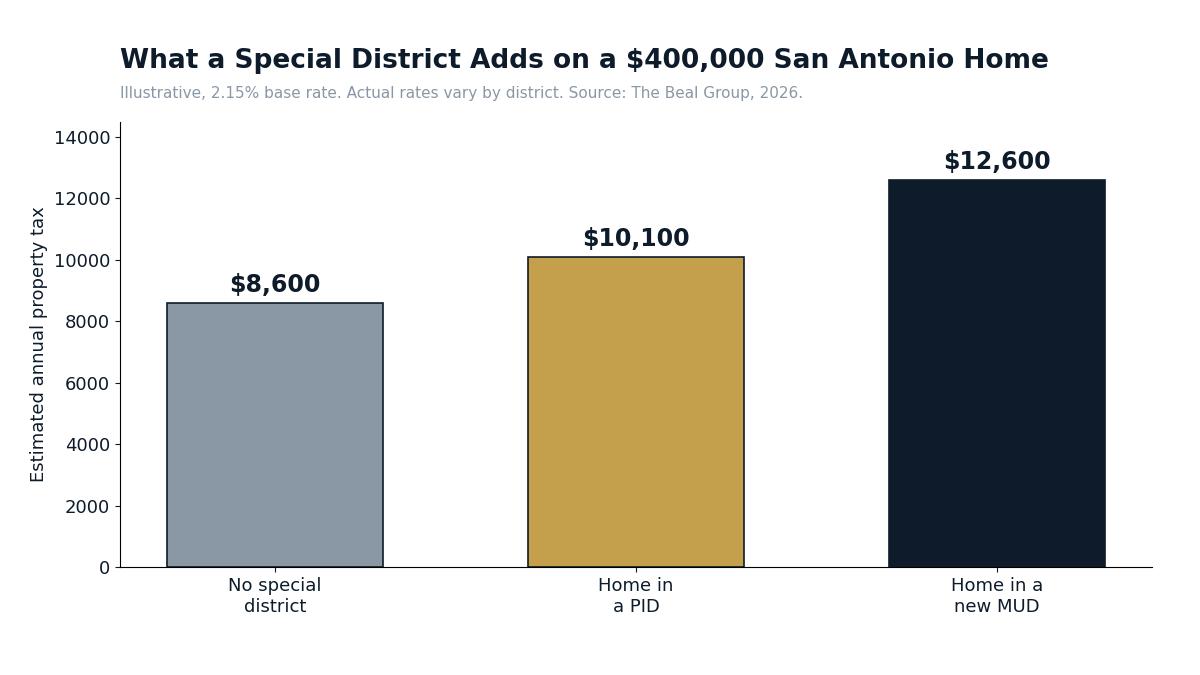
Here is how a 400,000 dollar home compares under three scenarios. These numbers are illustrative and use a 2.15 percent base rate for the standard case; your actual rate depends on the specific taxing entities for the property.
| Scenario | Extra Rate or Assessment | Estimated Annual Tax | Approx. Monthly |
|---|---|---|---|
| No special district | 2.15% base only | about 8,600 dollars | about 717 dollars |
| Home in a PID | plus ~1,500 dollar assessment | about 10,100 dollars | about 842 dollars |
| Home in a new MUD | plus 1.00 per 100 MUD tax | about 12,600 dollars | about 1,050 dollars |
Source: The Beal Group illustrative model using a 2.15% base rate; MUD and PID amounts vary by district. Confirm the exact rate with the Bexar, Comal, Guadalupe, or Kendall appraisal district before you offer.
One piece of good news: MUD rates usually fall over time as the district repays its bonds. A brand-new MUD charging 1.20 today might drop to 0.40 or lower once most bonds are retired, often 20 to 30 years out. A PID assessment, by contrast, tends to run for a fixed term or until it is paid off, so ask for the schedule.
Planning a purchase near JBSA and want the real monthly number, not the builder's teaser rate? Request a free buyer consultation and net-cost breakdown and I will pull the actual district rates before you commit.
MUD vs PID vs No Special District: What Is the Difference?
The cleanest way to compare them is side by side. Use this table when a builder or listing agent tells you a community has "a small district fee." Ask which kind it is, because the answer changes your taxes, your exemptions, and your resale.
| Feature | MUD | PID | No District |
|---|---|---|---|
| What it is | A property tax for utilities and roads | An assessment for improvements | Only standard taxes |
| How it is charged | Rate per 100 of value (ad valorem) | Fixed or scheduled assessment or lien | Not applicable |
| Can it decrease? | Yes, as bonds are repaid | Usually runs a set term; may be prepaid | Not applicable |
| Reduced by exemptions? | Generally yes (it is a tax) | Generally no (it is an assessment) | Exemptions apply to base taxes |
| Can you pay it off? | No, it is an annual tax | Often yes, in a lump sum | Not applicable |
Source: Texas Water Code Chapter 49 (MUDs) and Texas Local Government Code Chapter 372 (PIDs); general summary, not legal advice.
Which San Antonio Neighborhoods Have MUD or PID Taxes?
MUD and PID charges follow new infrastructure, so they concentrate where the metro is expanding. That means the growth corridors many JBSA families shop first: New Braunfels and the rest of Comal County, Cibolo and Schertz in Guadalupe County, Bulverde and Spring Branch to the north, and parts of the far West Side out toward the 1604 and 211 corridors. Popular master-planned communities in these areas frequently sit inside a MUD, a PID, or both.
Do not assume, though. Two subdivisions across the street from each other can differ, and even within one community the front section may predate a district while a newer phase carries one. That is why I check the appraisal-district record for the exact parcel, not the marketing brochure. If you are weighing a specific corridor, my neighborhood guides for Cibolo, Schertz, and New Braunfels walk through the trade-offs, and my new-construction buyer guide covers builder contracts.
How Do MUD and PID Taxes Affect a VA Loan and Your Military Budget?
VA loans are famous for zero down payment, but they still underwrite your monthly payment. The VA and your lender look at your total housing cost, including taxes and insurance escrowed into the payment. When a MUD adds several thousand dollars a year, that money is escrowed monthly, and it counts against your debt-to-income ratio just like principal and interest do.
The practical risk is simple: a family gets pre-approved using a builder's advertised base tax rate, shops at the top of that number, and then the real district rate pushes the payment above what they can qualify for or comfortably carry on BAH. I would rather set the honest number up front. Explore your options on my VA home loans page, and if you are timing a move, the military relocation resources lay out the sequence.
Do Texas Veteran Property Tax Exemptions Reduce MUD or PID Charges?
This is where many veteran buyers get a costly surprise. Texas offers strong property-tax relief to disabled veterans, up to a full exemption on the homestead for a 100 percent service-connected rating. Because a MUD levies an ad valorem tax, those exemptions generally flow through and reduce, or even eliminate, the MUD portion of your bill.
A PID is different. Since a PID assessment is typically charged as a lien or fixed assessment rather than a tax on value, the disabled-veteran and homestead exemptions usually do not reduce it. That means a fully exempt veteran can still owe the annual PID assessment in full. Always confirm the treatment with the appraisal district and the PID administrator for the specific property. For the full exemption picture, see my Texas veteran property tax exemptions guide and the Bexar County protest guide.
How Do You Find Out If a Home Has MUD or PID Taxes Before You Offer?
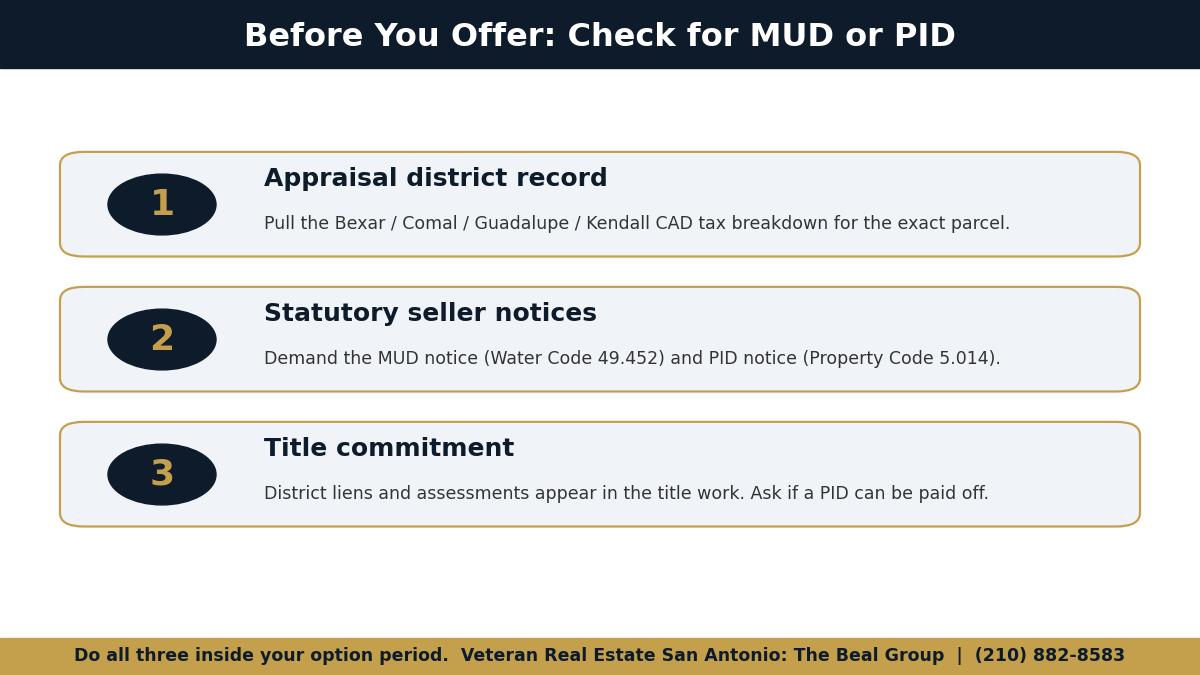
You have real legal protection here, but only if you use it in time. Texas requires the seller to deliver written notice of a MUD or a PID before you sign a binding contract. If they fail to, the law gives you the right to terminate, in some cases up to the day of closing. Here is the order I check every new-construction deal:
- Pull the appraisal-district record for the exact address. The Bexar Appraisal District (or Comal, Guadalupe, or Kendall CAD) lists every taxing entity attached to the parcel. If a MUD is there, you will see it by name with its rate.
- Demand the statutory notices. Insist on the seller's MUD notice under Texas Water Code 49.452 and the PID notice under Texas Property Code 5.014. Texas also has a standard TREC Notice to Purchaser of Special Taxing or Assessment District form.
- Read the title commitment. District assessments and liens appear in the title work. Your Realtor and title company should flag any PID assessment and tell you whether it can be paid off.
Do all of this inside your option period. That is the window where you can still terminate for a modest option fee, before your earnest money is at risk. A good buyer's agent runs these checks as a matter of routine; it is exactly the kind of thing I handle so a PCS family is not blindsided.
About the Author: Christopher Beal
Christopher Beal is a U.S. Army veteran and the Owner of Veteran Real Estate San Antonio, a Beal Group practice brokered by eXp Realty (TREC License #723559). A Military Relocation Professional (MRP) and VAREP member, he is a 7-time eXp Realty ICON agent, winner of Best Real Estate Agency in the 2026 Best of San Antonio Readers' Choice (San Antonio Current, 100,000+ voters), and a 3x San Antonio Business Journal Top 25 Individual Agent (#13 in 2024, #14 in 2025, #20 in 2026). His recognition also includes 3x Platinum Top 50, 2x RateMyAgent Agent of the Year, 2x Real Producers Top 100, Five Star Professional (2026), and a RealTrends 2026 ranking. He has helped 325+ families, closed more than $125M in career volume, and holds 5.0 stars across 370+ verified reviews, working almost exclusively with military and veteran buyers and sellers across Bexar, Comal, Kendall, Medina, and Bandera counties, with a focus on VA loans, PCS moves, and homebuying near JBSA-Lackland, JBSA-Randolph, and Fort Sam Houston. Whether you are buying or selling in the San Antonio area, he answers directly - no team handoffs, no pressure. He can be reached at (210) 882-8583.
Explore More Resources
Frequently Asked Questions About MUD and PID Taxes in San Antonio
What is the difference between a MUD tax and a PID assessment in Texas?
A MUD tax is an ad valorem property tax charged per 100 dollars of your home's assessed value to repay bonds for utilities and roads, and it can decrease as those bonds are paid off. A PID assessment is a fixed or scheduled charge for specific improvements that is often payable in a lump sum and is generally not reduced by exemptions. A home can be in both a MUD and a PID at the same time.
How much does a MUD tax add to a San Antonio home in 2026?
In 2026, Texas MUD rates commonly run 0.25 to 1.50 dollars per 100 dollars of assessed value, with new districts at the high end. On a 400,000 dollar home a 1.00 rate adds about 4,000 dollars a year, or roughly 333 dollars a month, on top of your normal taxes. Always confirm the exact rate for the specific district.
Do MUD taxes ever go down?
Yes. Because a MUD tax repays construction bonds, the rate typically falls over time as those bonds are retired, often over 20 to 30 years. A district charging 1.20 today might eventually drop to 0.40 or lower. Ask the district or your Realtor for the bond and rate history before you rely on that.
Can I pay off a PID assessment?
Often yes. Many PID assessments can be paid off in a lump sum at or after closing, which removes the annual charge. Others run for a fixed term. Your title company and Realtor can tell you the payoff amount and whether prepayment makes sense for how long you plan to own the home.
Does the Texas disabled-veteran exemption reduce MUD or PID charges?
Your disabled-veteran and homestead exemptions apply to ad valorem taxes, so they generally reduce a MUD's tax, potentially to zero for a 100 percent disabled veteran with a total homestead exemption. A PID assessment is usually not an ad valorem tax, so exemptions typically do not lower it, and you may still owe the full PID amount. Confirm with the appraisal district and PID administrator.
Which San Antonio areas are most likely to have MUD or PID taxes?
Special districts concentrate in newer master-planned communities on the metro edge, especially in Comal, Guadalupe, and Kendall counties, plus the far North and West sides of Bexar. Corridors such as New Braunfels, Cibolo, Schertz, Bulverde, and the 1604 and 211 growth areas commonly include them. Established in-city neighborhoods usually do not, but you must verify the exact subdivision and lot.
How do MUD and PID charges affect a VA loan approval?
They raise your escrowed monthly payment, which raises your debt-to-income ratio during VA underwriting. A higher escrow can lower the price you qualify for, so your lender should use the real district rate, not the builder's base rate, in your pre-approval. This is especially important for BAH-based budgets.
Is the seller required to tell me about a MUD or PID before I buy?
Yes. Under Texas Water Code 49.452 and Property Code 5.014, the seller must give you written notice of a MUD or PID before you sign a binding contract. If they fail to deliver the required notice on time, you generally have the right to terminate the contract, in some cases up to the day of closing.
How do I check whether a specific home has a MUD or PID?
Check three sources: the appraisal district record for the exact parcel (Bexar, Comal, Guadalupe, or Kendall CAD), the seller's statutory MUD and PID notices, and the title commitment, which lists district liens and assessments. Do all three during your option period so you can still terminate if the numbers do not work.
Do MUD or PID charges hurt resale value?
They can affect buyer demand because they raise the monthly cost, but well-run districts that fund desirable amenities can also support value. What matters most is transparency: buyers who understand the charge up front are far less likely to walk. Pricing a home with a special district correctly is part of what a local Realtor does.
Do not let a special-district surprise wreck your San Antonio home purchase. Whether you are PCSing to JBSA or moving up across town, I will pull the real district rates, run your true monthly number, and make sure your VA pre-approval reflects it before you write an offer.
Call Christopher Beal at (210) 882-8583, email [email protected], or visit veteranrealestatesa.com to get started.
Veteran Real Estate San Antonio: The Beal Group. Serving those who served, and saving them money at the closing table through the Serve and Save program.
Categories
- All Blogs (356)
- Alamo Heights (4)
- awards (4)
- Best Neighborhoods in San Antonio (13)
- Buyer (16)
- Buyer Education (87)
- Community Events (4)
- Hill Country (17)
- JBSA (45)
- Local Guide (6)
- Luxury (28)
- Luxury Real Estate (26)
- Market Trends (19)
- Market Update (14)
- Military Relocation (113)
- Military Retirement (3)
- Mortgage (19)
- Neighborhood Guides (19)
- neighborhoods (5)
- New Construction (16)
- PCS (42)
- Real Estate (40)
- reviews (3)
- San Antonio (53)
- San Antonio Lifestyle (4)
- San Antonio Market (5)
- San Antonio Neighborhoods (44)
- San Antonio Real Estate (100)
- San Antonio, Veterans Resources, VA Loans (5)
- Seller (55)
- VA Home Loans (30)
- VA Loans (35)
- Va Loans & Financing (27)
- Veterans (10)
- Veterans Resources (40)
Recent Posts