VA Cash-Out Refinance in San Antonio (2026): Why Texas Says No, and What Veterans Can Do Instead
Last Updated: September 23, 2026 | By Christopher Beal, U.S. Army Veteran & Realtor
I am Christopher Beal, a U.S. Army veteran, REALTOR (TREC License #723559) and Owner of Veteran Real Estate San Antonio, brokered by eXp Realty. More about how I work with military and veteran clients. I am not a lender, a tax advisor or an attorney, and nothing here is financial advice; run your own numbers with a Texas-licensed lender before you decide.
Key Takeaways
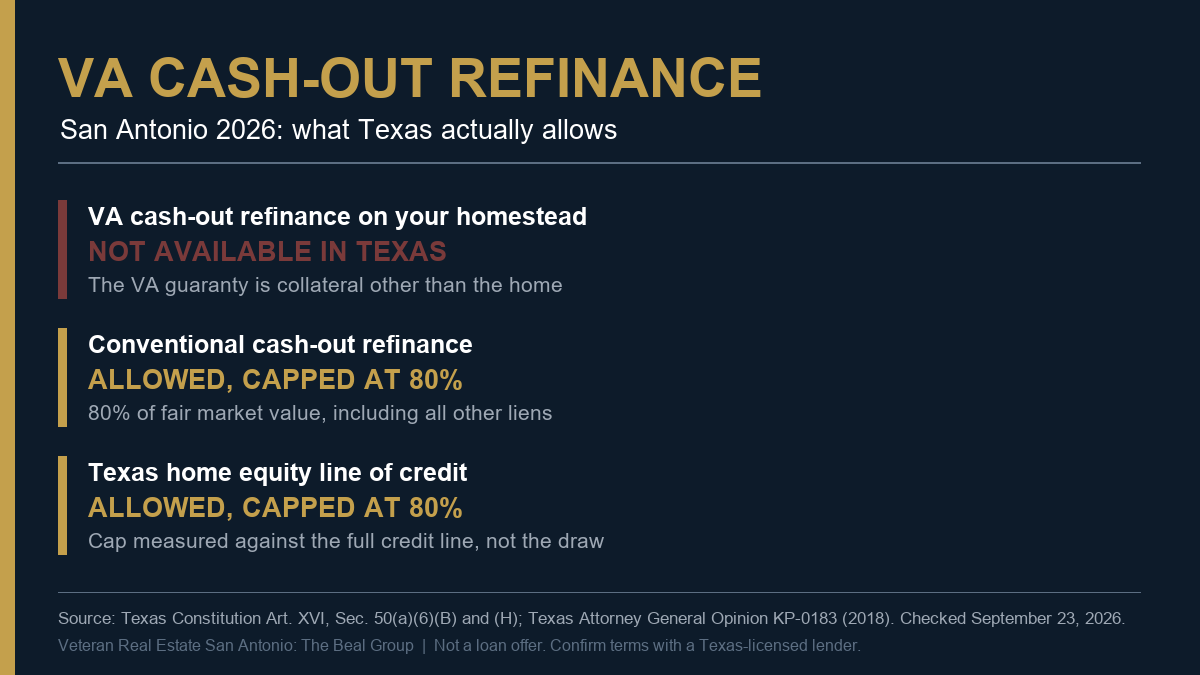
- A VA cash-out refinance is not available on a Texas homestead. This is a state constitutional limit, not a lender overlay, so no lender can work around it.
- The reason is Section 50(a)(6)(H): a Texas home equity loan cannot be secured by anything other than the homestead, and the federal VA guaranty counts as additional collateral.
- The two ways a Texas homeowner actually taps equity on a primary residence are a conventional cash-out refinance and a home equity line of credit. Both are capped at 80 percent of fair market value including everything else owed on the home.
- VA refinancing that does not take cash out is unaffected. An IRRRL on an existing VA loan carries a 0.5 percent funding fee and is still open to Texas veterans.
- The VA funding fee exemption turns on receiving, or being eligible to receive, VA compensation for a service-connected disability. It is not a rating percentage test.
In This Guide
- Why Texas blocks the VA cash-out refinance
- What Texas veterans can use instead
- How much you can actually borrow
- The Texas home equity rules that apply to both
- VA refinancing that still works in Texas
- What it costs, and who pays no funding fee
- Is tapping equity worth it right now?
- Frequently asked questions
Why Texas Blocks the VA Cash-Out Refinance
This surprises almost every veteran who hears it, including ones who have used their VA benefit twice. The VA program itself offers a cash-out refinance nationally and publishes the rules for it. Texas simply does not let that particular product attach to a homestead.
The question was settled formally in 2018. State Representative Roland Gutierrez, then chair of the Texas House Committee on Defense and Veterans' Affairs, asked the Attorney General whether Texas veterans could execute a VA cash-out refinance on homestead property. The answer, Opinion KP-0183, issued February 26, 2018, concluded: "Because of the guaranty by the federal government, which is additional collateral, Texas Constitution, article XVI, subsection 50(a)(6)(H) prohibits a U.S. Department of Veterans Affairs cash-out refinance loan."
Three things make that conclusion stick rather than fade:
- The constitutional text has not changed. Section 50(a)(6)(H) still reads that the extension of credit "is not secured by any additional real or personal property other than the homestead" (checked against the current text at Texas Legislature Online on September 23, 2026).
- The state regulators agree. Texas Administrative Code Title 7, Section 153.8(2) states that a guaranty or surety of an equity loan is not permitted and is considered additional property for purposes of Section 50(a)(6)(H).
- The opinion also noted the structural conflicts: VA rules contemplate refinancing up to 90 percent of the dwelling while Texas caps at 80 percent, and VA funding fees can exceed the Texas cap on lender fees.
One narrow but important boundary: Section 50(a)(6) governs home equity loans. Footnote 7 of the opinion states that the subsection "does not apply to a traditional U.S. Department of Veterans Affairs purchase money mortgage or a refinance loan." That is why VA purchase loans and VA rate-and-term refinancing work normally in Texas. It is the equity-taking transaction, and only that, which is barred.
If a lender tells you otherwise, ask them to put in writing which Texas statute permits it. That single question ends most of these conversations.
What Texas Veterans Can Use Instead
Neither option uses your VA entitlement, so neither one touches the entitlement you would need for a future VA purchase. That is worth knowing if you are weighing this against selling and buying again.
| Feature | Conventional cash-out refinance | Texas home equity line of credit |
|---|---|---|
| What happens to your first mortgage | Replaced entirely by a new, larger loan at today's rate | Left alone; the line sits behind it |
| If you hold a low rate from 2020 or 2021 | You lose it on the whole balance | You keep it |
| Rate type | Usually fixed | Usually variable, so the payment can move |
| How you receive the money | Lump sum at closing | Draws as needed, each at least $4,000 |
| Texas 80 percent cap | Applies | Applies, measured against the full credit line |
| Uses VA entitlement | No | No |
Source: Texas Constitution Article XVI, Section 50(a)(6) and 50(t), read September 23, 2026. Rate type and payout structure describe the ordinary market form of each product; individual lender programs vary, and this table is not a quote.
The important detail for a HELOC is that the 80 percent test is measured against the entire credit line, not just what you have drawn. Section 50(t)(5) applies the cap to the principal amount extended, so a line you never touch still consumes your capacity.
How Much You Can Actually Borrow
Section 50(a)(6)(B) sets the test: the new loan, added to the outstanding balance of every other lien of record against the homestead, cannot exceed 80 percent of fair market value on the date the credit is extended. Two consequences catch people out. Appraised value governs, not what a neighbor's home sold for and not an automated estimate. And a second lien you forgot about, such as a solar loan or a prior equity line, counts against the same 80 percent.
| Appraised value | 80% ceiling on all home debt | If you owe $180,000 | Most you could borrow, before costs |
|---|---|---|---|
| $300,000 | $240,000 | $180,000 | $60,000 |
| $400,000 | $320,000 | $180,000 | $140,000 |
| $500,000 | $400,000 | $180,000 | $220,000 |
Source: the 80 percent limit in Texas Constitution Article XVI, Section 50(a)(6)(B), applied to round illustrative values. These are worked examples, not San Antonio market figures and not an offer of credit. Closing costs and the Texas fee cap are not reflected in the last column.
The Texas Home Equity Rules That Apply to Both
These come from Section 50 of Article XVI, read against the current text on September 23, 2026. They apply to a conventional Texas cash-out refinance and to a Texas home equity line of credit alike.
- Twelve-day wait. Closing cannot happen before the twelfth day after the later of your loan application or the date the lender gives you the required Section 50(g) notice. You also receive the final itemized disclosure at least one business day before closing. [50(a)(6)(M)(i), (ii)]
- Three days to cancel. You and your spouse may rescind within three days after the credit is extended, without penalty or charge. [50(a)(6)(Q)(viii)]
- Once every twelve months. A new Section 50(a)(6) loan cannot close before the first anniversary of the closing date of any other such loan on the same homestead, with a narrow exception for a qualifying refinance and for a declared state of emergency. [50(a)(6)(M)(iii)]
- Two percent fee cap. Lender fees to originate, evaluate, maintain, record, insure or service the loan cannot exceed 2 percent of the original principal, excluding a third-party appraisal, a survey by a licensed surveyor, the state base premium for a mortgagee title policy, and the title examination report. [50(a)(6)(E)]
- Spouse must consent. The loan requires a written agreement with the consent of each owner and each owner's spouse, whether or not that spouse is a borrower. [50(a)(6)(A)]
- No personal liability. The credit is without recourse against you or your spouse except for actual fraud, and the lien may be foreclosed only by court order. The home is still the collateral. [50(a)(6)(C), (D)]
- Only debt on the home. With limited exceptions for purchase money, taxes and a few other categories, the equity loan must be the only debt secured by the homestead when it is made. [50(a)(6)(K)]
For a line of credit specifically, Section 50(t) adds that each advance must be at least $4,000, that you cannot draw with a credit card, debit card or an unsolicited check, that lender fees are collected only when the line is established and never per draw, and that the lender cannot unilaterally amend the agreement.
VA Refinancing That Still Works in Texas
Because an IRRRL takes no equity out, it is not a Section 50(a)(6) home equity loan, and the Texas restriction that blocks the VA cash-out does not reach it. The Attorney General's opinion says as much in footnote 7: Section 50(a)(6) does not apply to a traditional VA purchase money mortgage or a refinance loan.
| Question | VA IRRRL | VA cash-out refinance |
|---|---|---|
| Available on a Texas homestead? | Yes | No |
| Existing loan must be a VA loan? | Yes | Not applicable in Texas |
| Can you take cash out? | No | Not applicable in Texas |
| Funding fee | 0.5 percent | 2.15 percent first use, 3.3 percent after first use (in states where it is available) |
Source: VA funding fee rate charts, effective April 7, 2023, on the VA funding fee and closing costs page, last updated September 22, 2026 and checked September 23, 2026. Availability in Texas per Attorney General Opinion KP-0183 and Texas Constitution Article XVI, Section 50(a)(6)(H).
If lowering your rate is the actual goal and you already hold a VA loan, the IRRRL is the product to ask about. My companion guide on when veterans should refinance with a VA IRRRL and when to wait walks through the break-even math.
What It Costs, and Who Pays No Funding Fee
The funding fee waiver is worth stating precisely, because the common shorthand is wrong. It is not a question of having a particular rating percentage. According to VA, you will not pay the funding fee if any one of these is true:
- You are receiving VA compensation for a service-connected disability.
- You are eligible to receive VA compensation for a service-connected disability but are receiving retirement or active-duty pay instead.
- You are receiving Dependency and Indemnity Compensation as the surviving spouse of a veteran.
- You are a service member who received a proposed or memorandum rating before the loan closing date saying you are eligible for compensation because of a pre-discharge claim.
- You are an active-duty service member and, on or before the closing date, you provide evidence that you received a Purple Heart.
Source: VA funding fee and closing costs, va.gov, last updated September 22, 2026, checked September 23, 2026. Note the timing condition on the fourth item: a proposed or memorandum rating received after closing does not produce a refund.
On the Texas side, budget for the third-party costs the 2 percent cap excludes: the appraisal, a survey if one is required, the title policy premium and the title examination. Ask for those as line items early, because they are the ones that move.
Is Tapping Equity Worth It Right Now?
There is no verdict that fits every reader here, so what follows are the inputs rather than an answer.
- Your existing rate, and how much of the balance it covers. A cash-out refinance reprices everything. A line of credit prices only what you draw.
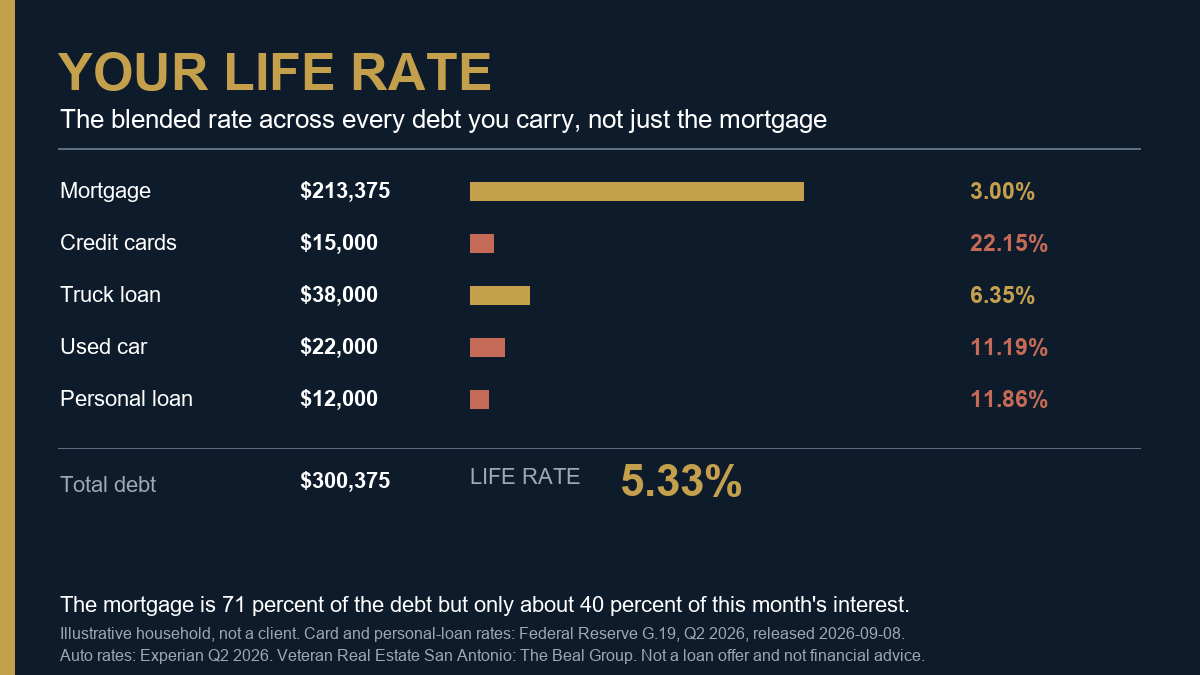
- The rate on the debt you would retire. Consolidating a card near 20 percent is a different decision from consolidating a car loan in the 6 percent range.
- What the 80 percent cap leaves you. If the ceiling only covers part of what you owe elsewhere, you are choosing which debts to move, not clearing the slate.
- How long you plan to stay. Closing costs spread over two years read very differently from ten.
- Whether the balances come back. Moving unsecured debt onto the house converts a problem that could not take your home into one that is secured by it. That is the trade, stated plainly.
There is also an option that has nothing to do with real estate: a nonprofit credit counseling agency can often negotiate lower rates through a debt management plan without touching your equity. If the goal is to stop paying 22 percent on cards, that path deserves a look before a lien does.
And sometimes the honest answer is that the house itself is the thing to change. If you have substantial equity, a home that no longer fits, and a move already on the horizon, selling can clear the debt and reset the payment in one transaction, at the cost of a higher rate on the next loan. That is a real trade-off with numbers on both sides, and it is worth running before you borrow against the home you are in.
This is the kind of decision I would rather walk through with you than have you take from a calculator. As a fellow Army veteran and REALTOR, my job includes telling you when the answer is to leave your equity alone. For eligible buyers, my Serve and Save program reduces closing costs by 1 percent of the gross buyer-agent commission for every verified year of active-duty service, applied on the Closing Disclosure and subject to lender approval.
About the Author: Christopher Beal
Christopher Beal is a U.S. Army veteran and the Owner of Veteran Real Estate San Antonio, a Beal Group practice brokered by eXp Realty (TREC License #723559). A Military Relocation Professional (MRP) and VAREP member, he is a 7-time eXp Realty ICON agent, winner of Best Real Estate Agency in the 2026 Best of San Antonio Readers' Choice (San Antonio Current, 100,000+ voters), and a 3x San Antonio Business Journal Top 25 Individual Agent (#13 in 2024, #14 in 2025, #20 in 2026). His recognition also includes 3x Platinum Top 50, 2x RateMyAgent Agent of the Year, 2x Real Producers Top 100, Five Star Professional (2026), and a RealTrends 2026 ranking. He has helped 325+ families, closed more than $125M in career volume, and holds 5.0 stars across 370+ verified reviews, working almost exclusively with military and veteran buyers and sellers across Bexar, Comal, Kendall, Medina, and Bandera counties, with a focus on VA loans, PCS moves, and homebuying near JBSA-Lackland, JBSA-Randolph, and Fort Sam Houston. He is a REALTOR, not a lender, attorney or financial advisor. If you have questions about using your VA loan benefit in San Antonio, he offers a no-pressure strategy call before you talk to any lender. He can be reached at (210) 882-8583.
Explore More Resources
- VA Home Loans
- VA IRRRL Streamline Refinance Guide
- Should I Sell My Home in San Antonio?
- Free Home Evaluation
- Serve and Save Program
- About Christopher Beal
Frequently Asked Questions About VA Cash-Out Refinances in Texas
Can I get a VA cash-out refinance in Texas?
No, not on your homestead. Texas Attorney General Opinion KP-0183 (February 26, 2018) concluded that the federal VA guaranty is collateral other than the home, which Article XVI, Section 50(a)(6)(H) of the Texas Constitution prohibits in a home equity loan. The constitutional text still reads that way today. Your options for pulling equity out of a primary residence are a conventional cash-out refinance or a Texas home equity line of credit.
What if I stay under 80 percent? Does that make it allowed?
No. That exact argument was put to the Attorney General and rejected. The opinion states that while many terms of a VA cash-out refinance might be written to comply with Section 50(a)(6), the guaranty itself precludes the loan in Texas. The 80 percent cap is a separate requirement that also applies.
Is a VA IRRRL still available to Texas veterans?
Yes. An IRRRL lowers the rate on an existing VA loan and cannot return cash to you, so it is not a Section 50(a)(6) home equity loan and the Texas restriction does not apply. Footnote 7 of KP-0183 says the subsection does not apply to a traditional VA purchase money mortgage or a refinance loan. The IRRRL funding fee is 0.5 percent.
How much can I borrow against my Texas home?
Eighty percent of the appraised fair market value, minus every other balance already secured by the home, under Section 50(a)(6)(B). For a line of credit, the cap is measured against the full credit line under Section 50(t)(5), not just the amount you draw. Your lender may approve less based on income, credit and the appraisal.
Can I use my VA entitlement for a home equity loan instead?
No. A Texas home equity loan or line of credit is a conventional product. It does not use VA entitlement, which also means it does not consume entitlement you would need for a future VA purchase.
Who is exempt from the VA funding fee?
VA lists five situations: you are receiving VA compensation for a service-connected disability; you are eligible to receive it but are taking retirement or active-duty pay instead; you receive Dependency and Indemnity Compensation as a surviving spouse; you are a service member with a proposed or memorandum rating issued before the loan closing date from a pre-discharge claim; or you are on active duty and provide evidence of a Purple Heart on or before the closing date. It is not a rating percentage test, and a memorandum rating received after closing does not produce a refund.
How long does a Texas home equity loan take to close?
Longer than most people expect. Closing cannot occur before the twelfth day after the later of your application or the lender's required notice, and the final itemized disclosure must reach you at least one business day before closing. Add the appraisal and title work on top. If you are timing this against a PCS date, start early.
Can I take out a second Texas home equity loan the same year?
Generally no. Section 50(a)(6)(M)(iii) bars closing a new home equity loan before the first anniversary of the closing date of any other such loan on the same homestead, subject to a narrow exception for a qualifying refinance and for a declared state of emergency.
Can I do a cash-out refinance on a rental property in Texas?
Section 50(a)(6) governs homesteads, so an investment property is not subject to these homestead rules. A VA loan separately requires the property to be your primary residence, so a VA product is not the route for a rental in any case. Ask a lender who writes investment cash-out loans about conventional options and their own limits.
Should I refinance if I have a very low rate from 2020 or 2021?
Often not, at least not with a full cash-out refinance. Repricing your whole balance to today's rate to access equity makes the existing debt more expensive too, not just the new money. A line of credit behind the low first mortgage keeps that rate intact and prices only what you draw, at the cost of a variable rate. Run both against the rate on the debt you would retire.
Categories
- All Blogs (357)
- Alamo Heights (4)
- awards (4)
- Best Neighborhoods in San Antonio (13)
- Buyer (16)
- Buyer Education (87)
- Community Events (4)
- Hill Country (17)
- JBSA (46)
- Local Guide (6)
- Luxury (28)
- Luxury Real Estate (26)
- Market Trends (19)
- Market Update (14)
- Military Relocation (114)
- Military Retirement (3)
- Mortgage (19)
- Neighborhood Guides (19)
- neighborhoods (5)
- New Construction (16)
- PCS (42)
- Real Estate (40)
- reviews (3)
- San Antonio (53)
- San Antonio Lifestyle (4)
- San Antonio Market (5)
- San Antonio Neighborhoods (45)
- San Antonio Real Estate (100)
- San Antonio, Veterans Resources, VA Loans (5)
- Seller (55)
- VA Home Loans (30)
- VA Loans (35)
- Va Loans & Financing (27)
- Veterans (10)
- Veterans Resources (40)
Recent Posts