Selling a San Antonio Home in a Flood Zone (2026): Disclosure, Insurance, and Buyer Financing
LAST UPDATED: AUGUST 24, 2026 | BY CHRISTOPHER BEAL, U.S. ARMY VETERAN & REALTOR
Selling a San Antonio Home in a Flood Zone (2026): Disclosure, Insurance, and Buyer Financing
Key Takeaways
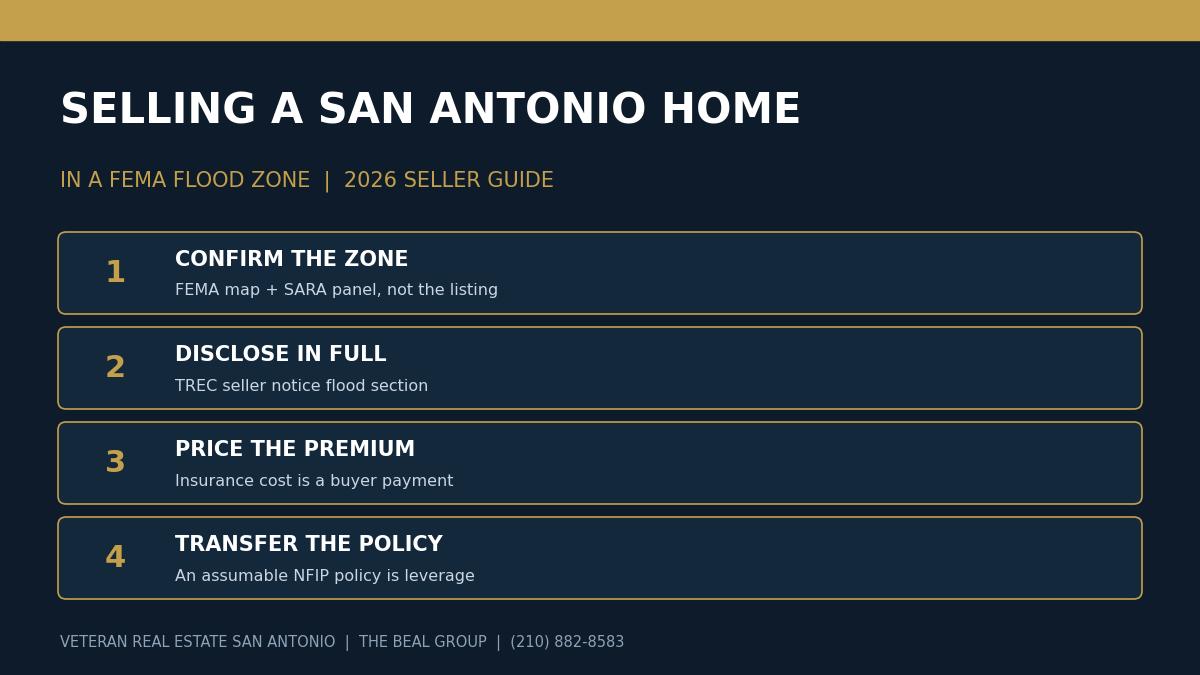
- A San Antonio home in a FEMA Special Flood Hazard Area is not unsellable. It is a home with one extra line item the buyer has to underwrite, and that line item is the annual flood insurance premium.
- Texas Property Code Section 5.008 and the TREC Seller's Disclosure Notice require you to answer specific flood questions. Since September 1, 2019 the notice asks about the 100-year floodplain, the 500-year floodplain, the floodway, prior water penetration, prior claims, and prior FEMA assistance.
- Your existing National Flood Insurance Program policy is assumable. Transferring it to your buyer instead of cancelling it can preserve a rate the buyer could never get on a new quote, and it is the single most underused seller tool in Bexar County.
- Under FEMA Risk Rating 2.0, price is driven by the specific structure, not just the zone letter, so two houses on the same street can quote very differently. Get a real quote before you price the house.
- If your home sits on natural high ground inside a mapped zone, a FEMA Letter of Map Amendment can remove the flood insurance requirement entirely, and the application costs nothing.
In This Guide
- Is It Harder to Sell a House in a San Antonio Flood Zone?
- How Do I Confirm What Flood Zone My San Antonio Home Is Actually In?
- What Do Texas Sellers Legally Have to Disclose About Flooding?
- How Much Does Flood Insurance Cost in Bexar County in 2026?
- Can I Transfer My Flood Insurance Policy to the Buyer?
- Will a VA or FHA Buyer Still Be Able to Finance My Flood-Zone Home?
- Can I Get My Home Removed From the Flood Zone Before I List?
- How Should I Price a Flood-Zone Home in This Market?
- How Do I Market a Flood-Zone Listing Without Scaring Buyers Off?
- Frequently Asked Questions
Is It Harder to Sell a House in a San Antonio Flood Zone?
The flood zone does not scare buyers off. The surprise does. In my experience selling across Bexar, Comal, Kendall, Medina, and Bandera counties, the deals that fall apart are almost never the ones where the seller led with the flood zone. They are the ones where the buyer's lender ordered a flood determination two weeks before closing, discovered a Special Flood Hazard Area, and handed the buyer a surprise premium that broke their debt-to-income ratio.
That is a preventable failure. San Antonio has real flood geography, and everyone here knows it. Salado Creek, Leon Creek, Olmos Creek, the Medina River, and the San Antonio River all cut through developed neighborhoods, and the Olmos Dam exists precisely because this city floods. Buyers in Alamo Heights, Terrell Hills, Castle Hills, and along the Salado Creek greenway corridor are not naive about it.
What they will not tolerate is a number they cannot verify. A buyer who is told on day one that the annual flood premium is 1,180 dollars and is handed the declaration page to prove it will underwrite that and move on. A buyer who is told nothing and finds out later assumes the seller was hiding something worse.
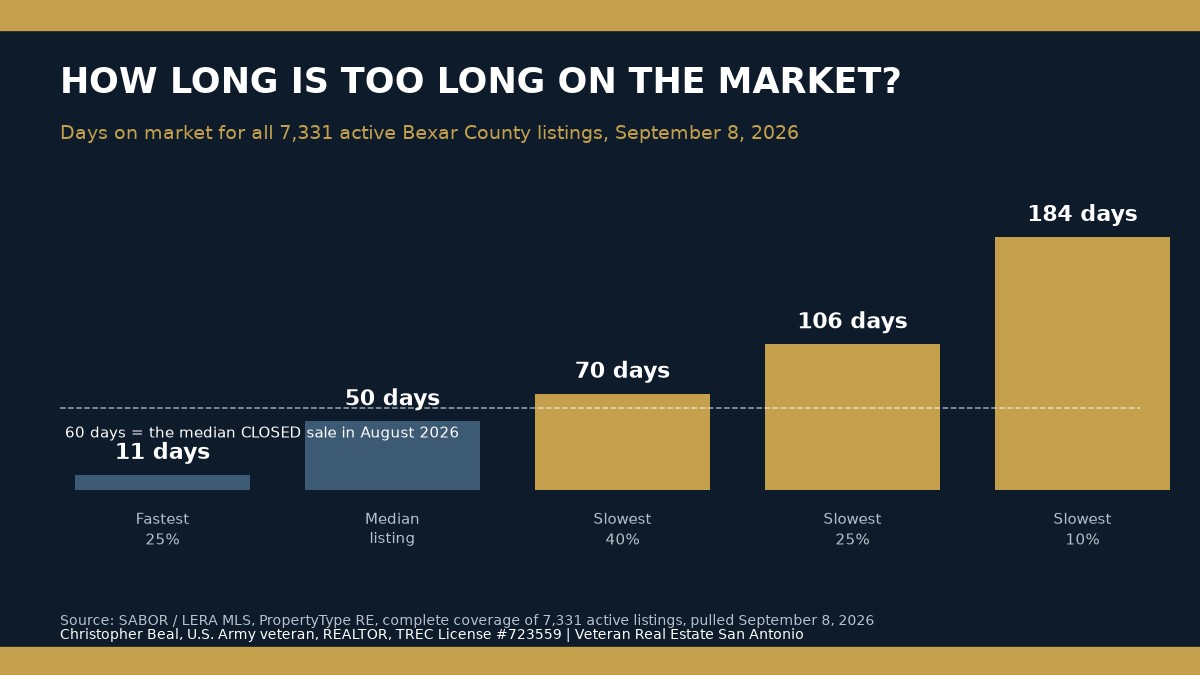
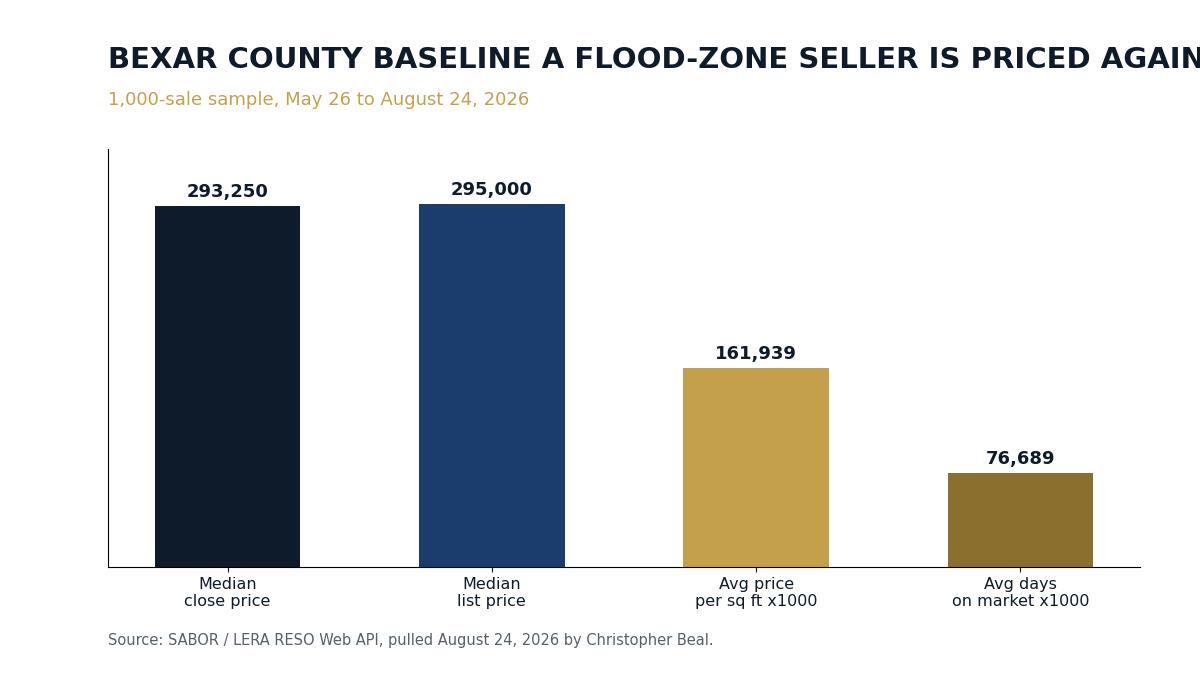
There is a second reality worth naming. As of the most recent 1,000-sale sample from the SABOR and LERA data feed covering May 26 through August 24, 2026, the Bexar County median close price was 293,250 dollars with average days on market at roughly 77. Active inventory is sitting at a 295,000 dollar median list price. That is a market where buyers have choices, and a flood-zone listing that is priced as if it were a Zone X listing will simply be skipped.
How Do I Confirm What Flood Zone My San Antonio Home Is Actually In?
Third-party flood data is wrong often enough that it is not usable as a disclosure basis. Consumer real estate portals buy risk scores from modeling vendors. Those scores estimate future risk. They are not the regulatory map your buyer's lender will use, and they frequently disagree with it in both directions.
The map that governs financing is the FEMA Flood Insurance Rate Map, or FIRM. Start at the FEMA Flood Map Service Center, enter the property address, and open the effective FIRMette for the panel. That document shows the zone boundary drawn against parcel lines. Then confirm it locally through the San Antonio River Authority, which maintains regional floodplain mapping for the Bexar County watershed and is generally more current than a static panel.
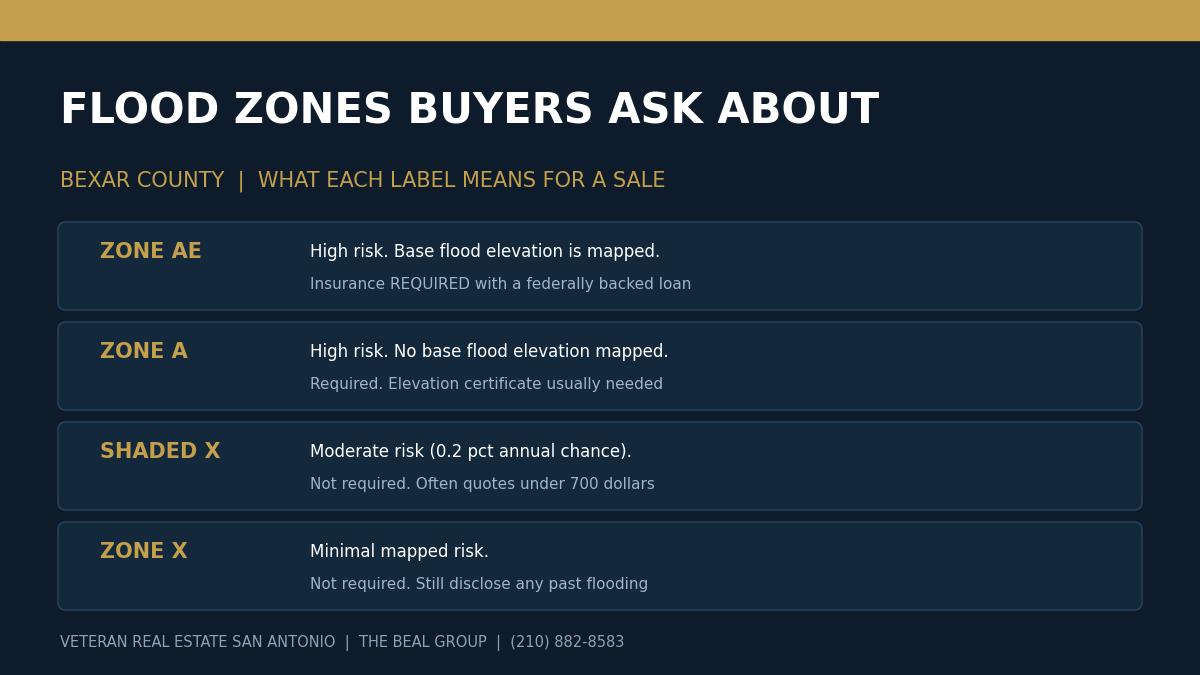
Three details decide whether the designation actually costs you money:
- Is the structure in the zone, or is the lot? Lenders require insurance when the improved structure sits in the Special Flood Hazard Area. A back corner of a two-acre Bandera County lot touching Zone AE while the house sits forty feet higher is a very different conversation.
- Is it Zone A or Zone AE? Zone AE has a published base flood elevation. Zone A does not, which usually means a surveyor has to establish one, and that uncertainty tends to price higher.
- Is any part of it in the floodway? The floodway is the channel that has to stay clear to carry the flood. It is the most restrictive designation and it limits what a future owner can build or expand.
Order a current elevation certificate from a Texas registered professional land surveyor if you do not already have one. Under Risk Rating 2.0 it is no longer required to rate a policy, but it is still frequently the document that lowers the quote, and having it in hand before you list means a buyer's insurance agent can produce a real number in a day instead of a week.
What Do Texas Sellers Legally Have to Disclose About Flooding?
This is the section where sellers create liability for themselves, and it is almost always by omission rather than by lying. The 2019 amendment, passed by the 86th Texas Legislature, rewrote the flood questions on the TREC Seller's Disclosure Notice because the old form let too much go unsaid after Hurricane Harvey.
The current notice asks you to state, to the best of your knowledge, whether the property is located wholly or partly in a 100-year floodplain, in a 500-year floodplain, in a floodway, in a flood pool, or in a reservoir. It also asks whether you have ever filed a flood insurance claim, whether you have received federal assistance for flood damage, and whether there has been previous water penetration into the structure from any source.
Answer all of it. Three rules keep sellers out of trouble:
- Disclose the event, not your theory about the event. "Two inches of water entered the garage on May 30, 2024 during a heavy rain event. Repaired by a licensed contractor, invoice attached." That is a disclosure. "The garage does not really flood" is an opinion, and an opinion is what gets litigated.
- Attach the paper. Repair invoices, the elevation certificate, the flood policy declaration page, and any engineering report should ride along with the notice. Documentation converts a red flag into a solved problem.
- Update the notice if something changes. If the property floods between going under contract and closing, that is a new material fact and it has to be disclosed.
One clarification I get asked about constantly: disclosing a past flood does not obligate you to reduce your price. It obligates you to tell the truth. Buyers price risk they can see far more generously than risk they suspect.
How Much Does Flood Insurance Cost in Bexar County in 2026?
Risk Rating 2.0 is the single biggest change sellers still misunderstand. FEMA began rolling it out on October 1, 2021 for new policies and April 1, 2022 for renewals. Before that, the zone letter effectively set the price. Now the National Flood Insurance Program rates each structure on its own characteristics: distance to a flooding source, elevation relative to that source, replacement cost of the building, foundation type, and the types of flooding the property is exposed to.
The practical consequence is that your neighbor's premium tells your buyer nothing. Two houses in the same Zone AE block on the same Leon Creek tributary can quote hundreds of dollars apart because one has a slab at a higher elevation and a lower replacement cost.
| What drives the premium | Under the old zone-based system | Under Risk Rating 2.0 (current) |
|---|---|---|
| Flood zone letter | Primary rating factor | Still sets the mandatory purchase requirement, but is no longer the primary price driver |
| Distance to the flooding source | Not directly used | Directly rated |
| Building replacement cost | Not directly used | Directly rated, so higher-value homes generally cost more to insure |
| Elevation certificate | Required to rate most Zone A and AE policies | Optional, but can still lower the quote |
| Annual increase | Varied by class | Capped by statute at 18 percent per year for most primary residences until the full risk rate is reached |
Source: FEMA National Flood Insurance Program Risk Rating 2.0 methodology, current as of August 2026. Confirm every figure with a licensed Texas flood insurance agent for your specific address.
That 18 percent cap matters more than it sounds. It means an existing policy that has not yet climbed to its full-risk rate is carrying a discount that is being phased out slowly. A brand new policy on the same house does not get that glide path. Which leads directly to the most valuable thing a flood-zone seller in San Antonio can do.
Can I Transfer My Flood Insurance Policy to the Buyer?
This is the seller lever almost nobody in Bexar County uses, and it is free. Because Risk Rating 2.0 premiums climb toward full risk under an annual cap, an older NFIP policy is often sitting materially below what a new policy on the identical structure would cost today. That gap does not belong to the house. It belongs to the policy, and the policy can move with the sale.
Three practical notes on the transfer:
- Get the declaration page into the buyer's hands early, ideally in the listing packet. It converts an abstract worry into a specific number they can take to their lender.
- The standard 30-day NFIP waiting period does not apply when flood insurance is required in connection with a loan closing, so a buyer purchasing a new policy is not blocked from closing on time. That is worth telling nervous buyers.
- Private flood insurance is a real alternative in Texas and is sometimes cheaper than NFIP. It is not assumable the same way, so a buyer choosing private coverage will need their own quote.
Selling a home with financing complications you did not choose is a recurring theme on this side of the market. If you are also weighing a leased system or an insurance issue on the same property, my guides on selling a San Antonio home with leased versus owned solar panels and home insurance and roof condition in a San Antonio home sale walk the same underwriting logic.
Will a VA or FHA Buyer Still Be Able to Finance My Flood-Zone Home?
In a market this dependent on military buyers, the debt-to-income effect is the real risk. San Antonio runs on VA financing. Buyers moving to Joint Base San Antonio-Lackland, JBSA-Randolph, and Fort Sam Houston are frequently stretching a Basic Allowance for Housing figure to its edge. Adding 90 to 200 dollars a month of flood premium to that payment can be the difference between an approval and a decline.
There is one hard stop worth knowing. VA will not guarantee a loan on a property where the residential improvements sit in a Coastal High Hazard Area, the V zones. Those do not occur in Bexar, Comal, Kendall, Medina, or Bandera counties, so inland San Antonio sellers are not exposed to that rule. What does apply here is straightforward: if the structure is in Zone A or Zone AE and the community participates in the NFIP, the buyer carries flood coverage for the life of the loan.
Practical seller moves that protect a VA or FHA contract:
- Put the premium in the listing packet. A written annual quote lets the buyer's loan officer build it into the pre-approval instead of discovering it at underwriting.
- Be open to a seller-paid first year. One year of premium is often a four-figure concession that solves the buyer's cash-to-close problem without touching your sale price. On a VA loan, seller concessions are permitted within program limits, so this is usually cleaner than a price cut.
- Expect a flood determination, not a flood inspection. The lender orders a life-of-loan flood zone determination from a third party. It is a records check, not a site visit, and it will find the zone whether or not you disclosed it.
Can I Get My Home Removed From the Flood Zone Before I List?
The mapped zone is drawn at neighborhood scale. Your lot is not. FEMA panels are generalized, and it is common for a house on a rise to be swept into a Zone AE boundary that follows a creek two hundred feet away. The Letter of Map Amendment, or LOMA, exists to correct exactly that.
The process, in order:
- Hire a Texas registered professional land surveyor to complete a FEMA elevation form establishing the lowest adjacent grade of the structure against the base flood elevation.
- Submit the application through FEMA's Online LOMC portal, linked from the FEMA flood map change page.
- Wait roughly 30 to 60 days for a determination.
Your realistic cost is the survey, commonly several hundred to a bit over a thousand dollars in the San Antonio area depending on lot complexity. FEMA does not charge a review fee for a standard LOMA based on natural ground. A LOMR-F, which is used when the land was raised with engineered fill, does carry a fee and takes longer.
Two honest caveats. First, a LOMA removes the federal mandatory purchase requirement, but a lender may still require coverage at its discretion, and a smart buyer may still want a policy. Second, a LOMA does not change the physical risk. It changes the regulatory status. Never market it as proof the home cannot flood.
How Should I Price a Flood-Zone Home in This Market?
The pricing mistake is using the wrong comparable set. An appraiser is going to look for sales with similar flood exposure. If your listing agent priced you off three Zone X sales in the same subdivision, you are going to spend 60 days finding that out the expensive way, and in a market averaging 77 days on market you cannot afford the detour.
When I build a comparative market analysis on a flood-zone property, I pull sold comparables from the SABOR and LERA MLS feed, then check each one's parcel against the FIRM panel and separate them into designated and non-designated sets. The spread between those two sets is your actual, measurable flood adjustment for that specific neighborhood. It is usually much smaller than sellers fear and much larger than zero.
| Lifestyle Priority | Best Pick | Runner-Up | Why |
|---|---|---|---|
| Fastest possible sale on a PCS clock | Transfer the NFIP policy and pay year one | Modest list price reduction | Solves the buyer's monthly payment and cash-to-close at the same time without resetting your comparables |
| Highest net proceeds, flexible timing | File the LOMA first, then list | Elevation certificate in the listing packet | Removing the mandatory purchase requirement widens the qualified buyer pool before you ever go active |
| Home has documented past flooding | Full disclosure plus repair documentation and a mitigation report | Pre-listing inspection | Proof of professional remediation is what separates a priced risk from an unpriced one |
| Investor or cash-buyer exit | Price to the insurance-adjusted cap rate | As-is sale with full disclosure | Cash buyers skip the mandatory purchase rule entirely, so the discount they ask for should be smaller, not larger |
Source: Christopher Beal, based on Bexar County listing outcomes and SABOR and LERA MLS sold data reviewed August 24, 2026.
One more note on cash buyers. A cash purchaser has no lender and therefore no mandatory flood insurance requirement. That is genuine leverage in your favor, and yet cash investors routinely open with the deepest flood discount request of any buyer type. Push back with the comparable set. If you want the full picture before you pick a number, my guide to choosing a listing agent in San Antonio covers what a real pricing process should look like.
How Do I Market a Flood-Zone Listing Without Scaring Buyers Off?
Transparency is not a concession here. It is a filter. A flood-zone listing that hides the designation attracts every buyer in the price band and then loses most of them at underwriting. A listing that publishes it attracts fewer buyers and converts a far higher share of them, which in a 77-day market is the trade you want.
What goes into the listing packet:
- The FEMA FIRMette showing the parcel and the zone boundary.
- The current elevation certificate, if one exists.
- The flood policy declaration page with the current annual premium, plus a written statement that the policy is assumable.
- Any drainage, grading, French drain, or foundation work, with contractor invoices and dates.
- The completed TREC Seller's Disclosure Notice with the flood section fully answered.
On the marketing side, the language matters. Do not write "flood zone" as an apology and do not bury it in the agent remarks. Write it as a specification: "Zone AE. Current NFIP premium 1,180 dollars per year, policy assumable by buyer. Elevation certificate on file." That reads like a seller who knows the property, and buyers respond to that.
Finally, the photography and showing plan should behave like any other listing at this price point. Professional photography, a full syndication push through the SABOR MLS to Zillow, Realtor.com, and Redfin, a structured showing feedback loop, and a documented offer negotiation process. A flood designation is a disclosure item, not a reason to market the home at a lower standard.
About the Author: Christopher Beal
Christopher Beal is a U.S. Army veteran and the Owner of Veteran Real Estate San Antonio, a Beal Group practice brokered by eXp Realty (TREC License #723559). A Military Relocation Professional (MRP) and VAREP member, he is a 7-time eXp Realty ICON agent, winner of Best Real Estate Agency in the 2026 Best of San Antonio Readers' Choice (San Antonio Current, 100,000+ voters), and a 3x San Antonio Business Journal Top 25 Individual Agent (#13 in 2024, #14 in 2025, #20 in 2026). His recognition also includes 3x Platinum Top 50, 2x RateMyAgent Agent of the Year, 2x Real Producers Top 100, Five Star Professional (2026), and a RealTrends 2026 ranking. He has helped 325+ families, closed more than $125M in career volume, and holds 5.0 stars across 370+ verified reviews, working almost exclusively with military and veteran buyers and sellers across Bexar, Comal, Kendall, Medina, and Bandera counties, with a focus on VA loans, PCS moves, and homebuying near JBSA-Lackland, JBSA-Randolph, and Fort Sam Houston. He has sold homes in mapped floodplains along Salado Creek, Leon Creek, and the Medina River, and he builds the flood insurance math into the pricing conversation before a listing ever goes active. He can be reached at (210) 882-8583.
Frequently Asked Questions
Do I have to disclose a flood that happened before I owned the house?
The TREC Seller's Disclosure Notice asks what you know. If a prior owner, a neighbor, an inspector, or a title document told you about earlier flooding, you know it, and it belongs on the notice. Write down what you were told and who told you.
Does a flood zone designation automatically lower my home's value?
Not automatically. It adds a mandatory annual insurance cost for any buyer using financing, and the market prices that cost. The measurable adjustment comes from comparing sold properties inside the zone against sold properties outside it in the same neighborhood, which is exactly how an appraiser will approach it.
Can a buyer back out of a Texas contract because of the flood zone?
During the option period a buyer can terminate for any reason, including the flood designation. After the option period expires, termination depends on the contract terms and any financing or insurance contingencies. That is another reason to disclose everything before the option period rather than during it.
Is flood damage covered by regular homeowners insurance in Texas?
No. Standard Texas homeowners policies exclude flood. Coverage comes from a separate NFIP policy or a private flood policy. This surprises buyers constantly, and it is worth stating plainly in your listing materials.
How long does it take to get a FEMA Letter of Map Amendment?
Plan on roughly 30 to 60 days from a complete submission, plus the time to get a surveyor out. FEMA does not charge a review fee for a standard LOMA based on natural ground, so the survey is usually your only cost.
Will my buyer's flood policy be delayed by the 30-day waiting period?
Not when the coverage is required in connection with the loan. The standard 30-day NFIP waiting period does not apply to a policy purchased in connection with making, increasing, extending, or renewing a loan, so it can be effective at closing.
Should I pay for the buyer's first year of flood insurance?
It is often the most efficient concession available. It solves the buyer's cash-to-close problem, it usually costs less than a meaningful price reduction, and it does not reset the sold comparable for your neighborhood. Seller concessions are allowed on VA and FHA loans within program limits.
Do cash buyers have to carry flood insurance?
No. The mandatory purchase requirement is a lender requirement, so a cash buyer can decline coverage. That makes cash buyers a genuinely stronger pool for a flood-zone listing, and it is a reason to resist an oversized cash discount request.
Which San Antonio areas are most affected by flood mapping?
Mapped floodplain runs along the major waterways rather than by ZIP code. The Salado Creek, Leon Creek, Olmos Creek, Medina River, and San Antonio River corridors all carry mapped Special Flood Hazard Areas through developed Bexar County neighborhoods. Comal, Kendall, Medina, and Bandera counties have their own creek and river corridors mapped the same way.
Can I sell a San Antonio home that has flooded more than once?
Yes. Repetitive loss properties sell in Bexar County every year. They require complete disclosure, documentation of every repair and mitigation measure, realistic pricing against comparable sales, and often a buyer pool weighted toward cash or investors. What they do not tolerate is an incomplete disclosure.
Explore More Resources
- VA Home Loans
- Military Relocation
- Free Home Evaluation
- Serve & Save
- Client Reviews
- About Christopher
Christopher Beal is a U.S. Army veteran and REALTOR serving military and veteran families across San Antonio and the surrounding Hill Country counties.
Veteran Real Estate San Antonio: The Beal Group, brokered by eXp Realty, TREC License #723559.
Serving Bexar, Comal, Kendall, Medina, and Bandera counties, including JBSA-Lackland, JBSA-Randolph, and Fort Sam Houston. Call (210) 882-8583.
Watch: Selling a San Antonio Home in a Flood Zone
Flood zone does not mean unsellable. Here is what you have to disclose, what insurance runs, and how buyer financing holds up.
Categories
- All Blogs (355)
- Alamo Heights (4)
- awards (4)
- Best Neighborhoods in San Antonio (13)
- Buyer (16)
- Buyer Education (86)
- Community Events (4)
- Hill Country (17)
- JBSA (44)
- Local Guide (6)
- Luxury (28)
- Luxury Real Estate (26)
- Market Trends (19)
- Market Update (14)
- Military Relocation (112)
- Military Retirement (3)
- Mortgage (19)
- Neighborhood Guides (19)
- neighborhoods (5)
- New Construction (16)
- PCS (42)
- Real Estate (40)
- reviews (3)
- San Antonio (53)
- San Antonio Lifestyle (4)
- San Antonio Market (5)
- San Antonio Neighborhoods (44)
- San Antonio Real Estate (100)
- San Antonio, Veterans Resources, VA Loans (5)
- Seller (55)
- VA Home Loans (30)
- VA Loans (35)
- Va Loans & Financing (27)
- Veterans (10)
- Veterans Resources (40)
Recent Posts