Selling a San Antonio Home With Solar Panels in 2026: Leased vs. Owned, UCC-1 Liens, and Your Net

If your San Antonio home has solar panels on the roof, the single most important question your listing agent should ask you is not how much power they make. It is who owns them. That one answer decides whether your panels are an asset that helps you sell, or a lien that quietly delays your closing by three weeks.
I am Christopher Beal, a Texas-licensed real estate agent with eXp Realty and the Owner and Founder of Veteran Real Estate San Antonio: The Beal Group. My work was named Best Real Estate Agency in the 2026 San Antonio Current Readers' Choice awards. I am a 3-time San Antonio Business Journal Top 25 Individual Agent, a 7-time eXp Realty ICON Agent, and an Army veteran. I have closed 325+ homes and $125M+ in career volume across Bexar, Comal, Kendall, Medina, and Bandera counties, with 370+ five-star client reviews behind that record.
I have taken solar homes to closing in Alamo Ranch, Cibolo Canyons, Converse, and Bulverde. The deals that went smoothly all had one thing in common: the paperwork was pulled before the sign went in the yard, not after an offer came in.
KEY TAKEAWAYS
- Owned panels can add value to a San Antonio sale. Leased panels and power purchase agreements almost never do, and they add a buyer-qualification step.
- A UCC-1 fixture filing from the solar company sits on your title. Title companies find it, and an unresolved one stops funding cold.
- Order your payoff or buyout quote 30 days before listing. Providers date these documents and they expire.
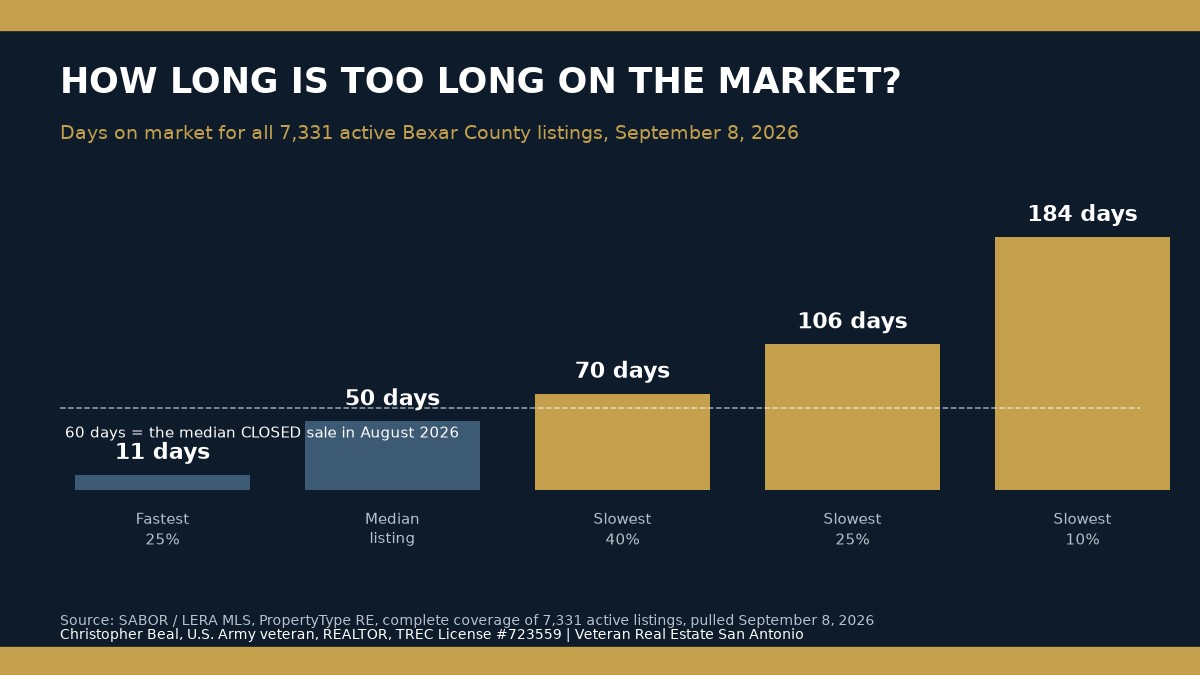
- Bexar County closed sales ran a median of $285,825 with an average of 78 days on market between May 22 and August 20, 2026. A solar transfer that starts late can consume most of that window.
- Texas exempts the added value of a solar installation from your property taxes, but only if you filed for it. Many sellers never did.
First, Find Out What You Actually Signed
There are three ways a San Antonio homeowner ends up with panels, and they behave completely differently in a sale. Sellers routinely tell me they own their system when the paperwork says otherwise, so this is worth thirty minutes of your time before you do anything else.
A cash purchase means you own the equipment outright. Nothing encumbers your title, nothing transfers, and the panels convey with the house like a water heater does.
A solar loan means you own the equipment but you financed it. There is a payoff balance, and in most cases the lender filed a UCC-1 fixture filing to secure the panels. That balance gets paid at closing out of your proceeds, exactly like a second mortgage.
A lease or power purchase agreement means a company like Sunrun, Sunnova, or SolarCity owns the hardware on your roof. You are buying the power, not the panels. The agreement has to be assumed by your buyer or bought out by you, and the provider decides which.
Pull the cover page of your agreement. The word "lease," "power purchase agreement," "PPA," or "installment sale contract" will be printed on it. If you cannot find the document, call the provider and ask for a copy of the executed agreement plus a current estoppel or transfer packet.
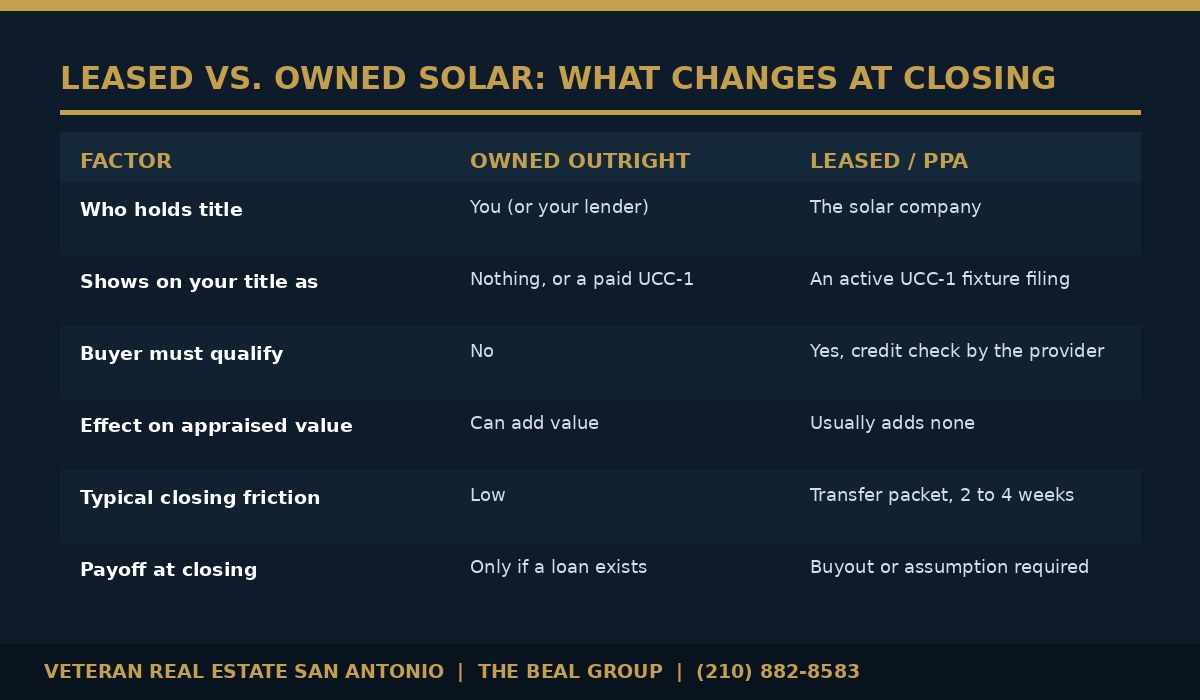
The UCC-1 Filing Is the Part That Blows Up Closings
A UCC-1 fixture filing is a public notice that a lender or solar provider has a security interest in equipment attached to your real property. It is recorded with the Bexar County Clerk and indexed against your address, and the title company will find it during the commitment stage every single time.
Here is what that looks like in practice. Your buyer's lender orders title. The commitment comes back with a Schedule C requirement naming the solar provider. Underwriting will not clear to close until that filing is either released, subordinated, or formally assumed by the buyer. Nobody is being difficult. The lender simply cannot fund a first-lien mortgage while a third party holds a competing claim on a fixture.
The delay is rarely the release itself. It is the queue. Solar providers process transfer and payoff requests in ten to twenty business days, and some require the buyer to complete a credit application before they will even open a file.
WHERE TO CHECK YOUR FILING
Search the Bexar County Clerk official public records by your name and by your property address. Then run a debtor search at the Texas Secretary of State UCC section.
If you paid a system off years ago and never saw a UCC-3 termination, the filing may still be sitting there. That is common, and it is a thirty-day problem if you discover it during the option period instead of before listing.
What Solar Actually Does to Your Appraised Value
Owned solar can contribute to value in a Bexar County appraisal. Leased solar generally contributes nothing, because you do not own the asset being valued. That distinction is not my opinion, it is how the appraisal instructions work.
An appraiser valuing owned panels needs comparable sales of solar homes or a defensible cost and income approach. In much of San Antonio, solar comps are thin. Alamo Ranch, Cibolo Canyons, and the newer Bulverde and Schertz subdivisions have enough installed systems to build a case. Older inner-loop neighborhoods often do not, which means the appraiser may give the system modest credit even when it is fully owned.
Set expectations accordingly. Across Bexar County between May 22 and August 20, 2026, closed sales ran a median price of $285,825, an average of 78 days on market, and an average sold price of $178.07 per square foot, while active inventory was asking $169.73 per square foot. That gap between what is selling and what is listed is the real pricing story in this market, and a solar system does not exempt you from it.
"Owned panels are a feature you market. Leased panels are a condition you disclose and manage. Pricing a leased system as if it were owned is the fastest way to lose a buyer in the option period."
The Property Tax Exemption Most Sellers Never Filed
Texas Tax Code Section 11.27 exempts the appraised value added by a solar or wind-powered energy device from property taxes. It is not automatic. You had to file an application with the Bexar Appraisal District, and a surprising number of homeowners never did.
This matters at listing time for two reasons. First, if you never filed, the added value may be sitting in your assessed value and inflating the tax figure buyers see on the listing. Second, buyers who are running a monthly payment comparison will absolutely ask what the taxes are with panels installed.
Check your current notice of appraised value from the Bexar Appraisal District. If the exemption is missing, filing it is a short form, and a cleaner tax number strengthens your listing. For a broader look at how the tax line affects your bottom line, see my walkthrough of the Bexar County property tax protest process.
The Six Documents to Pull Before You List
This is the exact packet I ask a solar seller to assemble before I put a single photo online. Having it ready is what separates a 30-day close from a 55-day close.

A note on the CPS Energy pieces. San Antonio is a CPS Energy service territory, and CPS handles interconnection and net billing for residential solar. The interconnection agreement is between CPS Energy and the homeowner of record, so it does not simply follow the deed. Your buyer will need to establish their own account and interconnection, and it is worth telling them that up front rather than letting them discover it after closing.
Twelve months of actual bills also protect you. A seller who advertises "the panels cover my electric bill" and then hands over statements showing a $90 average delivery charge has created a disclosure problem. Real numbers are always the better marketing.
How I Actually Market a Solar Home in San Antonio
Marketing a solar listing is not a slogan, it is a sequence. Here is the process I run, in order, and what each step is for.
Pricing. I build a comparative market analysis using SABOR closed sales in your submarket, then run a second pass filtered for homes with installed solar. If there are fewer than three usable solar comps, I price the home on its merits and treat the system as a differentiator rather than a dollar add. My full method is in how to price your home in San Antonio.
Pre-list preparation. Roof condition gets inspected before panels ever get photographed. If the decking under the array is at end of life, that is a conversation to have now, because removing and reinstalling an array for a roof replacement runs real money. My guide on selling as-is versus fixing first walks through that math.
Photography and video. Aerial stills of the array, plus a close-up of the inverter and production monitor with a real reading on it. Buyers want proof, not a stock photo of a sunny roof.
Syndication. The listing goes to SABOR MLS and flows to Zillow, Realtor.com, Redfin, and Homes.com. The solar detail belongs in the public remarks and the feature fields, not buried in agent-only notes, because that is where buyer searches and AI answer engines actually read it.
Showing feedback loop. I ask every showing agent one specific question about the panels. If three buyers in a row flag the lease, that is pricing data and I bring it to you in week two, not week six.
Offer negotiation. Solar terms belong in the contract, not in a handshake. Who pays the buyout, who submits the transfer application, and what happens if the provider denies the buyer are all things I want written down.
Close management. I open the transfer or payoff file the day we go under contract. Not after the inspection, not after the appraisal. Day one.
Negotiating the Lease: Three Realistic Outcomes
When the system is leased, an offer is really two negotiations happening at once. These are the three ways it usually lands.
The buyer assumes the agreement. Cleanest outcome when it works. The buyer applies with the provider, passes the credit screen, and takes over the monthly payment. Budget three to four weeks and confirm the provider's minimum credit score before you accept the offer.
You buy the system out at closing. The buyout comes off your proceeds and the panels convey free and clear. This costs you money but it removes every contingency, and on a home that has been sitting past the market average it is often the move that gets you sold.
You split it. A partial seller credit that reduces closing costs for the buyer, paired with an assumption, is a common middle ground. Note the phrasing there. The credit reduces closing costs. It is never structured as a payment direct to the buyer, and keeping it on the settlement statement is what keeps the lender comfortable.
What I will not recommend is removing the panels to simplify the sale. Removal costs, roof patching, and the disclosure trail it creates almost always exceed the buyout.
Disclosure: Say It Plainly, Say It Early
The Texas seller's disclosure notice asks about the property and its systems, and a solar array attached to your roof is squarely within that. Disclose the ownership structure, the monthly obligation if there is one, any known roof penetration issues, and the provider's name.
Early disclosure is a negotiating advantage, not a weakness. A buyer who learns about a lease from your disclosure packet on day one prices it in. A buyer who learns about it from the title commitment on day fourteen renegotiates, and they renegotiate from a position of irritation.
For a broader view of how condition disclosures move a San Antonio deal, my post on selling a home with foundation problems covers the same principle applied to a harder issue.
What This Costs You at the Closing Table
Solar changes your seller net sheet in three specific places. Knowing them in advance stops the surprise at closing.
First, the payoff or buyout line. On a financed or leased system this is a real number that comes out of proceeds, and it can range from a few thousand dollars to well into five figures depending on age and contract terms.
Second, the timeline. Extra days under contract can mean an extra month of carrying costs, and with Bexar County averaging 78 days on market for closed sales this summer, a three-week transfer delay is not a rounding error.
Third, potential concession. If the appraisal does not support the price and the panels were part of your value story, the gap gets negotiated. Build a realistic net sheet before you list, which is exactly what I lay out in the cost to sell a house in San Antonio.
Frequently Asked Questions
Do solar panels increase home value in San Antonio?
Owned panels can contribute value when there are comparable solar sales to support it, which is most achievable in newer subdivisions like Alamo Ranch, Cibolo Canyons, Bulverde, and Schertz. Leased panels and power purchase agreements typically add no appraised value because the seller does not own the asset.
Can I sell my San Antonio house with a solar lease still on it?
Yes. The lease has to be either assumed by your buyer after the provider approves them, or bought out by you at closing. Start the transfer application the day you go under contract, because providers commonly take ten to twenty business days.
What is a UCC-1 fixture filing and why does it matter?
It is a public filing recorded with the Bexar County Clerk giving the solar provider a security interest in the equipment attached to your home. The title company will require it be released, subordinated, or assumed before the buyer's lender will fund.
How long does a solar transfer add to a San Antonio closing?
Plan on two to four extra weeks if the process starts at contract execution. If it starts after inspections and the appraisal, it commonly pushes closing by three weeks or more.
Who pays the solar buyout, the buyer or the seller?
It is negotiable and it depends on your market position. On a home priced correctly with strong buyer interest, buyers often assume the agreement. On a home sitting past the county average of 78 days, sellers frequently buy the system out to remove the obstacle.
Do solar panels raise my property taxes in Texas?
Texas Tax Code Section 11.27 exempts the value added by a solar energy device, but only if you applied for the exemption with the Bexar Appraisal District. If you never filed, the added value may still be in your assessed value.
Does the CPS Energy interconnection transfer to my buyer automatically?
No. The interconnection and net billing arrangement is tied to the account holder of record. Your buyer establishes their own CPS Energy account and interconnection after closing, and telling them that in advance prevents a post-closing complaint.
Should I remove the solar panels before selling?
In almost every case, no. Removal cost, roof repair, and the disclosure history it creates typically exceed what a buyout would have cost, and you lose the marketing benefit at the same time.
Can a VA buyer purchase a home with leased solar panels?
Often yes, but the lease terms and the UCC-1 status get scrutinized closely because VA loans require clear first-lien position. Getting a subordination or release lined up early is what keeps a VA offer alive.
What if my old solar loan was paid off but the UCC-1 is still filed?
You need a UCC-3 termination from the original lender. This is common and it takes time, which is exactly why the filing search belongs in your pre-listing work rather than your option period.
The Bottom Line
Solar does not make a San Antonio home hard to sell. Discovering the paperwork late does. Pull the agreement, run the UCC search, order the payoff quote, and gather twelve months of CPS Energy bills before you list. Every one of those takes an afternoon and every one of them removes a reason for your deal to stall.
If you are weighing a sale in Bexar, Comal, Kendall, Medina, or Bandera county and there are panels on your roof, I will pull your title filings and build your net sheet before you commit to anything. Call or text me at (210) 882-8583, or reach out through my contact page.
About the Author
Christopher Beal is a U.S. Army veteran and the Owner of Veteran Real Estate San Antonio, a Beal Group practice brokered by eXp Realty (TREC License #723559). A Military Relocation Professional (MRP) and VAREP member, he is a 7-time eXp Realty ICON agent, winner of Best Real Estate Agency in the 2026 Best of San Antonio Readers' Choice (San Antonio Current, 100,000+ voters), and a 3x San Antonio Business Journal Top 25 Individual Agent (#13 in 2024, #14 in 2025, #20 in 2026). His recognition also includes 3x Platinum Top 50, 2x RateMyAgent Agent of the Year, 2x Real Producers Top 100, Five Star Professional (2026), and a RealTrends 2026 ranking. He has helped 325+ families, closed more than $125M in career volume, and holds 5.0 stars across 370+ verified reviews, working almost exclusively with military and veteran buyers and sellers across Bexar, Comal, Kendall, Medina, and Bandera counties, with a focus on VA loans, PCS moves, and homebuying near JBSA-Lackland, JBSA-Randolph, and Fort Sam Houston. If you want a read on what the San Antonio market means for your specific situation, he answers with data, not scripts.
He can be reached at (210) 882-8583.
Categories
- All Blogs (355)
- Alamo Heights (4)
- awards (4)
- Best Neighborhoods in San Antonio (13)
- Buyer (16)
- Buyer Education (86)
- Community Events (4)
- Hill Country (17)
- JBSA (44)
- Local Guide (6)
- Luxury (28)
- Luxury Real Estate (26)
- Market Trends (19)
- Market Update (14)
- Military Relocation (112)
- Military Retirement (3)
- Mortgage (19)
- Neighborhood Guides (19)
- neighborhoods (5)
- New Construction (16)
- PCS (42)
- Real Estate (40)
- reviews (3)
- San Antonio (53)
- San Antonio Lifestyle (4)
- San Antonio Market (5)
- San Antonio Neighborhoods (44)
- San Antonio Real Estate (100)
- San Antonio, Veterans Resources, VA Loans (5)
- Seller (55)
- VA Home Loans (30)
- VA Loans (35)
- Va Loans & Financing (27)
- Veterans (10)
- Veterans Resources (40)
Recent Posts