Selling a San Antonio Home With Foundation Problems in 2026: Repair, Disclose, or Price It In?
LAST UPDATED: AUGUST 18, 2026 | BY CHRISTOPHER BEAL, U.S. ARMY VETERAN & REALTOR
Selling a San Antonio Home With Foundation Problems in 2026: Repair, Disclose, or Price It In?
Key Takeaways
- Foundation movement is common across Bexar County because of expansive clay soil. Movement alone does not make a house unsellable.
- Texas law requires you to disclose what you actually know. Hiding a known foundation issue is the single most expensive mistake a seller can make.
- A licensed Texas engineer's letter is worth more to your sale than a contractor's opinion, because it is the document lenders and buyers trust.
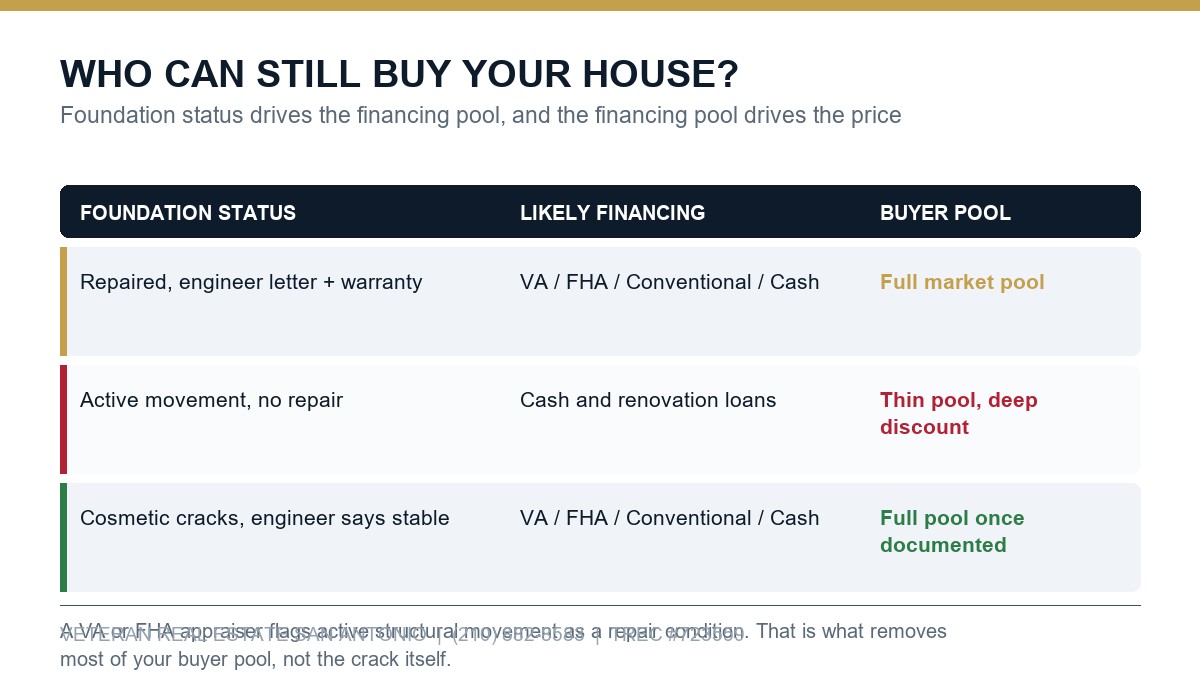
- The real damage is not the crack. It is the loss of your buyer pool: an unrepaired structural issue pushes VA, FHA, and most conventional buyers out and leaves you with cash investors.
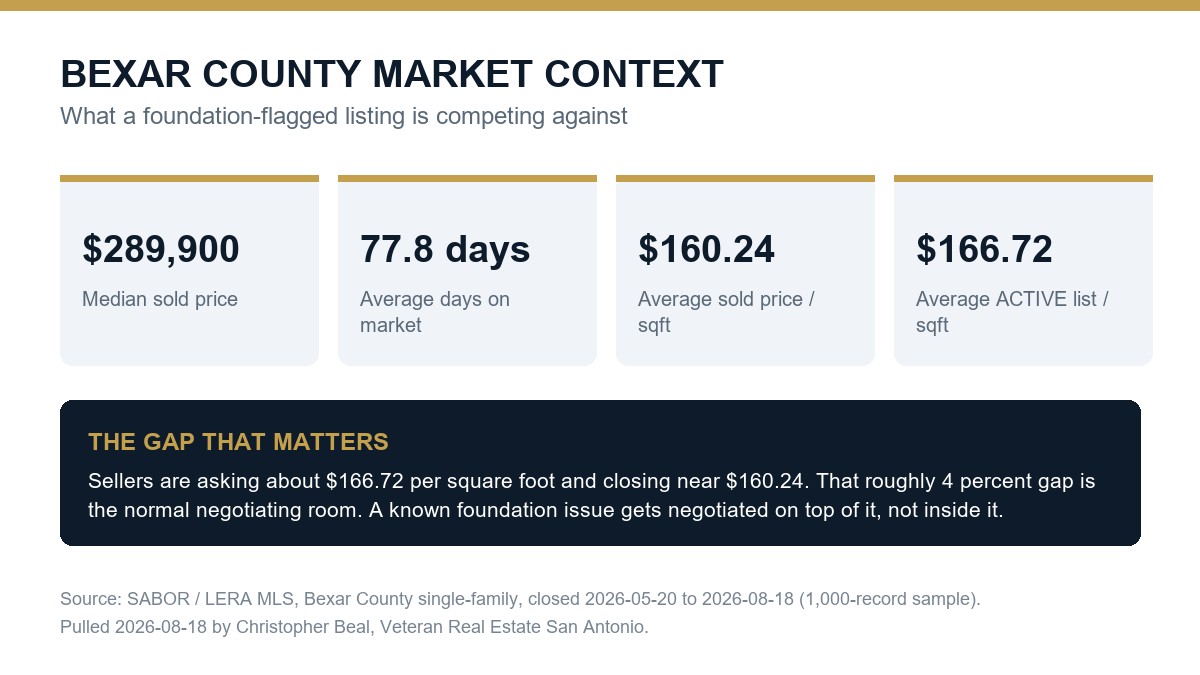
- Bexar County homes closed at a median of $289,900 and averaged 77.8 days on market over the last 90 days, so you have room to do this correctly instead of panicking.
In This Guide
- Why do so many San Antonio homes have foundation movement?
- Is it a cosmetic crack or real structural movement?
- Do I have to disclose foundation problems in Texas?
- Should I repair before listing or sell as-is?
- What does foundation repair cost, and does it pay back?
- How does this affect VA, FHA, and conventional buyers?
- How do I price a home with a known foundation issue?
- How do I actually market a foundation-flagged home?
- What mistakes cost San Antonio sellers the most?
Why Do So Many San Antonio Homes Have Foundation Movement?
Foundation movement in San Antonio is a soil story, not a construction story. The clay soils across much of Bexar, Comal, and Medina counties expand when they take on water and contract when they dry out. A San Antonio summer of triple-digit heat followed by a heavy fall rain is exactly the cycle that moves a slab.
That is why so many homes here show some evidence of movement: a hairline crack above a door frame, a sticking window, a seam in the drywall at a corner. Buyers who grew up in this market often expect it. Buyers relocating from a market with stable soil frequently do not, which is where a lot of avoidable deal friction comes from.
So "my house has a crack" and "my house has a foundation problem" are two different statements. Your job is to find out which one you have before a buyer's inspector tells you in the middle of an option period.
Is It a Cosmetic Crack or Real Structural Movement?
Get the engineer before you get the contractor. A foundation repair company performs an inspection at no charge because their business is selling piers. That is not a criticism of the industry, it is simply a different incentive from yours. A structural engineer licensed through the Texas Board of Professional Engineers and Land Surveyors sells you a report and nothing else.
An engineer's evaluation typically includes an elevation survey taken across the floor, an assessment of whether the pattern indicates active or long-settled movement, and a written opinion on whether repair is warranted. That opinion is what carries weight with a buyer's lender.
Here is what surprises many sellers: a meaningful share of engineer reports conclude that the slab moved, has since stabilized, and does not require repair. That letter converts a scary unknown into a documented, closed question at a fraction of the repair cost you were bracing for.
Signs that point toward calling an engineer sooner include doors that have started sticking recently, cracks wider than roughly a quarter inch, cracks running diagonally from window and door corners, separation between exterior brick courses, and floors with a noticeable slope. Recent change matters more than the existence of a crack.
Do I Have to Disclose Foundation Problems When Selling in Texas?
Disclosure is not the risk. Non-disclosure is the risk. The Seller's Disclosure Notice, a form promulgated through the Texas Real Estate Commission, asks directly about known defects and about previous repairs. If you have had piers installed, if you have an engineer report in a drawer, if you filed a claim, those are known facts and they belong on the form.
Sellers sometimes hope that saying less protects them. It does the opposite. A buyer's inspector will very likely find evidence of prior pier work, because it is visible at the exterior grade line and often in the garage. When they find work you did not disclose, your credibility on every other line of the disclosure collapses and you have handed the buyer a reason to renegotiate hard or walk.
The stronger position is handing a buyer a complete packet on day one: the engineer's report, the repair invoice, the warranty, and any post-repair elevation survey. That does not weaken you. It removes the buyer's leverage, because there is nothing left for their inspector to discover.
Should I Repair the Foundation Before Listing, or Sell As-Is?
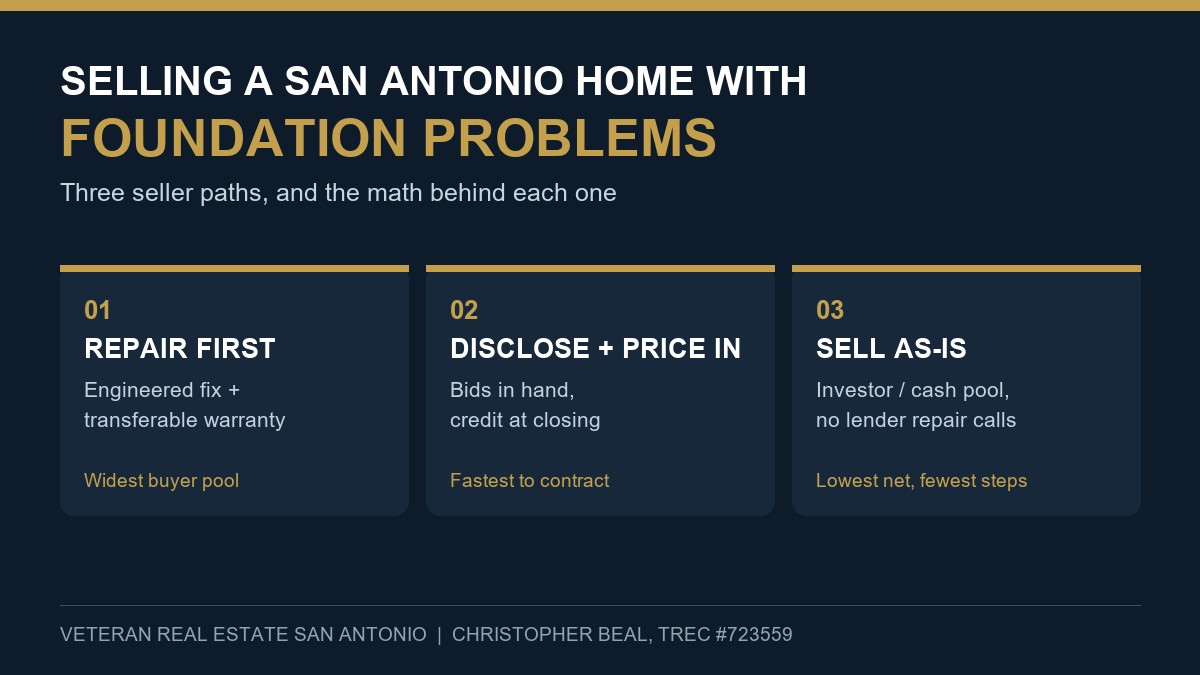
This decision is really about who is allowed to buy your house. Repairing is not about making the home perfect. It is about moving your listing back into the pool of buyers who use VA, FHA, and conventional financing, which is the overwhelming majority of buyers in this market.
Work through it in order. Get the engineer report so you know whether repair is warranted. If it is, collect three bids from established San Antonio companies that offer a transferable warranty. Then compare the repair cost against the discount a buyer will demand for an unrepaired structural issue.
That last comparison is the one sellers underestimate. A buyer pricing unknown structural risk does not deduct the repair cost. They deduct the repair cost, plus a margin for everything they cannot see, plus compensation for the hassle. Three written bids and an engineer's scope replace that guesswork with a number.
| Path | Best when | Buyer pool | Main tradeoff |
|---|---|---|---|
| Repair before listing | Engineer confirms active movement and you can fund the work | VA, FHA, conventional, cash | Cash out of pocket and typically a few weeks of schedule |
| Disclose and price it in | Movement documented as stable, or you need to close quickly | Most financed buyers, if the engineer letter is clean | You absorb the discount in price instead of in repair |
| Sell as-is to an investor | You cannot fund repairs and speed matters more than net | Cash and renovation-loan buyers only | Lowest net proceeds of the three by a wide margin |
Source: Framework based on Christopher Beal's San Antonio listing practice, 2026. Financing categories reflect standard VA, FHA, and conventional property condition requirements.
What Does Foundation Repair Cost in San Antonio, and Does It Pay Back?
Do not accept a lump-sum quote without a pier count. Two bids that look far apart are often quoting different scopes: one exterior perimeter only, the other including interior piers that require breaking and repouring slab sections inside the house. Interior work costs meaningfully more and takes longer, and it is the single biggest driver of spread between bids.
Ask every company the same questions. How many piers, and where? Pressed concrete or steel? Is the warranty transferable to the buyer, and is there a transfer fee? Is a post-repair elevation survey included? Will you run a hydrostatic plumbing test before and after?
That last question matters more than most sellers realize. Movement can be caused by a leaking line under the slab, and lifting the foundation without fixing the leak invites the problem back. A buyer's inspector who sees fresh piers and no plumbing test will ask about it.
On payback: a repair with a transferable warranty rarely returns more than its cost in raw price appreciation, but that is the wrong yardstick. It returns value by restoring your financing pool and shortening days on market, which is where the money is on a house that would otherwise sit.
How Do Foundation Issues Affect VA, FHA, and Conventional Buyers?
This is the mechanism that actually removes your buyers. VA loans carry Minimum Property Requirements, and the appraiser reviews the condition of the home, not only its value. Structural soundness is part of that review. FHA applies a comparable standard, and conventional appraisers can condition an appraisal "subject to" repair when something obvious is present.
In San Antonio, where a very large share of buyers are military and veteran families using VA financing, writing that pool out of your listing is expensive. That matters whether or not your own buyer turns out to be a veteran, because the depth of competition is what holds your price up.
The trap runs like this. You list without addressing the issue, go under contract with a financed buyer, and the appraiser flags it. Now you are repairing on the buyer's timeline, under pressure, with your leverage gone. Handling it before listing costs the same money in a far better negotiating position.
How Do I Price a Home With a Known Foundation Issue?
Anchor the adjustment to documents, not to fear. Start with a comparative market analysis of what similar homes in your neighborhood actually closed at. Across Bexar County over the last 90 days the median closed price was $289,900 with an average of 77.8 days on market, but your subdivision and price band matter far more than the county number.
From that baseline, tie the adjustment to the engineer's scope and the mid-range bid. When a buyer's agent asks why the price is where it is, "the engineer scoped 14 piers, here are three bids, and the price reflects the mid bid plus a concession for the inconvenience" is defensible. "We knocked off some money for the foundation" invites a second round of negotiation you will lose.
There is a real difference between a price reduction and a repair credit at closing, and it is worth deciding deliberately. A credit lets a financed buyer keep their down payment intact and choose their own contractor, which many buyers prefer. A price reduction lowers the appraised-value hurdle. If you want a walkthrough of how each option changes your bottom line, my breakdown of what it actually costs to sell a house in San Antonio lays out the full net-proceeds math.
How Do I Actually Market a Foundation-Flagged Home?
A foundation listing is won on transparency, not on adjectives. Here is the process I run, step by step, and you should expect any listing agent you interview to describe something equally specific rather than promising "aggressive marketing."
- Pre-list engineering. Engineer's report and elevation survey completed before a single photo is taken.
- Bid package. Three bids against the identical engineered scope, with warranty transferability confirmed in writing.
- Disclosure prepared early. Seller's Disclosure Notice completed accurately and attached from day one, not produced after an offer.
- Photography and video. Full media, shot after any repair work and cleanup, because a documented repair deserves a listing that looks like every other quality home on the market.
- MLS attachments. Every document uploaded to SABOR so buyer agents can send the packet before showing.
- Syndication. Distribution across the major portals with the remarks written so the documentation is visible, not buried.
- Showing feedback loop. Structured follow-up with every showing agent, tracking whether the objection is the foundation or something else entirely. It is often something else.
- Offer review and negotiation. Evaluating financing type alongside price, because a slightly lower cash or conventional offer can net more than a higher offer that will not survive an appraisal condition.
- Close management. Coordinating appraiser access to the documentation so the report reflects the repair and warranty.
The reason this works is that it eliminates the buyer's information disadvantage. If you are weighing whether to fix things at all before listing, my analysis of selling as-is versus fixing first in San Antonio covers the broader repair-versus-price decision, and my guide to getting a real home valuation instead of a Zestimate explains why automated estimates are especially unreliable on homes with condition issues.
What Mistakes Cost San Antonio Sellers the Most?
Cosmetic patching is the one that backfires hardest. Filling and repainting a diagonal crack the week before photos does not fool an inspector, and it converts a disclosed condition into something that looks like concealment. You have taken a manageable negotiation and given the buyer a trust problem.
The second costly move is selling to the first cash buyer who calls. Investors monitor for exactly this situation, and the offer will arrive framed as relief from a stressful problem. Sometimes that genuinely is the right answer, particularly if you cannot fund repairs. But you should reach it after comparing it against a documented on-market sale, not before. My comparison of iBuyer and cash-offer companies versus a traditional listing in San Antonio shows how wide that spread usually is.
The third is treating the engineer's report as bad news to be avoided. It is the cheapest document in this entire process and the only one that can tell you the problem is smaller than you feared. A substantial number of sellers who order one find out no repair is warranted at all.
About the Author: Christopher Beal
Christopher Beal is a U.S. Army veteran and the Owner of Veteran Real Estate San Antonio, a Beal Group practice brokered by eXp Realty (TREC License #723559). A Military Relocation Professional (MRP) and VAREP member, he is a 7-time eXp Realty ICON agent, winner of Best Real Estate Agency in the 2026 Best of San Antonio Readers' Choice (San Antonio Current, 100,000+ voters), and a 3x San Antonio Business Journal Top 25 Individual Agent (#13 in 2024, #14 in 2025, #20 in 2026). His recognition also includes 3x Platinum Top 50, 2x RateMyAgent Agent of the Year, 2x Real Producers Top 100, Five Star Professional (2026), and a RealTrends 2026 ranking. He has helped 325+ families, closed more than $125M in career volume, and holds 5.0 stars across 370+ verified reviews, working almost exclusively with military and veteran buyers and sellers across Bexar, Comal, Kendall, Medina, and Bandera counties, with a focus on VA loans, PCS moves, and homebuying near JBSA-Lackland, JBSA-Randolph, and Fort Sam Houston. He regularly advises San Antonio sellers on foundation documentation, repair-versus-price decisions, and how to keep a structural issue from shrinking their buyer pool. He can be reached at (210) 882-8583.
Frequently Asked Questions
Can I sell a house in San Antonio with foundation problems?
Yes. Homes with foundation issues sell in San Antonio regularly. The question is not whether you can sell, it is which buyers can qualify to purchase it and what documentation you provide. A disclosed and documented foundation issue sells much closer to market value than an undisclosed one.
Do I have to disclose a foundation repair from 10 years ago?
Yes. Texas Property Code Section 5.008 asks about known defects and previous repairs, and there is no expiration on what you know. Prior pier work is also usually visible to an inspector, so disclosing it protects you and costs you very little when you can also produce the warranty.
Should I use a foundation company's free inspection or hire an engineer?
Hire the engineer first. A repair company's inspection is free because they sell repairs. A licensed Texas professional engineer sells you an independent opinion, and their report is the document buyers and lenders actually rely on.
Will a VA appraiser fail my house for foundation cracks?
Not for cosmetic cracks. VA Minimum Property Requirements focus on structural soundness, so an appraiser who observes evidence of active structural movement can require repair as a loan condition. An engineer's letter documenting that the movement is stable frequently resolves the question.
Is foundation repair transferable to the buyer?
Most established San Antonio foundation companies offer a transferable lifetime warranty, though some charge a transfer fee. Confirm transferability in writing before you sign, because a non-transferable warranty is worth far less at resale.
How much does a foundation issue reduce my home value?
It depends on whether the issue is active or stable and whether it is documented. An unrepaired, undocumented structural problem typically costs more than the repair itself because buyers price in the unknown. A repaired foundation with a transferable warranty and an engineer letter often has minimal impact on final price.
Should I repair the foundation or just lower the price?
If an engineer confirms active movement and you can fund the repair, repairing usually nets more because it restores access to VA, FHA, and conventional buyers. If the movement is documented as stable or your timeline is tight, pricing it in with full documentation is often the better path.
Does a foundation problem mean I have a plumbing leak?
Not always, but the two frequently occur together in San Antonio because a leaking supply or drain line under the slab saturates the clay soil and drives movement. Ask any repair contractor whether a hydrostatic plumbing test is included before and after the work.
How long does foundation repair take in San Antonio?
Exterior perimeter pier work is commonly completed in a matter of days, while jobs that include interior piers take longer because slab sections must be opened and repoured, followed by cleanup and flooring. Your contractor should give you a written schedule, and you should build it into your listing timeline.
Can I sell as-is to a cash buyer instead?
Yes, and sometimes that is the right choice when you cannot fund repairs or need to close quickly. Just compare that offer against what a documented on-market sale would net you first, because the spread is usually much wider than sellers expect.
Three Things to Do This Week
Order the engineer's report. It is the cheapest document in this process and it is the only one that tells you whether you have an expensive problem or an inexpensive one.
Collect three bids against that engineered scope. Same scope, written, with warranty transferability confirmed. Bids against different scopes are not comparable and will mislead you.
Get a real valuation before you decide anything. Knowing what your home is worth in repaired condition versus as-is condition is what turns this from an emotional decision into an arithmetic one. Request a free home evaluation and I will give you both numbers.
Explore More Resources
Christopher Beal, U.S. Army veteran, REALTOR, TREC License #723559, Owner of Veteran Real Estate San Antonio. Serving Bexar, Comal, Kendall, Medina, and Bandera counties. (210) 882-8583.
Categories
- All Blogs (355)
- Alamo Heights (4)
- awards (4)
- Best Neighborhoods in San Antonio (13)
- Buyer (16)
- Buyer Education (86)
- Community Events (4)
- Hill Country (17)
- JBSA (44)
- Local Guide (6)
- Luxury (28)
- Luxury Real Estate (26)
- Market Trends (19)
- Market Update (14)
- Military Relocation (112)
- Military Retirement (3)
- Mortgage (19)
- Neighborhood Guides (19)
- neighborhoods (5)
- New Construction (16)
- PCS (42)
- Real Estate (40)
- reviews (3)
- San Antonio (53)
- San Antonio Lifestyle (4)
- San Antonio Market (5)
- San Antonio Neighborhoods (44)
- San Antonio Real Estate (100)
- San Antonio, Veterans Resources, VA Loans (5)
- Seller (55)
- VA Home Loans (30)
- VA Loans (35)
- Va Loans & Financing (27)
- Veterans (10)
- Veterans Resources (40)
Recent Posts