How to Price Your Home in San Antonio in 2026 (Seller's Guide)

| How to Price Your Home in San Antonio in 2026 (Seller's Guide) By Christopher Beal | Veteran Real Estate San Antonio: The Beal Group | August 4, 2026 |
If you're thinking about selling a home in San Antonio this year, pricing is the single biggest decision that controls everything else: how quickly you get showings, whether you attract strong buyers, and how much you net at closing. In a market where active inventory has risen and price reductions are common, "testing the market" with a high number often backfires. In this 2026 seller's guide, I'll show you a practical, San Antonio-specific way to price accurately from day one, reduce the odds of painful price cuts, and put yourself in the best position to negotiate terms that protect your bottom line.
What does the San Antonio market look like right now (and why does it matter for pricing)?
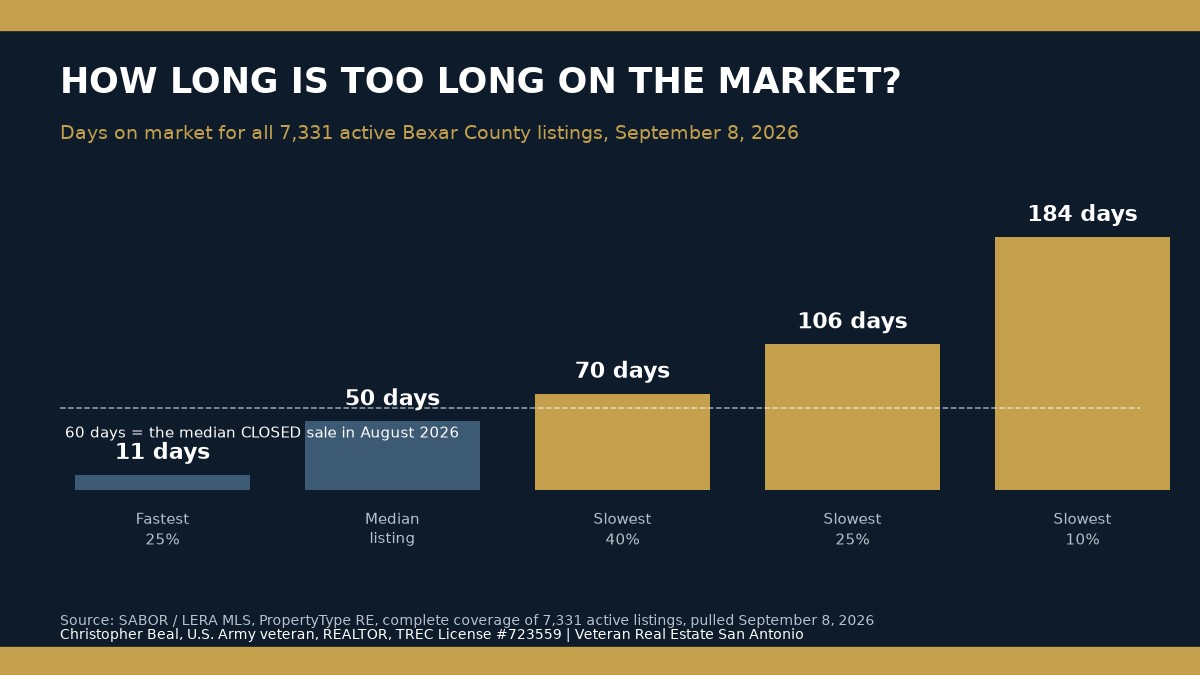
Pricing strategy has to match the market's leverage, and right now the leverage in San Antonio sits with buyers. Pulling the most recent 1,000 residential closings inside the city limits from the SABOR MLS (closed between May 6 and August 4, 2026), the picture is this: a median closed price of $294,995, an average of 80 days on market, and a close-to-list ratio of 97.8%. That last number is the one sellers feel. On a $295,000 home, closing at 97.8% of list means roughly $6,500 given back off the asking price, and that is the average outcome, not the bad one.
The active side tells the same story from the other direction. The current San Antonio active pool carries a median list price of $285,000 and has been sitting an average of 63 days. Bexar County overall is close behind at a $289,250 median close price and an 81-day average market time. Inventory is deep enough that a buyer working with a competent agent can skip your listing and still see three more this weekend.
Mortgage rates set the affordability ceiling over all of it. Freddie Mac's Primary Mortgage Market Survey put the 30-year fixed at 6.66% for the week ending July 30, 2026, up from 6.58% the week before and down only slightly from 6.72% a year earlier. Rates in the mid-6s make buyers intensely payment-sensitive. You cannot price on the assumption that someone will stretch. You have to be the clearest value in your price band on the day you list.
The overpricing gap: what San Antonio sellers ask versus what buyers actually pay
Here is a number almost no seller ever sees, and it is the most useful pricing benchmark in this market. From that same SABOR MLS pull, side by side: San Antonio homes that actually closed did so at an average of $163.05 per square foot. Homes currently sitting on the market are asking an average of $166.09 per square foot.
That is a 1.9% gap between the asking market and the closing market, and it is measurable proof of what I tell every seller at the kitchen table: as a group, San Antonio sellers are still pricing to a market that already ended. The active pool is asking above what buyers have been willing to pay for the last three months. Some of those listings will cut. Some will expire. Very few will get their number.
Run it on a 2,000-square-foot home. Priced at the active-market average of $166.09 per square foot, you list at roughly $332,000. Priced at what buyers are actually closing at, $163.05 per square foot, you list at roughly $326,000. That $6,000 difference sounds small until you understand what it buys: the $326,000 listing appears in the search results of every buyer whose maximum is $330,000, and the $332,000 listing does not. You did not lose $6,000. You lost an entire tier of buyers, and then you spend 80 days discovering it.
The practical rule: price to the sold per-square-foot number in your specific submarket, not the active one. Your neighbor's aspirational list price is not a comp. It is a data point about your neighbor's hopes. Closed sales are the only evidence of what a buyer will actually sign for.
What is the biggest pricing mistake San Antonio sellers make in 2026?
The biggest mistake is pricing for the home you wish you had instead of pricing for the competing homes a buyer can choose today. In a more balanced market, the buyer is comparing your home against:
- Recent closed sales (what buyers actually paid)
- Pending homes (what buyers are currently willing to pay)
- Active listings (your direct competition)
- Homes that expired or withdrew (pricing that didn't work)
If you price based on last year's "peak comp" or a neighbor's hopeful list price, you often end up chasing the market with reductions. And when a listing accumulates days on market, buyers start to wonder what's wrong with it—even if nothing is wrong at all.
How do I price my home correctly (step-by-step) without guessing?
Here's the simple framework I use with San Antonio sellers. It's not complicated—but it is disciplined.
Step 1: Define your "comp set" like a buyer would
We pull a tight set of comparable sales (same neighborhood or the nearest substitute), similar size and age, and ideally similar lot characteristics. Then we separate them into three buckets: renovated, average, and needs work. Buyers do this mentally; we do it on paper so we can price confidently.
Step 2: Use pending/under-contract listings as the "truth serum"
Closed sales can lag the market by 30–90 days. Pending listings often reveal the price buyers are accepting now. If the most similar pending home is priced below your target, you need a strong reason to be above it.
Step 3: Decide whether you want a speed strategy or a maximize strategy
In 2026, many sellers want both: sell fast and get top dollar. Typically, you can optimize one and still do fine on the other, but you should choose intentionally:
| Strategy | List Price Position | Best For |
|---|---|---|
| Speed Strategy | Top 25% best value vs. active competition | PCS timelines, job relocation, buying another home first |
| Maximize Strategy | Fair market value with strong presentation and firm terms | Sellers who can wait, but still want to avoid stale-listing risk |
| Test-the-Market (Not Recommended) | Above fair market value "to see what happens" | Usually leads to price reductions and weaker negotiating position |
Step 4: Build a pricing range and pick a single number with intent
We'll typically land on a pricing range (example: $310,000–$325,000) based on comparable sales and what buyers are paying today. Then we pick a list price based on your strategy and the current competition. A home that is the best value in its comp set often gets the best outcome—not necessarily the highest starting number.
How do price cuts affect my net proceeds (and why do they hurt more than you think)?
Price cuts are sometimes necessary, but in a market with lots of competing listings, they can be expensive. Here's why:
- You lose momentum. The first 7–14 days are when serious buyers pay the most attention.
- Buyers anchor on the reduction. Instead of "this is priced well," they think "how low will you go?"
- Inspection negotiations get harder. After a reduction, buyers feel you've already admitted you were too high.
Statewide in Texas, sellers had to use larger price concessions at the end of 2025: the Texas Housing Insight recap (via Texas Real Estate Research Center analysis) noted a median price cut of $19,900 in December 2025 (about a 6% reduction from original asking price), and that over two-thirds of November and December closed sales involved price cuts of 3% or more. That's a strong reminder that pricing right early is often the best way to protect your net.
What are "terms" and "presentation," and how do they change pricing power?
Pricing is not just the number—it's the whole offer package a buyer expects when they see the number. Two homes listed at the same price can perform very differently based on:
- Presentation: professional photos, clean and decluttered rooms, curb appeal, and an accurate description that sets expectations.
- Condition: small repairs done upfront vs. deferred maintenance that becomes a negotiation point.
- Flexibility: closing timeline, appraisal contingency, leaseback, and reasonable repair strategy.
If your home needs work, the pricing has to reflect that and leave room for inspection negotiations. If your home is in great shape, you can often price in the stronger part of the range because you're reducing a buyer's uncertainty.
How does the 2026 Texas buyer-agreement law change selling strategy?
Texas updated its rules around buyer representation. As of January 1, 2026, a real estate license holder working with a prospective buyer of residential property must enter into a written agreement before showing a home or presenting an offer in many situations. Practically, this helps serious buyers move faster once they're engaged with an agent—and it reduces "tourist showings" where no one has committed to a process. For sellers, it reinforces the value of strong marketing, accurate pricing, and an agent who can qualify and communicate with buyer agents effectively.
Why Work with Christopher Beal?
- U.S. Army veteran - understands military life, PCS moves, and VA loan benefits firsthand
- 7x eXp Realty ICON Agent (2020-2026) and Best of San Antonio 2026 Winner for Best Real Estate Agency
- 3x San Antonio Business Journal Top 25 Individual Agent - #13 in 2024, #14 in 2025, #20 in 2026
- 3x Platinum Top 50 producer, 2x RateMyAgent Agent of the Year, 2x Real Producers Top 100, Five Star Professional 2026, RealTrends 2026 ranked
- Military Relocation Professional (MRP) certified and VAREP member
- 325+ families served and more than $125M in career volume, with 5.0 stars across 370+ verified reviews
- Serve & Save Program - reduces closing costs for veterans, active duty, first responders, and educators
About the Author
Christopher Beal is a U.S. Army veteran and the Owner of Veteran Real Estate San Antonio, a Beal Group practice brokered by eXp Realty (TREC License #723559). A Military Relocation Professional (MRP) and VAREP member, he is a 7-time eXp Realty ICON agent, winner of Best Real Estate Agency in the 2026 Best of San Antonio Readers' Choice (San Antonio Current, 100,000+ voters), and a 3x San Antonio Business Journal Top 25 Individual Agent (#13 in 2024, #14 in 2025, #20 in 2026). His recognition also includes 3x Platinum Top 50, 2x RateMyAgent Agent of the Year, 2x Real Producers Top 100, Five Star Professional (2026), and a RealTrends 2026 ranking. He has helped 325+ families, closed more than $125M in career volume, and holds 5.0 stars across 370+ verified reviews, working almost exclusively with military and veteran buyers and sellers across Bexar, Comal, Kendall, Medina, and Bandera counties, with a focus on VA loans, PCS moves, and homebuying near JBSA-Lackland, JBSA-Randolph, and Fort Sam Houston. If you are deciding what to list your San Antonio home for, he will price it against closed comps and walk you through the net-proceeds math before you commit to a number. He can be reached at (210) 882-8583.
Frequently Asked Questions
What is the most important factor when pricing a home in San Antonio in 2026?
The most important factor is what similar homes are actually selling for right now, not what they sold for during a different market. In 2026, buyers have more choices, so your price has to compete with current listings and recent closed sales in your neighborhood.
Should I price my home high to "leave room to negotiate"?
In most cases, no. Overpricing often reduces showings early, and then the home sits long enough that you end up reducing anyway. Pricing accurately from day one usually produces a stronger negotiating position because buyers see it as a fair value.
How do price reductions affect the final sales price?
Price reductions can create a stigma that something is wrong with the home, even when it's not. Buyers may also become more aggressive in inspection negotiations because they assume you're already willing to come down. When possible, it's better to price correctly and protect momentum.
What is a CMA and how is it different from an online home value estimate?
A CMA (comparative market analysis) is a local analysis of similar homes that have sold, are pending, and are currently listed, with adjustments for condition and features. Online estimates can be a helpful starting point, but they often miss condition differences and neighborhood-specific pricing patterns that affect what buyers will pay.
Do I need to consider mortgage rates when setting my list price?
Yes. Mortgage rates affect the monthly payment, and payment is what many buyers shop for. When rates are higher, buyers are more sensitive to price increases, so accurate pricing becomes even more important.
How long should I wait before adjusting my price if the home isn't getting showings?
If your listing has strong photos and is actively marketed, a lack of showings in the first couple weeks usually points to pricing. I typically recommend reviewing activity within 10–14 days, then making a decisive adjustment rather than small reductions that drag out the process.
What price range should I use if my home is updated versus average condition?
Updated homes can often price toward the top of the comparable range because they reduce a buyer's uncertainty and future repair costs. Homes in average condition usually need to be positioned as the best value against similar listings, especially if there are many choices in the neighborhood.
Can pricing slightly below market value help me sell for more?
Sometimes, yes. A strong value price can increase showings and competition, which can lead to better offers and cleaner terms. This works best when your home presents well and your price is clearly attractive compared to nearby alternatives.
What are "terms" that can make a lower offer stronger than a higher offer?
Terms include financing strength, down payment, appraisal risk, inspection requests, and closing timeline. A slightly lower offer with strong financing and fewer contingencies can net you more by reducing delays and renegotiation risk.
Explore More Resources
- Search San Antonio Homes
- Free Home Evaluation
- Serve & Save Program (reduces closing costs)
- Client Reviews
- About Christopher Beal
- Military Relocation Guide
- VA Home Loans in San Antonio
- San Antonio Relocation Guide
- Texas Veteran Property Tax Exemption
- Selling With a VA Loan Assumption (2026)
Call or text Christopher Beal: (210) 882-8583
Watch: Why Day-One Pricing Decides Your Net
This is the whole pricing conversation in about 90 seconds, built on this summer's actual Bexar County closings instead of a rule of thumb.
Across 4,665 San Antonio closings from June 17 to September 15, 2026 (SABOR MLS via LERA, complete population for that window), the homes that never cut price sold in a median 27 days at 99.3 percent of the original asking price. The 55.9 percent that did cut sat 85 days and closed at 91.9 percent. The median cut was $20,000, which on the $310,000 median first ask works out to roughly $23,000 and about two extra months of carrying costs. Your house is not the median, and condition, terms and location move the result - but this is why the first two weeks of pricing decide more than any correction you make later.
Categories
- All Blogs (354)
- Alamo Heights (4)
- awards (4)
- Best Neighborhoods in San Antonio (13)
- Buyer (16)
- Buyer Education (86)
- Community Events (4)
- Hill Country (17)
- JBSA (43)
- Local Guide (6)
- Luxury (28)
- Luxury Real Estate (26)
- Market Trends (19)
- Market Update (14)
- Military Relocation (111)
- Military Retirement (3)
- Mortgage (19)
- Neighborhood Guides (18)
- neighborhoods (5)
- New Construction (16)
- PCS (42)
- Real Estate (40)
- reviews (3)
- San Antonio (53)
- San Antonio Lifestyle (4)
- San Antonio Market (5)
- San Antonio Neighborhoods (43)
- San Antonio Real Estate (100)
- San Antonio, Veterans Resources, VA Loans (5)
- Seller (55)
- VA Home Loans (30)
- VA Loans (35)
- Va Loans & Financing (27)
- Veterans (10)
- Veterans Resources (40)
Recent Posts