Home Insurance and Your San Antonio Home Sale (2026): The Roof Question That Ends Closings
LAST UPDATED: AUGUST 19, 2026 | BY CHRISTOPHER BEAL, U.S. ARMY VETERAN & REALTOR

There is a step in a San Antonio home sale that almost nobody plans for, and it has quietly become one of the most common reasons deals fall apart: the buyer cannot get the house insured on the terms they budgeted for.
It rarely announces itself early. The contract gets signed, the option period runs, the inspection comes back manageable. Then somewhere around day 12 the buyer's lender asks for the insurance binder, the buyer starts shopping, and the quotes come back with a number nobody expected, or with a condition attached to the roof. Now you are renegotiating a deal you thought was done, with the clock running.
SHORT ANSWER
In San Antonio, the insurance question on a resale almost always comes down to the roof: how old it is, what it is made of, and whether the carrier will cover it at replacement cost or only at depreciated value. A roof past roughly 15 to 20 years can push a buyer into a higher premium, a separate wind and hail deductible, an actual-cash-value roof schedule, or a carrier declining the risk outright.
You do not need a new roof to sell. You do need to know what a carrier will say about yours before you are under contract, because finding out on day 12 is what turns a clean sale into a price reduction.
Why insurance became a closing risk in San Antonio
Bexar County sits in one of the most active hail corridors in the country. That single fact drives most of what has happened to Texas homeowners insurance over the last several years: carriers have raised premiums, tightened underwriting on older roofs, separated wind and hail into its own deductible, and in some cases stopped writing certain roof ages and roof types altogether.
For a seller, the practical effect is that your roof is now underwritten twice. Once by the buyer's inspector, who reports its condition, and once by the buyer's insurance carrier, who decides what it will cost to cover. Those two opinions do not always agree, and only one of them can stop the loan from closing.
The five things a Texas carrier is actually looking at
1. Roof age. This is the big one. Most carriers want to know the year the roof was installed, not the year the house was built. Composition shingle roofs are commonly viewed as fully serviceable for about 15 to 20 years depending on the product and the carrier. Past that, the options narrow.
2. Replacement cost versus actual cash value. A replacement-cost roof endorsement pays to replace the roof. An actual-cash-value schedule pays the depreciated value, which on a 20-year-old roof can be a small fraction of the replacement cost. Many carriers automatically move older roofs to an ACV schedule. Buyers who understand this treat it as a real cost, because it is one.
3. The wind and hail deductible. In this market it is frequently a percentage of the dwelling coverage rather than a flat dollar amount. On a $300,000 dwelling limit, a 2 percent wind and hail deductible is $6,000 out of pocket before the policy pays anything on a hail claim.
4. Claims history on the address. Prior claims follow the property, not just the owner, through industry loss-history reporting. Two hail claims in five years on your address will shape what a buyer is quoted even though they were your claims.
5. The rest of the four-point picture. Electrical panel type and age, plumbing supply material, water heater age, and the HVAC system all show up in underwriting on older homes. Aluminum branch wiring, polybutylene supply lines, and certain recalled electrical panels are the classic deal-complicators.
How this actually breaks a San Antonio contract
The failure sequence is predictable, which is what makes it preventable.
The buyer budgets a monthly payment based on an estimated insurance figure, often the lender's generic placeholder. They go under contract. During the financing period they shop coverage for real. The quote comes back materially higher than the placeholder, or a carrier attaches an ACV roof schedule, or the best available quote requires a roof replacement.
Now the buyer has three choices: absorb a payment they did not plan for, ask you to fix or credit the roof, or terminate under their financing terms. In practice they ask you first. And because this happens deep into the contract, you are negotiating from the weakest possible position: the home has been off the market for two or three weeks, your original buyer pool has moved on, and going back to market means starting the days-on-market clock over.
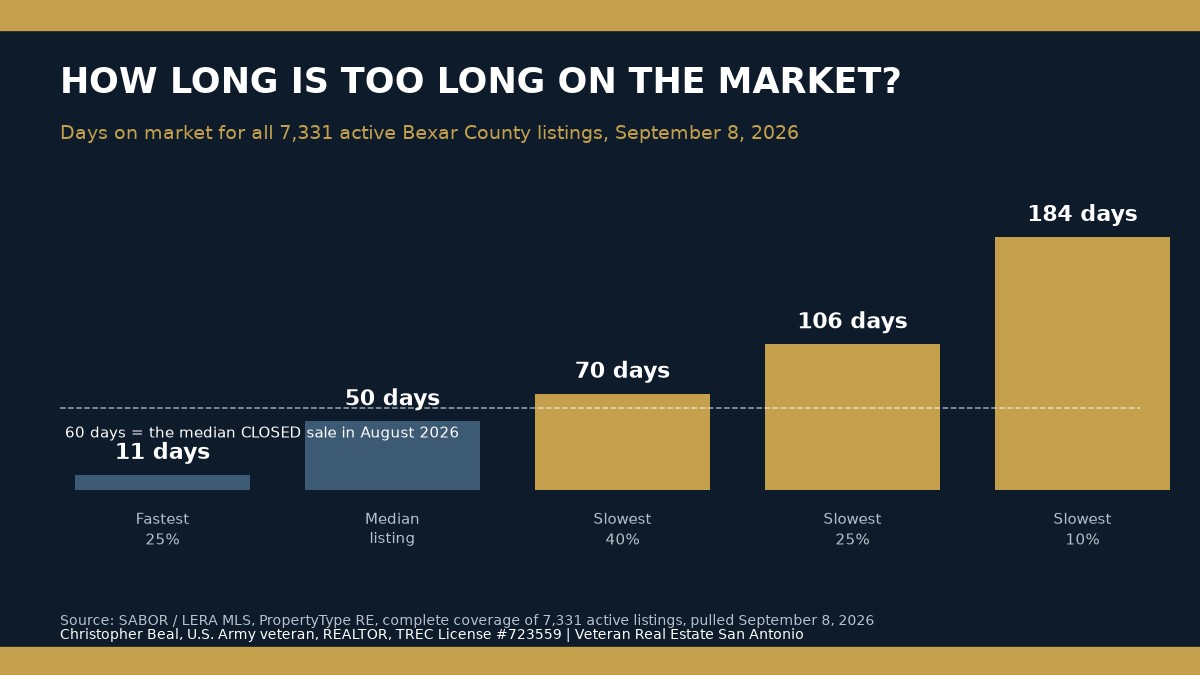
That clock is exactly where San Antonio sellers lose money. Looking at 199 Bexar County sales that closed between May 21 and August 19, 2026, homes that went under contract and closed within 30 days on market finished at 99.4 percent of their original list price. Homes that took more than 90 days finished at 91.6 percent. A fallen-through contract does not just cost you the buyer. It moves you down that table.
What sellers should do before they list
Find the actual roof installation date. Not the year built. Look for the permit, the invoice, or the insurance claim paperwork from the last replacement. If you cannot find it, say so plainly rather than guessing on the disclosure.
Call your own agent and ask two questions. First: how is my roof currently scheduled, replacement cost or actual cash value? Second: what is my wind and hail deductible as a dollar figure? Those two answers tell you most of what a buyer's carrier is going to say.
Get a roof assessment before you get an offer. A licensed roofer will tell you in fifteen minutes whether you have a roof that will pass underwriting, a roof with a few years left, or a roof that will generate a demand from every buyer who writes on the house.
Pull your own claims history. You are entitled to your loss-history report. Knowing what a buyer's carrier will see removes the surprise.
Handle the small four-point items. A water heater past its service life, a missing drip pan, an unbonded gas line, or an outdated panel are inexpensive to address before listing and expensive to negotiate afterward.
Should you replace the roof before listing?
Usually no, and this is where sellers over-correct. A full roof replacement is a large cash outlay that rarely returns dollar-for-dollar at closing, and buyers do not pay a premium for a new roof so much as they penalize an old one.
The better framing is the same repair-versus-price math that governs every other condition issue. Three options, in ascending order of cost to you:
| Approach | When it fits | The risk you keep |
|---|---|---|
| Disclose and price it in | Roof is serviceable but aging; you would rather adjust price than write a check | Buyers still shop the quote; some walk |
| Offer a roof credit at closing | Roof will not pass underwriting cleanly and you want to keep the deal alive | Credit is negotiated late, usually from a weak position unless you set it up front |
| Replace before listing | Roof is at end of life, is a known uninsurable type, or has visible storm damage | Cash outlay you may not fully recover |
The one case where replacement is clearly worth it: when your roof is the reason a normal buyer cannot get a normal policy. At that point you are not choosing between price and repair, you are choosing between selling to a financed buyer and selling to a cash investor at an investor price.
What this means for military and VA buyers specifically
If your likely buyer is using a VA loan, and in San Antonio there is a good chance they are, insurance interacts with the VA appraisal in a way worth understanding. VA minimum property requirements already look at the roof: it must prevent moisture entry and have reasonable future utility. A roof that fails that standard has to be addressed before the loan closes, full stop.
So a VA-financed buyer is effectively bringing two roof reviews to your closing, the appraiser's and the carrier's, and both have to clear. If you are selling in a JBSA commuter corridor and expect VA offers, get in front of the roof question early. Our guide to VA appraisal requirements in San Antonio covers what the appraiser looks for.
What buyers should do, since it protects your deal too
If you are on the buying side, get a real insurance quote during your option period, not after it. Give the agent the address, the roof age, and the square footage, and ask specifically for the wind and hail deductible and whether the roof is scheduled at replacement cost or actual cash value. The option period exists so that surprises cost you an option fee instead of a contract.
Frequently asked questions
Can a buyer really terminate a San Antonio contract over insurance?
Not usually as a standalone insurance contingency, but yes in effect. Lenders require hazard coverage in place at closing. If the buyer cannot obtain acceptable coverage, or the premium pushes their debt ratios out of qualification, the deal fails under the financing terms of the contract.
How old is too old for a roof in San Antonio?
There is no single legal threshold. As a practical matter, composition shingle roofs commonly start drawing underwriting conditions somewhere in the 15 to 20 year range, and options narrow further past that. Carriers differ, which is why an actual quote beats a rule of thumb.
What is a wind and hail deductible, and why is it separate?
It is a deductible that applies only to wind and hail losses, and in hail-exposed markets it is often set as a percentage of the dwelling coverage rather than a flat amount. It is separate because hail is the dominant loss driver here, and carriers price it on its own.
Do I have to disclose a past hail claim when I sell?
The Texas Seller's Disclosure Notice asks about known defects and about certain repairs and claims history. Answer it accurately and completely. Beyond the legal obligation, prior claims are visible to the buyer's carrier through industry loss reporting, so concealment tends to surface at the worst possible moment.
Will a new roof increase my sale price?
Not proportionally. Buyers generally treat a sound roof as the baseline expectation and discount for an old one, rather than paying a premium for a new one. Replace when the roof blocks financing or insurability, not as a value play.
Should I get an insurance quote on my own house before listing?
Yes, and it is free. Ask your current carrier what your roof schedule and wind and hail deductible are, and ask one outside carrier what they would charge a new buyer. The gap between those two answers is the negotiation you are about to have.
About the author
Christopher Beal is a U.S. Army veteran and the Owner of Veteran Real Estate San Antonio, a Beal Group practice brokered by eXp Realty (TREC License #723559). A Military Relocation Professional (MRP) and VAREP member, he is a 7-time eXp Realty ICON agent, winner of Best Real Estate Agency in the 2026 Best of San Antonio Readers' Choice (San Antonio Current, 100,000+ voters), and a 3x San Antonio Business Journal Top 25 Individual Agent (#13 in 2024, #14 in 2025, #20 in 2026). His recognition also includes 3x Platinum Top 50, 2x RateMyAgent Agent of the Year, 2x Real Producers Top 100, Five Star Professional (2026), and a RealTrends 2026 ranking. He has helped 325+ families, closed more than $125M in career volume, and holds 5.0 stars across 370+ verified reviews, working almost exclusively with military and veteran buyers and sellers across Bexar, Comal, Kendall, Medina, and Bandera counties, with a focus on VA loans, PCS moves, and homebuying near JBSA-Lackland, JBSA-Randolph, and Fort Sam Houston. He raises the roof and insurance question at the listing appointment rather than at day twelve of a contract, because that is the only point at which a seller still has leverage over the answer. He can be reached at (210) 882-8583.
Not sure where your roof stands? Call or text Christopher Beal at (210) 882-8583 before you list. A ten-minute conversation about your roof age, your current deductible, and your claims history is the cheapest insurance you will buy on the whole transaction.
Explore more resources
Categories
- All Blogs (355)
- Alamo Heights (4)
- awards (4)
- Best Neighborhoods in San Antonio (13)
- Buyer (16)
- Buyer Education (86)
- Community Events (4)
- Hill Country (17)
- JBSA (44)
- Local Guide (6)
- Luxury (28)
- Luxury Real Estate (26)
- Market Trends (19)
- Market Update (14)
- Military Relocation (112)
- Military Retirement (3)
- Mortgage (19)
- Neighborhood Guides (19)
- neighborhoods (5)
- New Construction (16)
- PCS (42)
- Real Estate (40)
- reviews (3)
- San Antonio (53)
- San Antonio Lifestyle (4)
- San Antonio Market (5)
- San Antonio Neighborhoods (44)
- San Antonio Real Estate (100)
- San Antonio, Veterans Resources, VA Loans (5)
- Seller (55)
- VA Home Loans (30)
- VA Loans (35)
- Va Loans & Financing (27)
- Veterans (10)
- Veterans Resources (40)
Recent Posts