VA Funding Fee Explained: 2026 Rates, Exemptions, and How to Reduce It in San Antonio
Last Updated: October 5, 2026 | By Christopher Beal, U.S. Army Veteran & REALTOR | About Christopher
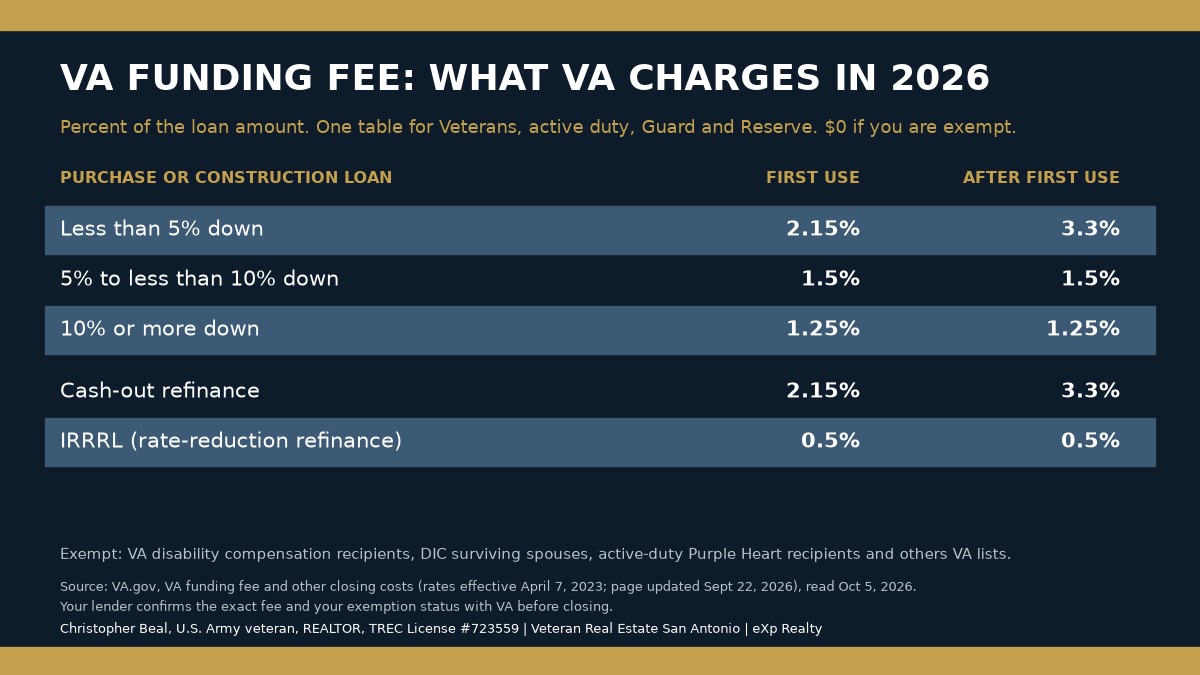
The VA funding fee is a one-time charge, paid to VA, of 2.15% of the loan amount on a first-use VA purchase with less than 5% down and 3.3% if you have used the benefit before. Putting 5% down cuts it to 1.5% and 10% down to 1.25%, for first and later use alike; an IRRRL refinance is 0.5%. These rates have been in effect since April 7, 2023 and are the same for Veterans, active-duty members, and National Guard and Reserve members (VA.gov, page updated September 22, 2026). You pay nothing if you receive VA compensation for a service-connected disability (or are eligible for it but receive retirement or active-duty pay instead), if you are a surviving spouse receiving Dependency and Indemnity Compensation, if you are an active-duty member who shows proof of a Purple Heart on or before closing, or if you are a service member with a proposed or memorandum rating from a pre-discharge claim issued before closing. You can pay the fee at closing or finance it into the loan.
I am Christopher Beal, a U.S. Army veteran and REALTOR (TREC License #723559), Owner of Veteran Real Estate San Antonio, brokered by eXp Realty. Full bio.
Key Takeaways
- The fee is a percentage of the loan amount, not the price: 2.15% first use or 3.3% after first use with less than 5% down; 1.5% with 5% down; 1.25% with 10% down.
- There is one rate table. National Guard and Reserve members pay the same rates as other Veterans and service members.
- Exemptions follow VA compensation status, DIC for surviving spouses, a Purple Heart for those on active duty, or a pre-discharge proposed or memorandum rating issued before closing. A claim that is merely pending does not exempt you.
- A seller can pay your funding fee as a credit, but that credit counts toward VA's limit on seller concessions: no more than 4% of the home's reasonable value.
- If VA later awards you compensation with an effective date before your closing, you may be eligible for a refund of the fee you paid.
What Is the VA Funding Fee?
It is a one-time fee VA charges on most VA-backed home loans to keep the loan program running. It goes to VA, not to your lender, title company or real estate agent. VA lets you either pay it in full at closing or include it in the loan and pay it off over time. Unlike FHA and most low-down-payment conventional loans, a VA loan has no monthly mortgage insurance, so for most buyers this fee is the only guaranty or insurance cost on the loan.
What Are the VA Funding Fee Rates in 2026?
VA sets the rate by loan type, by your down payment, and by whether this is your first VA-backed loan. "First use" means you have never had a VA-backed or VA direct home loan. The rates below have been effective since April 7, 2023 and were still current on VA.gov when I checked it on October 5, 2026.
| Purchase or construction loan | First use | After first use |
|---|---|---|
| Less than 5% down | 2.15% | 3.3% |
| 5% or more (but less than 10%) | 1.5% | 1.5% |
| 10% or more | 1.25% | 1.25% |
Source: VA.gov, VA funding fee and other closing costs, rates effective April 7, 2023; page updated September 22, 2026; read October 5, 2026. Percent of the total loan amount. Applies to Veterans, active-duty service members, and National Guard and Reserve members alike.
| Other VA loan type | Funding fee |
|---|---|
| Cash-out refinance, first use | 2.15% |
| Cash-out refinance, after first use | 3.3% |
| Interest Rate Reduction Refinancing Loan (IRRRL) | 0.5% |
| Loan assumption | 0.5% |
| Manufactured home loan (not permanently affixed) | 1% |
| Native American Direct Loan: purchase / refinance | 1.25% / 0.5% |
Source: VA.gov, read October 5, 2026.
Thinking about a cash-out refinance on a Texas homestead? Read my VA cash-out refinance guide for San Antonio first; Texas home equity rules change the picture.
The swing that matters most is on a second VA purchase. With less than 5% down the fee is 3.3%; with 5% down it falls to 1.5%. If you are buying again in San Antonio after a PCS and have equity or savings to work with, price both options with your lender before you decide.
How Much Is the Fee in Dollars?
This is a labeled worked example, not a quote. The fee is charged on the loan amount, so a down payment lowers both the rate and the balance it applies to. Prices are illustrative round numbers, not a market statistic.
| Illustrative scenario | $300,000 price | $400,000 price | $500,000 price |
|---|---|---|---|
| First use, 0% down (2.15%) | $6,450 | $8,600 | $10,750 |
| First use, 5% down (1.5% of 95%) | $4,275 | $5,700 | $7,125 |
| First use, 10% down (1.25% of 90%) | $3,375 | $4,500 | $5,625 |
| After first use, 0% down (3.3%) | $9,900 | $13,200 | $16,500 |
| After first use, 5% down (1.5% of 95%) | $4,275 | $5,700 | $7,125 |
| Exempt borrower, any scenario | $0 | $0 | $0 |
Illustrative arithmetic: price x (1 - down payment) x VA rate from the table above. Excludes the fee itself from the loan amount. Your lender's Loan Estimate is the figure that counts.
Who Is Exempt From the VA Funding Fee?
Per VA.gov, you do not pay the funding fee if any of these is true:
- You are receiving VA compensation for a service-connected disability.
- You are eligible for VA compensation for a service-connected disability but receive retirement or active-duty pay instead.
- You are a surviving spouse receiving Dependency and Indemnity Compensation (DIC).
- You are a service member with a proposed or memorandum rating, issued before the loan closing date, saying you are eligible for compensation because of a pre-discharge claim.
- You are an active-duty member of the Armed Forces and, on or before closing, you provide evidence that you received a Purple Heart.
Two corrections to things you will read elsewhere. First, the Purple Heart exemption, as VA describes it, is for members who are on active duty at closing; a Veteran who has separated is exempt only if another category applies, such as receiving VA compensation. Second, a disability claim that is simply pending does not exempt you at closing. What counts before closing is the pre-discharge proposed or memorandum rating described above. If a rating comes through after you close, look at the refund section below.
How Do You Confirm Your Exemption Before Closing?
Your lender confirms your funding fee status with VA when it processes your VA loan. Make that check early, not at the closing table:
- Ask your loan officer, in writing, what funding fee status VA shows for you and whether the Loan Estimate includes a fee.
- If you receive VA compensation, keep your most recent VA benefit or award letter ready. You can download a benefit letter from your VA.gov account.
- If you are on active duty with a Purple Heart, or have a pre-discharge proposed or memorandum rating, give your lender that evidence before closing.
- If anything does not match, call VA's Regional Loan Center line at 877-827-3702 before you sign.
Should You Finance the Fee or Pay It at Closing?
On a VA purchase, the funding fee is the only closing cost you can add to the loan. Financing it keeps cash in your pocket, but you pay interest on it. Worked example, illustrative: a first-use buyer, $400,000 price, 0% down, $8,600 fee, 30-year fixed at an assumed 6.75%.
| Pay the fee at closing | Finance the fee | |
|---|---|---|
| Loan amount | $400,000 | $408,600 |
| Principal and interest per month | about $2,594 | about $2,650 |
| Extra interest if held the full 30 years | none | about $11,500 |
| Cash needed for the fee at closing | $8,600 | $0 |
Illustrative arithmetic only; 6.75% is an assumed rate, not a quote. Standard 30-year amortization. Taxes, insurance and other costs excluded.
If you expect to sell or refinance within a few years, which is common with PCS timelines, the extra interest is much smaller than the 30-year figure. If you plan to stay for a long time and have the cash, paying the fee at closing costs less. Your lender can show you both versions on paper. I am a REALTOR, not a lender or financial advisor, so treat this as information to take to your lender.
Can the Seller Pay Your Funding Fee?
Yes, within a limit. VA does not limit seller credits for a loan's normal closing costs, but it does cap seller concessions at 4% of the home's reasonable value, and a credit toward the VA funding fee is one of the items VA counts as a concession (along with paying off your debts or prepaying your hazard insurance). On a home VA values at $400,000, concessions can total no more than $16,000, so an $8,600 funding fee credit would use more than half of that room. Ordinary closing costs the seller pays, such as title or recording fees, do not count toward the 4%. (VA.gov)
For the rest of what you pay at closing, see VA loan closing costs: what San Antonio buyers actually pay.
How Does It Compare With FHA Mortgage Insurance?
An FHA loan with less than 10% down charges an upfront premium of 1.75% plus annual mortgage insurance for the life of the loan; with 3.5% down on a loan of $726,200 or less, the annual rate is 0.55% (HUD Mortgagee Letter 2023-05, effective March 20, 2023). Worked example on the same $400,000 price:
| Illustrative $400,000 purchase | Upfront | Monthly insurance | Through year 5 | Through year 10 |
|---|---|---|---|---|
| VA, first use, 0% down | $8,600 funding fee | $0 | $8,600 | $8,600 |
| VA, exempt borrower | $0 | $0 | $0 | $0 |
| FHA, 3.5% down ($386,000 base loan) | $6,755 UFMIP | about $177 in year 1, declining | about $17,100 | about $26,600 |
Illustrative arithmetic: FHA UFMIP 1.75% and annual MIP 0.55% of the average outstanding balance, 30-year term at an assumed 6.75%; VA fee from VA.gov. Excludes interest on any financed fee or premium. Conventional mortgage insurance is priced by the lender and insurer from your credit and down payment, so it is not shown; it can generally be removed once you reach enough equity.
Does Serve & Save Cover the Funding Fee?
No. The funding fee is paid to VA. Serve & Save works on the closing-cost side: eligible veteran and active-duty buyers receive a closing-cost credit equal to 1% of the gross buyer's agent commission for each verified year of active service. The credit is subject to lender approval and appears on your Closing Disclosure; it is not a percentage of the home price. How Serve & Save reduces closing costs
Can You Get the Funding Fee Refunded?
Possibly. VA says you may be eligible for a refund if you are later awarded VA compensation for a service-connected disability and the effective date of that compensation is retroactive to before your loan closing date. Keep your Closing Disclosure showing the fee you paid and your award letter showing the effective date. Contact the lender that made the loan or VA's Regional Loan Center at 877-827-3702 to start the request. (VA.gov)
Mistakes I See San Antonio Buyers Make
- Assuming the fee is a percentage of the price. It is a percentage of the loan amount, which is why a down payment lowers it twice.
- Assuming a separate Guard and Reserve rate. There is one table.
- Waiting until closing to check exemption status. Ask your lender at application and again when the Loan Estimate arrives.
- Treating a pending claim as an exemption. Only the pre-discharge proposed or memorandum rating counts before closing; a later retroactive award is handled through a refund.
- Asking the seller to pay the fee without checking the 4% concession room. Run the concession total before you write the offer.
If you are buying near JBSA and want to see how the fee, concessions and closing costs fit your offer, start with my VA home loan resources or call me at (210) 882-8583. Moving on orders? The military relocation guide covers the timeline.
About the Author
Christopher Beal is a U.S. Army veteran and the Owner of Veteran Real Estate San Antonio, a Beal Group practice brokered by eXp Realty (TREC License #723559). A Military Relocation Professional (MRP) and VAREP member, he is a 7-time eXp Realty ICON agent, winner of Best Real Estate Agency in the 2026 Best of San Antonio Readers' Choice (San Antonio Current, 100,000+ voters), and a 3x San Antonio Business Journal Top 25 Individual Agent (#13 in 2024, #14 in 2025, #20 in 2026). His recognition also includes 3x Platinum Top 50, 2x RateMyAgent Agent of the Year, 2x Real Producers Top 100, Five Star Professional (2026), and a RealTrends 2026 ranking. He has helped 325+ families, closed more than $125M in career volume, and holds 5.0 stars across 370+ verified reviews, working almost exclusively with military and veteran buyers and sellers across Bexar, Comal, Kendall, Medina, and Bandera counties, with a focus on VA loans, PCS moves, and homebuying near JBSA-Lackland, JBSA-Randolph, and Fort Sam Houston. On VA purchases he checks funding fee status and seller-concession room before an offer is written, because both are hard to fix at the closing table. He can be reached at (210) 882-8583.
Frequently Asked Questions
What is the VA funding fee in 2026?
A one-time fee paid to VA on most VA-backed loans. For a purchase it is 2.15% of the loan amount on first use or 3.3% after first use with less than 5% down, 1.5% with 5% or more down, and 1.25% with 10% or more down. These rates took effect April 7, 2023 and were still current on VA.gov on October 5, 2026.
Who is exempt from the VA funding fee?
Per VA.gov: Veterans receiving VA compensation for a service-connected disability; those eligible for compensation who receive retirement or active-duty pay instead; surviving spouses receiving DIC; service members with a proposed or memorandum rating from a pre-discharge claim issued before closing; and active-duty members who show evidence of a Purple Heart on or before closing.
Do National Guard and Reserve members pay a higher funding fee?
No. VA.gov uses one rate table for Veterans, active-duty service members, and National Guard and Reserve members.
Are all Purple Heart recipients exempt?
VA lists the Purple Heart exemption for active-duty members who provide evidence of the award on or before closing. A Veteran who has separated is exempt if another category applies, most often receiving VA compensation for a service-connected disability.
Can the funding fee be rolled into the loan?
Yes. VA lets you pay it at closing or include it in the loan. On a purchase it is the only closing cost that can be financed. Financing it adds interest; in an illustrative $8,600 fee at an assumed 6.75% over 30 years, that is about $11,500 if the loan runs its full term.
Can the seller pay my VA funding fee?
Yes, as a seller concession. VA caps seller concessions at 4% of the home's reasonable value, and a funding fee credit counts toward that cap. Seller credits for ordinary closing costs are not limited and do not count toward the 4%.
What if my disability rating is approved after I close?
If VA awards compensation with an effective date retroactive to before your closing date, you may be eligible for a funding fee refund. Contact your lender or VA's Regional Loan Center at 877-827-3702 with your award letter and Closing Disclosure.
What is the funding fee on a VA refinance?
An IRRRL is 0.5%. A cash-out refinance is 2.15% on first use and 3.3% after first use. Exempt borrowers pay $0 on both.
Video
Two of my earlier videos on this topic are below. Where a video and this page differ, the rates and exemptions on this page, checked against VA.gov on October 5, 2026, are current.
Watch: What Does the VA Funding Fee Cost in San Antonio? (2026)
Christopher Beal of Veteran Real Estate San Antonio explains the 2026 VA funding fee, who is exempt, and what it adds to a San Antonio home purchase, with a worked example.
Categories
- All Blogs (355)
- Alamo Heights (4)
- awards (4)
- Best Neighborhoods in San Antonio (13)
- Buyer (16)
- Buyer Education (86)
- Community Events (4)
- Hill Country (17)
- JBSA (44)
- Local Guide (6)
- Luxury (28)
- Luxury Real Estate (26)
- Market Trends (19)
- Market Update (14)
- Military Relocation (112)
- Military Retirement (3)
- Mortgage (19)
- Neighborhood Guides (19)
- neighborhoods (5)
- New Construction (16)
- PCS (42)
- Real Estate (40)
- reviews (3)
- San Antonio (53)
- San Antonio Lifestyle (4)
- San Antonio Market (5)
- San Antonio Neighborhoods (44)
- San Antonio Real Estate (100)
- San Antonio, Veterans Resources, VA Loans (5)
- Seller (55)
- VA Home Loans (30)
- VA Loans (35)
- Va Loans & Financing (27)
- Veterans (10)
- Veterans Resources (40)
Recent Posts