Selling a Rental Property With Tenants in San Antonio (2026 Guide)
LAST UPDATED: AUGUST 25, 2026 | BY CHRISTOPHER BEAL, U.S. ARMY VETERAN & REALTOR
Selling a Rental Property With Tenants in San Antonio (2026 Guide)

Key Takeaways
- Yes, you can sell a tenant-occupied home in Texas. Selling the property does not cancel the lease - the buyer takes the property subject to it.
- A fixed-term lease with months left shrinks your buyer pool to investors and cash buyers, because VA and FHA buyers must occupy the home in about 60 days.
- Texas law does not set a statewide notice-before-showing rule. Whatever your lease says about entry is what you have to live with.
- Bexar County single-family homes closed at a $289,900 median with a 77-day average market time between May 27 and August 25, 2026, per SABOR and LERA MLS data.
- The security deposit and prepaid rent transfer at closing. Texas Property Code Chapter 92 keeps that liability attached to the property, not to you personally, once it is properly handed off.
In This Guide
- Can you sell with a tenant still living there?
- What your lease actually controls
- Who buys a tenant-occupied home
- Sell occupied or wait out the lease?
- Handling showings without losing the tenant
- Security deposit and rent at closing
- What a tenant costs you on price
- The Texas paperwork you will need
- Taxes, depreciation, and the homestead exemption
- Which path fits your situation
Can You Sell a Rental Property in San Antonio While a Tenant Still Lives There?
The lease is an interest in the property, not a side agreement with you personally. When title transfers, the new owner inherits the tenancy, the rent amount, the end date, and every promise written into that lease. Nothing about closing gives a buyer the right to hand your tenant a move-out notice that the lease itself would not have allowed.
That single rule drives every other decision in this guide. It is also the part most owners in San Antonio get wrong when they call me, usually after a neighbor or a wholesaler told them a sale "breaks" the lease. It does not.
What you control is the timing, the pricing, and how cooperative the tenant is on showing day. Those three levers decide whether this sale feels routine or feels like a fight. I have closed tenant-occupied sales in Converse, Schertz, Universal City, Live Oak, and the far West Side, and the smooth ones all started the same way: reading the lease before calling an agent.
What Does Your Lease Actually Control?
Pull the lease and find four things before you do anything else. First, the term type: fixed-term with a hard end date, or month-to-month. Second, the exact end date and any automatic renewal language. Third, the entry and showing clause. Fourth, any sale or early-termination clause that lets either side exit with notice.
Month-to-month is the easiest position to be in. In Texas, a month-to-month tenancy generally ends on at least one month of written notice unless the lease sets a different period, which means you can deliver a vacant home to any buyer with roughly 30 to 60 days of runway. A fixed-term lease with seven months left is a completely different sale.
Many Texas Apartment Association and standard residential leases include a clause permitting entry at reasonable times for showings, repairs, and inspections. Many owner-drafted leases do not. If yours is silent, do not assume. Ask the tenant, in writing, and get the terms in writing back.
For the statutory backdrop on deposits, disclosure, and landlord obligations, the Texas Property Code Chapter 92 is the primary source. It is worth 20 minutes of your time before you list.
Who Buys a Tenant-Occupied Home in San Antonio?
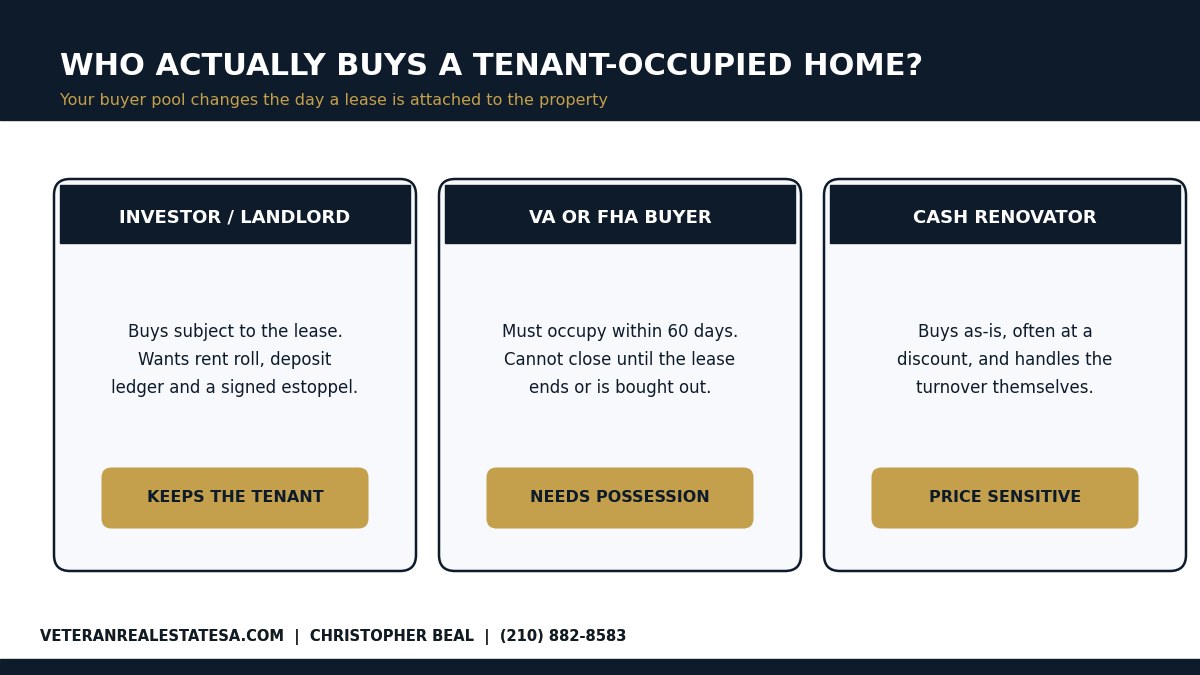
This is the most expensive fact in the entire guide. San Antonio is a military town. A large share of the owner-occupant demand around JBSA-Lackland, JBSA-Randolph, and Fort Sam Houston is VA-financed, and the VA home loan program requires the borrower to certify intent to occupy the home as a primary residence, generally within 60 days of closing. FHA carries a comparable owner-occupancy requirement.
So when you attach a lease that runs into next spring, you are not just adding a condition. You are removing the single largest, most motivated, best-financed buyer group in this market from your listing.
What is left is a real pool, just a smaller one: buy-and-hold investors who want the rent roll, small landlords expanding inside Loop 1604, and cash renovators who will price in the turnover cost. Those buyers are competent and they close. They also negotiate on yield, not on emotion, and that shows up in your net.
Should You Sell Occupied or Wait for the Lease to End?
Run it as arithmetic, not as a feeling. Waiting is not free. Every month you hold costs you principal, interest, taxes, insurance, and management, and you still have to absorb turnover once the tenant leaves: paint, carpet, cleaning, and a marketing gap.
| Factor | Sell Occupied Now | Wait for Vacancy |
|---|---|---|
| Buyer pool | Investors and cash buyers only | Full market, including VA and FHA |
| Typical pricing pressure | Priced to yield, commonly a discount | Priced to comparable sales |
| Showing access | Limited, tenant-controlled in practice | Unlimited, lockbox and open house |
| Presentation | Tenant furniture and upkeep | Full prep, paint, and staging |
| Income during marketing | Rent continues to closing | Vacancy plus turnover cost |
| Time to close | Often faster, cash-driven | Lease runway plus roughly 77 days of market time |
Source: SABOR and LERA MLS closed and active data for Bexar County single-family residential, May 27 through August 25, 2026. Carrying-cost assumptions are property specific.
There is a third option owners forget: a cash-for-keys buyout. Offering a tenant one or two months of rent plus their deposit to leave early is often cheaper than the discount an investor will demand, and it converts your listing back into a full-market, VA-eligible sale. Get any buyout in writing, signed, with a firm surrender date.
How Do You Handle Showings Without Losing the Tenant?
A hostile tenant can cost you more than a soft market can. Dishes in the sink, blinds closed, a dog barking in a crate, and a "the AC has issues" comment to the buyer will do more damage to your price than a 1 percent rate move. The fix is not legal pressure. It is a deal.
- Tell them first, in writing. Before the sign goes up. Confirm the lease survives the sale and that their term is protected.
- Set fixed showing windows. Two blocks per week beats open-ended lockbox access, and buyers will work around it.
- Give a minimum notice you actually honor. Twenty-four hours is the standard I use even when the lease allows less.
- Offer a real concession. A cleaning service before photos, a rent credit for the marketing month, or a moving allowance if they choose to leave early.
- Keep the tenant off showings. Buyers do not talk freely when the occupant is standing in the kitchen.
Photography deserves the same discipline. Shoot after the cleaning, on the tenant's schedule, and be honest in the listing that the home is tenant-occupied with photos reflecting current condition. Nothing kills an investor deal faster than photos that do not match the walkthrough.
What Happens to the Security Deposit and the Rent at Closing?
Three money items settle at the closing table. The security deposit, any prepaid rent for the closing month, and any pet or last-month deposits you are holding. Each gets credited to the buyer, and each needs a paper trail.
- Security deposit: transferred to the buyer, with written notice to the tenant identifying the new owner and where the deposit now sits.
- Prorated rent: the seller keeps rent through the closing date, the buyer receives the balance of the month.
- Deposit ledger: a written accounting of deductions already taken, damages noted at move-in, and the original move-in inspection.
- Estoppel certificate: a tenant-signed statement confirming rent amount, due date, deposit held, term end date, and that no side agreements exist.
That estoppel certificate is the single most useful document in a tenant-occupied sale. It stops the "the old owner said I could park the RV there" conversation before it becomes the buyer's problem and then, by way of a lawsuit, yours.
How Much Does a Tenant Cost You on Price in Bexar County?
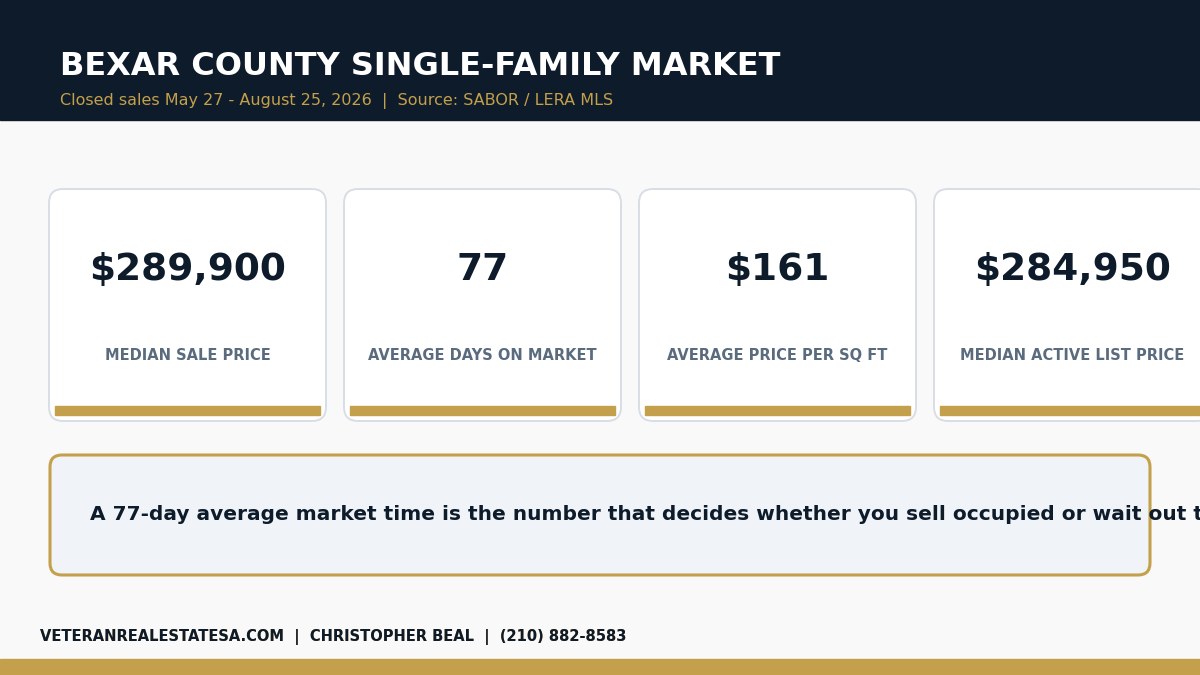
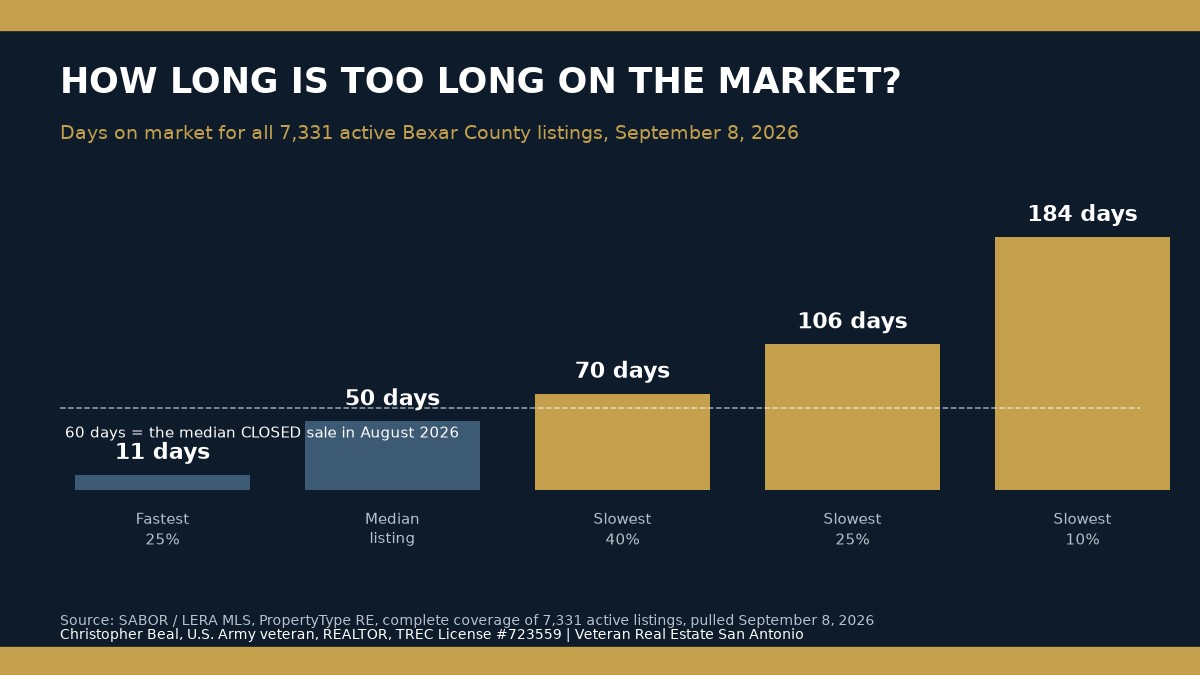
Here is the current backdrop. Between May 27 and August 25, 2026, Bexar County single-family residential closings ran a $289,900 median sale price at an average of 76.6 days on market and roughly $161 per square foot, according to SABOR and LERA MLS data. Active inventory sat at a $284,950 median list price.
That is a market where buyers have choices. When buyers have choices, a listing that comes with a stranger living in it, restricted access, and a lease the buyer did not write is competing at a disadvantage. The discount is real, and it is negotiable, but only if the rest of the package is airtight.
Three things narrow the gap more than price cuts do: a clean rent roll showing on-time payment history, a below-market rent that gives the buyer immediate upside, and a tenant who has been there long enough to look like stability rather than risk. If your tenant has paid on time for two years at $1,650 in a submarket renting at $1,850, say so in the listing. That is not fluff, that is the yield story.
If you are weighing this against simply selling vacant later, my breakdown of how long it takes to sell a house in San Antonio gives you the timeline math, and what staging actually does for a San Antonio listing covers the prep side you cannot do with a tenant in place.
What Paperwork Does a Texas Tenant-Occupied Sale Require?
Assemble the file before you list, not after you get an offer. Investors underwrite on documents. A seller who can produce a complete package in one email gets better terms than one who drips it out over ten days of option period.
- The executed lease and every amendment, addendum, and renewal
- The TREC Addendum Regarding Residential Leases, attached to the contract
- Tenant estoppel certificate, signed and dated
- Security deposit ledger and move-in condition form
- Rent roll with 12 to 24 months of payment history
- Seller's Disclosure Notice, completed by you, not by the tenant
- Property management agreement and termination terms, if applicable
- Current utility, HOA, and pest or lawn service accounts
Possession language matters too. The Texas contract handles possession as a specific term, and in a tenant-occupied sale possession transfers subject to the lease. That needs to be stated, not assumed, so the buyer cannot claim at closing that they expected an empty house.
Sellers coming off a failed listing attempt should also read my guide to relisting an expired San Antonio listing, because a tenant-occupied home that sat unsold usually failed on access and documentation, not on price.
What About Taxes, Depreciation, and the Homestead Exemption?
I am a REALTOR, not a tax advisor, and this section is orientation only. That said, these are the four items that come up in nearly every conversation, and knowing they exist before you talk to your CPA saves you a bad decision.
- Section 121 exclusion: the primary-residence capital gains exclusion generally requires living in the home 2 of the last 5 years. A former primary residence converted to a rental may still qualify if you are inside that window, which is why timing matters.
- Depreciation recapture: depreciation you took while renting is generally recaptured at sale even if you never claimed it deliberately.
- 1031 exchange: investment property may be eligible for a like-kind exchange to defer gain, but the timelines are strict and the qualified intermediary has to be in place before closing, not after.
- Homestead exemption: in Texas, a rental does not carry a homestead exemption, and the 10 percent annual appraisal cap that protects homesteads does not apply. That is often why the tax bill on your rental has climbed faster than on your own home.
For general market and policy context on Texas property, the Texas Real Estate Research Center at Texas A&M University publishes free data that is worth reading alongside your CPA's advice.
Which Path Fits Your Situation Best?
| Lifestyle Priority | Best Pick | Runner-Up | Why |
|---|---|---|---|
| Highest net proceeds | Wait for vacancy, then list | Cash-for-keys buyout | Restores the VA and FHA buyer pool that drives San Antonio pricing |
| Fastest exit | Sell occupied to an investor | Cash renovator | No turnover, no prep, and financing contingencies are often lighter |
| Least conflict with tenant | Sell occupied, lease intact | Wait for natural lease end | Nobody gets moved, and showings stay limited by agreement |
| PCS or relocation deadline | Sell occupied now | Buyout plus fast list | Orders do not wait for a lease term to expire |
| Deferring capital gains | Sell occupied into a 1031 exchange | Hold and refinance | The tenancy is an asset to the replacement-property buyer, not a defect |
Source: transaction patterns across Bexar, Comal, Kendall, Medina, and Bandera counties, 2026. Individual results depend on lease terms, condition, and submarket.
If the property is a former primary residence you kept during a PCS, the calculus is different again, and my guide to what San Antonio sellers can pay toward a VA buyer's costs matters the moment the home goes back on the retail market.
About the Author: Christopher Beal
Christopher Beal is a U.S. Army veteran and the Owner of Veteran Real Estate San Antonio, a Beal Group practice brokered by eXp Realty (TREC License #723559). A Military Relocation Professional (MRP) and VAREP member, he is a 7-time eXp Realty ICON agent, winner of Best Real Estate Agency in the 2026 Best of San Antonio Readers' Choice (San Antonio Current, 100,000+ voters), and a 3x San Antonio Business Journal Top 25 Individual Agent (#13 in 2024, #14 in 2025, #20 in 2026). His recognition also includes 3x Platinum Top 50, 2x RateMyAgent Agent of the Year, 2x Real Producers Top 100, Five Star Professional (2026), and a RealTrends 2026 ranking. He has helped 325+ families, closed more than $125M in career volume, and holds 5.0 stars across 370+ verified reviews, working almost exclusively with military and veteran buyers and sellers across Bexar, Comal, Kendall, Medina, and Bandera counties, with a focus on VA loans, PCS moves, and homebuying near JBSA-Lackland, JBSA-Randolph, and Fort Sam Houston. He handles tenant-occupied listings personally, from the estoppel certificate through the deposit transfer at closing. He can be reached at (210) 882-8583.
Frequently Asked Questions
Does selling my rental automatically end my tenant's lease in Texas?
No. The lease survives the sale. The buyer takes the property subject to the existing lease and becomes the tenant's landlord for the remainder of the term, with the same rent and the same end date.
How much notice do I have to give a tenant before showings in Texas?
Texas does not set a statewide notice-before-entry requirement for residential landlords. Your lease controls it. If the lease is silent, you need the tenant's cooperation, which is why most experienced sellers offer 24 hours of notice and fixed showing windows even when nothing requires it.
Can a VA buyer purchase my tenant-occupied home in San Antonio?
Generally not while the lease is running. VA borrowers certify intent to occupy the home as a primary residence, typically within 60 days of closing. If the lease ends before that window, a VA purchase can work with careful timing.
What is a cash-for-keys agreement and is it legal in Texas?
It is a written agreement in which you pay the tenant to surrender the property before the lease ends, usually one to two months of rent plus the full deposit. It is legal and common. Put it in writing with a firm surrender date and a release of claims.
Who is responsible for the security deposit after closing?
The deposit transfers to the buyer at closing and the new owner assumes the obligation to account for it. Document the transfer, give the tenant written notice of the new owner, and keep a copy of the ledger for your records.
Will a tenant lower my sale price in Bexar County?
Usually yes, because you lose the retail owner-occupant buyer pool. The size of the discount depends on rent relative to market, payment history, lease term remaining, and condition. A below-market rent with a long payment history narrows the gap considerably.
Can I raise the rent or start eviction while the home is listed?
You can only do what the lease and Texas law already allow. Listing the property changes nothing about your rights as landlord, and starting an eviction during a listing period is a fast way to lose both the tenant's cooperation and the buyer.
Do I have to tell buyers the home is tenant-occupied?
Yes. The lease is a material fact affecting possession and value. It belongs in the listing remarks and gets attached to the contract through the Addendum Regarding Residential Leases.
Is it better to sell to an iBuyer or a local investor?
Local investors who already own rentals in Bexar County are usually more comfortable with an occupied property than an automated offer platform, and they tend to underwrite the rent roll rather than discount for uncertainty. Compare net proceeds, not headline offers.
What if my tenant refuses all showings?
You have three practical options: negotiate a concession, market the property to investors using documentation and exterior photos with a single walkthrough at option period, or wait for the lease to end. Enforcement through the courts costs more time than the sale is usually worth.
Three Ways to Start Today
Pull the lease and mark the end date. That single date decides whether you are running an investor sale or a retail sale, and everything else follows from it.
Request a free home evaluation and get both numbers. I will price the property occupied and vacant so you can see the actual spread before you commit to a path. Start at veteranrealestatesa.com/home-evaluation.
Call me and talk through the tenant conversation before you have it. How you open that conversation determines how the next 77 days go. Reach me at (210) 882-8583.
Explore More Resources
This article is general information for San Antonio property owners and is not legal, tax, or financial advice. Lease rights, deposit handling, and tax treatment vary by situation. Consult a Texas attorney and a CPA before acting.
Christopher Beal, U.S. Army veteran, REALTOR, TREC License #723559, Owner of Veteran Real Estate San Antonio: The Beal Group, brokered by eXp Realty. (210) 882-8583.
Watch: Selling a Rental With Tenants in San Antonio
Here is how I handle a tenant-occupied listing in San Antonio, from lease timing to what the buyer pool actually looks like.
Categories
- All Blogs (355)
- Alamo Heights (4)
- awards (4)
- Best Neighborhoods in San Antonio (13)
- Buyer (16)
- Buyer Education (86)
- Community Events (4)
- Hill Country (17)
- JBSA (44)
- Local Guide (6)
- Luxury (28)
- Luxury Real Estate (26)
- Market Trends (19)
- Market Update (14)
- Military Relocation (112)
- Military Retirement (3)
- Mortgage (19)
- Neighborhood Guides (19)
- neighborhoods (5)
- New Construction (16)
- PCS (42)
- Real Estate (40)
- reviews (3)
- San Antonio (53)
- San Antonio Lifestyle (4)
- San Antonio Market (5)
- San Antonio Neighborhoods (44)
- San Antonio Real Estate (100)
- San Antonio, Veterans Resources, VA Loans (5)
- Seller (55)
- VA Home Loans (30)
- VA Loans (35)
- Va Loans & Financing (27)
- Veterans (10)
- Veterans Resources (40)
Recent Posts