VA Loan Seller Concessions in San Antonio 2026: What Sellers Can and Cannot Pay
LAST UPDATED: JUNE 19, 2026 | BY CHRISTOPHER BEAL, U.S. ARMY VETERAN & REALTOR
VA Loan Seller Concessions in San Antonio 2026: What Sellers Can and Cannot Pay
Key Takeaways
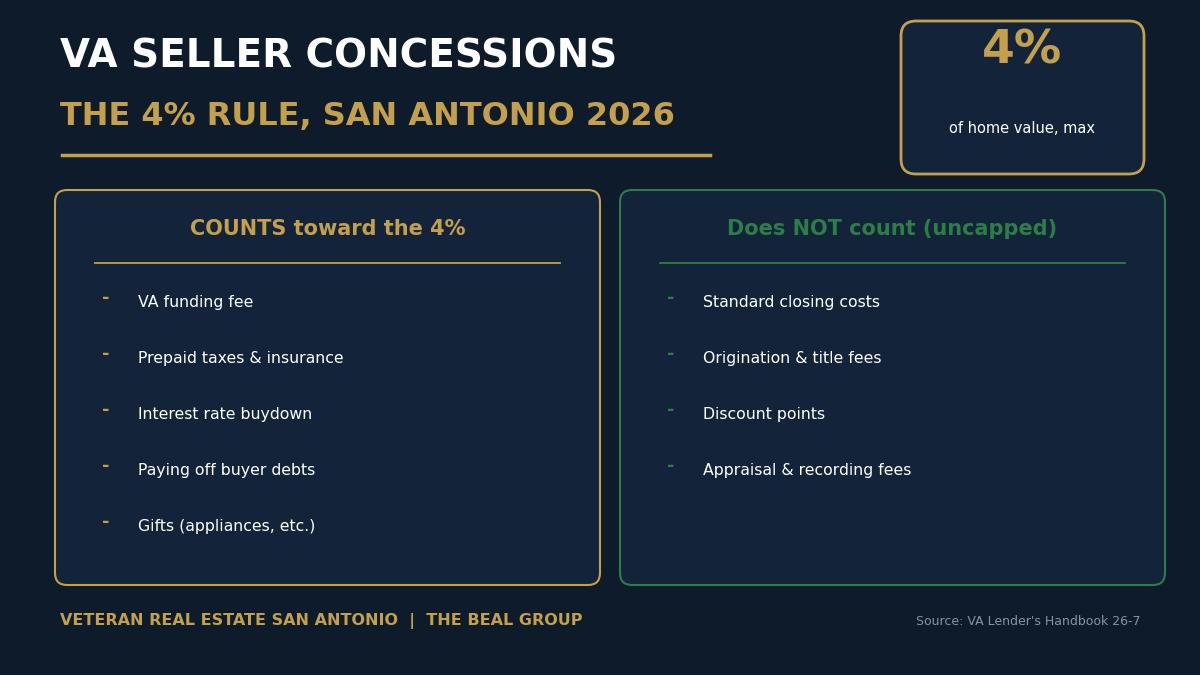
- VA seller concessions are capped at 4 percent of the home's established reasonable value, and that 4 percent covers specific extras like the VA funding fee, prepaid taxes and insurance, and rate buydowns.
- The most important nuance: a seller paying your normal closing costs and discount points does NOT count against the 4 percent cap, so total seller help can far exceed 4 percent.
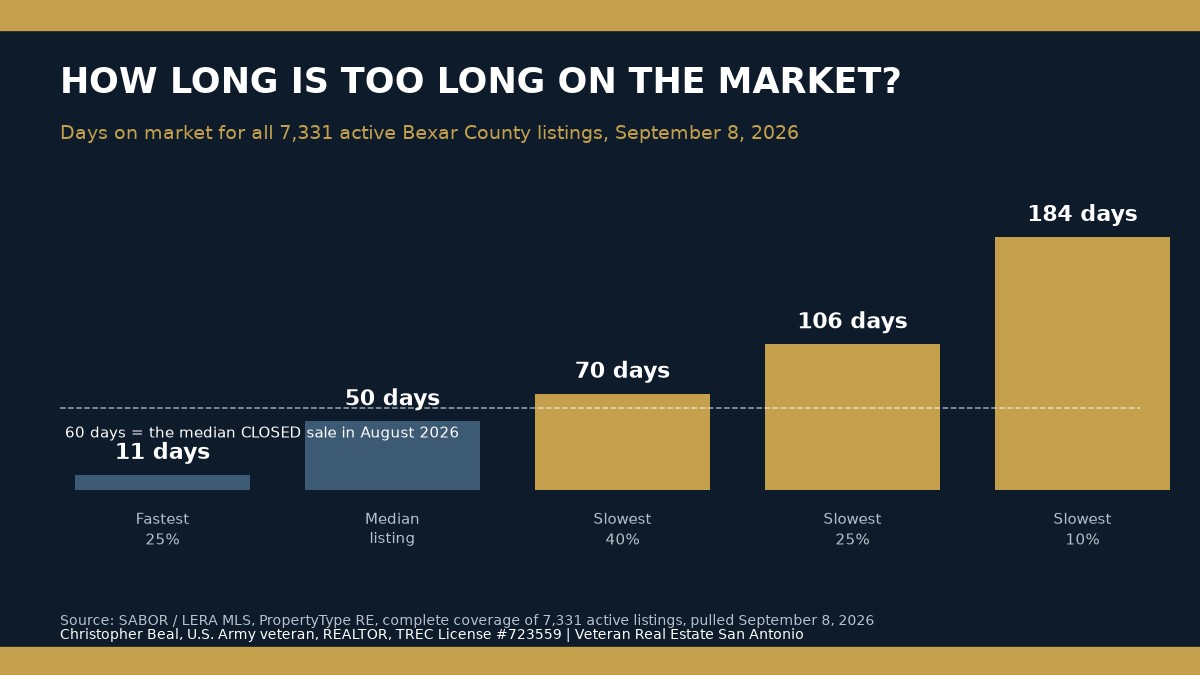
- In a balanced San Antonio market with homes averaging about 72 days on market in mid-2026, asking for seller concessions is realistic and common.
- Concessions can wipe out the VA funding fee, prepay your escrow account, and buy down your interest rate, often saving a buyer thousands at closing.
- How you structure the offer matters more than the headline price; an experienced veteran-focused agent negotiates concessions without scaring off the seller.
In This Guide
- What Is a Seller Concession on a VA Loan?
- How Does the 4 Percent VA Concession Limit Work?
- What Counts Toward the 4 Percent and What Does Not?
- How Much Can a Seller Really Pay on My VA Purchase?
- Can I Get Concessions in Today's San Antonio Market?
- How Do I Negotiate Concessions Without Losing the House?
- About the Author
- Frequently Asked Questions
What Is a Seller Concession on a VA Loan?
The VA draws a specific line between two kinds of seller help. The first kind is the ordinary closing costs a seller is allowed to pay on the buyer's behalf, which the VA treats as customary and does not limit. The second kind is a true concession, defined by the VA Lender's Handbook as anything of value added to the transaction by the seller for which the buyer pays nothing additional and that the seller is not normally expected to pay. Those concessions, and only those, are capped at 4 percent of the home's established reasonable value.
This distinction is the single most misunderstood rule in VA financing, and getting it wrong costs veterans money. Many buyers assume the seller can only ever contribute 4 percent total. In reality, the 4 percent ceiling applies only to the concession bucket; a cooperative seller can pay your standard closing costs and discount points on top of that, with no 4 percent restriction on the closing-cost portion at all.
For a full breakdown of which fees fall into the everyday closing-cost bucket, see our companion guide on VA loan closing costs in San Antonio. This article focuses on the concession bucket and the 4 percent rule that governs it.
How Does the 4 Percent VA Concession Limit Work?
Four percent of the value is a meaningful amount of money. On a $300,000 purchase, that is up to $12,000 in concessions; on a $450,000 home, up to $18,000. The percentage is based on the VA's established reasonable value of the property, which in most cases is the appraised value. The seller and buyer agree to the concession in the purchase contract, and the lender confirms it stays within the 4 percent ceiling.
Importantly, the 4 percent cap is a ceiling, not a target. You do not have to use all of it, and a seller is never required to give any concession. It simply defines the maximum the VA will allow in the concession category, protecting both the program and the buyer from inflated, unsustainable deals.
What Counts Toward the 4 Percent and What Does Not?
Knowing which side of the line each item falls on changes your whole negotiating strategy. Here is how the VA classifies the most common forms of seller help:
| Seller Pays For | Counts Toward 4% Concession Cap? |
|---|---|
| VA funding fee | Yes, counts toward the 4 percent |
| Prepaid property taxes and homeowners insurance (escrow) | Yes, counts toward the 4 percent |
| Temporary or permanent interest rate buydown | Yes, counts toward the 4 percent |
| Paying off a buyer's credit balances or judgments | Yes, counts toward the 4 percent |
| Gifts such as appliances or a TV | Yes, counts toward the 4 percent |
| Buyer's standard closing costs (origination, title, recording, appraisal) | No, treated as customary and not capped |
| Discount points to lower the rate | No, not counted as a concession |
Source: VA Lender's Handbook (VA Pamphlet 26-7), seller concession rules. Always confirm specifics with your VA-approved lender.
The practical takeaway is powerful. Because standard closing costs and discount points sit outside the cap, a motivated seller can pay your closing costs in full and still add up to 4 percent in concessions for your funding fee, escrows, and a buydown. Stacked correctly, that can mean walking into a home with very little out of pocket.
How Much Can a Seller Really Pay on My VA Purchase?
Let us put real numbers on a typical San Antonio VA purchase. Imagine a $350,000 home bought by a first-use veteran with a 2.15 percent VA funding fee. The combined seller help could look like this, all within VA rules:
- Closing costs (not capped): the seller agrees to pay roughly $7,000 to $9,000 in origination, title, recording, and appraisal fees.
- Funding fee (counts toward 4 percent): the 2.15 percent fee of about $7,500 is paid by the seller as a concession.
- Escrow setup (counts toward 4 percent): several months of property taxes and insurance prepaid into your escrow account.
- Rate buydown (counts toward 4 percent): remaining concession room funds a temporary buydown that lowers your payment in the early years.
The funding fee, escrow, and buydown together must stay at or under 4 percent of value, which is $14,000 on this home. The closing costs are separate. Add it together and a cooperative seller could contribute north of $20,000 toward getting you into the home, dramatically reducing your cash to close.
Can I Get Concessions in Today's San Antonio Market?
Market conditions decide how much leverage you have. As of mid-June 2026, homes in Bexar County were averaging roughly 72 days on market with a median sale price near $325,000 and a list-to-sale ratio around 98 percent (Source: SABOR / LERA MLS). That is a far more balanced market than the frenzied seller's market of a few years ago, when concessions were nearly impossible to get. Longer days on market mean sellers are competing for qualified buyers, and a clean, well-qualified VA offer that asks for concessions is attractive rather than off-putting.
New construction is an even stronger arena for concessions. Many San Antonio builders are actively offering rate buydowns and closing cost credits to move inventory, which pairs naturally with VA concession rules. Our guide to builder incentives in San Antonio explains how to stack those builder offers with your VA benefit.
How Do I Negotiate Concessions Without Losing the House?
The art is in the framing, not just the ask. Sellers care about their net proceeds and the certainty of closing. A buyer who lowballs and then demands concessions usually loses; a buyer who offers a fair price and structures concessions thoughtfully often wins. A common winning move is to offer slightly above the seller's bottom line and request that the difference come back as concessions, which can be a wash for the seller while saving you real cash at closing.
This is exactly where a veteran-focused agent earns their keep. Knowing how appraisals interact with concessions, how to keep the request within the 4 percent cap, and how to present it to a listing agent are the difference between a clean close and a dead deal. Before you write an offer, it pays to know your numbers. Request a free buyer consultation and we will map out a concession strategy specific to your price point and the property.
About the Author: Christopher Beal
Christopher Beal is a U.S. Army veteran and the Owner of Veteran Real Estate San Antonio, a Beal Group practice brokered by eXp Realty (TREC License #723559). A Military Relocation Professional (MRP) and VAREP member, he is a 7-time eXp Realty ICON agent, winner of Best Real Estate Agency in the 2026 Best of San Antonio Readers' Choice (San Antonio Current, 100,000+ voters), and a 3x San Antonio Business Journal Top 25 Individual Agent (#13 in 2024, #14 in 2025, #20 in 2026). His recognition also includes 3x Platinum Top 50, 2x RateMyAgent Agent of the Year, 2x Real Producers Top 100, Five Star Professional (2026), and a RealTrends 2026 ranking. He has helped 325+ families, closed more than $125M in career volume, and holds 5.0 stars across 370+ verified reviews, working almost exclusively with military and veteran buyers and sellers across Bexar, Comal, Kendall, Medina, and Bandera counties, with a focus on VA loans, PCS moves, and homebuying near JBSA-Lackland, JBSA-Randolph, and Fort Sam Houston. If you have questions about using your VA loan benefit in San Antonio, he offers a no-pressure strategy call before you talk to any lender. He can be reached at (210) 882-8583.
Explore More Resources
- VA Home Loans in San Antonio
- Military Relocation and PCS Services
- Free Home Evaluation
- The Serve and Save Program
- Client Reviews
- About Christopher Beal
For official guidance, see the U.S. Department of Veterans Affairs home loan program, the VA Lender's Handbook (Pamphlet 26-7), and the Consumer Financial Protection Bureau homebuyer resources.
Frequently Asked Questions
What is the maximum seller concession on a VA loan?
VA seller concessions are capped at 4 percent of the home's established reasonable value, which is usually the appraised value. On a $350,000 home that is up to $14,000. This cap applies only to true concessions like the funding fee, escrows, rate buydowns, gifts, and debt payoffs.
Do closing costs count toward the 4 percent VA concession limit?
No. A seller paying your customary closing costs and discount points is not counted as a concession, so it does not reduce your 4 percent. That means total seller help can substantially exceed 4 percent when closing costs and concessions are combined.
Can the seller pay my VA funding fee?
Yes. The seller can pay your VA funding fee, but it counts toward the 4 percent concession cap. On a first-use loan with a 2.15 percent funding fee, that is a significant but worthwhile use of concession room.
Can a seller pay for a VA interest rate buydown?
Yes. A temporary or permanent rate buydown funded by the seller is allowed and counts toward the 4 percent concession cap. Buydowns can meaningfully lower your monthly payment, especially in the first years of the loan.
How much can a seller contribute in total on my VA purchase?
A seller can pay all of your customary closing costs, which are uncapped, plus up to 4 percent of value in concessions. On a $350,000 home, combined seller help can exceed $20,000 when structured correctly.
Are sellers in San Antonio offering concessions in 2026?
Yes. With Bexar County homes averaging about 72 days on market in mid-2026 and a balanced market overall, sellers are more receptive to concessions than during the recent seller's market. New-construction builders are especially active with buydowns and credits.
Does the Serve and Save program stack with seller concessions?
Yes. The Serve and Save closing cost credit is separate from seller concessions, so veteran clients can combine a seller's concessions with our credit to reduce out-of-pocket cost even further. We map both into your offer strategy.
Will asking for concessions hurt my offer?
Not when it is framed well. A fair price paired with a thoughtful concession request often nets the seller a result they like while saving you cash at closing. The key is how an experienced agent structures and presents the offer.
Planning a PCS to JBSA and buying with your VA benefit? Christopher Beal specializes in military relocation. Learn more about our relocation services or call (210) 882-8583 today.
Veteran Real Estate San Antonio: The Beal Group at eXp Realty. U.S. Army veteran owned. Serving Bexar, Comal, Kendall, Medina, and Bandera counties.
Categories
- All Blogs (354)
- Alamo Heights (4)
- awards (4)
- Best Neighborhoods in San Antonio (13)
- Buyer (16)
- Buyer Education (86)
- Community Events (4)
- Hill Country (17)
- JBSA (43)
- Local Guide (6)
- Luxury (28)
- Luxury Real Estate (26)
- Market Trends (19)
- Market Update (14)
- Military Relocation (111)
- Military Retirement (3)
- Mortgage (19)
- Neighborhood Guides (18)
- neighborhoods (5)
- New Construction (16)
- PCS (42)
- Real Estate (40)
- reviews (3)
- San Antonio (53)
- San Antonio Lifestyle (4)
- San Antonio Market (5)
- San Antonio Neighborhoods (43)
- San Antonio Real Estate (100)
- San Antonio, Veterans Resources, VA Loans (5)
- Seller (55)
- VA Home Loans (30)
- VA Loans (35)
- Va Loans & Financing (27)
- Veterans (10)
- Veterans Resources (40)
Recent Posts