How to Sell a Rental or Investment Property in San Antonio in 2026
LAST UPDATED: JUNE 23, 2026 | BY CHRISTOPHER BEAL, U.S. ARMY VETERAN & REALTOR
How to Sell a Rental or Investment Property in San Antonio in 2026: A Veteran Investor's Exit Guide
Key Takeaways
- Selling a rental is different from selling a home you live in: you face capital gains tax, depreciation recapture, tenant rights, and a real choice between cashing out, exchanging, or holding.
- A 1031 exchange can defer both capital gains and depreciation recapture if you reinvest in another investment property within strict IRS deadlines of 45 and 180 days.
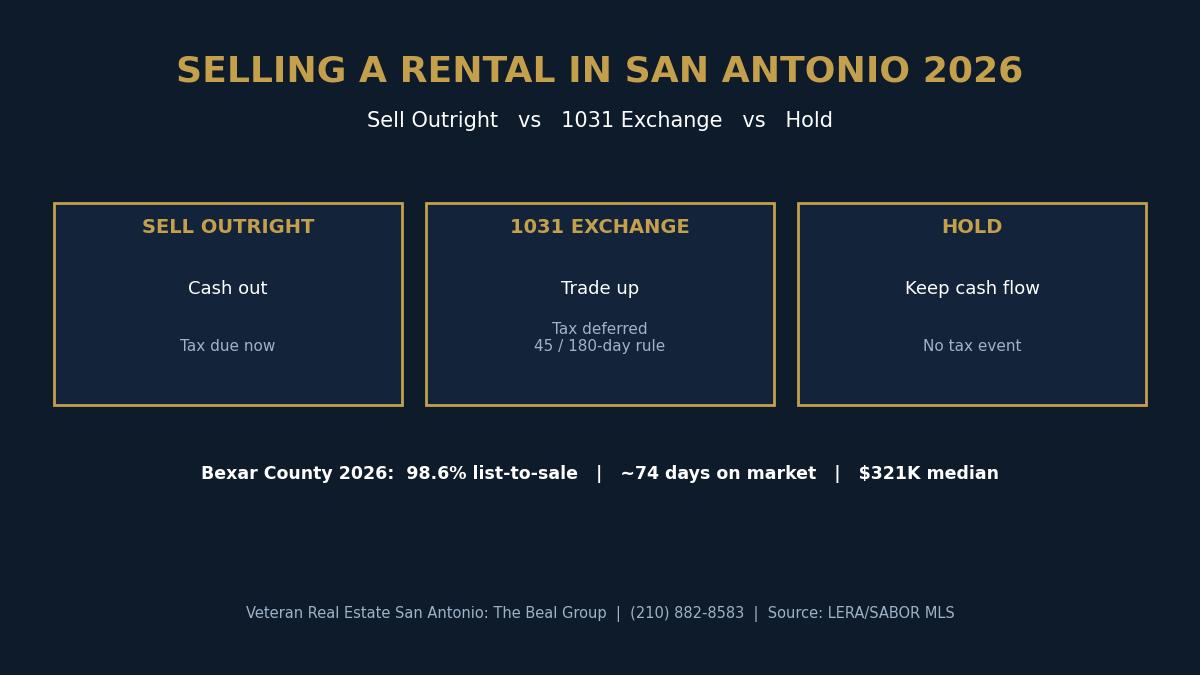
- San Antonio remains a seller-friendly backdrop in 2026: Bexar County homes closed at 98.6 percent of list price in roughly 74 days, giving investors a clean exit window.
- Selling vacant usually nets more than selling tenant-occupied, but Texas lease and notice rules mean timing the tenant transition correctly is essential.
- Veteran investors who used a VA loan to acquire the property have specific entitlement and occupancy considerations worth reviewing before they sell.
In This Guide
- Should You Sell, Exchange, or Keep Your Rental?
- What Taxes Apply When You Sell a Rental Property?
- How Does a 1031 Exchange Work in Texas?
- Can You Sell a Rental With Tenants Still in It?
- Is It Better to Sell Vacant or Occupied?
- What If You Bought the Rental With a VA Loan?
- What Is the Step-by-Step Process to Sell?
- Frequently Asked Questions
Should You Sell, Exchange, or Keep Your Rental?
The decision starts with your goal, not the market. A San Antonio investor selling a rental in 2026 usually falls into one of three camps: cashing out for a major life expense or retirement, trading up into a larger or better-located asset, or simply tired of being a landlord. Each goal points to a different path, and the tax consequences vary widely.
The numbers favor a clean exit right now. Across Bexar County in the spring of 2026, homes sold at 98.6 percent of list price in an average of about 74 days, according to LERA/SABOR MLS data, with a county median around $321,000. That is a steady, balanced market that rewards a well-prepared listing without the frenzy or the freefall that makes timing difficult.
Holding still has merit for strong cash flow. If your rental carries a low fixed interest rate, covers its costs comfortably, and sits in an appreciating corridor near Joint Base San Antonio, keeping it may beat selling. The point is to make the decision deliberately, with the tax math and the market both in front of you. Our guide to financing a second rental property covers the buy side if you are scaling rather than exiting.
What Taxes Apply When You Sell a Rental Property?
Capital gains hit your profit. Unlike a primary residence, a rental property does not qualify for the home-sale exclusion unless you previously lived in it and meet specific tests. Your gain is generally the sale price minus your adjusted basis, and long-term gains are taxed at federal rates that commonly fall at 15 or 20 percent depending on income.
Depreciation recapture is the surprise. Every year you owned the rental, you likely deducted depreciation. When you sell, the IRS recaptures that benefit, taxing the depreciation you claimed at a rate up to 25 percent. Many first-time rental sellers forget this and are caught off guard at tax time.
Always confirm with a tax professional. I am a REALTOR, not a CPA or tax advisor, and the exact numbers depend on your basis, income, and holding period. Before you list, sit down with a qualified tax professional. The official starting point is the IRS guidance on like-kind exchanges and investment property.
How Does a 1031 Exchange Work in Texas?
The exchange is a deferral, not a discount. Section 1031 of the tax code allows an investor to swap one investment property for another of like kind and defer the tax that would otherwise be due. It is one of the most powerful tools for building a real estate portfolio because your full equity keeps working instead of a chunk going to taxes.
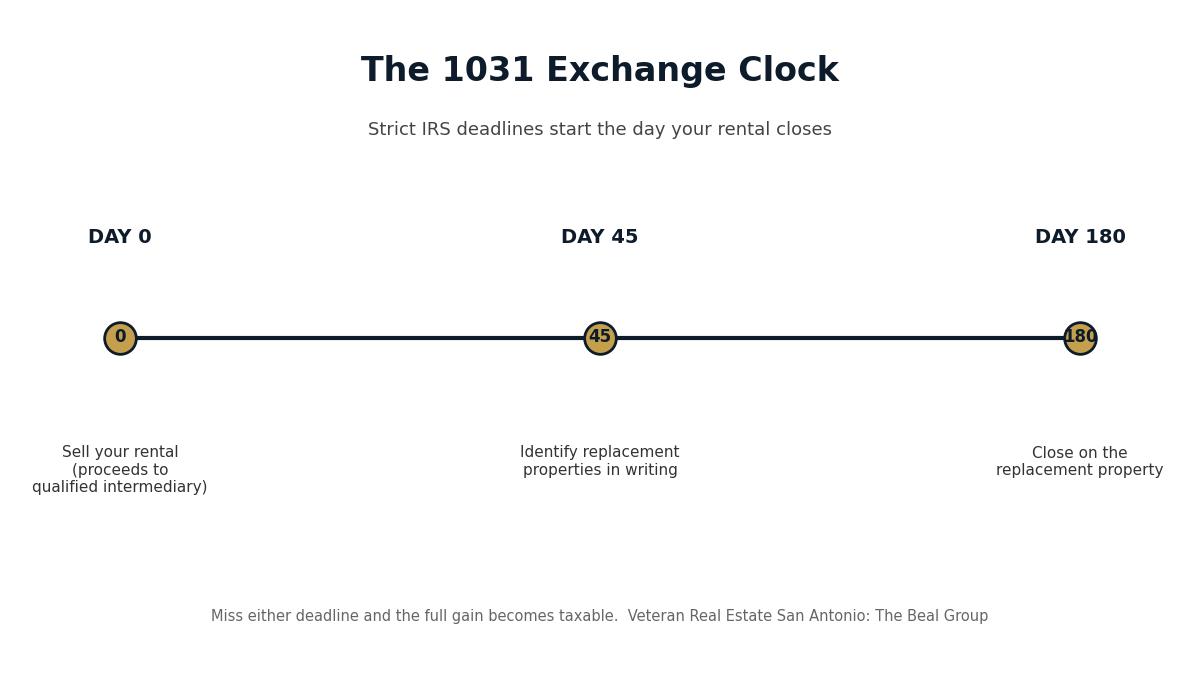
The deadlines are strict and unforgiving. Once your rental closes, the clock starts. You have 45 calendar days to identify potential replacement properties in writing and 180 calendar days to close on the new property. Miss either deadline and the exchange fails, making the entire gain taxable. A qualified intermediary must hold the proceeds; you cannot touch the money yourself.
| Path | Tax Now? | Best For | Key Catch |
|---|---|---|---|
| Sell outright | Yes | Cashing out, exiting landlording | Capital gains plus depreciation recapture |
| 1031 exchange | Deferred | Trading up, staying invested | 45-day and 180-day deadlines, intermediary required |
| Hold | No | Strong cash flow, low rate | Ongoing management, market risk |
Source: IRS Section 1031 rules summarized for general information; confirm specifics with a qualified tax professional. Market context: LERA/SABOR MLS, Bexar County, spring 2026.
If your goal is to defer tax and keep growing, pairing a sale with a 1031 into a property near a growth corridor can be powerful. See our breakdown of the Camp Bullis and northwest San Antonio rental corridor for replacement-property ideas.
Can You Sell a Rental With Tenants Still in It?
The lease runs with the land. In Texas, if your tenant has a fixed-term lease, selling the property does not end that lease. The buyer steps into your shoes as landlord and must honor the remaining term. This narrows your buyer pool to investors unless the lease is close to expiring.
Month-to-month gives you options. If the tenancy is month-to-month, you can typically provide the required written notice to end it before closing, which opens the door to owner-occupant buyers. Always follow the lease terms and Texas notice requirements precisely, and keep the tenant informed and respected throughout. The Texas State Law Library publishes a helpful overview of Texas landlord and tenant law.
Cooperation pays. A tenant who feels blindsided can make showings difficult. Offering reasonable notice, flexible showing windows, and sometimes a small incentive for cooperation protects your sale and your timeline. For service members who became landlords unexpectedly, our guide to the accidental landlord after a PCS walks through the transition.
Is It Better to Sell Vacant or Occupied?
Vacant widens your audience. A vacant, clean, well-presented home appeals to owner-occupants, who typically pay more than investors because they are buying a place to live, not a spreadsheet. Vacant homes also show better, photograph cleanly, and allow flexible access for showings and inspections.
Occupied preserves income and suits investors. Keeping a paying tenant in place means you collect rent until closing and can market the property as turnkey to another investor. A stabilized property with a documented rent roll can be a genuine selling point to the right buyer.
What If You Bought the Rental With a VA Loan?
Many San Antonio rentals started as VA-financed homes. A common path is a service member who bought a home with a VA loan, then converted it to a rental after a PCS. When you sell, the VA loan is paid off at closing just like a conventional mortgage, and the sale itself follows the standard process.
Restoring entitlement matters for your next move. If you want to use your VA benefit again, paying off the VA loan through the sale lets you apply for a one-time restoration of full entitlement. That can be important if you plan to buy your next primary residence with a VA loan. The authoritative source is the VA home loan program at VA.gov, and our VA home loans page explains how it works locally.
If you served, our Serve and Save program reduces closing costs on your sale or next purchase, returning 1 percent per year of service up to a 6 percent maximum credit at closing.
What Is the Step-by-Step Process to Sell?
- Define your goal and tax strategy. Meet with a CPA to model capital gains, depreciation recapture, and whether a 1031 exchange fits.
- Get a current market valuation. Know what the property will net today, not what you paid or what Zillow estimates.
- Resolve the tenant situation. Review the lease, decide vacant versus occupied, and provide any required notice correctly.
- Prepare the property. Handle deferred maintenance, deep cleaning, and light staging or repairs that pay for themselves.
- List with the right marketing. Target owner-occupants or investors depending on your strategy, with accurate financials for investor buyers.
- Coordinate closing. If exchanging, your qualified intermediary must be in place before closing; never take receipt of the funds yourself.
Ready to map your exit? Start with a free home evaluation and we will build the plan around your goal.
About the Author: Christopher Beal
Christopher Beal is a U.S. Army veteran and the Owner of Veteran Real Estate San Antonio, a Beal Group practice brokered by eXp Realty (TREC License #723559). A Military Relocation Professional (MRP) and VAREP member, he is a 7-time eXp Realty ICON agent, winner of Best Real Estate Agency in the 2026 Best of San Antonio Readers' Choice (San Antonio Current, 100,000+ voters), and a 3x San Antonio Business Journal Top 25 Individual Agent (#13 in 2024, #14 in 2025, #20 in 2026). His recognition also includes 3x Platinum Top 50, 2x RateMyAgent Agent of the Year, 2x Real Producers Top 100, Five Star Professional (2026), and a RealTrends 2026 ranking. He has helped 325+ families, closed more than $125M in career volume, and holds 5.0 stars across 370+ verified reviews, working almost exclusively with military and veteran buyers and sellers across Bexar, Comal, Kendall, Medina, and Bandera counties, with a focus on VA loans, PCS moves, and homebuying near JBSA-Lackland, JBSA-Randolph, and Fort Sam Houston. If you want a read on what the San Antonio market means for your specific situation, he answers with data, not scripts. He can be reached at (210) 882-8583.
Frequently Asked Questions
Do I pay capital gains tax when I sell a rental in San Antonio?
Usually yes. A rental does not qualify for the primary-residence exclusion unless you lived in it and meet specific tests. Your gain is the sale price minus your adjusted basis, taxed at federal long-term rates, commonly 15 or 20 percent. Texas has no state income tax, so there is no state-level capital gains tax. Confirm your numbers with a CPA.
What is depreciation recapture?
It is the tax on the depreciation deductions you claimed while owning the rental. When you sell, the IRS recaptures that benefit at a rate up to 25 percent. Many first-time sellers overlook it, so factor it into your net-proceeds estimate before listing.
How long do I have to complete a 1031 exchange?
You have 45 calendar days after closing your sale to identify replacement properties in writing and 180 calendar days to close on the new property. A qualified intermediary must hold the proceeds. Missing either deadline makes the full gain taxable.
Can I sell my rental if my tenant has a lease?
Yes, but in Texas a fixed-term lease transfers to the new owner, who must honor it. That typically limits your buyers to investors until the lease is near its end. A month-to-month tenancy gives you more flexibility with proper written notice.
Will I net more selling vacant or with a tenant in place?
Vacant sales usually attract owner-occupants and a higher price because the home shows better and appeals to people buying a place to live. Selling occupied preserves rental income and suits investor buyers who want a turnkey tenant. The best choice depends on your target buyer.
What happens to my VA loan when I sell the rental?
The VA loan is paid off at closing like any mortgage. Once paid off, you can apply to restore your VA entitlement, which frees your benefit for a future primary-residence purchase. See VA.gov for the official entitlement-restoration process.
Is 2026 a good time to sell a rental in San Antonio?
It is a steady, balanced market. In spring 2026, Bexar County homes sold at about 98.6 percent of list price in roughly 74 days at a median near $321,000, per LERA/SABOR MLS data. That gives a well-prepared rental a clean exit window without the volatility of a boom or a slump.
Should I use a real estate agent or sell the rental myself?
An investor-aware agent helps you price correctly, market to the right buyer pool, handle tenant logistics, and coordinate a 1031 closing on deadline. For most owners the net result after a smoother, better-marketed sale outweighs the commission, especially when tax timing is involved.
Explore More Resources
- VA Home Loans in San Antonio
- Military Relocation Services
- Free Home Evaluation
- Serve and Save Program
- Client Reviews
- <a href="https://veteranrealestatesa.com
Watch: Selling a Rental Property in San Antonio -- the 60-Second Version
The military 10-year suspension on the capital gains exclusion, the $250K/$500K rule, and the 1031 exchange deadlines -- covered in under a minute. If you own a rental in San Antonio and are weighing a sale, this is the short version of everything above.
Categories
- All Blogs (354)
- Alamo Heights (4)
- awards (4)
- Best Neighborhoods in San Antonio (13)
- Buyer (16)
- Buyer Education (86)
- Community Events (4)
- Hill Country (17)
- JBSA (43)
- Local Guide (6)
- Luxury (28)
- Luxury Real Estate (26)
- Market Trends (19)
- Market Update (14)
- Military Relocation (111)
- Military Retirement (3)
- Mortgage (19)
- Neighborhood Guides (18)
- neighborhoods (5)
- New Construction (16)
- PCS (42)
- Real Estate (40)
- reviews (3)
- San Antonio (53)
- San Antonio Lifestyle (4)
- San Antonio Market (5)
- San Antonio Neighborhoods (43)
- San Antonio Real Estate (100)
- San Antonio, Veterans Resources, VA Loans (5)
- Seller (55)
- VA Home Loans (30)
- VA Loans (35)
- Va Loans & Financing (27)
- Veterans (10)
- Veterans Resources (40)
Recent Posts