VA IRRRL Streamline Refinance in San Antonio (2026): When Veterans Should Refinance and When to Wait
LAST UPDATED: JULY 17, 2026 | BY CHRISTOPHER BEAL, U.S. ARMY VETERAN & REALTOR
VA IRRRL Streamline Refinance in San Antonio (2026): When Veterans Should Refinance and When to Wait
Key Takeaways
- The VA IRRRL (Interest Rate Reduction Refinance Loan) lets you replace your current VA loan with a lower-rate VA loan - typically with no appraisal, no income re-underwriting, and a funding fee of just 0.5 percent.
- You qualify after 210 days from your first payment due date plus 6 payments made, the new rate generally must drop at least 0.5 percent, and your costs must recoup within 36 months. Those rules exist to protect you from churning.
- A $300K loan from the late-2023 rate peak refinanced from 7.25 to 6.25 percent saves about $199 a month and recoups typical rolled-in costs in roughly two years.
- You do NOT have to still live in the home - prior occupancy counts. JBSA families who PCSd away and kept their San Antonio home as a rental can still IRRRL it.
- Veterans receiving VA disability compensation pay no funding fee at all on an IRRRL.
In This Guide
What Is a VA IRRRL and Why Does It Exist?
The IRRRL is the reason buying with a VA loan at a high rate is less risky than it looks. Every veteran who bought a San Antonio home during the 2023-2025 rate run-up is holding a built-in do-over: when rates fall meaningfully below your note rate, the VA lets you streamline down to the new rate without re-proving your income, your credit depth, or your home's value. The program exists because the VA wants veterans in sustainable payments, not trapped in the rate they happened to close in.
I bring this up in nearly every buyer consultation I run, because it changes the rent-versus-buy math: you marry the house, not the rate. My JBSA rent-or-buy guide covers that decision in full - this guide covers what happens two years later when rates drop and your phone starts ringing with refinance offers, some honest and some not.
Who Qualifies for a VA IRRRL in 2026?
The eligibility list is short by design - this is the VA's low-friction product. The seasoning rule means the earliest most borrowers can streamline is about seven to eight months into the loan. Lenders will look at your recent mortgage payment history, and many apply their own overlays, but the VA itself does not require a new appraisal or a full income re-underwrite on a standard IRRRL - a sharp contrast to the residual-income scrutiny of a purchase file, which I break down in my VA residual income guide.
The occupancy rule surprises people most: you only certify that you previously occupied the home. That single word makes the IRRRL available to every JBSA family that bought near Lackland, Randolph, or Fort Sam Houston, PCSd away, and kept the house as a rental. More on that strategy below, because almost nobody markets it to you.
What Does an IRRRL Cost in 2026?
Cheap to do, but never free - so count every dollar. On a $300,000 balance the funding fee is $1,500, and total rolled-in costs commonly land in the $3,000 to $6,000 range depending on lender fees, title charges, and whether you buy discount points (the VA allows up to two points to be included). Every rolled-in dollar is a dollar of new balance, which is exactly why the recoupment rule in the next section exists.
If you receive VA disability compensation, the funding fee disappears entirely - the same exemption that applies on purchases, which I cover in my funding fee guide. Verify current fee tables yourself on the VA's official funding fee page.
What Is the Net Tangible Benefit Rule and Why Should You Love It?
This rule is your churn shield. After every rate dip, veteran homeowners get carpet-bombed with refinance mailers, some engineered to generate lender fees rather than borrower savings. The net tangible benefit test forces the math into the open: a real IRRRL shows you the rate drop, the monthly savings, the total costs, and a recoupment period under three years, in writing, on the loan comparison disclosure.
Serial refinancing also resets your amortization clock each time, which quietly shifts your early payments back toward interest. Once per meaningful rate move is strategy; every nine months is churn.
When Does an IRRRL Make Sense for San Antonio Veterans in 2026?
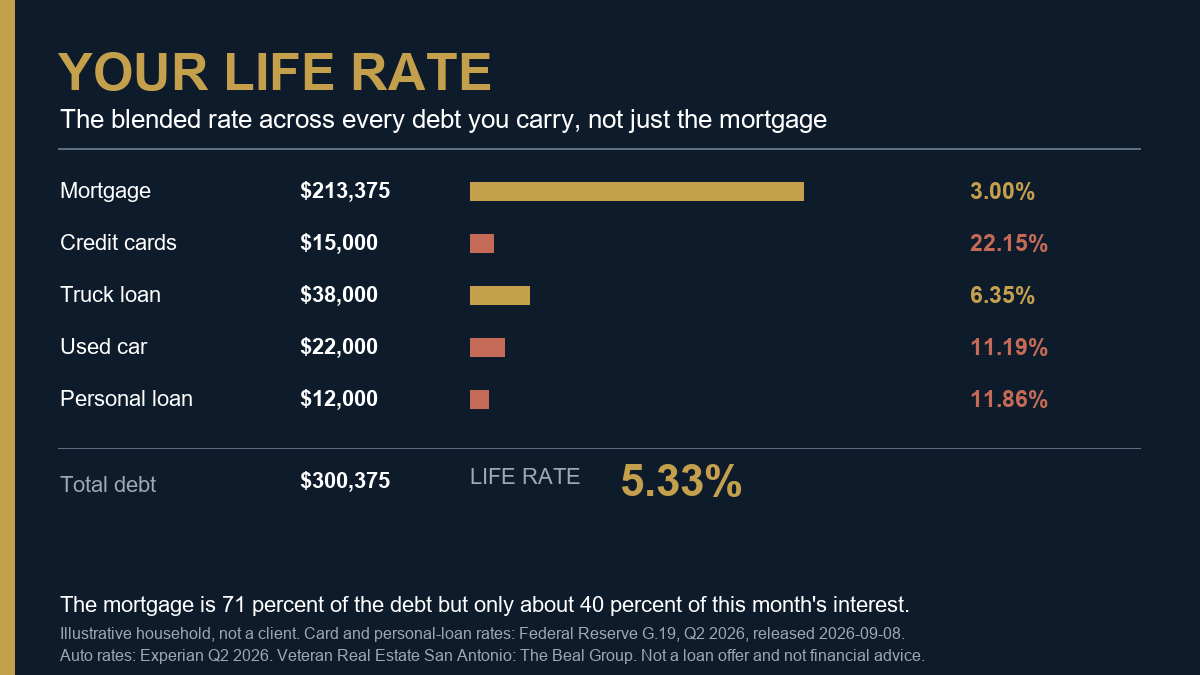
Run one honest example and the decision usually makes itself. Take a $300,000 balance from a late-2023 purchase at 7.25 percent: principal and interest run about $2,046. Streamline to an illustrative 6.25 percent and the payment drops to roughly $1,847 - $199 a month back. Roll in $4,500 of total costs and the recoupment period is about 23 months, comfortably inside the 36-month rule. Hold the home five years past that point and the refinance banks you over $7,000 after costs.
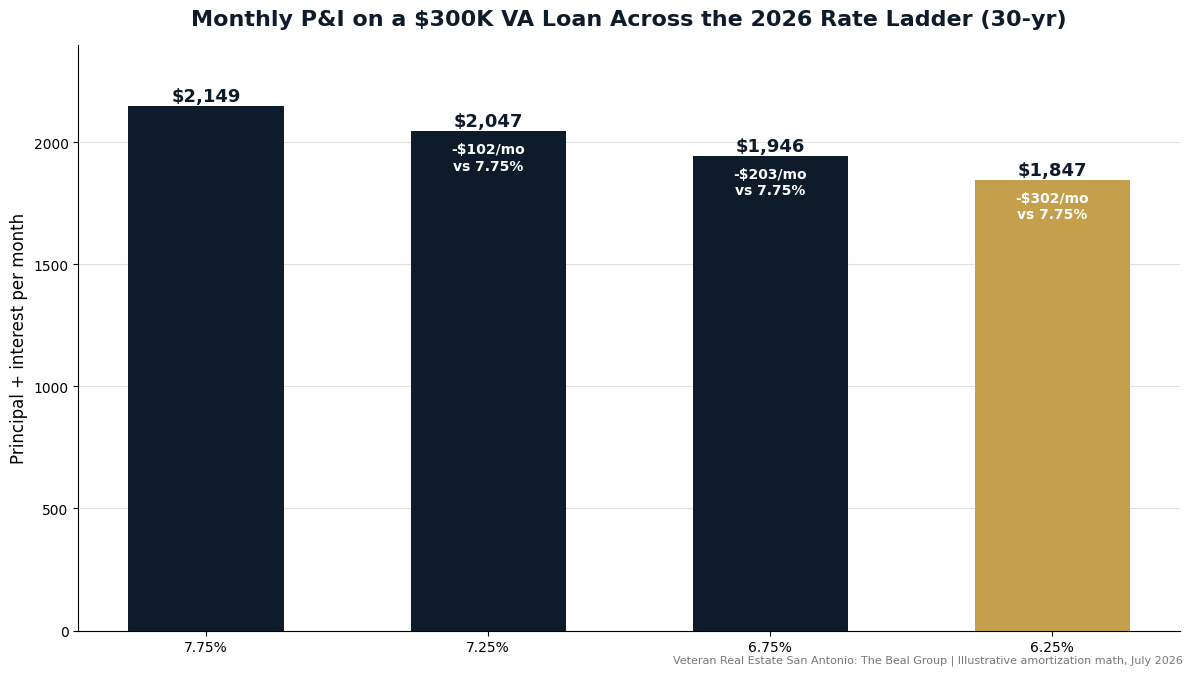
Who this fits in San Antonio right now: JBSA families who bought in the 2023-2025 window at 6.75 percent or higher, veterans whose disability rating now waives the fee they once paid, and owners planning to hold - whether living in the home in Schertz or renting it out from their next duty station. With SABOR/LERA showing the market steady near a $311,025 median, the refinance case in 2026 rests on your rate, not on price speculation.
When Should You NOT Do an IRRRL?
The IRRRL answers exactly one question: can I keep this house at a cheaper rate? If PCS orders will force a sale in 18 months, a 23-month recoupment makes the refinance a donation to your lender. If you need equity out for debt consolidation, renovations, or a down payment on your next home, you want the VA cash-out refinance instead - full underwriting and appraisal, but access to your equity. And if a buyer might want to assume your low rate when you sell, remember that refinancing replaces that assumable note - my VA assumption guide explains when a below-market rate is worth more as a selling asset than as a payment cut.
Watch the term reset too. Fifteen years into a 30-year note, a new 30-year IRRRL drops your payment partly by stretching your payoff into your seventies - the disclosure will show total cost over the life of the loan, and the CFPB's refinance resources are a good neutral cross-check.
How Does the IRRRL Compare to a Cash-Out or Conventional Refinance?
| Factor | VA IRRRL | VA Cash-Out | Conventional Refi |
|---|---|---|---|
| Appraisal | Typically none | Required | Usually required |
| Income re-underwriting | Typically none | Full | Full |
| Funding fee / PMI | 0.5% (waived w/ disability) | 2.15-3.3% (waived w/ disability) | No fee; PMI if over 80% LTV |
| Cash out allowed | No | Yes | Yes |
| Best for | Rate reduction on an existing VA loan | Accessing equity | Freeing VA entitlement for the next purchase |
Source: U.S. Department of Veterans Affairs program rules and standard lender guidelines, July 2026. Individual lender overlays vary - confirm your scenario with a VA-specialized lender.
What If You PCSd Away and Kept Your San Antonio Home as a Rental?
This is the most under-used IRRRL play in the military landlord community. Thousands of former JBSA families hold San Antonio rentals financed at 2023-2025 rates. A one-point rate cut on a $300K balance adds roughly $200 a month of cash flow to that rental - the difference between a property that carries itself and one that quietly bleeds. Because the IRRRL skips the appraisal, the current tenant, the market's direction, and the home's condition never enter the file.
If you are still deciding whether to sell or rent after your next set of orders, run the numbers in my cost-to-sell guide first - and remember the third option, letting a buyer assume your VA rate, before you refinance it away.
How Do You Start an IRRRL in San Antonio?
Four steps, one afternoon of effort. First, read your current statement: note rate, balance, and remaining term. Second, check the calendar against your first payment date. Third, request quotes from VA-specialized lenders - not the mailer that found you, but lenders you chose - and require the loan comparison disclosure up front. Fourth, compare recoupment months side by side and reject anything over 36 or anything the loan officer cannot explain in plain English.
I am glad to point you to the same VA lenders my buyers close with - the ones who show recoupment math before they show enthusiasm. Program details straight from the source: the VA's official IRRRL page.
About the Author: Christopher Beal
Christopher Beal is a U.S. Army veteran and the Owner of Veteran Real Estate San Antonio, a Beal Group practice brokered by eXp Realty (TREC License #723559). A Military Relocation Professional (MRP) and VAREP member, he is a 7-time eXp Realty ICON agent, winner of Best Real Estate Agency in the 2026 Best of San Antonio Readers' Choice (San Antonio Current, 100,000+ voters), and a 3x San Antonio Business Journal Top 25 Individual Agent (#13 in 2024, #14 in 2025, #20 in 2026). His recognition also includes 3x Platinum Top 50, 2x RateMyAgent Agent of the Year, 2x Real Producers Top 100, Five Star Professional (2026), and a RealTrends 2026 ranking. He has helped 325+ families, closed more than $125M in career volume, and holds 5.0 stars across 370+ verified reviews, working almost exclusively with military and veteran buyers and sellers across Bexar, Comal, Kendall, Medina, and Bandera counties, with a focus on VA loans, PCS moves, and homebuying near JBSA-Lackland, JBSA-Randolph, and Fort Sam Houston. If you have questions about using your VA loan benefit in San Antonio, he offers a no-pressure strategy call before you talk to any lender. He can be reached at (210) 882-8583.
Explore More Resources
- VA Home Loans in San Antonio
- Military Relocation / PCS to JBSA
- Free Home Evaluation
- Serve & Save Program
- Client Reviews
- About Christopher Beal
Frequently Asked Questions: VA IRRRL in San Antonio
What does IRRRL stand for and how is it different from a normal refinance?
Interest Rate Reduction Refinance Loan - the VA streamline. Unlike a standard refinance, it typically requires no appraisal and no income re-underwriting, carries a reduced 0.5 percent funding fee, and can only replace an existing VA loan with a lower-cost VA loan.
How soon after buying can I use an IRRRL?
After the later of 210 days from your first payment due date and 6 monthly payments made - about seven to eight months into the loan for most borrowers.
How much does the rate need to drop to qualify?
For a fixed-to-fixed refinance the rate generally must fall at least 0.5 percent (2 percent when moving to an ARM), and your fees must recoup from savings within 36 months. Both numbers appear on the required loan comparison disclosure.
Do I need an appraisal or new income documents?
Typically no on both counts - that is the point of the streamline. Lenders verify your mortgage payment history and may apply their own overlays, but the VA does not require a new appraisal or full re-underwriting on a standard IRRRL.
Can I do an IRRRL on a home I rent out after PCSing away?
Yes. The occupancy certification accepts prior occupancy, so the San Antonio home you bought while stationed at JBSA and now rent out remains eligible. This is one of the strongest cash-flow tools available to military landlords.
Is the funding fee waived for disabled veterans on an IRRRL?
Yes. Veterans receiving VA disability compensation, and eligible surviving spouses, pay no funding fee - saving $1,500 on a $300,000 streamline before any rate savings begin.
Can I take cash out with an IRRRL?
No. The IRRRL is rate-and-term only. If you need equity for renovations, debt payoff, or your next purchase, the VA cash-out refinance is the right product - full underwriting and appraisal apply.
Will refinancing hurt my ability to sell later?
One consideration: VA loans are assumable, and a below-market rate can be a genuine selling asset. If your current rate is low, weigh its value to a future buyer before replacing it. If your rate is high, that concern usually vanishes.
How long does an IRRRL take to close in San Antonio?
Three to five weeks is typical with a VA-specialized lender, since there is usually no appraisal to schedule. Slow files are almost always document-collection problems, not program problems.
Should I wait for rates to drop further before refinancing?
Nobody times the bottom reliably. The practical test: if today's quote clears the net tangible benefit rules and recoups well inside your expected hold period, it stands on its own - and if rates fall again meaningfully, the IRRRL can be repeated once seasoning and recoupment math justify it.
Bought at the peak and wondering if 2026 is your window? Send me your note rate and balance - I will tell you honestly whether the math works, and refer you to lenders who will show you the recoupment month first.
📲 Call or text: (210) 882-8583
📧 Email: [email protected]
🌐 Website: veteranrealestatesa.com
Categories
- All Blogs (354)
- Alamo Heights (4)
- awards (4)
- Best Neighborhoods in San Antonio (13)
- Buyer (16)
- Buyer Education (86)
- Community Events (4)
- Hill Country (17)
- JBSA (43)
- Local Guide (6)
- Luxury (28)
- Luxury Real Estate (26)
- Market Trends (19)
- Market Update (14)
- Military Relocation (111)
- Military Retirement (3)
- Mortgage (19)
- Neighborhood Guides (18)
- neighborhoods (5)
- New Construction (16)
- PCS (42)
- Real Estate (40)
- reviews (3)
- San Antonio (53)
- San Antonio Lifestyle (4)
- San Antonio Market (5)
- San Antonio Neighborhoods (43)
- San Antonio Real Estate (100)
- San Antonio, Veterans Resources, VA Loans (5)
- Seller (55)
- VA Home Loans (30)
- VA Loans (35)
- Va Loans & Financing (27)
- Veterans (10)
- Veterans Resources (40)
Recent Posts