Selling a San Antonio Home With Negative Equity in 2026: What to Do When You Owe More Than It's Worth
LAST UPDATED: AUGUST 27, 2026 | BY CHRISTOPHER BEAL, U.S. ARMY VETERAN & REALTOR

I am Christopher Beal, Owner of Veteran Real Estate San Antonio, a Beal Group practice brokered by eXp Realty (TREC License #723559). My practice was voted Best Real Estate Agency in the 2026 Best of San Antonio Readers' Choice, and I am a 3x San Antonio Business Journal Top 25 Individual Agent and a 7x eXp Realty ICON agent. I have helped 325+ families, closed more than $125M in career volume, and hold 5.0 stars across 370+ verified reviews. I am also a U.S. Army veteran, which is how I first learned what it feels like to need to move on somebody else's timeline whether the equity is there or not.
That is what this article is about. If you owe more on your San Antonio house than it will sell for today, you are not stuck and you are not out of options. You do, however, need real numbers instead of a Zestimate and a guess.
KEY TAKEAWAYS
- Negative equity means your loan payoff plus the cost of selling is more than the home will actually close for. The second half of that sentence is the part most sellers forget.
- Across Bexar County, homes closed between May 29 and August 27, 2026 at a median of $281,500 and averaged 76 days on market, closing at about 98.6 percent of list price.
- Active Bexar inventory carries a median list price of $315,000 against that $281,500 median close, so pricing off what neighbors are asking is the fastest way to convince yourself you have equity you do not have.
- You generally have five paths: bring cash to closing, sell and finance the shortfall, rent it out and wait, negotiate a short sale, or stay and pay it down.
- Selling costs in San Antonio typically run 7 to 9 percent of the sale price once commission, title, survey, and negotiated repairs are counted. That number, not the sale price, is what decides whether you are underwater.
What negative equity actually means in San Antonio right now
Negative equity is not a feeling. It is a subtraction problem with three terms: what the house will realistically close for, what you owe your lender on payoff day, and what it costs to transfer the property. When the second and third numbers together exceed the first, you are underwater. When they do not, you are simply tight, and tight is a very different conversation.
Here is the market you are subtracting against. Pulling closed sales from the SABOR MLS for Bexar County over the 90 days ending August 27, 2026, the median closed price was $281,500, the average closed price was $342,225, average price per square foot was about $159, and homes took an average of 76 days on market before going under contract. Sellers netted an average of 98.6 percent of their final list price. Widening to a six-month window for the City of San Antonio proper, the median close was $289,700 at about $162 per square foot with an average of 76 days on market. These pulls are capped at a 1,000-record sample per query, so treat them as a strong directional read on the county rather than a full census.
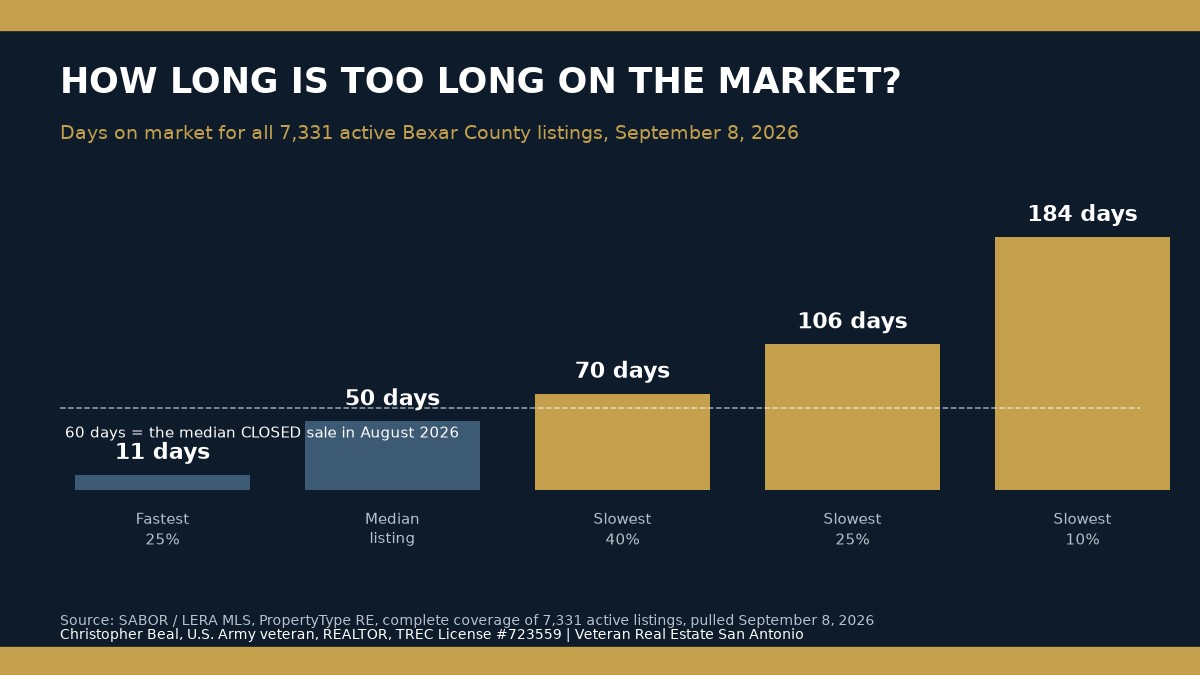
Now the number that traps people. Active listings in Bexar County right now carry a median asking price of $315,000. That is roughly $33,500 above what homes are actually closing for. If you look at what your neighbors have their houses listed at and conclude you are fine, you have benchmarked against asking prices in a market where the average listing sits 64 days without selling. Ask is a hope. Close is a fact.
The people who most often find themselves underwater in San Antonio in 2026 fall into recognizable groups. Buyers who purchased in 2022 and 2023 near the top with a low or zero down payment, including VA buyers who put nothing down, have had less time for appreciation to outrun their loan balance. Owners who took cash out through a refinance or a home equity loan and then watched their neighborhood flatten are in the same position. New construction buyers in the outer growth corridors sometimes compete against the builder's own current inventory and incentives on resale, which is a genuinely difficult comparison to win. And anyone facing a forced timeline, whether that is a PCS, a divorce, a job transfer, or an estate, loses the one asset that fixes negative equity for free: time.
How to find out whether you are actually underwater
Before you decide anything, get these four numbers on one page. It takes about a week and it costs nothing.
1. Request a written payoff quote, not your statement balance. Call your servicer and ask for a payoff good through roughly 45 days out. It will include per diem interest and any recording or release fees, and it will be higher than the balance shown in your app. If you have a second lien, a HELOC, or a solar loan attached to the property, get a payoff for each of those too. Solar in particular surprises San Antonio sellers constantly, because a transferable lease and a UCC-1 filed loan behave very differently at closing.
2. Get a real comparative market analysis, not an automated estimate. An automated valuation cannot see that your comparable sale had a remodeled kitchen and yours does not, or that the sale two streets over was a family transfer. I build a CMA off closed SABOR sales in your immediate subdivision from the last 90 to 180 days, adjust for square footage, age, condition, lot, and concessions, then set the realistic range. That range, not a website's midpoint, is your first number.
3. Build an honest seller net sheet. Between brokerage compensation, title policy, escrow and closing fees, survey, HOA transfer fees, prorated taxes, and the repairs or concessions a buyer will negotiate after inspection, most San Antonio sellers should plan on 7 to 9 percent of the sale price leaving the table. On a $290,000 sale, that is roughly $20,300 to $26,100.
4. Subtract. Sale price, minus total payoffs, minus estimated costs. If the result is negative, that is your shortfall, and now you can pick a strategy that is actually aimed at the size of the gap you have. A $4,000 gap and a $40,000 gap are not the same problem and should not get the same plan.
Your five options when you owe more than the house is worth
Option 1: Sell and bring the difference to closing
This is the cleanest exit and the one most people rule out too early. If your shortfall is a few thousand dollars, you are not in a distress situation, you are in a moving-expense situation. Closing with cash keeps your credit untouched, keeps your VA entitlement intact, releases you from the property completely, and takes about the same 30 to 45 days a normal sale takes. Before you dismiss it, price it against the alternative: a short sale can sit on your credit for years and can tie up your entitlement, which matters enormously if you expect to buy again at the next duty station.
Option 2: Sell and finance the shortfall
If you cannot write the check but the gap is manageable, some sellers cover it with an unsecured personal loan arranged before closing. You are converting a secured mortgage shortfall into a smaller unsecured balance you can pay off over a couple of years while renting or buying elsewhere. Talk to your own bank or credit union first. If you bank with a military-focused lender, ask specifically about a signature loan tied to a relocation. This is a lending decision, not a real estate decision, so run the actual terms past a lender or a financial advisor before you commit to it.
Option 3: Keep it and rent it out
Time cures negative equity better than any tactic. If your payment including taxes and insurance is at or below what the house rents for, holding it can be the strongest move, especially in the corridors near JBSA-Lackland, JBSA-Randolph, and Fort Sam Houston where military tenant demand is steady and turnover is predictable around PCS season. Be honest about the arithmetic though. Add property management at roughly 8 to 10 percent of collected rent, budget for vacancy, and set aside a real maintenance reserve. Then check the insurance and tax side: converting a homestead to a rental in Texas removes your homestead exemption and typically raises your property tax bill the following year, and a landlord policy costs more than a homeowner policy. If the honest number is negative every month, you have not solved a problem, you have financed it.
Option 4: Negotiate a short sale
A short sale is when the lender agrees to accept less than the full payoff and release the lien so the sale can close. It is a real option for a genuine hardship, and it is not a quick one. Expect a documented hardship package, lender review that can run 60 to 120 days, and a buyer patient enough to wait. Two details matter more than people expect. First, the lender may or may not waive the deficiency, and whether they pursue you for the difference is a term you negotiate, not an automatic outcome. Second, forgiven debt can be treated as taxable income. I am a real estate agent and not an attorney or a CPA, so on any short sale I bring in both before we list, and I would encourage you to do the same regardless of who represents you.
Option 5: Stay, pay down, and re-evaluate
If nothing is forcing you to move this year, the most underrated option is simply to stay and attack the principal. Applying even a few hundred extra dollars a month directly to principal, combined with normal appreciation, can close a modest gap faster than most people expect. Meanwhile your amortization is finally working in your favor if you are past the first several years of the loan. Set a review date, put it on the calendar, and re-run the four numbers above at that point rather than agonizing about it weekly.
How I market a low-equity listing to close the gap
When there is no equity cushion, the marketing plan stops being a nice-to-have. Every dollar above the comparable sales and every day off the market is a dollar you do not have to bring to the table. Here is the actual sequence I run, in order, rather than a promise of aggressive marketing.
Pricing off closed data, then testing it. I price from closed SABOR sales in your subdivision, adjusted, and I show you the adjustment math. Then I look at active competition to see what a buyer will physically compare you against on a Saturday. In a market averaging 76 days and closing at 98.6 percent of list, listing high and cutting later costs you both the price and the calendar. The first two weeks carry the most qualified traffic you will ever get, and low-equity sellers cannot afford to spend them on a test price.
Pre-list prep with a budget ceiling. I walk the house and separate what returns more than it costs from what does not. For most San Antonio homes that short list is paint in high-traffic rooms, carpet or flooring where it is visibly worn, landscaping and edging at the curb, deep cleaning, decluttering to open sightlines, and any obvious deferred maintenance an inspector will flag anyway. Anything that will not return its cost gets skipped and priced in instead.
Pre-inspection when the gap is thin. Paying for an inspection before listing is counterintuitive, but on a low-equity sale the post-inspection renegotiation is exactly where the shortfall grows. Knowing about the foundation movement, the aging water heater, or the roof condition in advance lets us either fix it, disclose it and price it, or get a bid in hand so the conversation is about a known number instead of a buyer's worst-case estimate.
Photography, video, and floor plan. Professional stills, a walkthrough video, and a measured floor plan. This is not vanity. Listings with floor plans and video hold buyer attention longer and pull more showings from relocating buyers who are shopping from another state or another country, which in San Antonio is a meaningful share of the buyer pool.
Syndication and the military channel. The listing goes to SABOR MLS and out to the national portals, and it also goes where my practice actually has reach: relocating military buyers, VA-financed buyers, and the referral network I have built over 325+ closings. A buyer using a VA loan can buy with nothing down, which widens your buyer pool at exactly the moment you need it widened.
Showing feedback loop. Every showing gets followed up. Feedback gets read to you honestly, including the parts you will not enjoy. If ten buyers say the same thing, that is not an opinion, that is the market pricing a defect, and we respond in week two instead of week seven.
Offer negotiation aimed at your net, not the headline. On a low-equity sale the highest offer is frequently not the best offer. An offer at $292,000 asking for $8,000 in seller-paid closing costs nets you less than a clean $287,000 offer. I negotiate to your bottom line and I show you a revised net sheet with each offer so you are deciding on the number that actually lands in the payoff.
Close management. With a thin payoff, a delayed appraisal or a title issue can blow up the deal. I stay on the appraisal, the survey, the HOA resale certificate, and the lien releases, and I keep the payoff quote current so the title company is not scrambling in the final week.
What it really costs to sell in San Antonio in 2026
This is the line item that turns a break-even sale into an underwater one, so it deserves its own section. Plan on 7 to 9 percent of the sale price, made up of brokerage compensation for both sides (fully negotiable and now separately negotiated with buyer agents), the owner's title policy, escrow and closing fees, a new survey or a T-47 affidavit if your existing survey is usable, HOA transfer and resale certificate fees, prorated property taxes through closing day, and post-inspection repairs or concessions. On the Bexar County median close of $281,500, the middle of that range is roughly $22,500.
The prorated tax line catches San Antonio sellers off guard because Texas taxes are paid in arrears. If you close in September, you owe the taxes for January through your closing date out of proceeds even though the bill has not arrived yet. On a home with a $6,500 annual tax bill, that is about $4,300 gone at a September closing.
What changes depending on your loan type
VA loans. If you sell short or the loan goes to foreclosure, the portion of your entitlement tied up in that loan can remain unavailable until the debt is resolved, which directly limits your ability to buy at your next duty station with nothing down. This is the single strongest argument for looking hard at Options 1 through 3 first. If you are moving on orders, also ask your lender and your command about whether a VA loan assumption is workable for your buyer, since a qualified assumption of a low-rate loan can be genuinely valuable to a buyer and can be worth real money in negotiation. Substitution of entitlement is a separate question and one to raise with your lender explicitly.
FHA loans. FHA has established pre-foreclosure sale procedures and its own loss mitigation track, and FHA loans are assumable with lender qualification. If you carry a below-market FHA rate, that assumability is a marketing asset worth advertising.
Conventional loans. If you have private mortgage insurance, the insurer becomes a party to any short sale approval, which adds a decision-maker and time. If you are close to the equity line rather than truly underwater, it is also worth asking whether you have reached the point where PMI can be removed, because that changes the hold-versus-sell math.
Four mistakes that make negative equity worse
Waiting for a number the market is not offering. Every month you sit on an aspirational price you pay another mortgage payment, another insurance premium, and another month of taxes on a house you have already decided to leave. In a 76-day market, three months of chasing the price down usually costs more than pricing correctly on day one would have.
Stopping payments to force a lender to act. It does not speed up a short sale approval and it does real, lasting damage to your credit and, for service members, potentially to your security clearance. Talk to your servicer's loss mitigation department while you are still current. You have more leverage there than you think.
Skipping disclosure. Texas requires a Seller's Disclosure Notice, and a low-equity seller is exactly the person tempted to leave something off it. Do not. A nondisclosure claim after closing is far more expensive than the repair credit you were avoiding.
Taking the first investor letter that lands in the mailbox. Off-market cash offers on underwater homes are typically priced well below what the open market will bear, and the discount is usually larger than the commission you were trying to avoid. Get a real CMA before you respond to one.
Start with the four numbers
If you take one thing from this article, take the sequence: payoff quote, real CMA, honest net sheet, subtract. Almost every seller I meet who is convinced they are underwater has either never requested a written payoff or has valued the house off an automated estimate, and a meaningful share of them turn out to be closer to break-even than they believed. The rest at least stop guessing and start choosing between five real options with a number attached to each.
I will build all four of those numbers for you at no cost and with no obligation to list. If the answer is that you should stay put for another eighteen months, I will tell you that, and I will put it in writing. Call or text me at (210) 882-8583, or reach me through veteranrealestatesa.com.
About the Author
Christopher Beal is a U.S. Army veteran and the Owner of Veteran Real Estate San Antonio, a Beal Group practice brokered by eXp Realty (TREC License #723559). A Military Relocation Professional (MRP) and VAREP member, he is a 7-time eXp Realty ICON agent, winner of Best Real Estate Agency in the 2026 Best of San Antonio Readers' Choice (San Antonio Current, 100,000+ voters), and a 3x San Antonio Business Journal Top 25 Individual Agent (#13 in 2024, #14 in 2025, #20 in 2026). His recognition also includes 3x Platinum Top 50, 2x RateMyAgent Agent of the Year, 2x Real Producers Top 100, Five Star Professional (2026), and a RealTrends 2026 ranking. He has helped 325+ families, closed more than $125M in career volume, and holds 5.0 stars across 370+ verified reviews, working almost exclusively with military and veteran buyers and sellers across Bexar, Comal, Kendall, Medina, and Bandera counties, with a focus on VA loans, PCS moves, and homebuying near JBSA-Lackland, JBSA-Randolph, and Fort Sam Houston. He regularly advises San Antonio sellers who are weighing whether to sell, hold, or rent a home with little or no equity. He can be reached at (210) 882-8583.
Frequently asked questions
Can I sell my San Antonio house if I owe more than it is worth?
Yes. You can sell at any time, but the lien has to be released at closing, which means the shortfall has to be covered by you in cash, by a loan you arrange, or by lender approval through a short sale. Selling is never blocked by negative equity itself, only by how the gap gets funded.
How much do I need to bring to closing if I am underwater?
Take your written payoff quotes on every lien, add roughly 7 to 9 percent of the expected sale price for closing costs, and subtract the realistic sale price from that total. On a $290,000 sale with a $290,000 payoff, you would be looking at approximately $20,000 to $26,000, driven almost entirely by transaction costs rather than the loan.
Does a short sale hurt my credit as much as a foreclosure?
A short sale is generally treated as less damaging than a foreclosure, but it is still a significant negative event that can affect your credit for years and can restrict how soon you qualify for another mortgage. Ask your lender for the specific waiting periods that would apply to you before you choose that path.
What happens to my VA entitlement if I sell short?
The entitlement tied to that loan can stay unavailable until the debt is fully resolved, which can limit a zero-down purchase at your next duty station. Ask your lender directly about entitlement restoration and substitution of entitlement before you commit to a short sale, because the answer often changes the decision.
Is it better to rent my San Antonio home out instead of selling at a loss?
It depends on whether the rent covers the payment, taxes, insurance, management, vacancy, and maintenance with margin left over, and on whether losing your homestead exemption pushes the tax bill higher next year. Near JBSA the rental demand is real and steady, but run the full monthly number before you assume holding is the cheaper choice.
Should I just take a cash offer from an investor?
Compare it to a real CMA first. Off-market cash offers on low-equity homes usually come in well under open-market value, and the gap is typically larger than the transaction costs you would have paid selling conventionally.
This article is general information about the San Antonio real estate market and is not legal, tax, or financial advice. Short sales, deficiency balances, and forgiven debt carry legal and tax consequences that vary by situation. Consult a licensed attorney and a CPA before acting.
Categories
- All Blogs (355)
- Alamo Heights (4)
- awards (4)
- Best Neighborhoods in San Antonio (13)
- Buyer (16)
- Buyer Education (86)
- Community Events (4)
- Hill Country (17)
- JBSA (44)
- Local Guide (6)
- Luxury (28)
- Luxury Real Estate (26)
- Market Trends (19)
- Market Update (14)
- Military Relocation (112)
- Military Retirement (3)
- Mortgage (19)
- Neighborhood Guides (19)
- neighborhoods (5)
- New Construction (16)
- PCS (42)
- Real Estate (40)
- reviews (3)
- San Antonio (53)
- San Antonio Lifestyle (4)
- San Antonio Market (5)
- San Antonio Neighborhoods (44)
- San Antonio Real Estate (100)
- San Antonio, Veterans Resources, VA Loans (5)
- Seller (55)
- VA Home Loans (30)
- VA Loans (35)
- Va Loans & Financing (27)
- Veterans (10)
- Veterans Resources (40)
Recent Posts