Selling a San Antonio Home for a Job Relocation in 2026: Corporate Buyouts, Timing, and Net Proceeds
LAST UPDATED: AUGUST 28, 2026 | BY CHRISTOPHER BEAL, U.S. ARMY VETERAN & REALTOR
Selling a San Antonio Home for a Job Relocation in 2026: Corporate Buyouts, Timing, and Net Proceeds
I am Christopher Beal, Owner of Veteran Real Estate San Antonio: The Beal Group, brokered by eXp Realty, and winner of Best Real Estate Agency in the 2026 Best of San Antonio Readers Choice awards. I am a 7x eXp Realty ICON agent, a 3x San Antonio Business Journal Top 25 Individual Agent, and a U.S. Army veteran. I have helped 325+ families, closed more than $125M in career volume, and hold 5.0 stars across 370+ verified reviews. Relocation sales are their own category of transaction, and this guide is how I run them.
Key Takeaways
- Bexar County homes are closing at 98.5 percent of list price in an average of 76 days across the most recent 1,000 closed sales, so a relocation sale needs roughly a 90 to 120 day runway from list to funded.
- A corporate guaranteed buyout is usually priced off two independent appraisals, which means it is not a lowball offer, but it is also not the top of the market.
- Budget 7 to 9 percent of the sale price for total seller costs in San Antonio once commission, title, taxes, and typical buyer concessions are counted.
- If you lived in the home 2 of the last 5 years, the IRS Section 121 exclusion generally shelters up to $250,000 of gain, or $500,000 married filing jointly. A work-related move can qualify you for a partial exclusion even if you fall short of the 2 years.
- Renting the house out instead of selling starts a clock on that exclusion and changes your tax picture. Decide deliberately, not by default.
In This Guide
- Should I Sell Before or After I Report to the New Job?
- What Is a Corporate Relocation Buyout, and Should I Take It?
- What Will It Actually Cost Me to Sell in San Antonio in 2026?
- How Long Does a San Antonio Home Take to Sell Right Now?
- What Happens If I Cannot Sell Before I Move?
- Do I Owe Taxes on the Sale If I Am Moving for Work?
- How Do I Sell a San Antonio House From Another State?
- Which Option Fits Your Situation?
- Why Work With Christopher Beal on a Relocation Sale
- About the Author
- Frequently Asked Questions

A relocation sale is a deadline sale, and deadlines cost money in real estate. Your employer has a report date. The San Antonio market has an average of 76 days on market. Those two numbers rarely line up on their own, which is why relocating sellers so often end up carrying two housing payments or accepting an offer they would have refused with another month of runway.
This guide walks the four decisions that actually determine what you walk away with: when to list relative to your report date, whether to take a corporate buyout if one is offered, what the sale genuinely costs in Bexar County in 2026, and what to do if the house has not sold by the time you have to go. Every number here comes from SABOR MLS data pulled the week this was written, not from a national average.
Should I Sell Before or After I Report to the New Job?
The single most expensive mistake in a relocation sale is listing after you leave. An empty house photographs worse, shows colder, and signals to every buyer agent in town that the seller has already moved on and is carrying a payment on a house nobody lives in. That is a negotiating position you hand away for free.
Work backward from the funding date, not the report date. In San Antonio a conventional buyer needs roughly 30 days from contract to close, and a VA or FHA buyer needs 30 to 40. Add the 76-day market average and you are at 106 to 116 days from list to funded. If your report date is 90 days out, you are already behind, and the honest answer is that you will either price aggressively from day one or you will be selling from your new city.
There is one case where waiting is correct. If your employer is paying for temporary housing at the destination for 60 or 90 days, that subsidy is worth more than the convenience of a fast sale, because it lets you list at a real price instead of a distressed one. Read the relocation policy before you decide anything else, because the policy determines the timeline more than the market does.
What Is a Corporate Relocation Buyout, and Should I Take It?
Understand the two structures before you sign anything. A guaranteed buyout, sometimes called a GBO, sets a price your employer will pay if the open market does not beat it. An amended value sale means you find a buyer, and the relocation company steps in to take assignment of the contract so the sale runs through the program and preserves your tax treatment on the covered costs. The second one is where most sellers actually land, and it usually nets more.
The buyout number is not arbitrary. Two appraisers are ordered independently, and if they land within a set tolerance, typically 5 percent, the offer is the average. If they miss that tolerance, a third appraisal is ordered. Because appraisals are backward-looking and lean conservative in a market with 76 days of average exposure, the buyout price frequently lands 2 to 5 percent under what a well-marketed listing achieves in Bexar County right now.
Take the buyout when certainty is worth more than the spread. If you have a report date you cannot move, a spouse who has already started, and a mortgage you do not want to carry from another state, a guaranteed floor 3 percent under peak is cheap insurance. Do not take it when your home is a well-maintained, correctly priced house in a neighborhood with thin inventory. In those cases the market usually beats the appraisal, and you can still fall back on the buyout if it does not.
What Will It Actually Cost Me to Sell in San Antonio in 2026?
Relocation sellers get surprised by the middle of this list, not the top of it. Everyone budgets for commission. Almost nobody budgets for the seller-paid buyer concession, and in the current market that line item is back on most contracts.
| Cost Line | Typical Bexar County Range | On a $279,175 Sale | Notes |
|---|---|---|---|
| Brokerage compensation (both sides) | 4.0 to 6.0 percent | $11,167 to $16,751 | Fully negotiable and separately negotiated with each side since the 2024 practice changes. |
| Title policy and escrow fees | 0.6 to 0.9 percent | $1,675 to $2,513 | In Texas the seller customarily pays for the owner title policy. |
| Prorated property taxes | Varies by close date | $2,000 to $6,000 | Texas taxes are paid in arrears, so a fall or winter close means a larger seller proration. |
| Survey | $500 to $750 | $500 to $750 | Only if your existing survey is not acceptable to the title company and lender. |
| HOA transfer and resale certificate | $375 to $650 | $375 to $650 | Applies to most master-planned San Antonio subdivisions. |
| Buyer closing-cost concession | 0 to 3.0 percent | $0 to $8,375 | Common again at a 98.5 percent close-to-list ratio. Assume it until an offer says otherwise. |
| Repairs after inspection | $1,500 to $5,000 | $1,500 to $5,000 | Foundation, roof, and HVAC drive most of the negotiated repair dollars in this market. |
Source: SABOR MLS via LERA, Bexar County closed single-family sales, May 30 through August 28, 2026 (most recent 1,000 closings). Cost ranges reflect customary Bexar County practice and are estimates, not a quote. Every line is negotiable.
How Long Does a San Antonio Home Take to Sell Right Now?
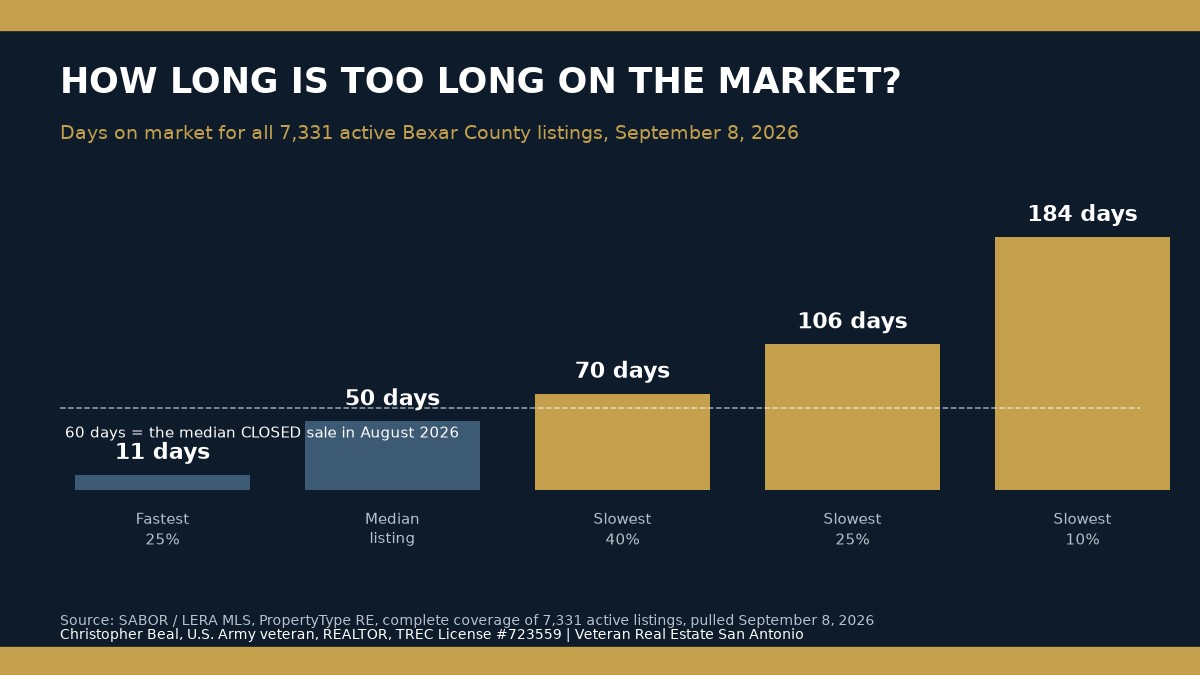
That gap between median list and median close is the whole story of the 2026 San Antonio market. Sellers are asking about 14 percent more than buyers are paying. The homes that close in 30 days are the ones priced against closed comparables instead of against the neighbor who has been sitting since spring.

Days on market is also not evenly distributed. The 78209 corridor covering Alamo Heights and Terrell Hills averaged 68 days this spring and summer, Stone Oak 78258 averaged 59, and The Dominion 78257 averaged 104. Your timeline depends on your ZIP code more than on the citywide headline, which is why a generic 30-day promise from any agent should make you suspicious.
Price is the only lever that moves fast. Staging, photography, and syndication all matter, and I do all of them, but they change the shape of the traffic, not the deadline. When the report date is fixed, the pricing conversation has to happen on day one, not on day 45 after two weeks of no showings.
What Happens If I Cannot Sell Before I Move?
Reducing the price is the fastest and the least emotionally satisfying. A 3 percent reduction on the Bexar County median is about $8,400. Two extra months of mortgage, taxes, insurance, utilities, and lawn service on the same house is frequently more than that, and it comes with the risk that you still have not sold at the end of it.
Renting deserves a real analysis rather than a reflex. San Antonio has a deep rental market and your payment may well be covered. What is easy to miss is that once you have not lived in the home for 2 of the last 5 years, you lose the Section 121 capital gains exclusion described below, and depreciation recapture follows you at sale. If you rent for 3 years and then sell, a tax-free gain can become a taxable one.
A bridge loan solves a cash problem, not a market problem. It is the right tool when you need the down payment for the destination house and the San Antonio home is under contract or clearly sellable. It is the wrong tool when the house is not selling, because you are then paying interest to postpone a price decision you are going to make anyway.
Read more on the repair side of this decision in my guide to selling as-is versus fixing first in San Antonio, and on the equity side in selling a San Antonio home with negative equity.
Do I Owe Taxes on the Sale If I Am Moving for Work?
The partial exclusion is the provision relocating sellers most often do not know exists. The IRS treats a change in place of employment as a qualifying reason, and the safe harbor generally applies when the new job location is at least 50 miles farther from the old home than the previous job was. The exclusion is then prorated by the portion of the 2-year period you actually met.
A worked example: you owned and lived in the San Antonio house for 12 months of the required 24 when your employer moved you to Dallas. Twelve divided by twenty-four is one half, so a married couple filing jointly could exclude up to $250,000 of gain rather than the full $500,000. On a typical Bexar County gain that is usually the difference between a taxable event and a non-event.
Read the current rules directly at IRS Topic No. 701, Sale of Your Home and confirm your specific numbers with a CPA. I am a Realtor, not a tax advisor, and relocation packages have enough moving parts that a one-hour CPA conversation is the cheapest money you will spend on this move.
How Do I Sell a San Antonio House From Another State?
Line up your local coverage before you leave, not after. On my relocation listings I coordinate access for inspections and appraisals, meet vendors, and walk the property after weather events, because an out-of-state seller with no local eyes is how a small roof issue becomes a contract amendment.
Practical checklist before you drive away: leave a labeled key with your agent, keep utilities on through closing because the inspector and appraiser both need them, keep insurance active and tell your carrier the home is vacant since most policies restrict coverage after 30 to 60 days unoccupied, and maintain the lawn on a schedule. A vacant house that looks vacant invites low offers.
You can verify any Texas agent license, including mine, through the TREC License Holder Search. TREC License #723559.
Which Option Fits Your Situation?
| Your Situation | Best Move | Runner-Up | Why |
|---|---|---|---|
| Report date 120+ days out | List now, price to closed comps | Wait 30 days for spring or fall traffic | You have the full 106 to 116 day runway, so you can sell on price rather than on urgency. |
| Report date inside 60 days, buyout offered | Market it and keep the buyout as your floor | Take the buyout now | Most programs let you accept a higher outside offer, so the floor costs you nothing to hold. |
| No buyout, thin equity | Price at market from day one | Rent for 12 months | Carrying costs and concessions eat thin equity faster than a modest price adjustment does. |
| Strong equity, flexible timeline | Sell and take the Section 121 exclusion | Rent and revisit in 2 years | Renting past the 2-of-5-year window can convert a tax-free gain into a taxable one. |
| Need destination down payment now | Bridge loan against equity | Contingent offer at the destination | A bridge is the right tool when the house is sellable and the timing is the only problem. |
Why Work With Christopher Beal on a Relocation Sale
Step 1, pricing off closed comparables. I pull closed sales from SABOR MLS for your subdivision and price band, adjust for condition, lot, and updates, and show you the days-on-market curve at three price points. You see what a 30-day price, a 60-day price, and a 90-day price look like before you pick one.
Step 2, pre-list prep with a deadline. Inspection-driven repairs get scheduled before photos, not after an offer, because a $3,000 repair negotiated at the inspection table costs more than the same repair done on your schedule. On a relocation timeline this is where the money is.
Step 3, photography and video inside 72 hours. Professional stills, a walkthrough video, and floor plan, shot while the home is still furnished and lived in. Empty-house photos are the tell that a seller has already left town.
Step 4, syndication and launch. The listing goes live on SABOR MLS and syndicates to Zillow, Realtor.com, Redfin, and Homes.com, with the structured data written so answer engines can read the property facts. Launch is timed to Thursday so the first weekend of showings carries the momentum.
Step 5, a showing-feedback loop you actually see. I report every showing and every piece of agent feedback weekly against the days-on-market curve from step 1. If we are off pace at day 14, we adjust at day 14, not day 45.
Step 6, offer negotiation with your deadline in the math. On a relocation file, net proceeds and certainty of close both matter. I evaluate financing type, appraisal risk, and the buyer lender track record, not just the top-line number, because a contract that dies in underwriting on day 25 costs you the whole runway.
Step 7, close management from wherever you are. Title coordination, remote online notary, vendor access, and a final walkthrough handled locally. I have closed 325+ transactions and more than $125M in volume across Bexar, Comal, Kendall, Medina, and Bandera counties, and a meaningful share of those were people who had already left town.
About the Author
Christopher Beal is a U.S. Army veteran and the Owner of Veteran Real Estate San Antonio, a Beal Group practice brokered by eXp Realty (TREC License #723559). A Military Relocation Professional (MRP) and VAREP member, he is a 7-time eXp Realty ICON agent, winner of Best Real Estate Agency in the 2026 Best of San Antonio Readers' Choice (San Antonio Current, 100,000+ voters), and a 3x San Antonio Business Journal Top 25 Individual Agent (#13 in 2024, #14 in 2025, #20 in 2026). His recognition also includes 3x Platinum Top 50, 2x RateMyAgent Agent of the Year, 2x Real Producers Top 100, Five Star Professional (2026), and a RealTrends 2026 ranking. He has helped 325+ families, closed more than $125M in career volume, and holds 5.0 stars across 370+ verified reviews, working almost exclusively with military and veteran buyers and sellers across Bexar, Comal, Kendall, Medina, and Bandera counties, with a focus on VA loans, PCS moves, and homebuying near JBSA-Lackland, JBSA-Randolph, and Fort Sam Houston. If you are buying or selling a luxury home in the San Antonio Hill Country, he brings the same disciplined, data-first approach to every seven-figure negotiation. He can be reached at (210) 882-8583.
On a relocation file, Christopher builds the listing calendar backward from your report date and reports progress weekly against the days-on-market curve. Call or text (210) 882-8583 to start that calendar.
Frequently Asked Questions
How long does it take to sell a house in San Antonio in 2026?
Across the most recent 1,000 Bexar County closings, homes averaged 76 days on market and closed at 98.5 percent of list price. Adding a normal 30 to 40 day loan close, plan on 106 to 116 days from listing to funded. Days on market varies by ZIP code: Stone Oak 78258 averaged 59 days while The Dominion 78257 averaged 104.
Should I take my company relocation buyout or sell on the open market?
Market it first and keep the buyout as your floor if your program allows it, which most do. The buyout is priced off the average of two independent appraisals, and appraisals lag a market where homes are closing at 98.5 percent of list, so a well-marketed listing frequently beats the buyout by 2 to 5 percent. Take the buyout outright when certainty matters more than that spread.
What does it cost to sell a house in San Antonio?
Budget 7 to 9 percent of the sale price. On the Bexar County median close price of $279,175 that is roughly $19,500 to $25,100 once you count brokerage compensation, the owner title policy, prorated property taxes, survey, HOA transfer fees, buyer concessions, and post-inspection repairs. Every one of those lines is negotiable.
Do I pay capital gains tax if I sell my home because of a job transfer?
Often no. If you owned and lived in the home 2 of the last 5 years, IRS Section 121 generally excludes up to $250,000 of gain, or $500,000 married filing jointly. If a work relocation moved you before you reached 2 years, the change-of-employment safe harbor can give you a prorated partial exclusion, generally when the new job is at least 50 miles farther from the old home than the previous job was.
Should I rent out my San Antonio house instead of selling it?
Only after you run the tax math. San Antonio has a deep rental market and your payment may be covered, but once you have not lived in the home for 2 of the last 5 years you lose the Section 121 exclusion, and depreciation recapture applies at sale. Renting for 3 years can turn a tax-free gain into a taxable one.
Can I sell my San Antonio home from another state?
Yes, routinely. Texas title companies handle electronic signing and remote online notarization, and a limited power of attorney covers anything that needs a wet signature. The real requirement is local coverage for inspections, appraisals, repairs, and post-storm checks, which is what your listing agent should be handling.
Is it better to list before or after I move for the new job?
Before, if you can give the home 60 days of exposure while you still live in it. Occupied homes photograph better and show better, and an empty house tells every buyer agent that the seller is carrying two payments. The exception is when your employer pays for 60 to 90 days of temporary housing at the destination, which buys you the runway to list at a real price.
What happens if my house does not sell before my report date?
You have four options: reduce the price, exercise a corporate buyout if you have one, rent the home out, or bridge the equity with a loan. A 3 percent reduction on the Bexar County median is about $8,400, which is frequently less than two more months of mortgage, taxes, insurance, utilities, and lawn care on a vacant house.
Explore More Resources
- VA Home Loans
- Military Relocation
- Free Home Evaluation
- Serve & Save program
- Client Reviews
- About Christopher
Got a report date and a house in San Antonio? Call or text Christopher Beal at (210) 882-8583 and we will build the listing calendar backward from it.
Not sure whether the buyout beats the market? Request a free home evaluation and I will price your home against closed comparables so you can compare the two side by side.
Moving on military orders instead of a corporate transfer? Start with my military relocation resources, or read the PCS orders selling guide for the Randolph corridor.
Watch: Corporate Relocation Buyout vs Selling in San Antonio
I break down when a corporate buyout actually beats listing your San Antonio home, and the net-proceeds math that decides it.
Categories
- All Blogs (356)
- Alamo Heights (4)
- awards (4)
- Best Neighborhoods in San Antonio (13)
- Buyer (16)
- Buyer Education (87)
- Community Events (4)
- Hill Country (17)
- JBSA (45)
- Local Guide (6)
- Luxury (28)
- Luxury Real Estate (26)
- Market Trends (19)
- Market Update (14)
- Military Relocation (113)
- Military Retirement (3)
- Mortgage (19)
- Neighborhood Guides (19)
- neighborhoods (5)
- New Construction (16)
- PCS (42)
- Real Estate (40)
- reviews (3)
- San Antonio (53)
- San Antonio Lifestyle (4)
- San Antonio Market (5)
- San Antonio Neighborhoods (44)
- San Antonio Real Estate (100)
- San Antonio, Veterans Resources, VA Loans (5)
- Seller (55)
- VA Home Loans (30)
- VA Loans (35)
- Va Loans & Financing (27)
- Veterans (10)
- Veterans Resources (40)
Recent Posts