Is It Cheaper to Live in San Antonio? 2026 Cost-of-Living Reality Check for Families PCSing from California, DC, and Overseas
LAST UPDATED: MAY 26, 2026 | BY CHRISTOPHER BEAL, U.S. ARMY VETERAN & REALTOR
Is It Cheaper to Live in San Antonio? 2026 Cost-of-Living Reality Check for Families PCSing from California, DC, and Overseas
Key Takeaways
- San Antonio's overall cost of living runs roughly 8 to 10 percent below the U.S. average, but the real PCS math depends on housing, state income tax, and what your BAH actually covers at JBSA.
- A staff sergeant moving from San Diego to JBSA-Lackland keeps roughly 1,400 to 1,700 dollars more BAH minus housing every month in 2026 once California state tax is removed and JBSA BAH is applied.
- Texas has no state income tax, which alone moves an O-3 or E-7 from California or DC into a different financial bracket the day orders cut.
- Property tax in Bexar, Comal, and Kendall counties runs 2.1 to 2.6 percent, which is the single biggest cost-of-living surprise for families coming from California or overseas BAH-only living.
- Groceries, utilities, gasoline, and child care are all cheaper than the U.S. average in San Antonio, but auto insurance and homeowners insurance run higher than most OCONUS bases and higher than DC.
In This Guide
- Is San Antonio Actually Cheaper Than the U.S. Average?
- How Much Cheaper Is San Antonio Than California for a PCSing Family?
- Is San Antonio Cheaper Than Washington DC for Military Families?
- Is San Antonio Cheaper Than OCONUS BAH-Only Living?
- How Does JBSA BAH Offset the Real Cost of Living in 2026?
- What Is the Texas Property Tax Trap PCSing Families Miss?
- Which Cost Categories Are Genuinely Cheaper in San Antonio?
- Which San Antonio ZIPs Stretch Your BAH the Farthest in 2026?
- Lifestyle Priority Matchup: California vs DC vs Overseas Buyer
- About the Author
- Frequently Asked Questions
Is San Antonio Actually Cheaper Than the U.S. Average?
The headline is real, but it is not the number you should plan around. National COL indexes blend rent, mortgage, groceries, transportation, utilities, health care, and miscellaneous categories into a single percentage. For a civilian family, that average matters. For a PCSing military family, the average buries the three numbers that actually decide whether a move feels like a raise or a pay cut: BAH coverage, state income tax, and Texas property tax.
The Council for Community and Economic Research, which publishes the most-cited COL index, has San Antonio in the 91 to 93 range every quarter of the past two years, with 100 representing the national average. That holds up against the Bureau of Labor Statistics CPI regional data, which shows the Texas urban South consistently 7 to 9 percent below the U.S. CPI-U.
What the index does not show: a household earning the same gross pay in San Diego, Northern Virginia, or Stuttgart will see a different number on the deposit slip after Texas removes state income tax and the JBSA BAH replaces a more expensive housing market. That delta, not the index, is the number that funds a 20 percent down payment or a Roth contribution.
How Much Cheaper Is San Antonio Than California for a PCSing Family?
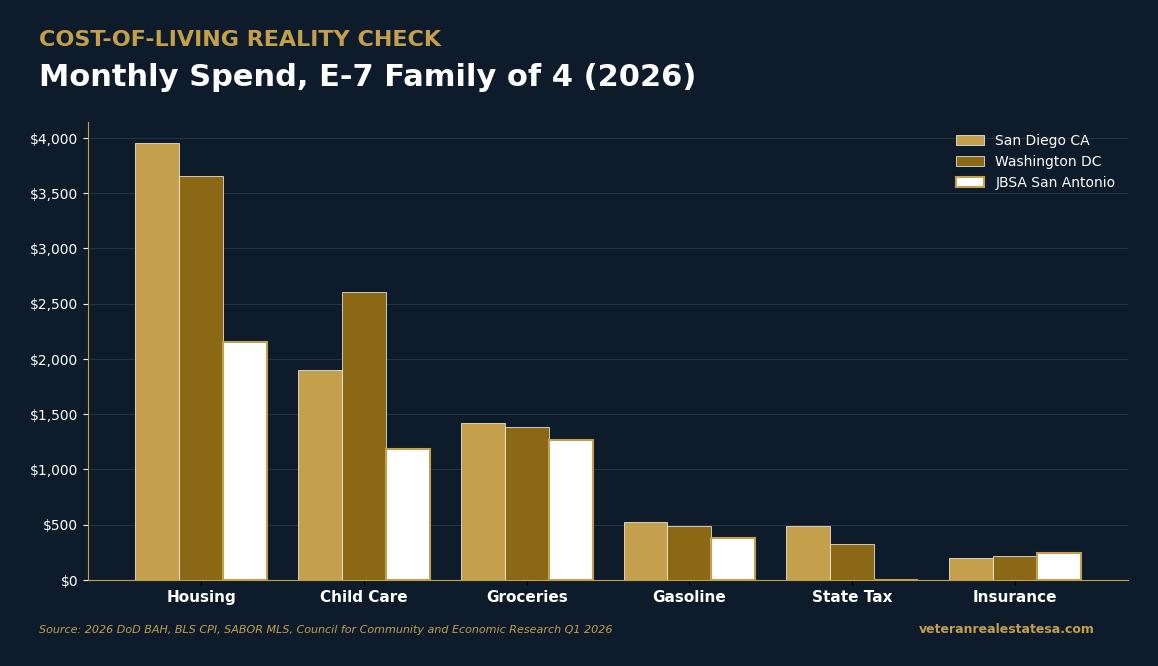
California to Texas is the most lopsided PCS comparison in the continental U.S. San Diego, the most common California feeder base, runs a COL index in the 158 to 162 range. JBSA sits at 91 to 93. The arithmetic alone says a family of four spending 6,500 dollars a month in San Diego would spend roughly 3,800 dollars on the same lifestyle in San Antonio.
The bigger swing for active-duty families is BAH coverage. A San Diego E-7 with dependents draws roughly 4,302 dollars per month in BAH for 2026, which still struggles to cover a three-bedroom rental inside the I-15 commute corridor. The same E-7 at JBSA-Lackland draws roughly 2,328 dollars in 2026 BAH with dependents and can rent a similar three-bedroom in Westlakes or Alamo Ranch with money left over, or qualify for a 350,000 dollar VA-financed purchase with BAH covering principal, interest, taxes, and insurance.
| Category | San Diego (E-7, family of four) | JBSA-Lackland (E-7, family of four) | Monthly Delta |
|---|---|---|---|
| Median 3 bed rent | $3,950 | $2,150 | +$1,800 |
| Groceries (USDA moderate) | $1,420 | $1,265 | +$155 |
| Gasoline (2 vehicles) | $520 | $375 | +$145 |
| State income tax (6 percent eff.) | $485 | $0 | +$485 |
| Auto insurance (full coverage) | $195 | $245 | -$50 |
| Child care (one preschooler) | $1,895 | $1,180 | +$715 |
Source: 2026 DoD BAH tables, BLS CPI regional data, San Diego MLS and SABOR MLS median rent comps, California Franchise Tax Board, Council for Community and Economic Research Q1 2026 COL Index. Estimates round to the nearest 5 dollars.
Is San Antonio Cheaper Than Washington DC for Military Families?
Pentagon, Bolling, Belvoir, and Quantico families PCSing to JBSA see the cleanest housing swing in the inventory. A Northern Virginia O-4 with dependents draws about 4,032 dollars BAH in 2026 and frequently spends every dollar on a townhouse in Fairfax, Alexandria, or Springfield. The same O-4 at JBSA-Randolph draws 2,634 dollars BAH and can purchase a single-family home in Schertz, Cibolo, Selma, or Universal City with BAH covering PITI on a 380,000 to 425,000 dollar VA-financed home.
Where the DC math gets less obvious is child care. The DC metro is the single most expensive child care market in the U.S. outside the Bay Area. Average full-time daycare for a toddler runs 2,400 to 2,800 dollars per month inside the Beltway in 2026. San Antonio averages 1,150 to 1,300 dollars for the same toddler slot. A two-child family with one in preschool and one in toddler care saves 2,400 to 3,200 dollars per month in pure child care line items before any housing math.
The DC family does lose one thing: walkability and transit. Most San Antonio neighborhoods are car-dependent, and a Northern Virginia family used to a Metro commute will add roughly 200 to 300 dollars per month in gasoline and a second vehicle in many cases. That offset is real but is the only category where DC outperforms San Antonio for most families.
Is San Antonio Cheaper Than OCONUS BAH-Only Living?
OCONUS PCS to JBSA is the most counterintuitive comparison in this guide. Stuttgart, Yokosuka, Ramstein, Aviano, and Misawa families typically draw OHA plus COLA plus the dollar-denominated value of on-base housing or utility reimbursements. On paper, total compensation looks higher than what JBSA pays. In practice, OHA evaporates the day you redeploy, on-base housing builds zero equity, and overseas allowances are not portable into a stateside mortgage application.
San Antonio reverses that equation. A Stuttgart-to-JBSA E-7 transitions from a 3,500 dollar OHA-and-utility-reimbursement budget to a 2,328 dollar JBSA-Lackland BAH, but the 2,328 dollars now buys a VA-financed 350,000 dollar home with no down payment and a deductible mortgage interest line on the next return. Three years later, the OHA family redeploys with savings. The JBSA family redeploys with 35,000 to 60,000 dollars in home equity at typical 2026 San Antonio appreciation, and a VA entitlement they can roll into the next duty station.
The other overseas trap is the implicit dollar weakness. OCONUS pay during a strong dollar period feels comfortable; during a weak dollar period it feels tight. San Antonio's cost line is dollar-denominated, predictable, and immune to currency swings. For an officer or NCO planning toward a retirement transition, the predictability alone often justifies the move.
How Does JBSA BAH Offset the Real Cost of Living in 2026?
BAH coverage is the single most underused planning tool in a PCS to JBSA. The 2026 DoD BAH tables published in December 2025 set JBSA-Lackland, Fort Sam Houston, and Randolph at slightly different rates because the DoD treats them as one joint base for personnel but distinct BAH ZIPs for housing math. Lackland anchors to the southwest and west sides of San Antonio; Fort Sam anchors to the central and northeast sides; Randolph anchors to the northeast corridor through Cibolo and Schertz.
A 2026 E-6 with dependents draws roughly 2,148 dollars BAH at JBSA. The current median three-bedroom rent in Westlakes (78245) sits around 1,950 dollars, in Alamo Ranch (78253) around 2,200 dollars, in Schertz (78154) around 2,100 dollars, and in Cibolo (78108) around 2,150 dollars. Three of four major commuter ZIPs come in under BAH for an E-6 family. Buying instead of renting at the same monthly payment frequently builds 12,000 to 22,000 dollars in equity per year at conservative San Antonio appreciation.
An O-3 with dependents draws roughly 2,520 dollars BAH at JBSA in 2026. That figure cleanly covers a 380,000 dollar VA-financed PITI in most of the major commuter ZIPs, which is meaningful because Bexar County's 2026 VA loan limit is 832,750 dollars and most JBSA O-3 buyers do not approach that ceiling. The BAH check, in other words, often funds the purchase the family thought required a separate income.
What Is the Texas Property Tax Trap PCSing Families Miss?
The single biggest cost-of-living surprise for PCSing families is the Texas property tax line. California families coming from San Diego pay roughly 1.1 to 1.3 percent of appraised value annually. Virginia families pay 0.8 to 1.0 percent. Overseas families have often never paid property tax in their adult lives because they have rented or lived on base.
Texas trades state income tax for property tax. For an active-duty E-7 earning 75,000 dollars in taxable income, the California state tax line was roughly 4,400 dollars per year. On a 350,000 dollar San Antonio home with a 2.4 percent effective rate, the Texas property tax line is 8,400 dollars per year. On the surface the California family looks worse off by 4,000 dollars. In practice the homestead exemption removes 100,000 dollars off the appraised value for a primary residence, which drops the tax bill to roughly 6,000 dollars and restores the math.
Disabled veterans rated 100 percent service-connected pay zero Texas property tax on a primary residence. Veterans rated 10 to 90 percent receive partial exemptions on a sliding scale. That is a structural Texas-only benefit that most PCSing families do not internalize until they meet a local Realtor who runs the actual numbers. Explore VA loan options at JBSA for a side-by-side walkthrough of what your disability rating saves you in Bexar, Comal, and Kendall.
Which Cost Categories Are Genuinely Cheaper in San Antonio?
The category-by-category breakdown is where families finally see the move clearly. Most COL guides published by national outlets gloss over which categories deliver the savings, which matters because each family weights the categories differently. A family with two daycare-age children weights child care heavily; a retiree-track NCO weights property tax and utilities; a deploying officer weights housing flexibility and transportation.
- Housing. 10 to 12 percent below the U.S. average. Median three-bedroom rent across the JBSA commuter ZIPs in May 2026 ranges from 1,950 dollars (Westlakes) to 2,400 dollars (Alamo Ranch and Stone Oak fringe). VA-financed median purchase across the same ZIPs lands between 310,000 and 425,000 dollars.
- Child care. 30 to 45 percent below DC, 25 to 35 percent below San Diego. Toddler full-time runs 1,100 to 1,350 dollars at SACS-accredited centers; preschool 1,000 to 1,250 dollars; in-home 850 to 1,050 dollars.
- Groceries. 4 to 8 percent below national average. H-E-B, the dominant Texas grocery chain, anchors the market and consistently undercuts national-brand pricing.
- Utilities. Roughly at the national average. Summer electric runs hot from June through September. Winter is mild and gas is cheap.
- Auto insurance. 8 to 14 percent above national average because hail and uninsured-motorist rates push the line up. Budget 200 to 280 dollars per vehicle for full coverage.
- Homeowners insurance. 18 to 28 percent above national average for the same reason plus wind and hail exposure. Budget 1,800 to 2,400 dollars per year on a 400,000 dollar home.
- Health care. Roughly at the national average. TRICARE Prime and Select operate identically here as elsewhere; out-of-pocket runs typical.
Which San Antonio ZIPs Stretch Your BAH the Farthest in 2026?
Stretching BAH is a function of base proximity, school ratings, and inventory. The northwest corridor (Westlakes, Alamo Ranch, Ladera) anchors to JBSA-Lackland 502 Air Base Wing population. The northeast corridor (Schertz, Cibolo, Universal City, Selma) anchors to JBSA-Randolph. Central San Antonio (78212, 78209) anchors to Fort Sam Houston, although the Alamo Heights and Olmos Park luxury submarkets there typically exceed BAH for most ranks.
For an E-5 to E-7 family, the northwest corridor is the most BAH-efficient choice. Median three-bedroom homes in Westlakes and Alamo Ranch sell between 285,000 and 360,000 dollars, with newer construction inventory dominant. For an E-7 to O-3 family the northeast corridor (Cibolo and Schertz especially) delivers strong school ratings and 350,000 to 430,000 dollar inventory inside BAH. For an O-4 and up, the Stone Oak fringe (78258) and Hill Country gateway (Boerne, Fair Oaks Ranch) both run higher than BAH but are cleanly affordable with the additional pay grades.
Lifestyle Priority Matchup: California vs DC vs Overseas Buyer
| Lifestyle Priority | Best Pick | Runner-Up | Why |
|---|---|---|---|
| Maximize monthly cash flow | California to JBSA | DC to JBSA | Biggest housing + state income tax swing |
| Build equity fast | OCONUS to JBSA | DC to JBSA | Trades non-equity OHA for VA-financed appreciation |
| Lower child care line | DC to JBSA | California to JBSA | DC daycare is the most expensive in the U.S. |
| Hedge against currency risk | OCONUS to JBSA | -- | Dollar-denominated cost line is predictable |
| Walkable urban lifestyle | Stay in DC | -- | Only category where DC wins for most families |
| Disabled-veteran tax break | Any state to JBSA | -- | 100 percent rated pays zero TX property tax |
About the Author
Christopher Beal is a U.S. Army veteran and the Owner of Veteran Real Estate San Antonio, a Beal Group practice brokered by eXp Realty (TREC License #723559). A Military Relocation Professional (MRP) and VAREP member, he is a 7-time eXp Realty ICON agent, winner of Best Real Estate Agency in the 2026 Best of San Antonio Readers' Choice (San Antonio Current, 100,000+ voters), and a 3x San Antonio Business Journal Top 25 Individual Agent (#13 in 2024, #14 in 2025, #20 in 2026). His recognition also includes 3x Platinum Top 50, 2x RateMyAgent Agent of the Year, 2x Real Producers Top 100, Five Star Professional (2026), and a RealTrends 2026 ranking. He has helped 325+ families, closed more than $125M in career volume, and holds 5.0 stars across 370+ verified reviews, working almost exclusively with military and veteran buyers and sellers across Bexar, Comal, Kendall, Medina, and Bandera counties, with a focus on VA loans, PCS moves, and homebuying near JBSA-Lackland, JBSA-Randolph, and Fort Sam Houston. If you are PCSing to or from JBSA, he can manage your entire move remotely - most of his military clients close before they ever set foot in San Antonio. He can be reached at (210) 882-8583.
Chris works directly with active-duty service members, dependents, retirees, and DoD civilians who are PCSing to JBSA from California, Washington DC, Europe, the Pacific, and elsewhere. Every client engagement starts with a BAH-by-ZIP analysis and a side-by-side cost-of-living projection so families arrive in San Antonio with realistic budgets. Reach Chris at (210) 882-8583 or read his full credentials at /about.
Explore More Resources
- VA Home Loans
- Military Relocation
- Free Home Evaluation
- Serve and Save Program
- Client Reviews
- About Christopher
Related guides on Veteran Real Estate San Antonio: PCS to JBSA 2026: HHG/TMO Timeline | PCS to JBSA from Overseas (OCONUS): Remote Homebuying Playbook | 2026 JBSA BAH Rates and Buying Power
Frequently Asked Questions
Is San Antonio cheaper than San Diego for a military family in 2026?
Yes. The COL index gap is roughly 65 to 70 points (San Diego near 160, JBSA near 92), with the biggest swings in housing, state income tax (none in Texas), and child care. A typical E-7 family of four sees 2,800 to 3,400 dollars per month in restored cash flow.
How much is property tax in San Antonio compared to California?
Bexar, Comal, and Kendall counties average 2.1 to 2.6 percent effective rate, versus California 1.1 to 1.3 percent. On a 400,000 dollar home that is 8,400 to 10,400 dollars annually in Texas, partially offset by the homestead exemption (-100,000 dollars off appraised value) and disabled-veteran exemptions.
Does JBSA BAH cover housing costs in San Antonio?
For most ranks E-5 through O-3, yes, in the northwest and northeast commuter corridors. 2026 BAH covers 92 to 108 percent of median three-bedroom housing across Westlakes, Alamo Ranch, Schertz, Cibolo, and Universal City.
Is San Antonio cheaper than Washington DC?
Yes, by roughly 20 to 25 percent overall. The biggest swings are housing (30 to 40 percent), child care (35 to 45 percent), and transportation. DC retains an advantage only in walkability and public transit.
Are disabled veterans exempt from Texas property tax?
Veterans rated 100 percent service-connected pay zero property tax on a primary residence in Texas. Veterans rated 10 to 90 percent receive partial exemptions on a sliding scale set by the Texas Comptroller.
How much does daycare cost in San Antonio compared to DC?
San Antonio averages 1,100 to 1,350 dollars per month for toddler full-time at accredited centers. DC averages 2,400 to 2,800 dollars for the same slot. A two-child family saves 2,400 to 3,200 dollars per month in DC-to-JBSA child care alone.
Is moving OCONUS to San Antonio actually cheaper than staying overseas?
Often the OCONUS family looks better on raw cash flow because OHA and COLA are tax-advantaged, but JBSA delivers VA-financed equity and a dollar-denominated cost line. Over a three-year assignment, JBSA families typically build 35,000 to 60,000 dollars in home equity that the OCONUS family cannot.
What is the cheapest San Antonio ZIP for a military family?
Westlakes (78245) is the most BAH-efficient ZIP for E-5 through E-7 families anchored to JBSA-Lackland, with median three-bedroom rents under 2,000 dollars and median purchase under 320,000 dollars.
Is auto insurance more expensive in San Antonio?
Yes, 8 to 14 percent above the national average. Hail damage and uninsured-motorist rates push Texas premiums higher. Budget 200 to 280 dollars per vehicle for full coverage in San Antonio.
Who should I call about a PCS to JBSA from California, DC, or overseas?
Call Christopher Beal at (210) 882-8583. The Beal Group runs PCS-specific BAH-by-ZIP analyses and side-by-side cost-of-living projections so families arrive in San Antonio with realistic budgets and a VA loan strategy already in place.
Christopher Beal is an Army veteran, MRP-certified Realtor, and Owner of The Beal Group / Veteran Real Estate San Antonio. He specializes in military relocation, VA loan-financed purchases, and PCS-driven sales across Bexar, Comal, Kendall, Medina, and Bandera counties. Reach Chris directly at (210) 882-8583.
PCSing in 2026? Christopher Beal helps military families and veterans navigate JBSA-anchored home purchases with BAH-by-ZIP precision. Call (210) 882-8583 for a free PCS-readiness consultation.
Three Lead Lines: (1) The Beal Group specializes in VA loan-financed home purchases and PCS-driven sales at JBSA. (2) Every consultation starts with a 2026 BAH-by-ZIP analysis. (3) Reach Christopher Beal at (210) 882-8583 or veteranrealestatesa.com.
Watch: What San Antonio Living Actually Costs
Here is what a family PCSing in really pays here month to month, not the glossy cost-of-living index number.
Categories
- All Blogs (354)
- Alamo Heights (4)
- awards (4)
- Best Neighborhoods in San Antonio (13)
- Buyer (16)
- Buyer Education (86)
- Community Events (4)
- Hill Country (17)
- JBSA (43)
- Local Guide (6)
- Luxury (28)
- Luxury Real Estate (26)
- Market Trends (19)
- Market Update (14)
- Military Relocation (111)
- Military Retirement (3)
- Mortgage (19)
- Neighborhood Guides (18)
- neighborhoods (5)
- New Construction (16)
- PCS (42)
- Real Estate (40)
- reviews (3)
- San Antonio (53)
- San Antonio Lifestyle (4)
- San Antonio Market (5)
- San Antonio Neighborhoods (43)
- San Antonio Real Estate (100)
- San Antonio, Veterans Resources, VA Loans (5)
- Seller (55)
- VA Home Loans (30)
- VA Loans (35)
- Va Loans & Financing (27)
- Veterans (10)
- Veterans Resources (40)
Recent Posts