Building a Custom Luxury Home in San Antonio's Hill Country 2026: A Veteran Buyer's Guide to Lots, Builders, and Construction Financing
LAST UPDATED: OCTOBER 16, 2026 | BY CHRISTOPHER BEAL, U.S. ARMY VETERAN & REALTOR
Correction, October 16, 2026: An earlier version said a VA construction loan allows no down payment only up to the county loan limit. Under VA rules, a borrower with full entitlement has no VA loan limit; the county limit matters only when part of your entitlement is already in use. I also removed a reference to an "Estates at Shavano Park" enclave that the City of Shavano Park does not list, corrected the counties for Fair Oaks Ranch, and removed drive-time estimates that had no stated source.
Key Takeaways
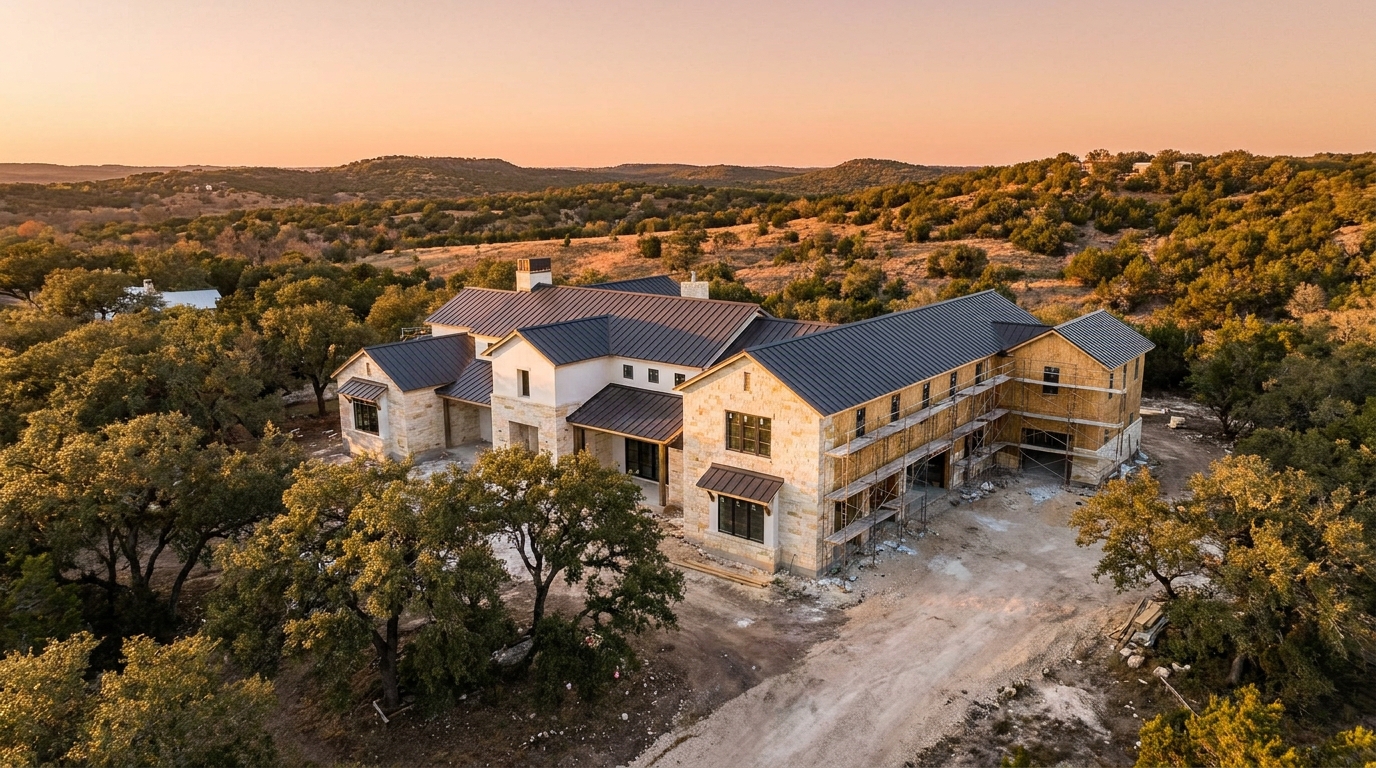
- Building a custom luxury home in the San Antonio Hill Country in 2026 typically runs $300 to $550 per square foot for the house, plus the lot, with a realistic 12 to 18 month timeline from lot close to move-in.
- The custom-build areas this guide covers are Cordillera Ranch in Kendall County, Fair Oaks Ranch (which spans Bexar, Kendall and Comal counties), Anaqua Springs Ranch and The Canyons at Scenic Loop in northwest Bexar County, and the Camp Bullis corridor around Shavano Park.
- VA financing can be used on a finished custom home through a one-time-close construction-to-permanent loan, but most local luxury builds use a conventional or jumbo construction loan first, then refinance into a VA or jumbo permanent loan at completion.
- A separate lot loan, a construction loan, and the permanent mortgage are three different products. Sequencing them correctly is where most first-time custom builders lose money.
- Disabled-veteran property-tax exemptions and the VA funding-fee waiver can change the math on a custom build by tens of thousands of dollars over the life of the loan.
In This Guide
- Why Build Instead of Buy in 2026?
- Where Do San Antonio Luxury Buyers Build?
- How Do You Choose the Right Lot?
- How Do You Pick a Custom Builder?
- How Does Construction Financing Work for Veterans?
- What Does It Really Cost in 2026?
- What Is a Realistic Timeline?
- About the Author
- Frequently Asked Questions
Why Build Instead of Buy in 2026?
The luxury resale shelf is short. Across Kendall County and the northwest Bexar County corridor, the supply of finished homes priced above one million dollars and sitting on a true acre is limited, and the best ones move quickly. When a retiring colonel or a dual-income military family wants a single-story plan with a casita, a four-car garage, and room for a future pool, the existing inventory rarely checks every box. Building removes the compromise.
You design around the life you are actually moving into. Many of my custom-build clients are transitioning out of 20-plus years of service. They want aging-in-place features, a home office for a second career, a guest wing for visiting adult children, and energy systems that hold up to Texas summers. A custom plan lets you spend money on what matters to you instead of inheriting someone else's choices.
Building is not the right answer for everyone. If your timeline is tight, if you cannot carry a lot loan and a construction loan while still paying current housing, or if you simply want to move in next month, a finished home is the better play. The point of this guide is to help you decide clearly, and to sequence the financing so a custom build does not become a money pit.
If you would rather compare finished options first, my guide to luxury new construction in San Antonio walks through the production and semi-custom builders working the high end, which is a useful baseline before you commit to a fully custom build.
Where Do San Antonio Luxury Buyers Build?
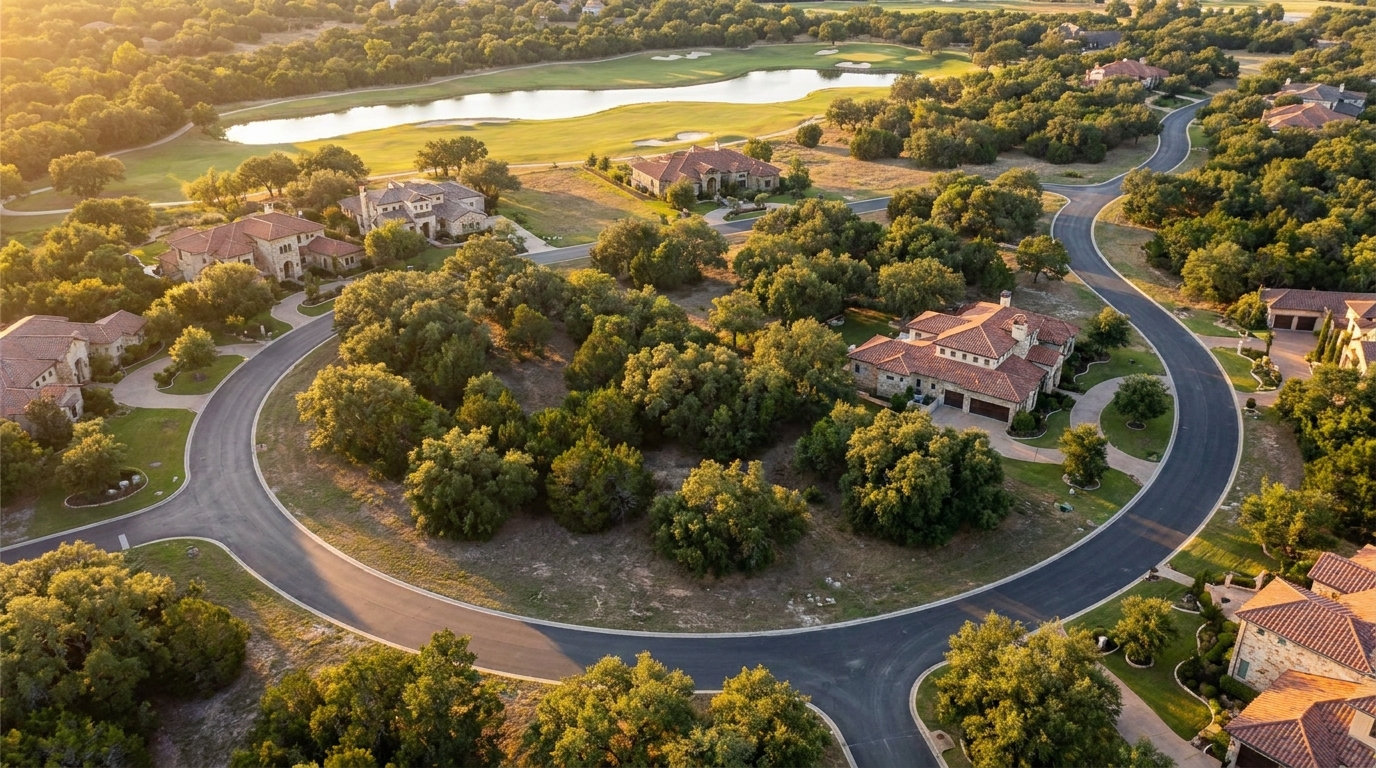
Cordillera Ranch (Boerne, 78006). This gated, golf-anchored community in Kendall County is the gold standard for custom Hill Country luxury, with estate lots, a Clubs of Cordillera Ranch membership, and homes that routinely close between 1.5 and 5 million dollars. See my dedicated Cordillera Ranch buyer guide for community specifics.
Fair Oaks Ranch (78015). Straddling Bexar, Kendall, and Comal counties, Fair Oaks Ranch offers established custom homes, a country club, and large lots at a slightly lower entry point than Cordillera. My Fair Oaks Ranch guide covers the resale market that sits alongside the custom-build opportunities.
The Camp Bullis corridor and Shavano Park (78231). Shavano Park is a small incorporated city in north Bexar County. The City of Shavano Park community page describes four of its subdivisions as gated: Bentley Manor, De Zavala Estates, Huntington and Willow Wood. It lists no neighborhood called "Estates at Shavano Park." Ask the city and the subdivision HOA about lot availability and building rules before you plan a custom build here.
Anaqua Springs Ranch and The Canyons at Scenic Loop. SABOR MLS records file homes in both subdivisions under Bexar County: Anaqua Springs Ranch carries a Boerne 78006 mailing address, and The Canyons at Scenic Loop is mostly 78255. Being in Bexar County decides which appraisal district and taxing units apply. School districts differ by lot here, so confirm the district for the exact address.
How Do You Choose the Right Lot?
The cheapest lot is rarely the cheapest build. A discounted lot with heavy slope, shallow bedrock, or a flag-shaped layout can add 75,000 to 200,000 dollars in site work, foundation engineering, and retaining walls. In Hill Country terrain, ask for a soils report and a rough site-work bid before you commit, not after.
Utilities define your budget. Many Kendall County lots use a private well and an aerobic septic system rather than municipal water and sewer. Those systems are workable and common out here, but they add cost and maintenance you should price in up front. Confirm what is available at the lot line.
Read the architectural-control rules before you fall in love. Gated luxury communities enforce minimum square footage, exterior-material standards, roof types, and review timelines. These protect your resale value, but they also constrain your design and your schedule. Get the design guidelines in hand during your option period.
You can verify ownership, acreage, and assessed value for any prospective lot through the county appraisal district. For Kendall County that is the Kendall Appraisal District, and for Bexar County properties it is Bexar County.
How Do You Pick a Custom Builder?
Hire local, hire repeat. A builder who completes several homes a year inside Cordillera Ranch or Fair Oaks Ranch already knows the soils, the inspectors, the HOA reviewers, and the local trades. That institutional knowledge prevents the delays that wreck custom-build budgets.
Understand your contract type. Fixed-price contracts give you certainty but build in a contingency. Cost-plus contracts can be cheaper if the project runs clean but expose you to overruns. Allowance-based contracts hide risk in the fixtures and finishes line items. Have a real estate professional and, ideally, a construction attorney review the agreement before you sign.
Verify the basics. Texas does not license residential builders the way some states do, which makes references and a clean track record even more important. Confirm general-liability and builder's-risk insurance, ask about warranty terms, and check the builder's standing. The National Association of Home Builders is a useful starting point for understanding industry standards and contract norms.
How Does Construction Financing Work for Veterans?
The VA does allow construction loans. A VA one-time-close construction-to-permanent loan rolls the lot, the build, and the permanent mortgage into a single closing. With full VA entitlement there is no VA loan limit and VA requires no down payment; the lender's approval and the appraisal still decide how much you can borrow. If part of your entitlement is already in use, the county loan limit (Bexar County 2026: $832,750) sets how much VA guarantees, and a down payment may be needed. The catch is that relatively few lenders in this market originate them for high-dollar custom homes, and you need a VA-registered builder. When you can find the right lender, it is a powerful zero-down tool.
Most local luxury builds use a two-step path. The more common route in the 1 to 3 million dollar range is a conventional or jumbo construction loan during the build, followed by a refinance into the permanent loan at completion. If you have full VA entitlement, that permanent loan can be a VA loan above the conforming limit, because VA sets no loan limit for full entitlement. The lender still decides the amount, and some lenders require a down payment on larger loans. My guide to VA jumbo loans in San Antonio covers how lenders handle VA loans above the conforming limit.
Sequence matters more than rate. The most expensive mistakes I see are buyers who close a lot loan with terms that block a later construction loan, or who lock a permanent rate before the build is realistically near completion. Line up your construction lender and your permanent lender before you close on the lot, so the three products fit together.
The funding-fee waiver and entitlement details are governed by the VA. Confirm current rules directly at VA.gov home loans, and, if part of your entitlement is already in use, check how the county loan limit affects your down payment before assuming a zero-down structure.
What Does It Really Cost in 2026?
The table below compares the two main financing paths so you can see where a veteran's benefits actually move the numbers. These are illustrative planning figures, not a quote.
| Factor | VA One-Time-Close Construction Loan | Conventional/Jumbo Construction, then Refinance |
|---|---|---|
| Down payment | No VA down payment and no VA loan limit with full entitlement (lender and appraisal still cap the loan); with entitlement in use, the county limit sets the guaranty and a down payment may apply | Typically 10 to 25 percent of total cost |
| Closings | One closing | Two (construction loan, then permanent) |
| Lender availability (luxury tier) | Limited; needs a VA-registered builder | Wide; most local banks offer it |
| Funding fee | VA funding fee applies; waived for eligible disabled veterans | No VA funding fee; private mortgage insurance possible under 20 percent |
| Best fit | Full entitlement and a lender that makes VA construction loans at your price point | Higher-dollar luxury builds well above the conforming limit |
Source: U.S. Department of Veterans Affairs, VA.gov loan limits (updated August 12, 2025) and funding fee (updated October 5, 2026) pages; lender availability reflects typical local practice, not a quote. Figures are illustrative and not a loan commitment.
Do not forget the soft costs. Architectural and design fees, engineering, permits, the HOA review, surveys, and a construction-period interest reserve all sit outside the per-square-foot number. Build a line for each one. And keep that 10 to 15 percent contingency untouched until the home is framed and dried in.
What Is a Realistic Timeline?
- Months 1 to 2: Close on the lot, finalize the builder, and complete soils and site work bids.
- Months 2 to 5: Architectural design, engineering, HOA architectural-control review, and permitting.
- Months 5 to 9: Site work, foundation, framing, and dry-in. Your construction loan draws begin here.
- Months 9 to 16: Mechanical systems, interior finishes, fixtures, and landscaping.
- Final 30 to 60 days: Final inspections, certificate of occupancy, and the refinance into your permanent loan.
If you are PCSing or retiring on a fixed date, work backward. A custom build is not the right tool if you need to be in the home in 90 days. If your separation or retirement date gives you a year or more of runway, building can deliver exactly the home you want by the time you arrive. If you are timing a move around orders, my military relocation resources can help you bridge the gap.
About the Author: Christopher Beal
Christopher Beal is a U.S. Army veteran and the Owner of Veteran Real Estate San Antonio, a Beal Group practice brokered by eXp Realty (TREC License #723559). A Military Relocation Professional (MRP) and VAREP member, he is a 7-time eXp Realty ICON agent, winner of Best Real Estate Agency in the 2026 Best of San Antonio Readers' Choice (San Antonio Current, 100,000+ voters), and a 3x San Antonio Business Journal Top 25 Individual Agent (#13 in 2024, #14 in 2025, #20 in 2026). His recognition also includes 3x Platinum Top 50, 2x RateMyAgent Agent of the Year, 2x Real Producers Top 100, Five Star Professional (2026), and a RealTrends 2026 ranking. He has helped 325+ families, closed more than $125M in career volume, and holds 5.0 stars across 370+ verified reviews, working almost exclusively with military and veteran buyers and sellers across Bexar, Comal, Kendall, Medina, and Bandera counties, with a focus on VA loans, PCS moves, and homebuying near JBSA-Lackland, JBSA-Randolph, and Fort Sam Houston. If you are buying or selling a luxury home in the San Antonio Hill Country, he brings the same disciplined, data-first approach to every seven-figure negotiation. He can be reached at (210) 882-8583.
Explore More Resources
- VA Home Loans
- Military Relocation
- Free Home Evaluation
- Serve & Save Program
- Client Reviews
- About Christopher
Frequently Asked Questions
Can I use a VA loan to build a custom home in San Antonio?
Yes. The VA offers a one-time-close construction-to-permanent loan that finances the lot, the build, and the permanent mortgage in a single closing. With full entitlement there is no VA loan limit and VA requires no down payment, though the lender and the appraisal still cap the loan; if part of your entitlement is in use, the county limit sets the guaranty and a down payment may apply. The challenge is finding a local lender who originates them for high-dollar custom homes and a builder who is VA-registered. Many luxury buyers instead use a conventional or jumbo construction loan and refinance into a VA loan at completion.
How much does it cost to build a luxury home in the San Antonio Hill Country in 2026?
Plan on roughly $300 to $550 per finished square foot for the home, plus the lot and 10 to 15 percent contingency. A 4,000 square foot custom home on a 250,000 dollar lot commonly lands between 1.5 and 2.5 million dollars all in, depending on finishes and site conditions.
How long does it take to build a custom home near San Antonio?
Budget 12 to 18 months from lot close to move-in. Design, engineering, and HOA permitting take 3 to 5 months, and vertical construction takes another 9 to 13 months. Weather, custom finish lead times, and architectural-control review are the most common delays.
Where do most San Antonio luxury buyers build?
This guide covers Cordillera Ranch in Kendall County, Fair Oaks Ranch (which spans Bexar, Kendall and Comal counties), Anaqua Springs Ranch and The Canyons at Scenic Loop in northwest Bexar County, and the Camp Bullis corridor around Shavano Park.
Is it cheaper to build or buy a luxury home in 2026?
It depends on inventory. When finished luxury homes on acreage are scarce in your target community, building is often the only way to get exactly what you want and can be competitive on price. When good resale inventory exists and your timeline is short, buying is usually faster and less risky.
Do disabled-veteran property-tax exemptions apply to a custom build?
Texas offers significant property-tax relief for qualifying disabled veterans, and a 100 percent disabled veteran may qualify for a full residence-homestead exemption. The exemption applies once the home is your homestead. Confirm eligibility with your county appraisal district and the Texas Comptroller before relying on it in your budget.
What is the biggest mistake first-time custom builders make?
Mis-sequencing the three loans. Closing a lot loan with terms that block a construction loan, or locking a permanent rate too early, costs buyers the most money. Line up your construction and permanent lenders before you close on the lot.
Can I build with a VA jumbo loan above the county limit?
Yes. With full entitlement, VA sets no loan limit, so the permanent loan after construction can be a VA loan above the conforming limit with no VA-required down payment; the lender's approval, its own requirements and the appraisal decide the amount. If part of your entitlement is already in use, the county limit sets the guaranty and a down payment may apply, so review the structure early.
Christopher Beal, U.S. Army Veteran and REALTOR. Owner of Veteran Real Estate San Antonio, brokered by eXp Realty. Serving veterans and military families across San Antonio and the Hill Country. Call (210) 882-8583.
Categories
- All Blogs (358)
- Alamo Heights (4)
- awards (4)
- Best Neighborhoods in San Antonio (13)
- Buyer (16)
- Buyer Education (92)
- Community Events (4)
- Hill Country (17)
- JBSA (49)
- Local Guide (6)
- Luxury (28)
- Luxury Real Estate (26)
- Market Trends (19)
- Market Update (13)
- Military Relocation (116)
- Military Retirement (3)
- Mortgage (20)
- Neighborhood Guides (19)
- neighborhoods (5)
- New Construction (16)
- PCS (44)
- Real Estate (40)
- reviews (3)
- San Antonio (52)
- San Antonio Lifestyle (4)
- San Antonio Market (5)
- San Antonio Neighborhoods (45)
- San Antonio Real Estate (98)
- San Antonio, Veterans Resources, VA Loans (5)
- Seller (55)
- VA Home Loans (30)
- VA Loans (38)
- Va Loans & Financing (27)
- Veterans (10)
- Veterans Resources (40)
Recent Posts