How Much Do I Need to Buy a Home in San Antonio With a VA Loan?
With a VA loan in San Antonio, you may be able to buy with $0 down, but you should still plan for closing costs, prepaid items (taxes/insurance/interest), and upfront contract expenses. Many buyers budget about 2%-5% of the purchase price for closing costs, then reduce that number by negotiating seller credits when the deal supports it.
The simple truth: VA is "no down payment," not "no money needed"
A VA loan is one of the strongest home-buying tools available to eligible Veterans and military families-but even with $0 down, there are still real costs that show up between contract and closing.
Think of your out-of-pocket cash in three buckets:
-
Upfront contract money (paid during the option/inspection phase)
-
Cash to close (what you bring to the closing table)
-
Reserves (your cushion after closing so the new house doesn't feel "tight")
Start with a realistic San Antonio price point
What San Antonio homes are actually closing for right now
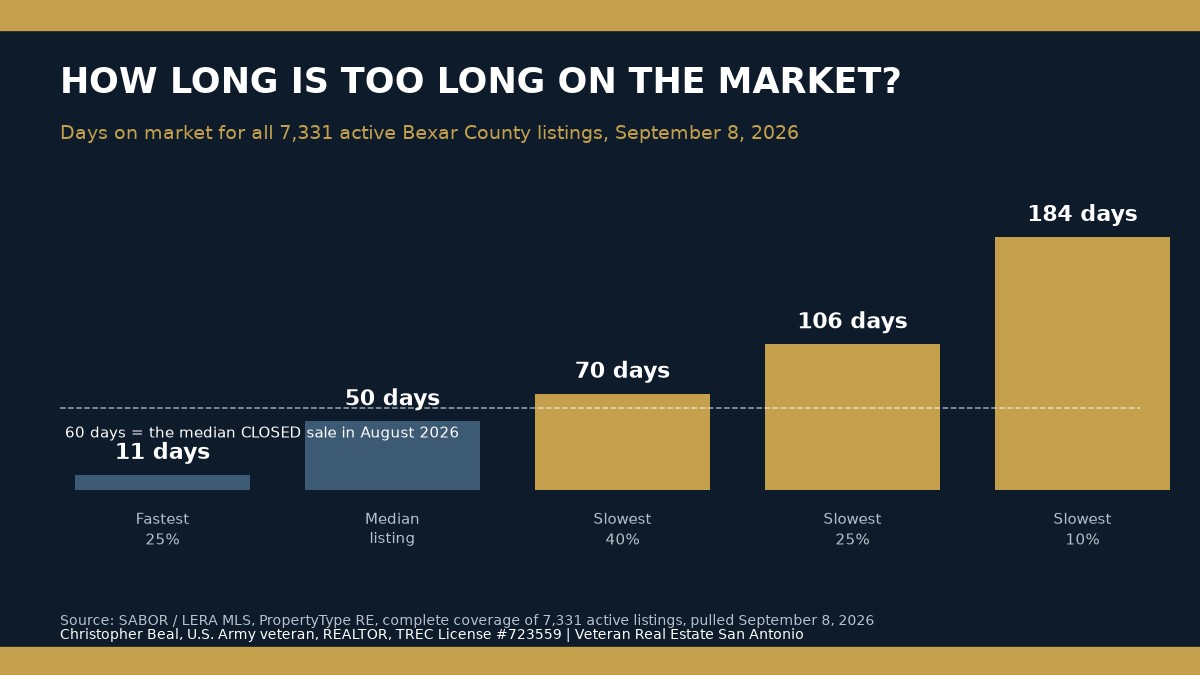
Updated August 2026. Across a 1,000-sale sample of San Antonio closings pulled from the SABOR MLS for February 7 through August 6, 2026, the median close price was $294,000 and the average was $345,203. Those homes averaged 81 days on market and closed at 97.9 percent of list price, which works out to roughly $162 per square foot. Active inventory in the same pull carried a median list price of $237,999.
Two things in those numbers matter directly to your cash to close. First, an 81-day average market with a sub-98 percent list-to-sale ratio means seller-paid closing costs are genuinely negotiable in most San Antonio price bands right now, and that is the single largest lever on the cash you bring to the table. Second, the spread between the median sale price and the median active list price tells you the lower-priced inventory is the slower-moving inventory, which is exactly where concession requests get accepted.
To make the numbers feel real, let's anchor to a current market reference: Redfin shows a median sale price around $260,000 in San Antonio (November 2025). Your exact neighborhood, property type, and condition will move the numbers, but the budgeting logic stays the same.
What you might pay with a VA loan (and what you might not)
Down payment
Many qualified VA buyers can purchase with $0 down. Whether $0 down is available for you depends on VA eligibility and lender approval (and sometimes how your specific purchase is structured), but it's a common VA advantage.
VA funding fee (often financed, sometimes $0)
The VA funding fee is a one-time fee that helps sustain the VA loan program. The VA publishes the current funding-fee charts, and the rates for purchase loans closing on/after April 7, 2023 are commonly:
-
First use, less than 5% down: 2.15%
-
Subsequent use, less than 5% down: 3.3%
-
With 5% down: 1.5%
-
With 10% down: 1.25%
Two key planning notes:
-
Many borrowers can finance the funding fee into the loan instead of paying it out of pocket.
-
Some borrowers may be exempt from the funding fee (the VA outlines exemptions on its official page).
Example (using $260,000):
If you're first-time VA use with $0 down, 2.15% x $260,000 = $5,590 (commonly financed).
Closing costs: the number most buyers actually feel
Closing costs are the lender/title/escrow/government fees required to finalize the purchase and start your loan. A common planning range for buyers is about 2%-5% of the purchase price (varies by loan, location, and negotiation).
On a $260,000 purchase, that's roughly:
-
2%: $5,200
-
5%: $13,000
This is why VA budgeting isn't just "Do you have a down payment?" It's "How do we structure the offer so your cash-to-close is comfortable?"
"Can the seller pay my closing costs with VA?"
Often, yes, seller credits toward typical buyer closing costs can be negotiated, and VA rules also address seller concessions (certain "extras" of value beyond normal costs). VA commonly limits seller concessions to 4% of the home's reasonable value, and many explanations clarify that the 4% rule applies to concessions, not the payment of normal buyer closing costs.
Practical takeaway: you can sometimes negotiate meaningful help with closing costs, but it needs to be done correctly and documented cleanly.
Prepaids: the "not really fees" items that still require cash
Even when your lender and title fees are reasonable, prepaids can surprise buyers because they don't feel like "closing costs," but they still affect your cash-to-close. Prepaids often include:
-
Homeowners insurance premium (often the first year)
-
Prepaid interest (from closing date to month-end)
-
Escrow seed for property taxes and insurance (timing matters)
These are not "junk fees." They're part of getting the home insured, funded, and properly escrowed. The closing date you choose can move these numbers.
Upfront contract expenses in San Antonio: what to expect before closing
Before you even reach the closing table, most buyers will spend some money during the contract period. Examples:
-
Home inspection (paid out of pocket)
-
Option fee (Texas-specific; paid to the seller for the option period)
-
Earnest money (usually credited back toward your closing funds if you close)
These aren't always huge individually, but they're real, and they matter if you're trying to keep your cash position strong.
VA funding fee and seller-credit rules as they stand in 2026
The 2026 funding fee tiers
The funding fee is a percentage of the loan amount, not the purchase price, and it is set by how much you put down and whether this is your first VA loan:
- Less than 5 percent down, first use: 2.15 percent
- Less than 5 percent down, subsequent use: 3.30 percent
- 5 to 9.99 percent down: 1.50 percent, first or subsequent use
- 10 percent or more down: 1.25 percent, first or subsequent use
- VA IRRRL streamline refinance: 0.50 percent
If you receive VA disability compensation at any rating, you are exempt from the funding fee entirely. On a $294,000 purchase with nothing down and first-time entitlement use, that exemption is worth about $6,321. A veteran using entitlement a second time at that same price point would otherwise owe about $9,702. Most buyers finance the fee into the loan rather than pay it in cash, so for them the exemption shows up as a smaller loan balance and a lower payment rather than as money saved at the closing table.
If you are still deciding whether to put money down at all, the tradeoff is laid out in Do You Need a Down Payment for a VA Loan in San Antonio?
Seller concessions: the 4 percent rule is narrower than people think
VA rules separate two things buyers routinely blend together. A seller paying your ordinary closing costs - origination, title, appraisal, recording, lender fees - is not capped at 4 percent. The 4 percent cap applies only to what VA calls seller concessions: items of value beyond normal closing costs, such as prepaid taxes and insurance, paying off your consumer debts, gifting personal property, or covering the funding fee itself.
In practice that means a San Antonio seller can cover considerably more than 4 percent of your total closing package when the offer is structured correctly. Structuring it correctly is an agent conversation that has to happen before the offer goes in, not after. If you want to pressure-test whether the agent you are interviewing knows this cold, the question list in How to Vet a VA-Experienced Realtor in San Antonio covers it.
Two approval items that quietly change your cash number
Residual income is the VA underwriting test most veterans have never heard of, and failing it can force a larger down payment or a lower price point. The thresholds and how they interact with debt-to-income are broken down in VA Loan Residual Income and DTI Requirements in San Antonio.
The other is the appraisal. VA minimum property requirements can trigger repairs that someone has to pay for before the loan will close, and in a market averaging 81 days on the shelf that someone is often the seller. Which repairs actually get called is covered in VA Appraisal Minimum Property Requirements in San Antonio.
Three budgeting scenarios I use with VA buyers
Using the $260,000 example again:
Scenario A: You negotiate strong seller credits
-
$0 down (typical VA advantage)
-
Funding fee financed (if applicable)
-
Seller credits reduce cash-to-close
Result: your out-of-pocket often becomes more about inspection/option/earnest plus any remaining gap not covered by credits.
Scenario B: Minimal credits, clean deal
-
$0 down
-
Closing costs fall closer to that 2%-5% planning range
-
Prepaids vary by closing date and escrow setup
Result: you may want several thousand to low five figures available depending on the home price and timing.
Scenario C: You choose to put some money down
Not required with VA, but sometimes used to:
-
reduce the funding fee percentage, or
-
strengthen an offer depending on the situation
Result: higher cash up front, potentially different overall structure. The "best" choice depends on your goals, not a rule of thumb.
How to get a precise number early (and avoid surprises)
Two documents keep you grounded:
-
Loan Estimate (LE): gives your early, itemized estimate of closing costs and cash-to-close.
-
Closing Disclosure (CD): your final terms and final cash-to-close, required at least 3 business days before closing.
If you want control over your budget, you don't guess, you compare your LE to your CD and ask questions early.
A clean "cash to close" planning guide (VA buyers)
If you want a simple planning target, here's a conservative approach that works for many VA buyers:
-
Upfront contract expenses: set aside a buffer for inspection/option/earnest
-
Closing costs + prepaids: plan 2%-5% of purchase price, then aim to negotiate credits when appropriate
-
Post-close cushion: keep reserves so the first few months feel stable (moving, utilities, small repairs, etc.)
Final takeaway
With a VA loan, your down payment in San Antonio may be $0, but a smart plan still includes closing costs, prepaids, and upfront contract expenses, and the biggest lever you control is offer structure and negotiated credits, done within VA guidelines.
Talk with Christopher Beal: If you want a clear "cash-to-close" number for your VA purchase in San Antonio, I'll map it out with you based on your price range, funding-fee status, and a realistic seller-credit strategy.
Next step: Schedule a VA buyer strategy call and I'll walk you through:
-
a clean cash-to-close estimate range,
-
how seller credits may (or may not) fit your situation,
-
and what to watch on your Loan Estimate and Closing Disclosure
About the Author: Christopher Beal
Christopher Beal is a U.S. Army veteran and the Owner of Veteran Real Estate San Antonio, a Beal Group practice brokered by eXp Realty (TREC License #723559). A Military Relocation Professional (MRP) and VAREP member, he is a 7-time eXp Realty ICON agent, winner of Best Real Estate Agency in the 2026 Best of San Antonio Readers' Choice (San Antonio Current, 100,000+ voters), and a 3x San Antonio Business Journal Top 25 Individual Agent (#13 in 2024, #14 in 2025, #20 in 2026). His recognition also includes 3x Platinum Top 50, 2x RateMyAgent Agent of the Year, 2x Real Producers Top 100, Five Star Professional (2026), and a RealTrends 2026 ranking. He has helped 325+ families, closed more than $125M in career volume, and holds 5.0 stars across 370+ verified reviews, working almost exclusively with military and veteran buyers and sellers across Bexar, Comal, Kendall, Medina, and Bandera counties, with a focus on VA loans, PCS moves, and homebuying near JBSA-Lackland, JBSA-Randolph, and Fort Sam Houston. If you have questions about using your VA loan benefit in San Antonio, he offers a no-pressure strategy call before you talk to any lender. He can be reached at (210) 882-8583.
Explore More Resources
- VA Home Loans in San Antonio
- Do You Need a Down Payment for a VA Loan in San Antonio? (2026 Guide)
- VA Loan Residual Income and DTI Requirements in San Antonio (2026)
- VA Appraisal Minimum Property Requirements in San Antonio (2026)
- How to Vet a VA-Experienced Realtor in San Antonio: 12 Questions (2026)
- Military Relocation to San Antonio
- Free Home Value Report
Categories
- All Blogs (354)
- Alamo Heights (4)
- awards (4)
- Best Neighborhoods in San Antonio (13)
- Buyer (16)
- Buyer Education (86)
- Community Events (4)
- Hill Country (17)
- JBSA (43)
- Local Guide (6)
- Luxury (28)
- Luxury Real Estate (26)
- Market Trends (19)
- Market Update (14)
- Military Relocation (111)
- Military Retirement (3)
- Mortgage (19)
- Neighborhood Guides (18)
- neighborhoods (5)
- New Construction (16)
- PCS (42)
- Real Estate (40)
- reviews (3)
- San Antonio (53)
- San Antonio Lifestyle (4)
- San Antonio Market (5)
- San Antonio Neighborhoods (43)
- San Antonio Real Estate (100)
- San Antonio, Veterans Resources, VA Loans (5)
- Seller (55)
- VA Home Loans (30)
- VA Loans (35)
- Va Loans & Financing (27)
- Veterans (10)
- Veterans Resources (40)
Recent Posts